
Trimming a dog’s nails takes a few minutes once you both know the routine. What makes it feel hard is usually nerves, yours and your dog’s. Learning how to trim dog nails safely comes down to three habits: knowing where the quick sits, taking off less than you think you need, and never rushing a worried dog.
Overgrown nails do more than click on the kitchen floor. They change how the foot meets the ground, catch and tear more easily, and get harder to shorten the longer you wait.
At a glance: trim when the nails click on hard floors or touch the ground while your dog stands. Use sharp clippers or a grinder and take off thin slivers, stopping before the quick. On dark nails, watch the cut surface for a dark dot in the center. Keep styptic powder or cornstarch nearby, and call your vet if bleeding won’t stop. Nervous dogs need slow practice, and a groomer or vet is the better choice if your dog has to be held down.
How to tell the nails are too long
Watch your dog stand relaxed on a hard floor. The nails should sit just clear of the ground. If they press into it, they’re due. Other giveaways:
- Clicking or tapping on tile or wood
- Nails that curve or catch on carpet and clothes
- Toes that splay or twist when the foot takes weight
- More slipping on smooth floors
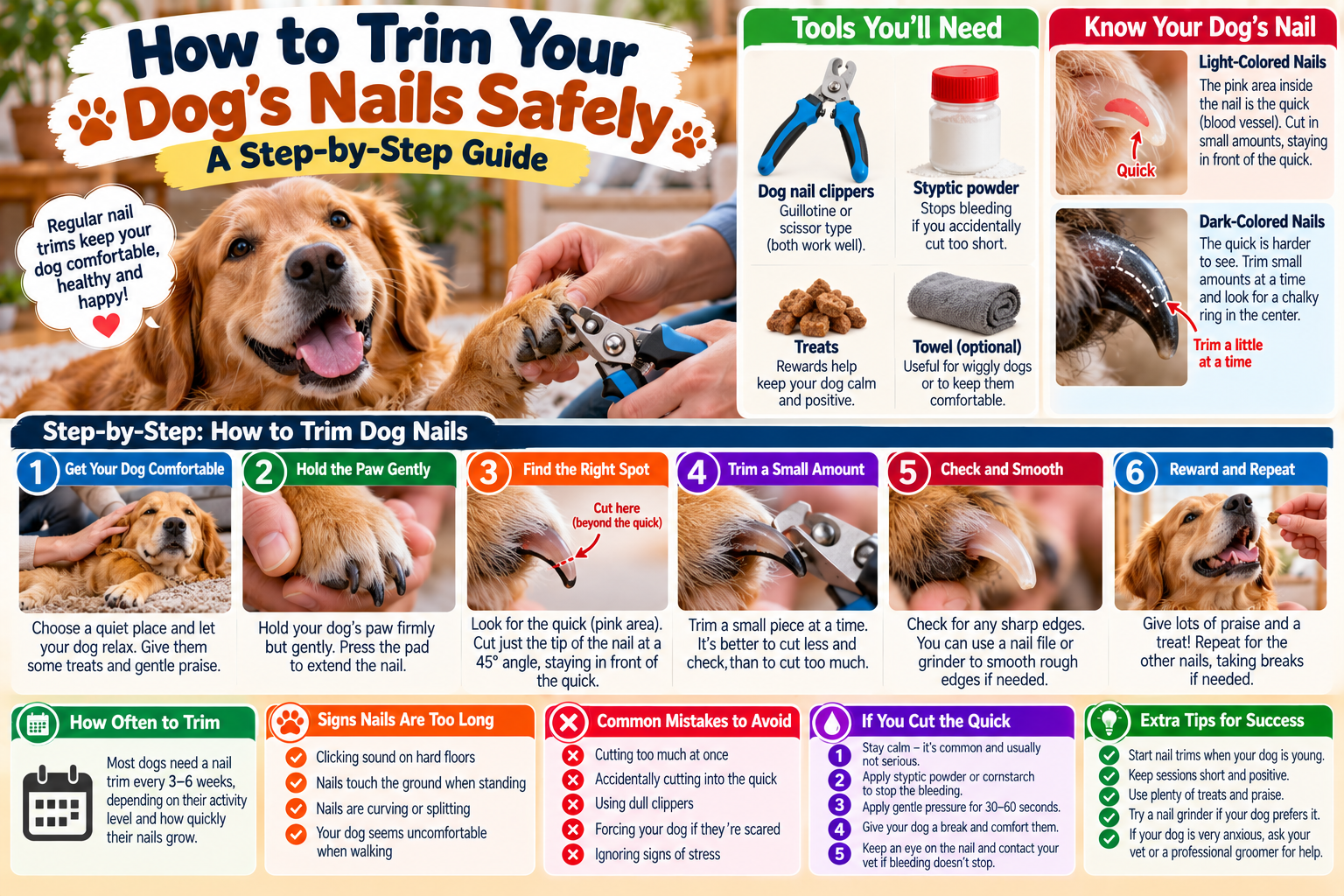
Each nail has a living core, the quick, that grows along with it. Let the nails get long and the quick extends too, so you can’t cut them back to a good length in one go. Regular small trims help the quick recede over time. Many dogs need a trim every three to four weeks, though dogs who walk a lot on pavement often wear their nails down and can go longer.
Clippers or a grinder?
The best tool is simply the one you use confidently and your dog tolerates.
- Scissor or plier-style clippers close two curved blades around the nail. Small ones suit little dogs and puppies; sturdier spring-loaded ones handle thick nails on big breeds.
- Guillotine clippers have a ring you slip the nail through and a sliding blade. Some owners like them for small to medium nails, but the hidden blade makes it harder to judge where you’re cutting.
- Grinders sand the nail down gradually, which makes it easy to take off a little at a time and helps with dark nails. Some dogs dislike the noise and vibration, and a dog who jerks away can get skin nicked. Use brief touches, and keep long fur pulled back so it can’t wrap around the spinning head.
Keep blades sharp, because dull clippers squeeze and can split the nail. Before you start, put styptic powder (or a dish of cornstarch) within reach, find good light and have small treats ready.
Finding the quick on light and dark nails
The quick carries blood vessels and nerves, so cutting into it hurts and bleeds.
Light or clear nails: look from the side in good light and you’ll see a pinkish area running down from the toe. Trim the white tip beyond it and leave a small gap, since the quick often runs a little further than it looks.
Dark or black nails: you can’t see the quick, so work by feedback. Take a very thin slice from the tip, then look straight at the cut end. Early cuts show a pale, dry, chalky surface. As you near the quick, a small dark or slightly shiny dot appears in the center. When you see it, stop. That nail is done. If your dog has a mix of colors, the light nails give a rough guide, but quick length varies from toe to toe, so still work in slivers.
Trimming a small amount at a time
- Settle your dog comfortably. Small dogs can sit on your lap; bigger dogs are often easiest lying on their side.
- Hold the paw gently but securely. A light press on the toe pad pushes the nail out and makes it easier to see.
- Snip just the tip, then check the cut surface before taking more.
- Reward after each nail, or each paw once your dog is comfortable.
You don’t have to finish every foot at once. One paw a day is a perfectly good routine.
Don’t forget the dewclaws
Dewclaws sit higher up on the inner side of the leg. Most dogs have them on the front legs, and some breeds also have them on the back legs, occasionally doubled. Because they never touch the ground, they never wear down, and an overgrown one can curl around and grow into the skin or pad. Check and trim them every time. If one has already grown in, let your vet deal with it.
Getting a nervous dog used to it
One painful trim can make a dog wary for a long time. The fix is to separate handling from cutting and build up slowly, pairing each step with a treat:
- Touch a leg for a second, then treat. Repeat until your dog stays relaxed.
- Progress to holding a paw briefly, then gently pressing individual toes.
- Show the clippers or grinder and reward calm interest. Run a grinder at a distance first so the sound becomes familiar.
- Touch the tool to a nail without cutting, and reward.
- Trim one nail, reward generously and stop for the day.
Some dogs get there in days, others need weeks or months. If you see yawning, panting, ears pinned back, trembling, pulling away or a growl, go back a step next time. Forcing a frightened dog to stay still tends to deepen the fear and raises the risk of a bite.
If you cut the quick
It happens to careful owners and groomers alike. The nail may bleed a lot, but it usually stops with simple first aid. Stay calm; your dog will read your reaction.
- Press styptic powder firmly onto the nail tip. It may sting briefly.
- No styptic powder? Plain cornstarch or flour packed onto the tip is a reasonable stand-in.
- Hold steady pressure with a clean cloth or gauze for a few minutes without lifting it to check.
- Keep your dog quiet for a while so the clot isn’t knocked loose.
Important: contact your vet if the nail is still bleeding after about 10 minutes of pressure and styptic powder, if the nail is split or broken back toward the toe, or if your dog has a condition that affects blood clotting. Swelling, redness, discharge or limping over the following days also need a vet check, since the quick sits right against the toe bone and infection there is serious.
When to leave it to a groomer or vet
Home trims aren’t the right call for every dog. Book a groomer or your vet clinic if your dog panics, snaps or can only be trimmed while held down, if the nails are badly overgrown and need bringing back in stages, or if a nail is cracked, ingrown or looks infected. For very fearful dogs, your vet can discuss calming medication before the visit or light sedation for the trim, so the job gets done without a struggle.
If you’re building a regular grooming routine, our guide on how often to bathe a dog covers the bathing side of it.
Frequently asked questions
How often should I trim my dog’s nails?
It depends on how fast your dog’s nails grow and how much they wear down on walks. Many dogs need a trim every three to four weeks. Trim whenever you hear clicking on hard floors or see the nails touching the ground when your dog stands.
What should I do if my dog’s nail won’t stop bleeding?
Apply styptic powder or cornstarch to the tip and hold steady pressure with a clean cloth for a few minutes. If it is still bleeding after about 10 minutes, or the nail is badly split, contact your vet.
Should I trim my puppy’s nails?
Yes. Puppy nails are sharp and grow quickly, and short, gentle sessions while your puppy is young make handling feel normal. Often you only need to take off the very tip.