
A tank can look crystal clear and still need fresh water. The filter deals with the most toxic waste, but it can’t remove everything, and some of what it leaves behind slowly builds up week after week. Regular partial water changes are how you clear that out.
A good aquarium water change is one your fish barely notice: the right amount, properly treated water and steady conditions throughout.
Key points: an aquarium water change removes nitrate and other waste the filter can’t break down, and restores minerals that get used up. For many freshwater tanks, changing roughly 10–30% of the water each week is a sensible starting point, adjusted using nitrate test results. Treat tap water with a conditioner that handles chlorine and chloramine, match the temperature, and rinse filter media only in old tank water. Avoid changing all the water at once.
What a water change actually does
In a cycled tank, bacteria in the filter turn toxic ammonia into nitrite and then into nitrate. Nitrate is much less toxic, but nothing in a typical aquarium removes much of it, so the level keeps climbing between changes. High nitrate stresses fish, makes them more prone to disease and feeds algae.
The same bacterial process also uses up carbonate hardness (KH), the dissolved minerals that keep pH stable, so pH can slowly sink in a neglected tank. Fresh tap water restores them.
Topping up evaporated water doesn’t do the same job. Evaporation leaves waste behind, so top-ups fix the level without diluting anything.
How much to change and how often
For many freshwater community tanks, a change of somewhere around 10–30% every week works well. The right amount depends on how many fish you keep, their size, how much you feed and how well planted the tank is.
A nitrate test is the most reliable guide. Test just before your usual water change for a few weeks. If nitrate keeps rising higher each time, you need to change more water, change it more often, or look at whether the tank is overstocked or overfed. Advice on the ideal level varies. Many guides suggest keeping nitrate below about 40 ppm, while some experienced keepers are relaxed about higher readings. Planted tanks and sensitive species generally do better toward the low end.
What you’ll need
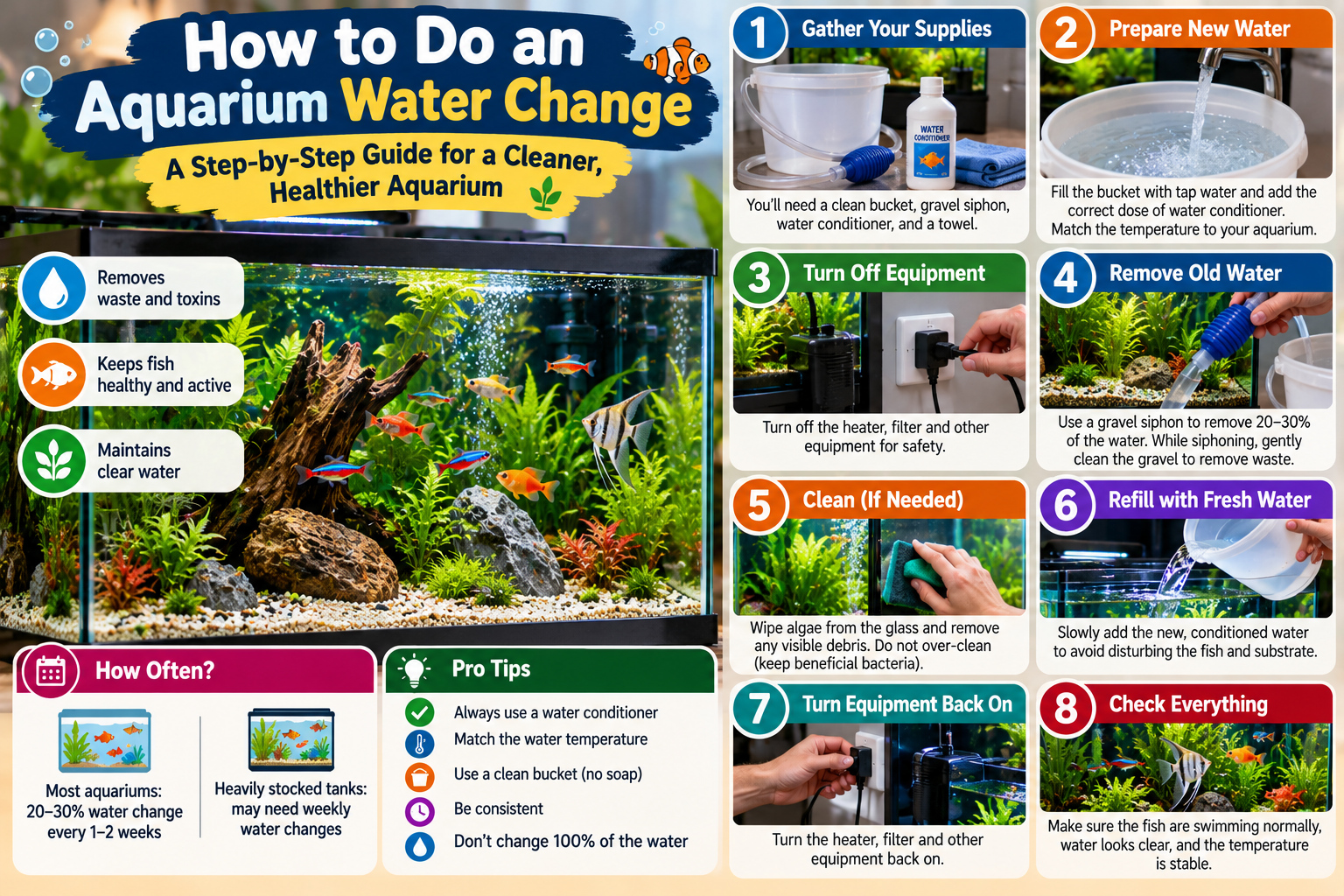
- A siphon or gravel vacuum (a wide tube attached to a hose)
- A bucket used only for the aquarium, never washed with soap or household cleaners
- Water conditioner (dechlorinator) that treats both chlorine and chloramine
- A thermometer
- A test kit for at least nitrate, and ideally ammonia, nitrite and pH
How to do an aquarium water change, step by step
- Unplug the heater and filter. A heater exposed to air can crack or overheat, and some filters can be damaged if they run dry.
- Start the siphon. Put the wide end of the gravel vacuum in the tank and the hose in your bucket, below the tank level. Avoid starting a siphon with your mouth, since aquarium water isn’t something you want to swallow.
- Clean the substrate as you drain. Push the tube down into the gravel or sand in one small area, let the dirt lift and flow out, then move on. With sand, hover just above the surface so you pick up waste without sucking up the sand. Covering part of the bottom each time is plenty.
- Watch the level. Stop once you’ve removed your planned amount. A strip of tape on the glass marks the target. Watch for small fish and shrimp near the tube.
- Prepare the new water. Fill a clean bucket from the tap, adjust it until the thermometer reads as close to the tank temperature as you can get, then add conditioner following the label dose for the volume you’re adding.
- Refill gently. Pour slowly onto a decoration, your hand or a small plate so you don’t blast the substrate and uproot plants.
- Restart everything. Switch the filter back on, then the heater, and check later that the temperature is stable.
Why tap water always needs treating
Water suppliers add chlorine or chloramine to make tap water safe for people. Both damage fish gills and can kill the helpful bacteria in your filter. Chlorine can gas off if water stands for a while, but chloramine is much more stable and doesn’t leave in any practical amount of time, so letting water sit out isn’t a reliable fix. A conditioner that handles both covers you either way. For temperature, trust a thermometer rather than your hand, since a sudden swing of several degrees stresses fish.
Leave the filter for another day
Most of the bacteria that keep your tank safe live in the filter media, with more on the gravel and decorations. Tap water, even conditioned, can harm them, and scrubbing everything at once removes a lot of bacteria in one go.
When the filter does need attention, save some of the old tank water you siphon out and gently squeeze or swish the sponges in that. The aim is to clear clogs, not make it look new. Spacing out filter cleaning and deep gravel cleaning, rather than doing both on the same day, gives the bacteria a better chance to keep up. Replace media only when it’s falling apart, and never all of it at once.
Why a 100% change does more harm than good
Emptying the whole tank hits fish with sudden changes in temperature, pH and hardness at once, and means netting them out.
This matters most when water changes have slipped for a long time. Fish adjust slowly to the poor water, and a sudden large change can shock them. If you’re catching up after a long gap, do smaller changes every day or two over a week or so, testing as you go.
In an emergency such as an ammonia spike, changing up to about half the water can help. Repeat over several days if needed rather than going further in one go.
Important: if your fish gasp at the surface, dart around, or suddenly go still on the bottom soon after a water change, check that you added conditioner and that the temperature is right, then test for ammonia and nitrite. If you forgot the conditioner, add the correct dose for the whole tank straight away.
Signs your routine needs adjusting
A good routine shows up as healthy, active fish and stable test results. These are signs something isn’t working:
- Nitrate keeps rising higher before each weekly change
- Ammonia or nitrite reads above zero in an established tank
- Algae grows much faster than usual
- Fish seem stressed or lethargic, or keep getting sick
- Cloudy water that doesn’t clear within a few days
Often the fix is to feed less, change more or rethink stocking. If fish keep getting ill even with good test results, speak to a vet who treats fish or an experienced aquatic specialist.
Setting up a new tank? Water changes only keep a tank healthy once the filter is established, so start with how to cycle a new aquarium before adding fish. Betta keepers with small tanks will find specific advice in how often to change betta fish water.
Frequently asked questions
How much water should I change in my aquarium each week?
Around 10–30% a week suits many freshwater tanks, but the right amount depends on stocking, feeding and plants. Test nitrate before each change and adjust. If it keeps climbing, change more water or change more often.
Can I use tap water for a fish tank water change?
Yes, as long as you treat it with a water conditioner that neutralizes both chlorine and chloramine, and match the temperature to the tank. Untreated tap water can harm fish and the bacteria in the filter.
Should I take the fish out during a water change?
No. For a normal partial change, fish should stay in the tank. Netting them out causes more stress than the water change itself. Just work carefully around them.
Is it OK to clean the filter during a water change?
You can rinse the filter media in the old tank water you’ve just removed, but many fishkeepers prefer to clean the filter on a different day from a deep gravel clean. Never rinse media under the tap, and don’t replace all of it at once.