
Used well, a crate becomes a quiet den where your puppy naps, settles at night and stays safe when you can’t watch them. Used badly, it becomes a box your puppy dreads.
If you want to crate train a puppy, the goal is simple: your puppy should choose to walk in, lie down and relax. That takes small steps, not a door slammed shut on the first night.
The short version: to crate train a puppy, pick a crate just big enough to stand, turn around and stretch out in, make it comfortable, and build up time inside in small, rewarded steps. Keep crate time short for young puppies, since they can’t hold their bladder for long. Never use the crate as punishment.
Why a crate helps
A crate gives your puppy a snug place to rest and gives you a safe place to put them when you’re cooking, on a call or asleep. It also helps with house training, because most puppies try not to soil where they sleep.
It’s a tool for short periods, not a place to spend the day. A puppy playpen or gated, puppy-proofed room works on the same principles.
Choosing the right size and spot
The crate should be large enough for your puppy to stand up, turn around, lie down and stretch out comfortably. It shouldn’t be so big that your puppy can sleep at one end and use the other end as a toilet.
Puppies grow fast, so many owners buy a crate sized for their dog’s adult size and use a divider panel to make the space smaller for now, moving it back as the puppy grows.
Where you put it matters too:
- Choose a room where the family spends time, so your puppy doesn’t feel shut away.
- Keep it out of direct sunlight and away from drafts and heaters.
- Add soft bedding, a safe chew toy and access to water if your puppy will be in there for more than a short while.
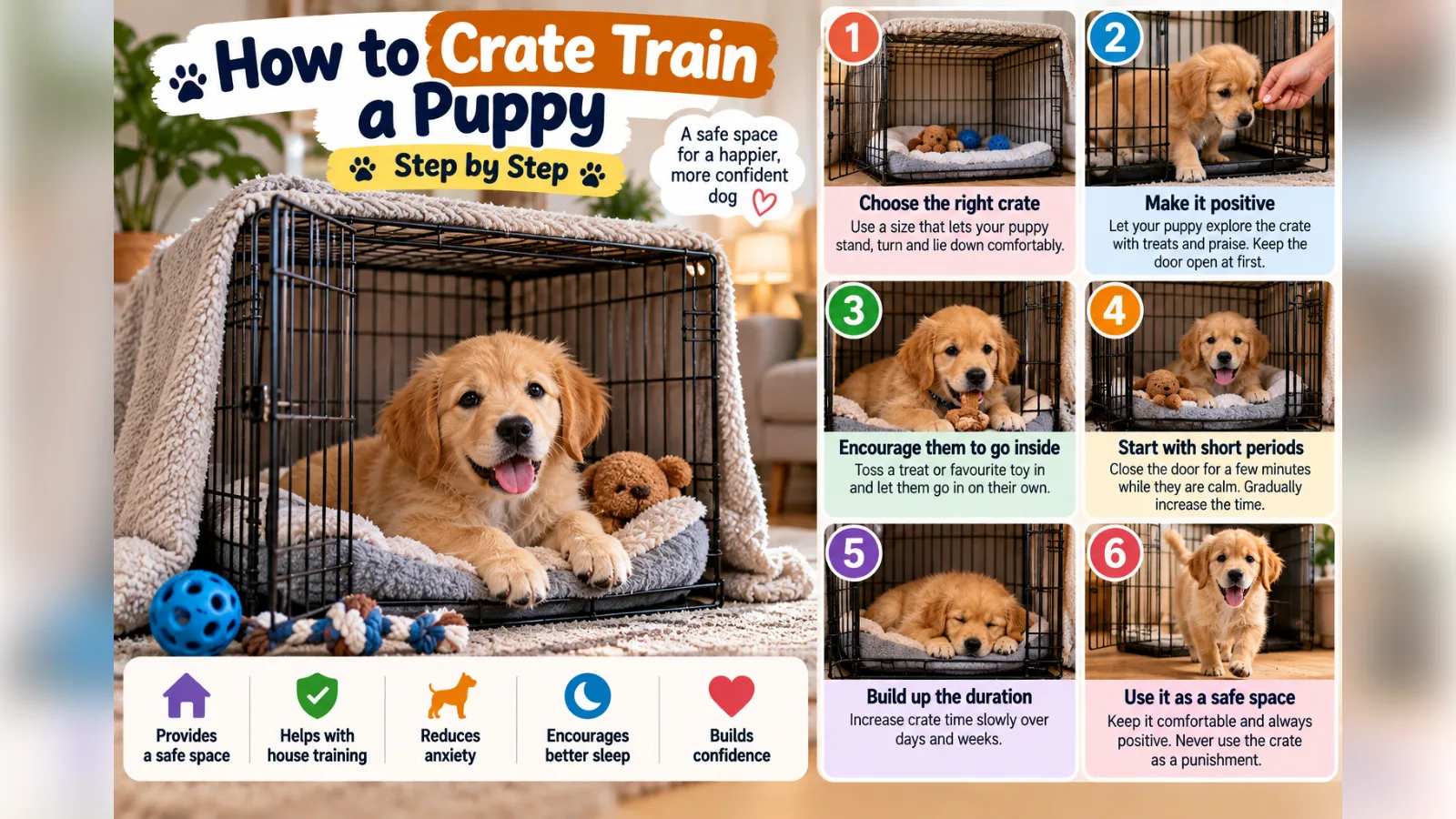
How to crate train a puppy, step by step
Move at your puppy’s pace. Some pups are happy with the crate in a couple of days; others need a few weeks. If your puppy starts whining or scrabbling to get out, go back to the last stage where they were relaxed.
1. Make the crate the best spot in the room
Prop or tie the door open so it can’t swing shut and give your puppy a fright. Drop treats by the entrance, then just inside, then at the back, and let your puppy wander in and out as they please. Mealtimes are the easiest win: serve the bowl beside the crate at first, then a little further in each time until your puppy is happily eating at the back. Don’t push or carry them in.
2. Close the door for a few moments
Once your puppy eats inside without hesitating, shut the door while they eat and open it the moment they finish. Over the next few meals, wait a little longer before opening it, working up to about 10 minutes after the bowl is empty. At other times of day, invite them in with a word such as “bed,” toss in a treat and close the door briefly while you sit nearby.
3. Practice being out of sight
With your puppy settled inside, perhaps with a stuffed food toy, leave the room for a few seconds and come back. Stretch those absences out gradually. Keep the house going about its normal business so the crate doesn’t only mean you’re leaving.
4. Try short trips out
When your puppy can rest quietly in the crate for around half an hour while you’re mostly out of sight, you can start crating them for short errands. Give them a toilet break and some play first. Keep hellos and goodbyes low-key; a big emotional exit or return makes being left feel like more of an event.
The first nights
Put the crate in your bedroom or just outside it to begin with. Your puppy won’t feel abandoned, and you’ll hear when they need to go out, which most young puppies do at least once in the night. Keep those trips dull: out to the toilet spot, quiet praise, straight back to bed, no games. If you’d rather the crate lived elsewhere, move it a little at a time once nights are settled.
How long can a puppy stay in a crate?
Less time than many people expect. Young puppies have small bladders and need frequent toilet breaks, company and exercise.
Advice varies a little between organizations. A common rule of thumb from US shelters is a puppy’s age in months plus one gives a rough maximum in hours, so a 3-month-old might manage about 4 hours. Humane World for Animals is more cautious and suggests puppies under 6 months shouldn’t be crated for more than three or four hours at a stretch. Treat these as upper limits, not targets.
Adult dogs shouldn’t spend long spells crated either. Humane World for Animals puts the daytime limit at around 4 to 5 hours, and a crate shouldn’t be used to confine a dog all day while you’re at work. If your schedule means long absences, a dog walker, a friend or daycare is a better answer than a longer crate stint.
Important: too much time in a crate can leave a puppy stiff, under-exercised and anxious, and it can undo house training by forcing them to soil their bed. Plan crate time around toilet breaks, play and company.
What not to do
The crate only works if your puppy feels good about it. That means:
- Never use it as punishment. If your puppy is sent there after chewing a shoe, they’ll learn to link the crate with feeling bad.
- Don’t rush. Shutting a puppy in before they’re comfortable is the quickest way to make them hate it.
- Don’t bang on the crate or shout if your puppy whines. It frightens them and doesn’t teach anything useful.
- Don’t let children or visitors disturb a puppy who has gone into the crate to rest. It should be a place where they’re left alone.
When your puppy whines in the crate
Start with the practical question: could they need the toilet? If it’s been a while, take them out on a leash, let them go and bring them back in without any play.
If their needs are met and they’re simply testing whether whining opens the door, it usually helps to wait for a moment of quiet before letting them out, so they learn that calm behavior, not noise, is what gets results. If your puppy is truly distressed (panting, drooling, frantically trying to escape), that’s a sign you’ve moved too fast. Go back a few steps.
Some dogs panic when confined no matter how gently they’re introduced. If your puppy or dog shows that level of distress, stop crating and talk to your vet or a qualified, reward-based behaviorist, as it can be linked to separation-related problems that need a different plan.
Crate time is only one part of a puppy’s day. The rest should be filled with play, training and new experiences, and introducing your puppy to the world gently matters just as much in these early weeks. As your puppy grows, you’ll also want realistic limits on leaving a dog home alone.
Frequently asked questions
How long does it take to crate train a puppy?
It varies. Some puppies are comfortable in a few days, while others need several weeks. Go at your puppy’s pace and move back a step whenever they seem worried.
Should I put a puppy pad or water in the crate?
A pad can encourage your puppy to toilet in the crate, which works against house training. Water is a good idea if your puppy will be inside for more than a short time. A bowl or bottle that clips to the side is less likely to spill.
Is crate training cruel?
Not when it’s done gradually and the crate is used for short periods. Many dogs come to treat their crate as a favorite resting spot. It becomes a welfare problem when a dog is shut in for long hours, forced in or crated as punishment.
Can I crate my puppy while I’m at work all day?
No. Young puppies can’t hold their bladder that long, and long periods of confinement can cause stress and set back house training. Arrange for someone to give your puppy toilet breaks, company and exercise during the day.