
A rabbit can have a spotless enclosure and still have very little to do. The most useful enrichment gives them a reason to forage, dig, hide, chew and explore. You can build much of it from safe, inexpensive materials already at home, then watch which activities your rabbit actually chooses.
Give hay more than one job
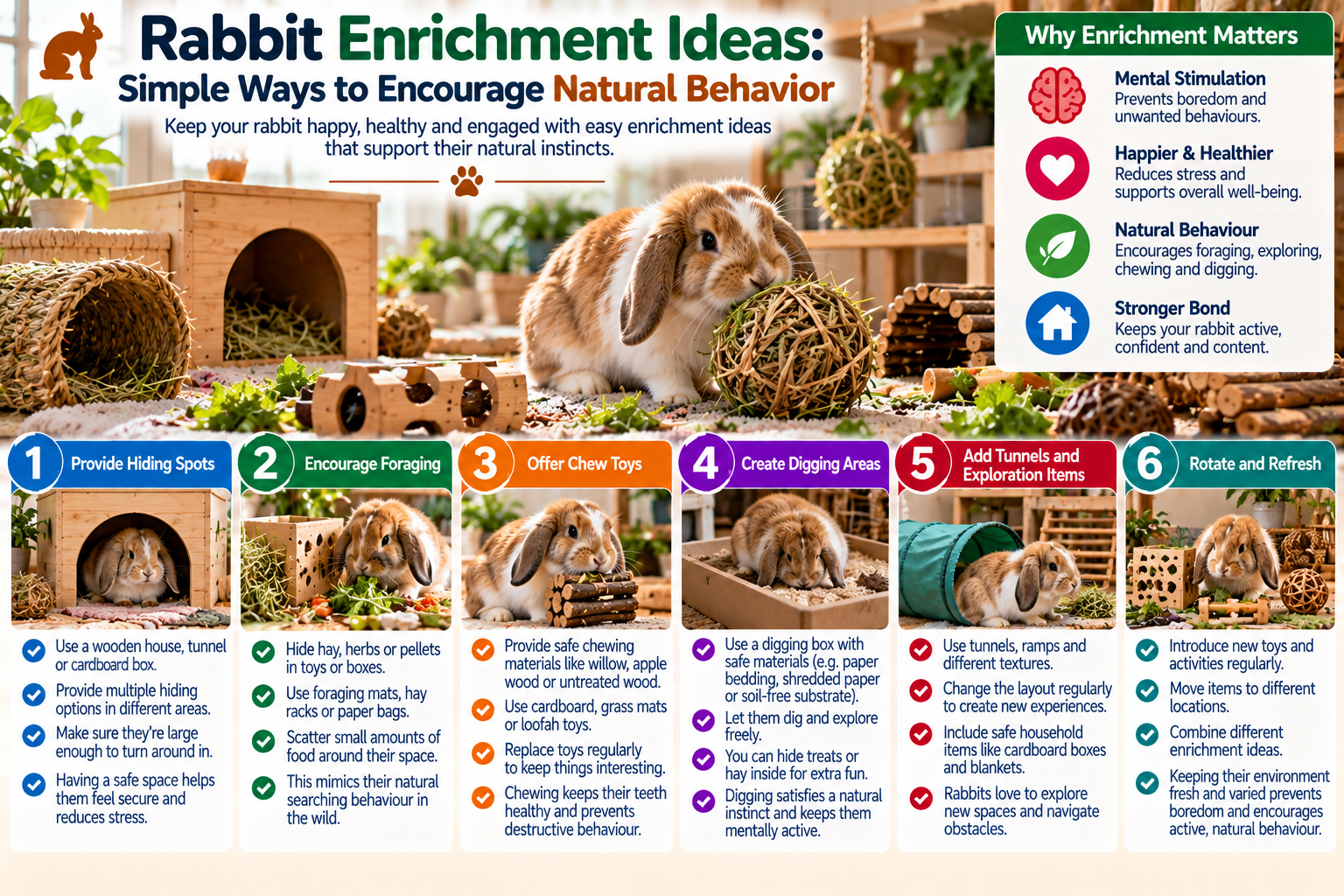
Hay should remain easy to reach throughout the day, but it need not appear in only one pile. Offer several clean hay stations, or tuck some into a cardboard tube with the ends left open. Scatter a little of the daily measured food among hay so the rabbit has to search. Keep hay fresh and make sure a toy never becomes the only way to eat.
Read your rabbit’s response
The best enrichment is the one your rabbit chooses to use. Watch quietly before adding another object.
| What you notice | Try this | Check next |
|---|---|---|
| Rabbit investigates and forages | Keep the activity and vary its location | Normal eating and droppings continue |
| Rabbit avoids a new object | Move it farther away and simplify | Curiosity returns without pressure |
Build tunnels and hiding places
A large cardboard box with two generous entrances makes a simple retreat. Connect boxes or add a stable tunnel to encourage movement. Two exits matter: a rabbit should never feel trapped. Remove staples, tape, plastic coatings and damaged cardboard, and check that openings are wide enough for a comfortable turn. A quiet hiding place is especially useful in a busy home.
Create a digging option
Some rabbits love a dedicated digging box. Use a sturdy, low container with rabbit-safe material that your rabbit cannot easily scatter throughout the room. Place it where supervision is easy. If your rabbit ignores it, try changing the location or material before buying more accessories. Avoid any substrate that is dusty, scented or likely to be eaten.
Rotate rather than crowd
A large pile of toys can shrink usable floor space. Offer a few safe chews, a tunnel and one foraging activity, then change an item after a few days. Watch for loose fibers, sharp edges or small pieces. Enrichment should add to a spacious home and daily exercise, not compensate for an enclosure that is too small.
Read your rabbit’s response
A rabbit that approaches, sniffs and returns to an activity is giving useful feedback. A rabbit that freezes or avoids a new object may need time or a simpler option. Introduce changes gradually, especially for a nervous newcomer. Provide companionship with a compatible rabbit where appropriate, along with daily chances to move freely in a safe area.
Start with a cardboard hide and one hay-foraging idea. Those two changes reveal more about your rabbit’s preferences than a shopping basket full of toys. For more background, see Blue Cross’s guides to small pet enrichment and rabbit care: Blue Cross guide and Blue Cross guide.
A ten-minute setup to try today
Put a generous hay pile beside a box with two exits, then leave a clear route around it. Sit back and watch what happens. Does your rabbit forage first, investigate the tunnel, or choose to rest inside? That observation tells you what to add next. If your rabbit spends most of the day confined, prioritize a larger safe exercise area before buying another toy. Our rabbit home setup guide explains the space and essentials behind enrichment.
Frequently asked questions
Are cardboard boxes safe for rabbits?
Plain, clean cardboard can be useful if you remove staples, tape and loose parts and supervise chewing.
How often should I change enrichment?
Rotate a few items when interest fades; keep familiar hides and routines available so the space remains predictable.