
Most guinea pig cage problems are decided at the store. A cage that looks roomy on the shelf can feel cramped once two adults, a hay pile and a couple of shelters are inside, and a tall cage with shelves often gives less usable space than a plain, wide one.
The rules for how to set up a guinea pig cage are simple: a large, flat floor, soft bedding, places to hide, constant hay and water, and a spot that stays comfortably cool.
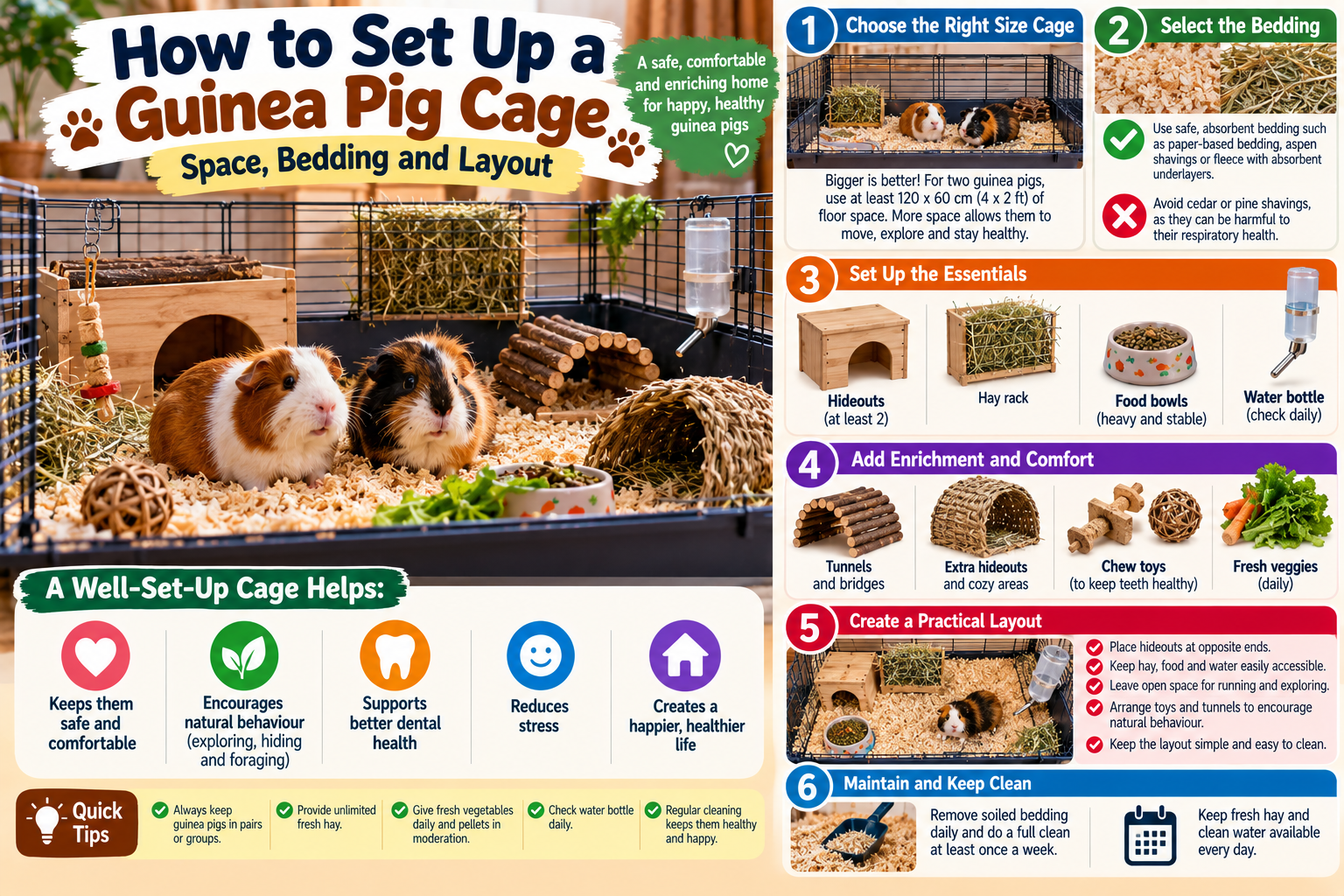
The short version: for a pair, treat about 7.5–10.5 sq ft (roughly 0.7–1 m²) of single-level floor as the bare minimum, and go bigger if you can. Use a solid floor, a few inches of absorbent bedding (not cedar or pine shavings), one hide per guinea pig plus a spare, a hay rack, a water bottle and a heavy food bowl. Keep the cage indoors around 65–75°F (about 18–24°C), away from drafts, radiators and sunny windows. Spot clean every day and do a full clean once a week.
Start with the floor space
Guinea pigs graze, trot and, when happy, sprint laps and leap straight up (popcorning). All of it happens on the floor, so floor area is the number to compare.
Published figures vary a lot. US guidance sits at the lower end, while UK welfare charities ask for much more room.
| Organization | Guidance for two guinea pigs |
|---|---|
| Humane World for Animals (US) | 7.5 sq ft (about 0.7 m²) minimum; 10.5 sq ft (about 1 m²), such as 30 x 50 in (76 x 127 cm), preferred |
| Blue Cross (UK) | A hutch of at least 5 x 2 ft (about 150 x 60 cm) plus a separate run of at least 6 x 4 ft (about 180 x 120 cm); at least 6 x 4 ft if the enclosure is their only space |
| PDSA (UK) | A hutch of at least 1.5 x 1 m (about 5 x 3.3 ft) with a run of at least 2 x 1 m (about 6.5 x 3.3 ft) attached |
Treat the US minimum as a floor, not a goal. If you have room for something closer to the UK figures, your guinea pigs will use it. Each extra guinea pig needs more space again.
Compare cages by their internal floor measurements, and check that the space is one open area rather than linked sections. Many owners build a large enclosure from grid panels on a waterproof base, which is often cheaper than a big store cage. Sides of around 12 in (30 cm) or more stop bedding from being kicked out.
Why a wide cage beats a tall one
Guinea pigs have short legs and stocky bodies, and most are not confident climbers. A second level adds something to explore, but it doesn’t replace floor area. The upper floor is usually too small to run on, and a steep ramp can lead to slips and falls.
If you add a loft, keep it low, use a solid ramp with a gentle slope and raised sides, and don’t count it toward your floor space. Extra length is worth far more than an extra story.
A solid floor and a soft layer on top
Avoid any cage with a wire or grid floor, even a partial one. Mesh lets bedding fall through, is hard on sensitive feet and can trap toes and legs. Choose a smooth, solid, waterproof base.
On top of it goes 2–3 in (5–8 cm) of absorbent bedding. Good options include:
- Paper-based bedding, which is soft, absorbent and low in dust. It’s the simplest safe choice.
- Dust-extracted wood shavings from a non-aromatic hardwood such as aspen, topped with hay.
- Hay as a top layer, which guinea pigs love to burrow into and nibble. On its own it doesn’t soak up urine well.
Skip cedar and pine shavings. These softwoods contain aromatic oils that can irritate a guinea pig’s airways. Advice on kiln-dried pine varies, so paper is the easier choice. Also avoid sawdust, cat litter, straw (it can injure eyes) and fluffy cotton-wool style nesting.
Hides, hay, water and food
Guinea pigs are prey animals and relax only when they can get out of sight. Give at least one hide per guinea pig, plus one extra, so nobody gets pushed out of the only shelter. Hides with two openings are useful because a timid pig can’t be cornered inside.
Hay should be available all the time and in generous amounts, since it makes up most of a guinea pig’s diet. A hay rack keeps some of it clean and off the bedding, and a second pile on the floor gives both pigs a place to eat without competing.
A gravity water bottle keeps water clean; check the spout twice a day, since it can jam, and refill daily. For pellets and vegetables, use a heavy bowl with a wide base so it can’t be flipped.
Where to put the cage
Indoors, choose a room that stays steady at around 65–75°F (about 18–24°C). Guinea pigs handle heat badly. They can become uncomfortable above about 75°F (24°C), and temperatures around 79–80°F (26–27°C) and up put them at risk of heatstroke. Avoid putting the cage:
- next to radiators, heaters or fireplaces
- in direct sun or right beside a sunny window or sunroom glass
- in drafts from doors, windows, fans or air vents
- next to loud speakers, TVs or noisy appliances
A quieter corner of a room your household uses works well. If you have cats or dogs, make sure they can’t reach in or stand over the enclosure.
If your guinea pigs live outside
Guinea pigs can live outdoors in suitable climates, but the hutch needs to be weatherproof, raised off the ground, secure against predators such as foxes and cats, and positioned out of direct sun and wind. In cold spells they need a lot more bedding. When temperatures fall below about 59°F (15°C), the RSPCA advises bringing them indoors, and in hot weather an outdoor hutch can overheat quickly. A shed or garage can work, but never one where cars are parked, because of exhaust fumes.
Keeping the cage clean
A simple routine stops smells and keeps feet and airways healthy:
- Every day: remove wet or dirty bedding and droppings, clear out uneaten fresh food, rinse and refill water, and top up hay.
- Every week: replace all the bedding, wash bowls, bottles and hides, and wipe the base with a pet-safe cleaner. Let everything dry fully before refilling.
A strong ammonia smell between cleans usually means the space is too small or the bedding isn’t absorbent enough.
Guinea pigs should live with at least one companion, and our article on guinea pigs’ social needs explains why company matters so much. For what goes in the hay rack and food bowl, see what guinea pigs eat every day.
Frequently asked questions
How big should a cage be for two guinea pigs?
Guidance varies. US advice gives 7.5 sq ft (about 0.7 m²) as a minimum and 10.5 sq ft (about 1 m²) as preferred, while UK charities recommend considerably more, from about 10 sq ft with a separate run to around 24 sq ft without one. Treat the smaller figures as a minimum and go bigger if you can.
Are multi-level cages good for guinea pigs?
Not as a substitute for floor space. Guinea pigs aren’t natural climbers and can fall from ramps and shelves. A low second level with a gentle, solid ramp that has sides is fine as an extra, but the main floor still needs to be large.
What is the safest bedding for guinea pigs?
Paper-based bedding is the simplest safe choice, and dust-extracted hardwood shavings such as aspen also work, often topped with hay. Avoid cedar and pine shavings, sawdust, straw, cat litter and fluffy cotton-wool style bedding.
How often should you clean a guinea pig cage?
Spot clean every day by removing wet bedding, droppings and leftover fresh food, and refreshing water and hay. Do a full clean with fresh bedding and washed bowls, bottles and hides about once a week, or more often for small setups or larger groups.