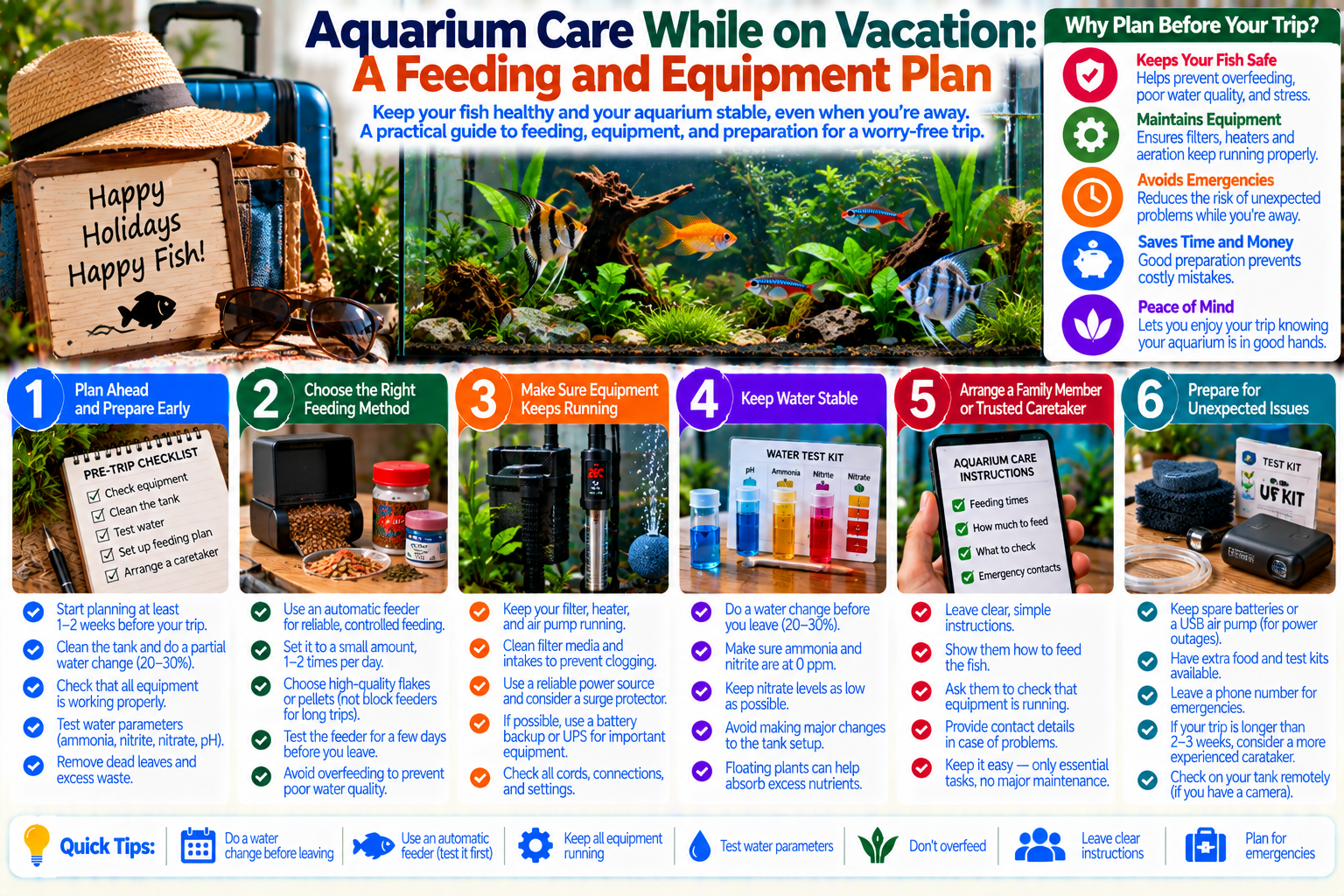

A successful aquarium holiday plan depends on keeping a stable system stable. Last-minute overfeeding, an untested feeder, or unnecessary deep cleaning can create problems just as you leave. Plan for the particular fish and equipment you own, with a person able to check that everything is working.
Quick answer: Test the feeding plan and equipment before departure, pre-measure food for a sitter, and provide clear daily checks and emergency contacts. Avoid extra “make-up” meals and major last-minute changes. Feeding needs depend on species, age, health, and trip length.
Choose a feeding arrangement for your livestock
Do not assume every fish can safely go without food for the same number of days. Fry, specialised feeders, sick fish, and some species need more frequent attention than healthy adults of other species. Ask an experienced aquatic professional or fish vet when uncertain.
A reliable sitter is useful because feeding is only one part of care. An automatic feeder cannot notice a stopped filter, a leak, or abnormal breathing. For a longer absence, arrange in-person checks even when food delivery is automated.
Test the plan while you are still home
Set up an automatic feeder several days ahead and watch complete feeding cycles. Check the quantity, whether moisture makes food clump, and whether food reaches the intended fish. Confirm that the feeder stays secure when the lid is opened or equipment vibrates.
For a sitter, place measured portions in labelled containers. Write “one container at this visit” instead of “a small pinch.” Demonstrate the routine, then ask the sitter to show it back to you. Keep extra food separate so a helpful person is not tempted to add more because fish approach the glass.
| Check | Normal for this tank | When to contact you |
|---|---|---|
| Temperature | Write the actual species-appropriate range | Outside that range or changing unexpectedly |
| Filter and flow | Demonstrate the usual movement and sound | No flow, unusual noise, or leakage |
| Fish behaviour | Show normal feeding and swimming | Gasping, loss of balance, injury, or missing fish |
| Feeding | Labelled portions and scheduled visits | Food left uneaten or a fish refusing its usual ration |
Do routine maintenance with time to observe
Check water quality and complete appropriate routine maintenance several days before leaving, allowing time to see that the system remains stable. Avoid replacing all filter media or combining several major changes immediately before departure. Keep biological filtration protected.
Check the heater, thermometer, filter intake, air supply if used, timers, lid, and electrical safety. Make sure cables have appropriate drip loops and equipment is used according to its instructions. Do not ask an inexperienced sitter to repair wet electrical equipment.
Write an emergency plan that can be followed
Include your contact details, a backup person, and a knowledgeable local aquarium professional or fish vet. Label essential equipment and explain what should remain powered. Record where prepared supplies are kept and which actions require advice first.
A useful instruction is specific: “If fish are gasping, call immediately and send a short video; check whether the filter is running.” Avoid vague directions such as “fix the water.” If a water change may be needed, train the sitter in your actual routine beforehand.
Return without overcorrecting
Observe the fish, check temperature and water parameters, and review the sitter’s notes. Resume the normal ration rather than compensating with a large meal. Address abnormal readings or symptoms with a measured plan.
Avoid last-minute additions: New fish, untested feeding blocks, and unfamiliar equipment can add uncertainty. Make changes well before a trip or wait until you can monitor them properly.
See safe aquarium water changes and what surface gasping can mean.
Frequently asked questions
Can I feed extra before leaving?
No. Extra food can become waste and harm water quality. Use an appropriate planned schedule for your fish.
Is an automatic feeder enough on its own?
It covers only food delivery and can malfunction. Arrange checks for equipment, water conditions, and fish wellbeing.
Should I deep-clean everything the night before?
No. Perform routine maintenance early enough to observe the result, and avoid disrupting the biological filter.