
Your dog comes running when you open the treat cupboard, yet seems not to hear you at the park. The difference is usually the situation: returning to you is easy in the kitchen and much harder around moving dogs, interesting scents, and wildlife. Dog recall training closes that gap through practice that your dog can succeed at.
Quick answer: Teach one recall cue in a quiet place, reward your dog for returning all the way to you, and increase difficulty gradually. Use a secure enclosure or a long line attached to a well-fitted harness while learning. Never punish a dog who has come back, even after a delay.
Decide what a successful recall looks like
A useful recall ends beside you, close enough to take hold of the harness or attach the lead. A dog who races past, grabs a snack, and disappears again has learned only part of the task. Plan to reward both the return and a brief, comfortable pause with you.
Choose a short word such as “here” and agree on it with everyone who walks the dog. Keep that cue separate from your dog’s name, which can simply mean “pay attention.” Pick rewards your dog enjoys in that setting. A piece of ordinary kibble might work indoors; a favorite toy or a small, higher-value food reward may help outside.
Start where the answer is easy
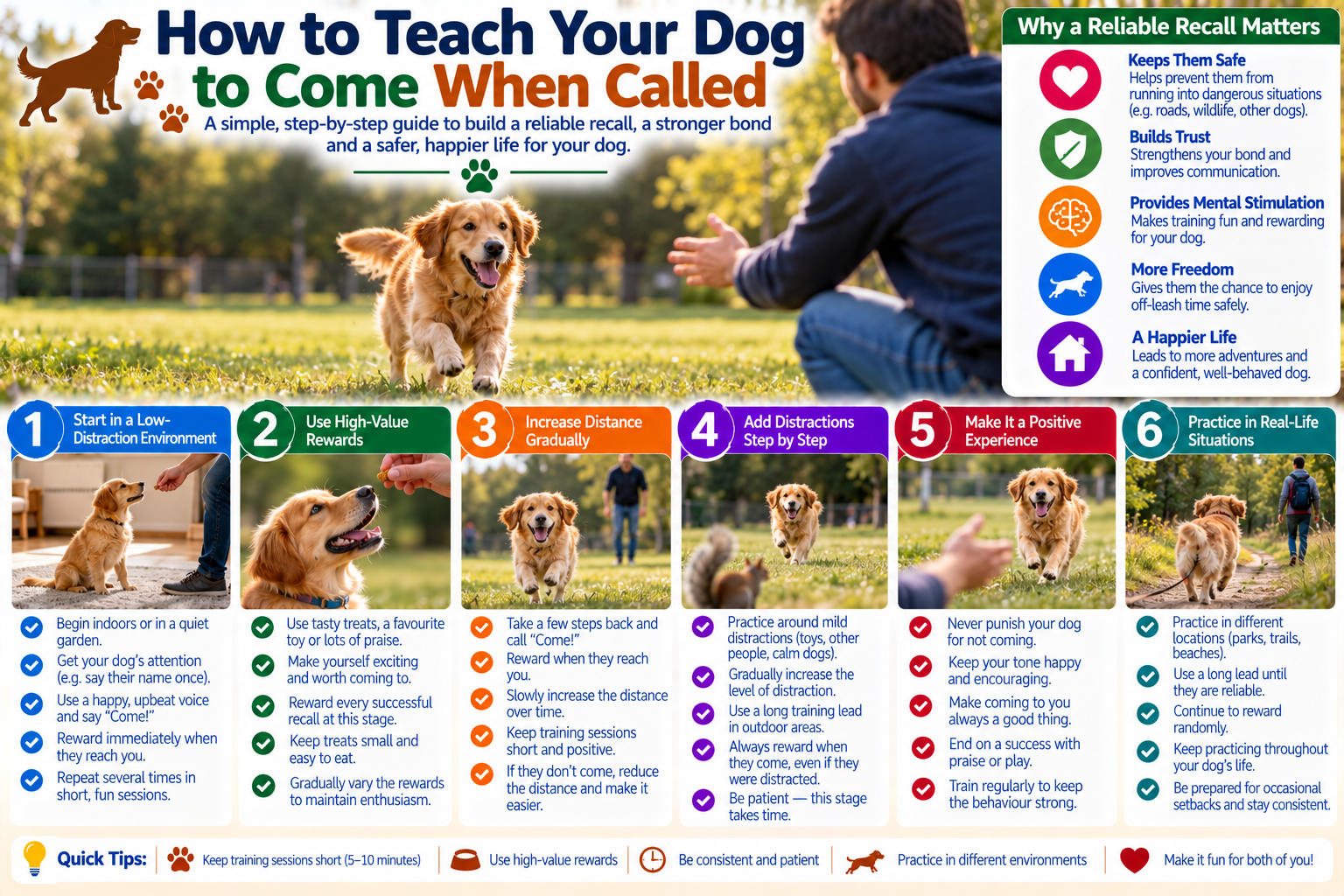
- Stand a few steps away in a quiet room. When your dog is likely to approach, say the cue once and move a step backward.
- Mark the arrival with a quiet “yes,” then give the reward beside your legs.
- If your dog is comfortable with handling, briefly touch the harness, reward again, and release them with “go sniff” or another consistent release cue.
- Repeat a few times, then finish. Several short sessions fit learning better than a long session after attention has faded.
For example, try three easy returns before breakfast and three in the hallway later. The point is not to complete a daily quota. Stop while the dog is still engaged, and use their normal food allowance where practical.
Move outdoors without removing the safety net
Dogs do not automatically transfer a skill from one place to another. In the garden, begin at the indoor distance again. In a quiet outdoor area, use a long line and harness, leaving enough room to avoid tangles with people, trees, or other dogs. Do not wrap the line around your hand or let your dog build up speed into its end.
| Stage | Practice | Ready to progress when |
|---|---|---|
| Quiet room | A few steps, no competing activity | Your dog turns and returns readily |
| Secure garden | Short distance with mild smells | The same easy response appears repeatedly |
| Quiet outdoor space | Harness and long line, generous distance from distractions | Your dog can disengage and reach you calmly |
| More activity nearby | Shorten your distance and increase reward value | Success remains consistent without repeated calling |
Change one challenge at a time. If you move to a busier place, shorten the distance. If you increase distance, keep the surroundings familiar. A training log can be as simple as “garden, five steps, four easy returns.” That tells you more than deciding your dog was good or stubborn.
What to do when your dog does not come
Repeatedly calling across a field usually adds noise without making the task clearer. If safe, move closer or farther from the distraction and invite an easier return. Use the line to prevent access to hazards, not to jerk the dog toward you. Reward the eventual arrival and make the next attempt simpler.
Practice recalls that do not end the walk. Return, reward, then allow sniffing again when safe. Otherwise, your cue can become a prediction that every enjoyable activity is about to stop. During ordinary walks, also notice and reward voluntary check-ins.
Safety first: Recall is not a guarantee around traffic, livestock, cliffs, or wildlife. Keep appropriate physical control and follow local access rules even when training is going well.
When extra help makes sense
If your dog suddenly stops responding to familiar sounds, discuss hearing or health changes with your vet. A qualified reward-based trainer can help when chasing, fear, or intense excitement makes outdoor practice difficult. Until then, enjoyable walks on a lead remain a valid option.
For the walking equipment that supports this training, read our collar and harness guide. If the journey to the practice area is already a struggle, start with loose-lead walking.
Frequently asked questions
How long does recall training take?
There is no fixed deadline. Learning the cue indoors can be quick; responding around real-world distractions takes repeated practice over time. Increase difficulty according to your dog’s response, not a calendar.
Should I show the treat before calling?
You can use food to help the first few repetitions, but gradually keep it out of sight until your dog returns. The cue should predict a reward, rather than depend on seeing one.
Can an adult dog learn recall?
Yes. Begin with easy, safe repetitions just as you would with a younger dog. A new cue may be useful if an old one has become associated with confusion or unpleasant outcomes.
When can I remove the long line?
Only in a safe, permitted setting after consistent practice with relevant distractions. Some dogs and environments will still need a lead; safety matters more than reaching an off-lead milestone.