
Pet store walls are full of collars, harnesses and leashes, and it’s hard to tell which ones are right for your dog. The answer depends on your dog’s size, shape and walking habits more than on style.
Most dogs do well with a simple setup: a flat collar that carries their ID, a well-fitted harness for walks if they pull or have a delicate neck, and a plain fixed-length leash. Here’s how to choose between a dog collar or harness, check the fit and spot gear that’s best left on the shelf.
At a glance: a flat collar with up-to-date ID tags suits almost every dog. A harness is often more comfortable for walks, especially for pullers, small dogs and flat-faced breeds. Check fit with the two-finger rule, use a fixed-length leash, and avoid choke, prong and shock collars.
Collars: what they’re good for
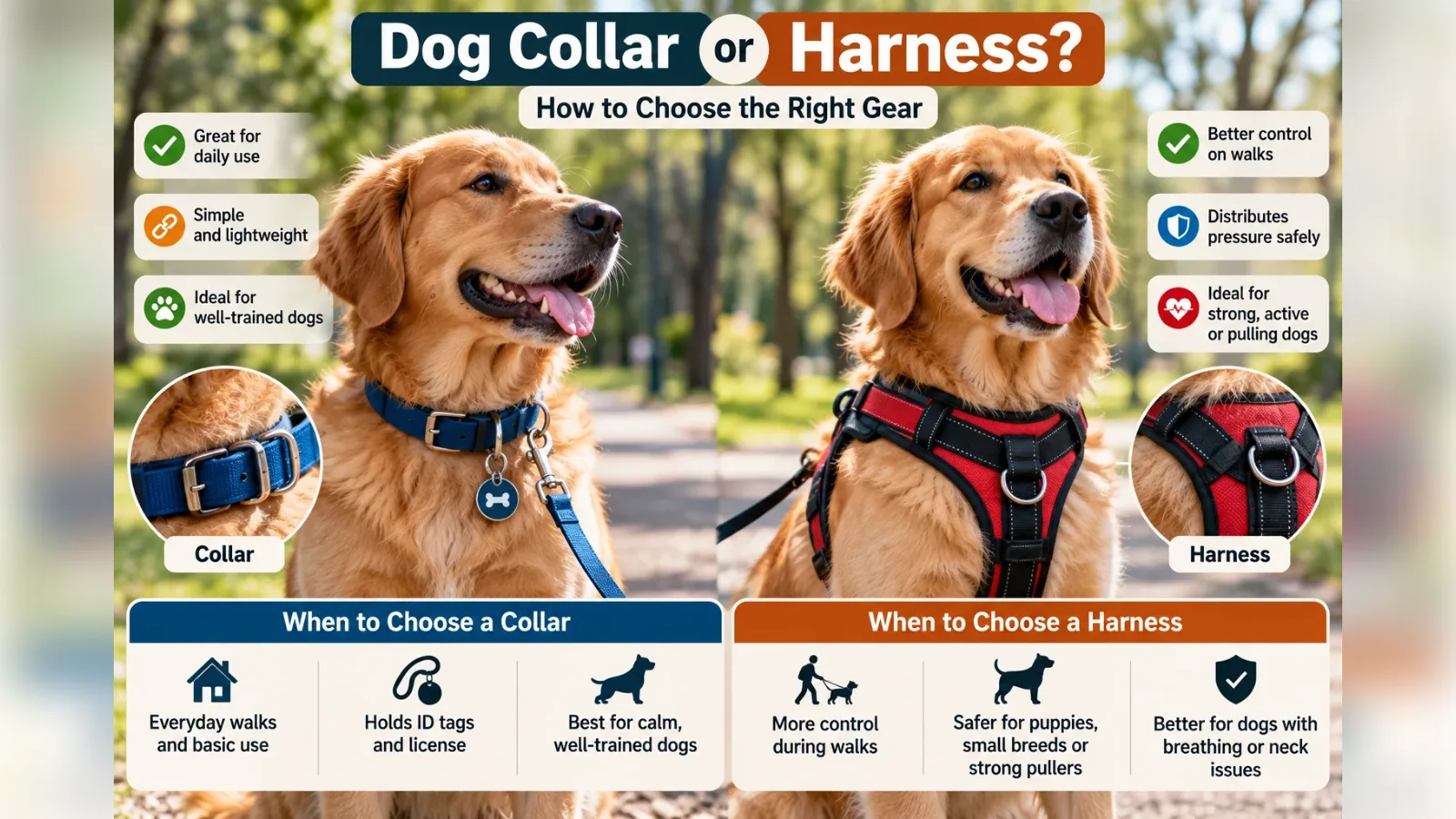
Even if you walk your dog on a harness, a collar is the easiest way to keep ID on them at all times. The main types you’ll see:
- Flat collar. A simple buckle or clip collar. It’s the everyday choice for carrying ID tags and works for walking dogs that don’t pull.
- Rolled collar. A round, rolled design that can be kinder to long coats, sensitive skin or skin folds.
- Martingale (limited-slip) collar. Tightens a set amount when the dog pulls back, then stops. It’s designed for dogs whose heads are about as narrow as their necks, such as greyhounds and whippets, so they can’t back out of it. Fit it so it can’t close tight around the neck, and use it for walks rather than as an all-day collar.
Harnesses: when they make more sense
A harness spreads pressure across the chest and body instead of the throat. That makes it a good choice for:
- Dogs that pull, while you work on loose leash walking
- Small and toy breeds, whose necks are more delicate
- Dogs with airway or neck problems, and flat-faced (brachycephalic) breeds, where pressure on the throat can make breathing harder
- Dogs that slip out of collars
Look for a Y-shaped design that sits on the breastbone and leaves the shoulders free to move. Harnesses with a strap straight across the front of the chest can restrict the natural stride.
Many harnesses have two leash points. A back clip is comfortable for dogs who already walk nicely. A front (chest) clip gives you more help with pullers, because tension on the leash gently turns the dog back toward you. Some people use a double-ended leash attached to both.
| Option | Best for | Watch out for |
|---|---|---|
| Flat collar | Carrying ID; dogs that walk calmly | Neck pressure if the dog pulls; can slip off narrow heads |
| Martingale collar | Dogs with narrow heads that back out of collars | Must be fitted correctly; best used on walks only |
| Back-clip harness | Small dogs, dogs with delicate necks, calm walkers | Doesn’t discourage pulling |
| Front-clip harness | Dogs that pull | Needs a good fit so it doesn’t slide sideways or rub |
How to check the fit
Poorly fitted gear causes most problems, from rubbed skin to escape artists slipping free near a road.
Collars
- Use the two-finger rule: you should be able to slide two fingers comfortably between the collar and your dog’s neck.
- Try gently pulling it forward over your dog’s head. If it slides off easily, it’s too loose.
- Recheck a puppy’s collar often. Bigger breeds in particular can outgrow one in a matter of weeks.
Harnesses
- You should be able to slip two fingers under every strap.
- With the harness on, try to ease it forward over your dog’s head. You shouldn’t be able to pull it off.
- Check the armpits and chest after walks for rubbing, hair loss or redness, which means the fit needs adjusting.
- Watch your dog move. They should be able to walk, trot and sit without the harness digging in or twisting.
Introduce a new harness gradually. Let your dog sniff it, reward them, then put it on for short spells with treats before heading out.
ID tags and microchips
The American Veterinary Medical Association recommends a layered approach: a collar with current ID tags, plus a registered microchip. A tag lets the person who finds your dog call you straight away, while a microchip only helps once your dog reaches a vet clinic or shelter with a scanner.
- Put your phone number on the tag. Many owners add “microchipped” too.
- Keep the rabies tag or license on if your area requires it.
- Update your microchip registration whenever you move or change phone numbers.
- Check whether local laws require your dog to wear ID in public. Rules vary by place.
Choosing a leash
A plain, fixed-length leash of about 6 feet (roughly 2 meters) suits most everyday walks. Pick a width that matches your dog’s size and a clip that’s sturdy enough for their strength. A longer training line can be useful for recall practice in open, safe spaces.
Retractable leashes are best avoided. The constant tension teaches dogs that pulling earns more room, and it’s hard to reel in a dog quickly near traffic or another dog. The thin cord can cause burns and cuts to hands and legs, and a dropped handle can clatter after a dog and frighten them into running. When a dog hits the end of the line at speed, the sudden jolt can also injure the neck.
Gear to avoid
Safety note: skip choke (slip) chains, prong (pinch) collars and shock collars. Each one gets results by hurting or startling the dog, which risks damage to the throat and neck and can leave a dog nervous or reactive around whatever it was looking at when the pain arrived, often another dog or a person. The American Veterinary Society of Animal Behavior advises against using them for training.
Head halters sit between the two. They can give extra control over large, strong dogs, but many dogs find them uncomfortable at first, and they can hurt the neck if the leash is jerked. If you’re considering one, get advice from a reward-based trainer, introduce it slowly and attach a second leash to a harness as backup.
An adult dog whose collar keeps needing to be let out a notch may be putting on weight. It’s worth running through the simple checks for an overweight dog and mentioning any gain to your vet.
Once the gear fits well, the next step is teaching your dog not to pull on the leash.
Frequently asked questions
Is a harness better than a collar for dogs?
For walking, a well-fitted harness is often more comfortable, especially for dogs that pull, small breeds and flat-faced breeds. Most dogs still benefit from wearing a collar to carry ID tags.
How tight should a dog collar be?
You should be able to fit two fingers comfortably between the collar and your dog’s neck, and the collar shouldn’t slide over your dog’s head when you pull it gently forward.
Should my dog wear a harness all the time?
A harness is mainly for walks. Taking it off at home gives your dog’s skin and coat a rest and means straps can’t rub or catch on things. A well-fitted collar with ID tags can stay on.
Are retractable leashes bad for dogs?
They’re not recommended for everyday walks. They encourage pulling, give you less control near hazards and the cord can cause burns and cuts. A fixed-length leash is safer.