
House training a puppy comes down to one idea: make going outside so easy and rewarding that it becomes a habit, and give accidents as few chances as possible. No trick does it overnight. What works is a predictable routine, sharp eyes and a lot of trips to the same patch of grass.
The short version: to house train a puppy, take them out on a regular schedule and at the key moments (waking, after meals, after play and before bed), reward them the second they finish outside, and watch them closely indoors. Clean up accidents with an enzymatic cleaner, and skip punishment entirely. Most puppies take around 4 to 6 months to become reliable, and a sudden run of accidents is worth a vet check.
What a young puppy can manage
Puppies don’t have full bladder and bowel control yet, and they give very little warning. A common rule of thumb is roughly one hour of holding time for every month of age, so a 2-month-old might last about 2 hours between breaks. Treat that as the upper end, not a target. A puppy who is racing around, eating or drinking can need to go within minutes. That’s why house training is mostly about timing: get them out before they need to go, and every success strengthens the habit.
When to take your puppy out
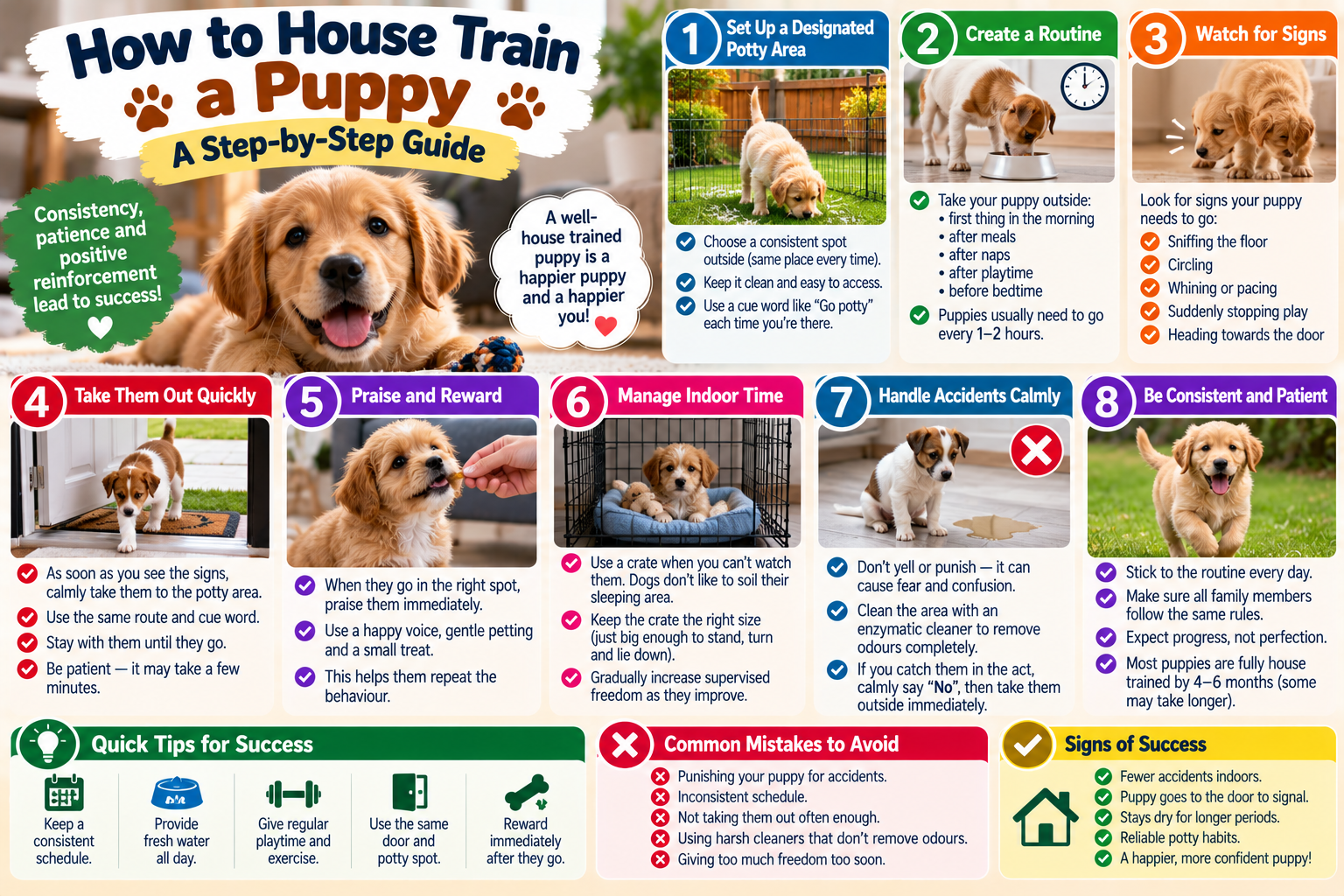
Young puppies need a break every hour or two while awake, and more often during lively play. On top of that, go out:
- First thing in the morning, before anything else
- Straight after waking from any nap
- Shortly after eating or having a big drink
- During and after play or any excitement, such as visitors arriving
- After time in a crate or pen
- Last thing before bed
Learn your puppy’s own signals too. Sniffing the floor, circling, suddenly wandering off, whining or heading toward the door all mean “take me out now.”
A sample day for a young puppy
Feeding at the same times each day makes toilet times more predictable. A day built around the key moments might look like this:
| Time | What happens |
|---|---|
| 6:30 a.m. | Wake up and go straight outside |
| 7:00 a.m. | Breakfast, then outside again shortly after |
| Morning | Play and naps, with a trip out after each one and every hour or two |
| Midday | Lunch, then outside (arrange a visitor if you’re at work) |
| 5:30 p.m. | Dinner, then outside |
| 10:30 p.m. | Last trip out, then bed |
What to do once you’re outside
Go out with your puppy, on a leash, rather than opening the door and hoping. Take them to the same spot each time, since the familiar smell helps prompt them, and stand quietly while they sniff. A short cue such as “go potty” said as they start will, over time, become linked to going.
Wait until they’ve completely finished (praise too early and many puppies stop halfway), then praise warmly and give a tasty treat right there. A treat handed out in the kitchen rewards coming inside, not peeing outside. If nothing happens within a few minutes, bring your puppy in, keep them right beside you or in their crate, and try again a little later.
Save play for after they’ve been, so puppies learn to get the job done rather than treating every trip as playtime.
Supervision indoors
Most accidents happen when nobody is watching. In the early weeks, keep your puppy in the same room as you, with doors closed or baby gates up, or clip a light leash (around 6 feet, or 1.8 m) to your belt so they can’t slip away. When you can’t supervise, a crate or small pen used for short periods keeps them from wandering off to a quiet corner. Our guide to crate training a puppy covers introducing one so your puppy is happy inside.
Give freedom gradually, one room at a time. A good benchmark is 8 to 12 weeks without mistakes before handing over much more of the house, and even then, open up new rooms while you’re around to watch.
Handling accidents
Every puppy has accidents. How you respond decides whether they set you back:
- If you catch them in the act, make a quick, odd noise or clap once to interrupt (not a shout), then scoop them up or lead them outside to finish. Reward if they go out there.
- If you find it afterward, just clean it up. A telling-off now means nothing to them.
- Never punish, shout or rub a puppy’s nose in it. It teaches them to be afraid of going in front of you, so they start sneaking off to hide it.
Treat the spot with an enzymatic cleaner. It breaks down the odor that would otherwise draw your puppy back to the same place. Skip ammonia-based household cleaners: to a dog’s nose they can smell like urine and end up marking the spot as a toilet.
Repeated accidents usually mean breaks are too far apart, supervision slipped or your puppy has more freedom than they’re ready for.
Getting through the night
Very young puppies usually need at least one toilet trip in the night, and some keep needing one until they’re around 5 months old. You can make nights easier in three ways:
- Take the water bowl up about two and a half hours before bedtime, so there’s less to hold. Keep fresh water available all day.
- Make the last trip out right before you go to bed, not an hour earlier.
- If your puppy whines or stirs in the night, assume they need to go and take them out, rather than waiting to see if they settle.
How long house training takes
Most puppies take somewhere around 4 to 6 months to become reliably house trained, though it varies with size, age and what habits they’ve already picked up. Small and toy breeds, with their smaller bladders, often take longer. A puppy or rescue dog who spent long stretches shut in with no chance to go outside may also need extra patience and a full return to the basics, since they’ve had to get used to soiling where they live.
Progress isn’t a straight line, and a puppy who seemed to have it sorted can slip back for a while. Return to more frequent breaks and closer supervision for a week or two, then ease off again.
When accidents might be medical
Sometimes the problem isn’t training at all. Talk to your vet if your puppy:
- Pees very often, especially in small amounts
- Strains, cries or seems uncomfortable when peeing
- Has blood in their urine or urine with a strong smell
- Suddenly starts having accidents after being reliable
- Is drinking much more than usual
- Has diarrhea or dribbles urine without seeming to notice
Urinary tract infections, intestinal parasites that cause diarrhea, and conditions that make a dog drink and pee more can all make house training fall apart. They need diagnosis and treatment, not more training.
Urgent: contact a vet right away if your puppy is straining and passing little or no urine, or has diarrhea along with vomiting, lethargy or refusing food. Young puppies can become dehydrated quickly.
For the other big job of these months, our guide on socializing a puppy safely explains how to add new sights and sounds without overwhelming them.
Frequently asked questions
How often should I take my puppy out to pee?
Every hour or two while a young puppy is awake, plus after waking, eating, drinking and playing, and last thing at night. About one hour per month of age is a rough upper limit, not a target.
Should I use puppy pads?
They can help if you live high up in an apartment building or can’t get outside often, but they teach your puppy that going indoors is sometimes fine, which can make outdoor training take longer. If you use them, keep them in one spot and move toward outdoor toilet trips as soon as you can.
Why does my puppy pee right after coming back inside?
Usually they got distracted outside and didn’t finish. Stay out a little longer, keep things boring until they go, and reward the instant they do. If it keeps happening along with frequent peeing, ask your vet to check for a urinary infection.
At what age should a puppy be fully house trained?
Most puppies need around 4 to 6 months of consistent training to become reliable, and small breeds often take longer. Occasional setbacks along the way are normal.