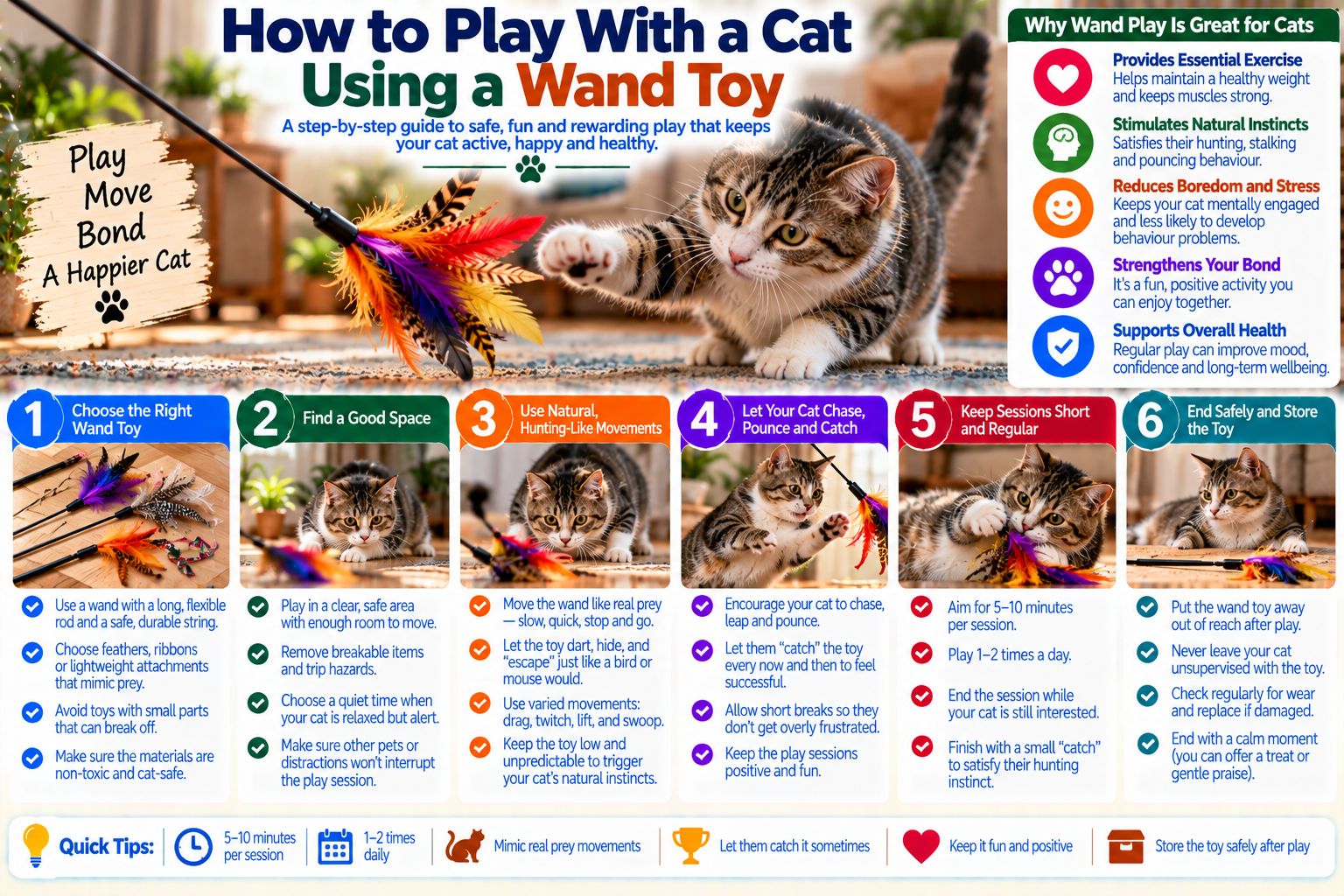

A wand toy can make an ordinary room feel like a hunting ground. Good play is less about waving the toy nonstop and more about giving the cat chances to watch, stalk, chase and catch it. A few thoughtful minutes can be more engaging than a long, frantic session.
Set the scene
Choose a clear floor area and move fragile objects. Use a wand with a secure attachment and keep any long string away from a cat when unsupervised. Start with the toy partly hidden behind furniture, then let it move like small prey rather than spinning it around the cat’s face.
Let your cat set the pace
A good game has a catch. Notice whether your cat is stalking, pouncing or losing interest.
| What you notice | Try this | Check next |
|---|---|---|
| Cat watches but does not chase | Slow the lure and let it hide | Interest and relaxed body language |
| Cat grabs and chews the string | End play and store the toy | No loose parts swallowed |
Let the cat succeed
Pause often so the cat can watch and plan. Move the toy away in short bursts, then slow it down so the cat can pounce and grab it. A game with no successful catches can become frustrating. End with a catch and, if appropriate, a small part of the normal meal.
Match the cat’s pace
A kitten may dash repeatedly; an older cat may prefer reaching from a comfortable spot. Keep jumps low for a cat with mobility problems and ask a veterinarian if play suddenly becomes difficult. Stop if the cat is panting, upset or avoiding the activity.
Play separately in multi-cat homes
One confident cat can monopolize the wand. Give each cat its own turn in a calm space. Store the wand after play so a cat cannot chew or become tangled in the string. Rotate toy styles occasionally without replacing familiar favorites.
Notice which movement makes your cat curious and repeat that pattern. International Cat Care explains the hunting sequence behind play: International Cat Care guide.
Let the cat catch the toy
Move the lure like prey that sometimes hides and sometimes slows down. Give your cat chances to pounce and hold it, then end with a small reward or meal. Put string toys away after play to avoid unsupervised chewing. For more variety, see our indoor cat enrichment ideas.
Make the last minute count
A cat may enjoy a few minutes of watching and stalking before the first pounce. Slow the lure near a corner, let it disappear briefly, then allow a catch. Repeatedly waving it just out of reach can make the session less satisfying.
When your cat has caught the toy several times, slow the movement and finish with a small food reward or a meal if it fits the routine. Check the lure and string for damage before putting it away. If your cat walks off, let the session end.
Frequently asked questions
Should I let my cat catch the toy?
Yes. Repeated catches make the hunting game more satisfying than a lure that is always out of reach.
Can I leave a wand toy out?
Put string and dangling parts away when play ends to reduce chewing and entanglement risks.