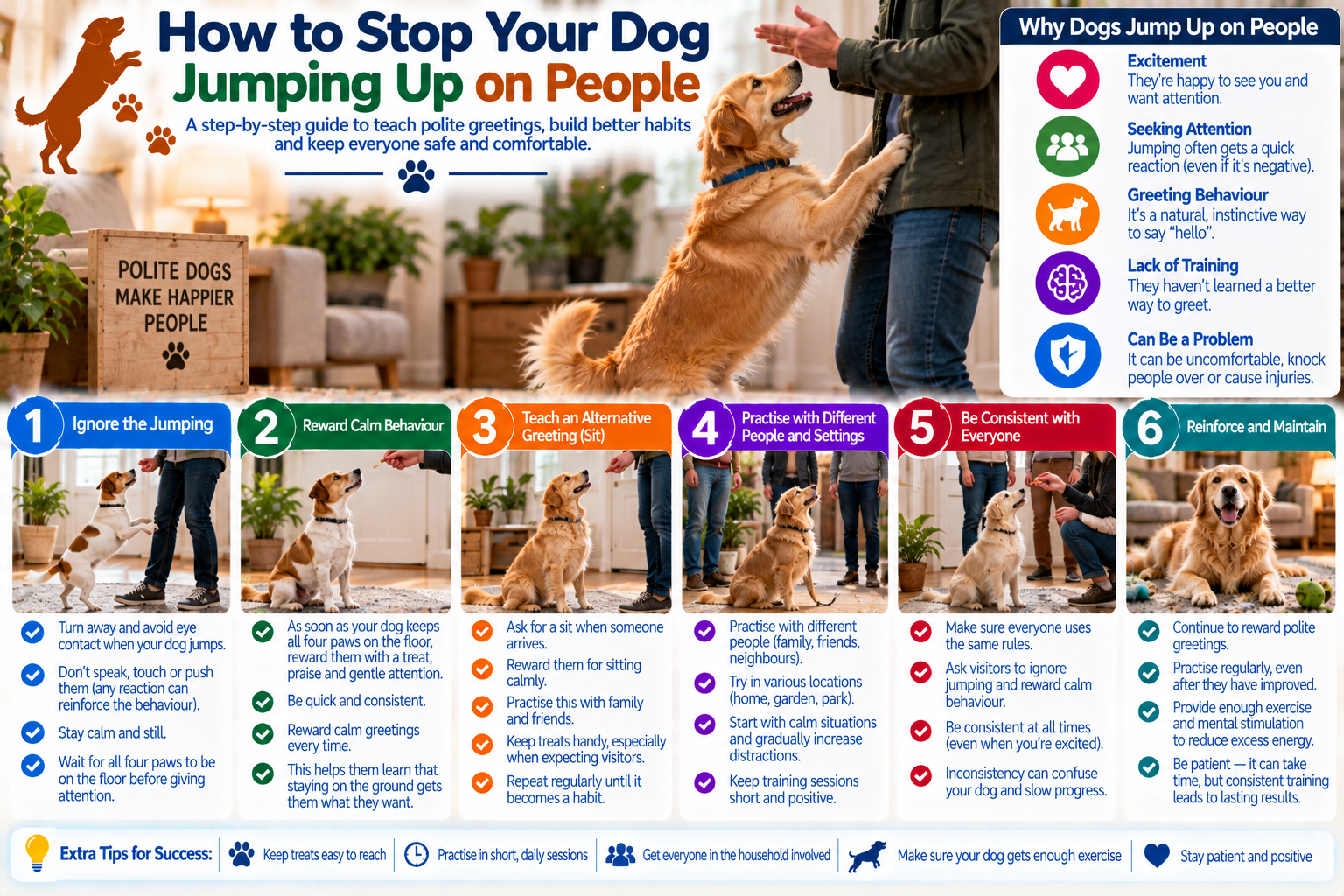

A friendly dog can still knock over a visitor or leave muddy paw prints on a stranger. To stop your dog jumping up, teach a greeting that works for everyone and arrange encounters so your dog can practice it. Waiting for a chaotic doorway arrival and then shouting “down” gives you very little room to teach.
At a glance: Reward four paws on the floor, start with a calm helper, and use distance or a barrier to prevent repeated jumping. Make attention available for the greeting you want. Avoid kneeing, pushing, leash corrections, or frightening your dog.
Work out what happens before the jump
Jumping can accompany excitement, attention-seeking, uncertainty, or frustration. It does not automatically mean your dog is trying to dominate someone. Watch the whole picture: loose movement and eager approaches are different from a tense body, retreating, barking, or repeated attempts to escape.
Write down three things after an encounter: who arrived, how close they got, and what your dog received after jumping. A household might discover that adults turn away while one visitor laughs and rubs the dog’s chest. That inconsistent response makes the old greeting worth trying again.
Build the new greeting away from the front door
- Choose a quiet room and a familiar adult helper. Keep small rewards ready before the person approaches.
- Have the helper stop at a distance where your dog can keep their feet down. Mark that moment with “yes” and deliver the reward low.
- Let the helper come one step closer. Reward again if the dog stays comfortable with four paws on the floor.
- If the dog launches upward, calmly increase space. Reset at an easier distance rather than asking for repeated failures.
- Finish with a brief, calm greeting if your dog wants contact. Some dogs prefer a treat and room to move over being stroked.
A sit can be useful if the dog already knows it and finds it comfortable, but it is not essential. Standing with four paws down is a perfectly acceptable greeting. For an older dog with sore joints, insisting on repeated sits may add a problem instead of solving one.
Make real arrivals easier
Put rewards near the entry in a container out of reach of pets and children. Before opening the door, place your dog behind a secure gate or have another adult hold a loose lead attached to suitable walking equipment. Allow the visitor to enter and settle before deciding whether a greeting is appropriate.
| Situation | Helpful setup | What to practice |
|---|---|---|
| A familiar adult arrives | Calm helper and generous space | Approach only while paws remain down |
| A delivery at the door | Secure barrier away from the opening | Reward staying safely behind it |
| A child or unsteady visitor | Physical separation and adult supervision | No direct greeting until safely manageable |
| A person on a walk | Stop well before reaching them | Calm attention to you; greeting is optional |
For example, a dog who manages a greeting with a seated friend may still struggle with three people carrying bags. That is a harder exercise. Use the gate, let the room settle, and save training for a simpler moment.
What if your dog has already jumped?
Keep your response brief and calm. If safe, stop offering attention and create space, then reward the next achievable feet-down moment. Avoid grabbing paws or pushing the dog around; physical interaction can excite some dogs and alarm others. The prevention plan matters more than finding a perfect reaction after the jump.
Ask visitors to follow one clear instruction, such as “Please wait while I reward four paws.” A long list is harder to remember. If someone cannot follow the plan, use a comfortable separate space with an appropriate activity. Your dog does not need to greet every person who enters the home.
Measure progress without expecting perfection
Count successful calm approaches rather than only counting jumps. Keep a note of the easiest distance and whether your dog could take food gently. Short, successful practice with predictable helpers provides a foundation for more exciting arrivals.
Get support: If greetings involve growling, snapping, fear, or sudden changes in behavior, speak with your vet and a qualified reward-based behavior professional. Keep people safely separated while you arrange help.
For related skills, see safe puppy socialisation and loose-lead walking.
Frequently asked questions
Should I turn my back when my dog jumps?
Removing attention can help some dogs, but turning away is not a complete plan and may be unsafe around a large, excited dog. Prevent the jump with distance or a barrier and actively reward a calm greeting.
Should every greeting include a sit?
No. Four paws on the floor is enough. Choose a position your dog can comfortably maintain, and avoid repeatedly asking a sore or worried dog to sit.
Why does my dog jump only on visitors?
Visitors may be more exciting, less predictable, or more rewarding than familiar household members. Practice with one calm helper before progressing to ordinary arrivals.
Can I still greet my dog affectionately?
Yes. Give affection when your dog is comfortable and their paws are down. Calm greetings do not mean withholding all social contact.