
A cat wearing a harness in a video may look adventurous, but the same outing can feel frightening to another cat. Cat harness training should begin with a suitability decision, not a walking itinerary. Your cat’s comfort matters more than whether they eventually go around the block.
Quick answer: Harness walks are not suitable for every cat, and Cats Protection generally does not recommend walking cats on leads because it can be stressful. If you explore harness use with professional advice, introduce it voluntarily indoors, watch body language, and stop if your cat is uncomfortable. Secure enclosed outdoor space or indoor enrichment may be better options.
Consider what the outing would add
Ask whether the goal is safe transport practice, controlled access to a quiet space, or enrichment. These are different tasks. A cat who enjoys watching from a protected window does not necessarily want to meet dogs, traffic, and unfamiliar people outdoors.
Speak with your vet about health, preventive care, identification, and your local environment before planning outdoor exposure. A harness is not escape-proof, and an unfamiliar place may offer few safe retreats. Never use outdoor practice to force a fearful cat to become confident.
Learn the difference between stillness and comfort
A cat who freezes or flattens to the floor is not necessarily accepting the harness. Watch for normal movement, voluntary investigation, relaxed posture, and willingness to interact. Crouching, frantic rolling, hiding, flattened ears, or persistent attempts to remove the equipment are reasons to stop.
For example, place the harness nearby during an ordinary calm moment. If your cat chooses to move away, do not follow them around the room with it. Increase distance or put it away and reconsider whether this activity suits them.
If appropriate, introduce equipment indoors
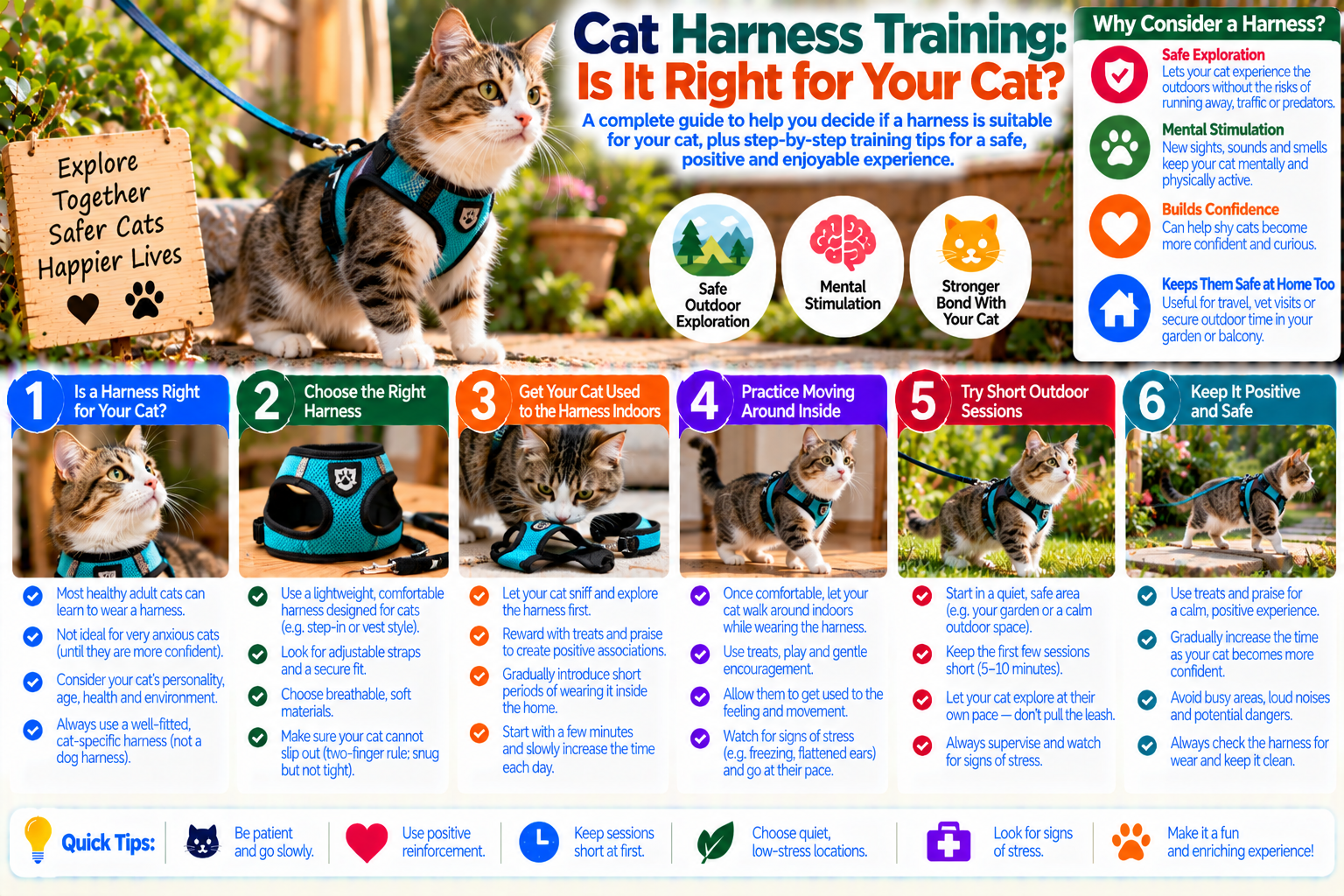
- Choose a cat-specific, well-fitting harness and follow the manufacturer’s fitting instructions.
- Let the cat investigate it without putting it on. Pair calm interest with a familiar reward.
- Progress to brief contact, then a very short wearing session only if your cat remains comfortable.
- Allow normal indoor movement before considering a lightweight lead under close supervision.
- Keep sessions short and remove the equipment afterward.
Never attach a lead to a neck collar, drag your cat, or tether them unattended. Secure doors and windows during early practice. Loose straps and trailing leads can catch on furniture, so supervision is essential even indoors.
| Option | Potential benefit | Key consideration |
|---|---|---|
| Indoor play and climbing | Choice within familiar territory | Match activity to mobility and preferences |
| Secure window viewing | Visual interest | Prevent falls and watch for frustration |
| Professionally planned enclosure | Protected outdoor exploration | Check construction, shade, escape gaps, and supervision needs |
| Harness use | Controlled access for a suitable individual | Stress and escape risk may outweigh benefits |
Do not treat the pavement as the next automatic step
Indoor comfort does not establish outdoor readiness. Dogs, engines, children, and sudden noises can change the situation instantly. If an appropriate professional supports outdoor practice, choose a quiet, secure setting with a familiar carrier available as a retreat, and keep the first exposure very brief.
Let your cat set the pace and direction within safe boundaries. A cat walk is not a dog-style distance target. If your cat shows distress, return safely to familiar surroundings and reassess.
A good outcome may be choosing another activity
Stopping harness training is not failure. The useful question is whether the cat’s life improves. Track voluntary participation and recovery afterward, rather than celebrating how long the equipment stayed on.
Try our indoor enrichment ideas and positive carrier routine for activities with direct everyday value.
Frequently asked questions
Why does my cat fall over in a harness?
Freezing or collapsing into a crouch can reflect discomfort or an unfamiliar sensation. Do not pull the cat upright or assume it is amusing; remove the equipment safely and reassess.
Can a cat escape a harness?
Yes. Fit and supervision reduce risk but cannot guarantee containment. A frightened cat may back out, twist, or slip free.
Does my indoor cat need walks?
Not necessarily. Many cats can have a rich life through suitable indoor resources, play, social choice, and secure viewing or enclosed outdoor opportunities.