
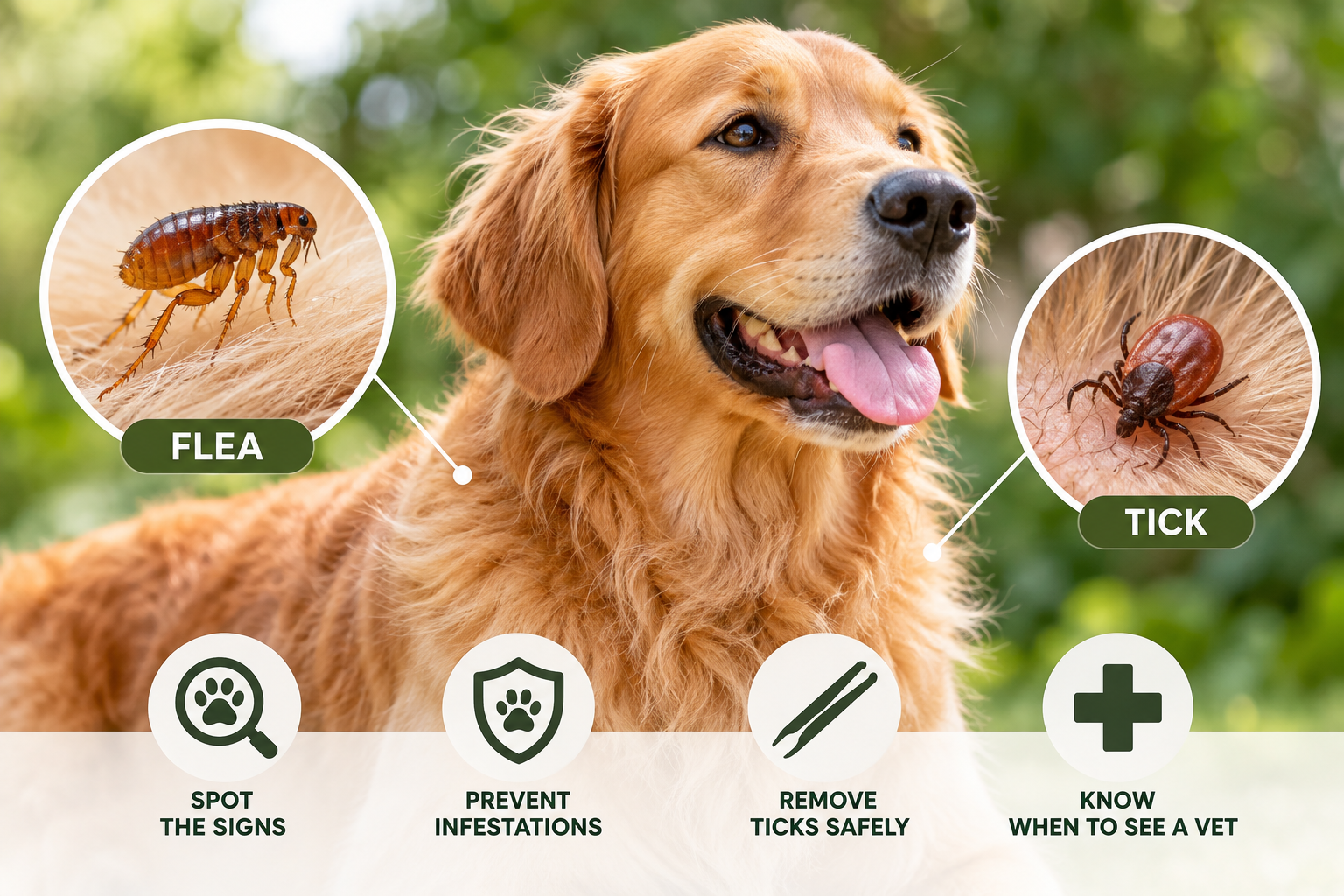

Fleas and ticks on dogs are more than an annoyance. These external parasites can cause itching, skin irritation and discomfort, and they may also contribute to more serious health problems. Fleas can trigger flea allergy dermatitis and heavy infestations can cause anemia, especially in young animals. Ticks can transmit several infectious diseases, depending on the tick species and where your dog lives.
The good news is that regular parasite prevention, routine coat checks and quick action when you find fleas or ticks can greatly reduce the risk of an infestation becoming a larger problem.
Fleas vs Ticks on Dogs: What Is the Difference?
Fleas and ticks are both external parasites, but they behave differently.
| Feature | Fleas | Ticks |
|---|---|---|
| What they are | Small, wingless insects that feed on blood. | Arachnids related to spiders and mites that attach to the skin and feed on blood. |
| Movement | Adult fleas move quickly through the coat and can jump. | Ticks crawl and then attach firmly to the skin to feed. |
| Common clue | Itching, flea dirt or moving fleas in the coat. | An attached tick felt or seen on the skin. |
| Main concerns | Skin irritation, flea allergy dermatitis, tapeworm transmission and anemia in severe infestations. | Skin irritation and transmission of tick-borne infections. |
| Home infestation | Yes. Eggs, larvae and pupae develop mainly away from the dog in the environment. | Most tick species are mainly acquired outdoors, although some species such as the brown dog tick can establish indoor infestations. |
Signs of Fleas on Dogs
Some dogs with fleas scratch constantly, while others show only subtle signs. A dog that is allergic to flea saliva may react intensely even when only a small number of fleas are present.
Possible signs include:
- Frequent scratching
- Biting or chewing at the skin
- Excessive licking
- Restlessness
- Red or irritated skin
- Small scabs or crusts
- Hair loss
- Skin irritation around the lower back, base of the tail and thighs
- Visible fleas moving through the coat
- Dark specks known as flea dirt
Dogs with flea allergy dermatitis can become extremely itchy and may develop secondary skin infections from repeated scratching and chewing.
What Does Flea Dirt Look Like?
Flea dirt is flea feces containing digested blood. It often appears as tiny reddish-black or dark brown specks in the coat.
You are most likely to notice it while parting the hair or using a flea comb, particularly around the lower back, tail base, belly and thighs.
Not finding fleas does not completely rule them out. Dogs that are very itchy may groom away many of the adult fleas before you see them.
Where Do Fleas Come From?
Adult fleas live and feed on an animal, but much of the flea life cycle takes place away from the pet.
Flea eggs deposited in the dog’s coat can fall into:
- Pet bedding
- Carpets
- Furniture
- Floor cracks
- Pet carriers
- Shaded outdoor resting areas
Those eggs can develop into larvae and then pupae before new adult fleas emerge and find a host.
This is why simply killing the adult fleas you can see on your dog may not immediately end an established infestation. New fleas can continue emerging from the environment for weeks.
Why Flea Infestations Can Take Time to Control
Flea infestations are frustrating because the adult fleas seen on a dog are only one part of the life cycle.
Eggs, larvae and pupae can remain in the places where pets sleep and spend time. Even when an effective preventive product is being used correctly, newly emerging fleas may continue appearing while the environmental stages complete their development.
For an established infestation, control can take several weeks and sometimes a few months.
Health Problems Fleas Can Cause in Dogs
Flea allergy dermatitis
Flea allergy dermatitis is an allergic reaction to flea saliva. Affected dogs can develop severe itching, redness, scabs, hair loss and irritated skin, commonly around the lower back and base of the tail.
Some dogs are so sensitive that only a small number of flea bites can trigger significant discomfort.
Skin infections
Repeated scratching, licking and chewing can damage the skin barrier. This may allow secondary bacterial or yeast infections to develop.
Anemia
Because fleas feed on blood, very heavy infestations can contribute to blood-loss anemia. Young puppies and other vulnerable dogs can be at greater risk.
Tapeworm transmission
Fleas also play an important role in the life cycle of Dipylidium caninum, a common tapeworm of dogs and cats.
A dog can become infected after swallowing an infected flea while grooming or chewing at itchy skin.
Signs of Ticks on Dogs
The clearest sign of a tick infestation is finding a tick attached to your dog’s skin.
An unfed tick can be small and flat. As it feeds on blood, its body can become larger and more rounded.
You may also notice:
- A small bump under the coat
- Localized redness or irritation
- Repeated licking or scratching at one area
- A small scab where a tick was attached
- An attached parasite that becomes larger over time
Long coats can make ticks difficult to see, so using your fingertips to slowly feel through the coat can help.
Where Should You Check a Dog for Ticks?
Check your dog carefully after walks, hikes, time in long grass or visits to wooded and brushy areas.
Pay particular attention to:
- In and around the ears
- Around the eyelids and face
- Under the collar
- Neck and shoulders
- Under the front legs
- Groin area
- Between the back legs
- Between the toes
- Around the tail
Run your hands slowly over the dog’s body and part the coat when you feel an unfamiliar lump.
How to Remove a Tick From a Dog Safely
An attached tick should be removed promptly.
If there are only one or a few ticks and you are comfortable removing them, use the following method:
- Wear gloves if possible. Avoid direct contact with the tick’s body or fluids.
- Use fine-tipped tweezers or a suitable tick-removal tool.
- Part your dog’s fur so you can clearly see where the tick enters the skin.
- Grasp the tick close to the skin. Try to hold it near the mouthparts rather than squeezing the swollen body.
- Pull with slow, steady pressure. Do not sharply twist or jerk the tick.
- Place the removed tick in a sealed container or otherwise dispose of it safely. Do not crush it with bare fingers.
- Clean the area and wash your hands.
- Check the rest of your dog carefully because more than one tick may be present.
If you cannot remove the tick safely, if it is located in a difficult area such as near the eye or deep in the ear, or if your dog becomes extremely distressed, contact your veterinarian.
What If Part of the Tick Appears to Stay in the Skin?
Occasionally, small mouthparts may remain in the skin after a tick is removed.
Do not aggressively dig into your dog’s skin trying to remove deeply embedded material. That can cause additional trauma.
If the area becomes increasingly swollen, painful, red or develops discharge, have your veterinarian examine it.
Can Ticks Make Dogs Sick?
Yes. Ticks can transmit infectious organisms while feeding. The diseases involved vary considerably by country, region and tick species.
Examples of tick-borne diseases affecting dogs in some parts of the world include:
- Lyme disease
- Ehrlichiosis
- Anaplasmosis
- Rocky Mountain spotted fever and related infections
- Other region-specific tick-borne diseases
Not every tick carries disease, and not every dog exposed to an infected tick becomes clinically ill. However, prompt removal and consistent prevention reduce risk.
Signs of Tick-Borne Illness to Watch For
Illness may not appear immediately after a tick bite. Depending on the organism involved, signs can develop days or weeks later.
Contact your veterinarian if your dog develops unexplained signs such as:
- Fever
- Unusual tiredness or weakness
- Reduced appetite
- Lameness or painful joints
- Swollen lymph nodes
- Unexplained bruising or bleeding
- Other significant changes in behaviour or health after tick exposure
Tell your veterinarian that you found a tick and, if you know it, when and where the exposure occurred.
What to Do If Your Dog Has Fleas
Finding fleas usually means thinking beyond the individual adult fleas you can see.
A practical flea-control plan normally includes several parts.
1. Use an appropriate flea-control product
Ask your veterinarian which product is appropriate for your dog’s age, weight, medical history, location and lifestyle.
Products may differ in how they work, how long they last and which parasites they control.
2. Treat all appropriate pets in the household
If one pet has fleas, other susceptible pets in the home may also be exposed.
Effective household flea control generally requires that every pet receives an appropriate species-specific parasite-control plan.
3. Address the environment
Because flea eggs, larvae and pupae develop away from the dog, cleaning the areas where pets spend time can help reduce the environmental flea population.
Useful measures can include:
- Washing pet bedding regularly
- Vacuuming carpets and rugs thoroughly
- Vacuuming sofas and upholstered furniture
- Cleaning under furniture
- Paying attention to floor cracks and crevices
- Cleaning pet resting and sleeping areas
Severe household infestations may require professional pest-management advice in addition to treating the pets.
4. Continue prevention consistently
Stopping parasite control as soon as the visible fleas disappear can allow the cycle to start again.
Follow your veterinarian’s advice and the product label for ongoing protection.
How to Prevent Fleas and Ticks on Dogs
Prevention is usually easier than controlling a large infestation.
A sensible prevention plan can include:
- Using a veterinarian-recommended flea and tick preventive
- Giving or applying products on the correct schedule
- Checking your dog for ticks after outdoor activity
- Regularly examining the coat for fleas and flea dirt
- Keeping pet bedding clean
- Vacuuming areas where pets rest
- Reducing heavy brush, leaf litter and tick-friendly habitat around the home where practical
- Keeping dogs away from heavily tick-infested areas when possible
- Reviewing parasite risks with your veterinarian when travelling
Parasite activity and disease risk vary by climate and geographical area. In many locations, veterinarians recommend consistent protection rather than waiting until parasites are visibly active.
Choosing a Flea and Tick Preventive
There are several types of flea and tick control products, including oral medications, topical products and some collars. The best choice depends on the individual dog.
Factors your veterinarian may consider include:
- Your dog’s age
- Body weight
- Health history
- History of neurological problems
- Parasites common in your area
- Swimming and bathing habits
- Other pets in the home
- Travel
- How easy it is for you to use the product correctly and consistently
Flea and Tick Products in Homes With Cats
Be especially careful if your household includes cats.
A parasite product labelled for dogs should never automatically be assumed to be safe for cats. Some ingredients and concentrations used in dog products can be dangerous to cats.
Keep packaging available, follow the label exactly and ask your veterinarian how to manage parasite prevention safely in a multi-pet household.
Fleas and Ticks on Puppies
Puppies require extra care because parasite products have minimum age and weight requirements that vary between products.
Do not use an adult dog’s medication on a puppy simply by guessing a smaller amount.
A heavy flea infestation can also be more concerning in a young puppy because significant blood loss can contribute to anemia.
If a young puppy has many fleas, pale gums, weakness, poor appetite or unusual tiredness, contact a veterinarian promptly.
Can Fleas and Ticks Affect People?
Fleas can bite people living in an infested environment. Pets can also carry ticks into the home, where a tick may later encounter a person.
This is another reason parasite control is not only about stopping your dog from scratching. Reducing flea and tick exposure can benefit the whole household.
When Should You Take Your Dog to the Vet?
Contact your veterinarian if:
- Your dog has severe or persistent itching
- The skin is raw, infected, swollen or painful
- Your dog has extensive hair loss or scabbing
- A puppy has a heavy flea infestation
- Your dog’s gums appear unusually pale
- Your dog is weak or unusually lethargic
- You find a very large number of ticks
- You cannot safely remove an attached tick
- A tick is attached near the eye or deep in the ear
- Your dog develops fever, poor appetite, lameness, weakness or other illness after a tick bite
- Your dog develops a reaction after receiving a parasite-control product
Common Flea and Tick Control Mistakes
Avoid these common problems:
- Waiting until you see large numbers of fleas before starting prevention
- Treating only one pet when several pets share the home
- Ignoring flea eggs and immature stages in the environment
- Stopping prevention as soon as visible fleas disappear
- Using a product intended for a different species
- Guessing doses
- Combining parasite products without veterinary advice
- Assuming every lump in the coat is a tick and pulling without looking carefully
- Crushing ticks with bare fingers
- Using heat or chemicals to try to make a tick detach
Flea and Tick Prevention as Part of Your Dog’s Health Care
Parasite prevention works best as part of a broader preventive health plan rather than as a response only when a problem becomes visible.
Your veterinarian can help you combine parasite control with routine examinations, vaccinations and other preventive care based on your dog’s individual risks.
For another part of your dog’s preventive health plan, read our Dog Vaccination Schedule: What Vaccines Does Your Dog Need? .
Frequently Asked Questions
How can I tell if my dog has fleas?
Look for frequent scratching, chewing, irritated skin, moving fleas or small dark specks of flea dirt. A flea comb can help you inspect the coat. Flea dirt placed on a damp white tissue may produce a reddish-brown stain because it contains digested blood.
Can a dog have fleas even if I cannot see any?
Yes. Fleas move quickly and dogs may remove some through grooming. Dogs with flea allergy can also react strongly even when relatively few fleas are present.
Where do fleas usually hide on dogs?
Fleas and flea dirt are often easier to find around the lower back, base of the tail, thighs, belly and other warm protected areas of the coat.
What is the safest way to remove a tick from a dog?
Use fine-tipped tweezers or a suitable tick-removal tool. Grasp the tick close to the skin and pull with slow, steady pressure. Avoid crushing, sharply twisting or jerking the tick.
Should I put petroleum jelly or heat on a tick?
No. Do not use petroleum jelly, heat, nail polish or similar methods to try to make an attached tick release. Remove it mechanically with an appropriate tool.
Why am I still seeing fleas after treating my dog?
An established infestation includes immature flea stages in the environment. New adult fleas may continue emerging even after treatment has begun, so complete control can take several weeks and sometimes longer.
Do I need to treat my home for fleas?
Cleaning the environment is important during an infestation because eggs, larvae and pupae develop away from the dog. Wash pet bedding and thoroughly vacuum areas where pets sleep and rest. Severe infestations may require additional professional pest-control advice.
Can fleas cause worms in dogs?
Fleas can carry the larval stage of the tapeworm Dipylidium caninum. Dogs can become infected if they swallow an infected flea while grooming.
Can ticks make a dog sick?
Yes. Depending on the region and tick species, ticks can transmit infections including Lyme disease, ehrlichiosis and anaplasmosis. Contact your veterinarian if your dog becomes ill after known tick exposure.
Should dogs use flea and tick prevention all year?
Parasite risk varies by location and climate, but veterinary parasite-control organisations commonly recommend consistent ongoing protection because fleas can persist indoors and some ticks may remain active whenever environmental conditions allow. Ask your veterinarian what schedule is appropriate where you live.
Can I use my dog’s flea treatment on my cat?
No. Never assume a dog flea or tick product is safe for a cat. Use only products specifically approved for the species and follow veterinary and label instructions.
The Bottom Line
Fleas and ticks on dogs are easier to manage when you act early and prevent them consistently.
For fleas, successful control usually means more than treating the adult fleas visible on your dog. Every appropriate pet in the household may need protection, and an established infestation also requires attention to the places where flea eggs, larvae and pupae develop.
For ticks, check your dog regularly, especially after outdoor activity, and remove attached ticks promptly with the correct technique.
Most importantly, choose parasite-control products according to your dog’s age, weight, health, lifestyle and local parasite risks rather than using a one-size-fits-all approach.
References and Further Reading
Companion Animal Parasite Council (CAPC)
Guidelines for flea prevention, tick prevention, parasite control and tick removal in dogs.
Merck Veterinary Manual
Veterinary guidance on fleas, flea allergy dermatitis, flea life cycles, ticks and tick-borne disease in dogs.
Centers for Disease Control and Prevention (CDC)
Guidance on checking pets for ticks, preventing tick exposure and safe tick-removal principles.
U.S. Food and Drug Administration (FDA)
Safety information for flea and tick medications, including isoxazoline-class products.


