
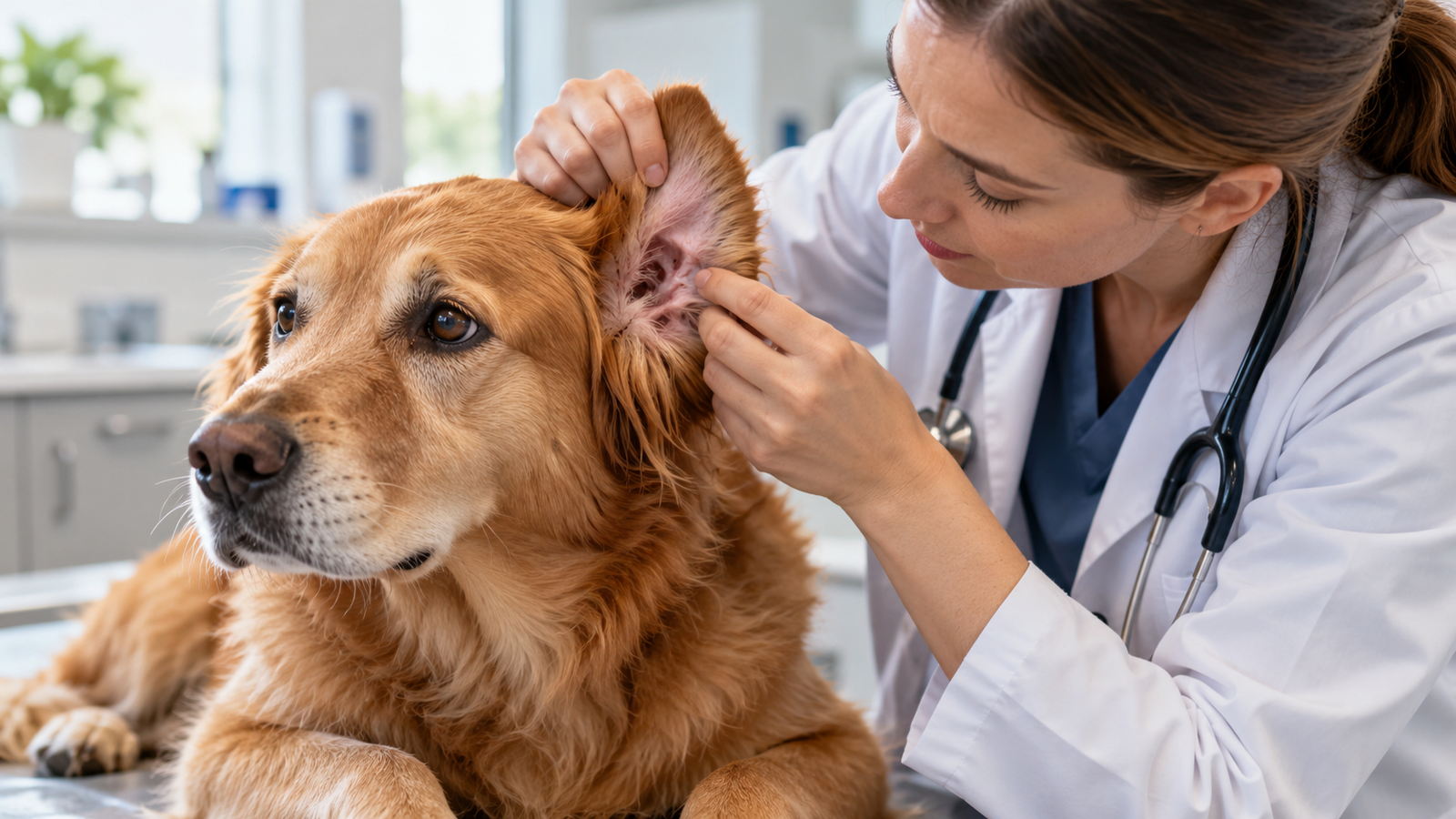

A dog ear infection can make an otherwise comfortable dog suddenly start scratching, shaking their head or avoiding having an ear touched. You may also notice redness, an unusual smell or discharge inside the ear.
Although people often use the term “ear infection” for any sore or inflamed ear, the problem is usually more complicated. Dogs can develop inflammation of the outer ear canal, known as otitis externa, because of allergies, parasites, foreign material or other underlying problems. Bacteria or yeast can then multiply in the changed ear environment and make the inflammation worse.
Signs of a Dog Ear Infection
Ear problems can affect one ear or both. Some dogs develop sudden symptoms, while others have infections that return repeatedly or continue for weeks.
Common signs include:
- Frequent head shaking
- Scratching or pawing at an ear
- Rubbing the head or ear against furniture or the floor
- Redness inside the ear
- Swelling of the ear canal
- An unpleasant or unusual odor
- Brown, yellow, black or pus-like discharge
- Excessive wax
- Crusting or irritated skin around the ear
- Pain when the ear or side of the head is touched
- Reluctance to have the ear examined
Some dogs become unusually quiet or irritable because ear inflammation can be painful.
What Is Otitis Externa?
Otitis externa means inflammation of the external ear canal. It is one of the most common ear problems in dogs.
The external ear canal runs from the visible opening of the ear down to the eardrum. When the canal becomes inflamed, it can become red, itchy, painful and swollen.
Inflammation also changes the environment inside the ear. This can allow organisms that normally live in small numbers on the skin, particularly certain bacteria and yeast, to multiply excessively.
That is why simply treating the organisms without finding the reason the ear became inflamed can lead to repeated infections.
What Causes Ear Infections in Dogs?
There is rarely one universal cause. Veterinarians often think about the problem in terms of an underlying trigger plus factors that allow inflammation or infection to continue.
| Possible Cause or Factor | How It Can Affect the Ear |
|---|---|
| Allergies | Environmental allergies and adverse reactions to food can cause inflammation of the skin lining the ear canal and contribute to recurrent infections. |
| Bacteria | Bacteria can multiply in an already inflamed or abnormal ear and contribute to discharge, odor, pain and inflammation. |
| Yeast | Yeast such as Malassezia may increase when conditions inside the ear change, contributing to itching, discharge and inflammation. |
| Ear mites | Mites can irritate the external ear canal and cause itching, inflammation and discharge. They are more common in cats but can also affect dogs. |
| Foreign bodies | Grass awns, plant material or other debris can become lodged in an ear and cause sudden, often one-sided irritation. |
| Moisture | Frequent swimming or moisture remaining inside susceptible ears can help create conditions that favour inflammation and microbial overgrowth. |
| Ear anatomy | Narrow canals, heavy hair growth or ear shape can contribute to poor ventilation or moisture retention in some dogs. |
| Underlying skin or hormonal disease | Some chronic skin disorders and endocrine conditions can contribute to recurrent ear problems. |
Allergies and Recurrent Dog Ear Infections
Allergies are particularly important when a dog repeatedly develops ear inflammation.
Environmental allergies and food-related allergic disease can affect the skin inside the ear canal just as they affect skin elsewhere on the body.
A dog with allergy-related ear disease may also have:
- Itchy paws
- Frequent paw licking
- Red skin
- Recurring skin infections
- Itching around the face or belly
- Seasonal flare-ups
For some dogs, recurring ear inflammation may be one of the earliest or most noticeable signs of allergic skin disease.
If ear infections keep returning after apparently successful treatment, finding the underlying trigger becomes especially important.
Yeast Ear Infections in Dogs
Yeast can normally be present in small amounts on canine skin. In an inflamed ear, however, the environment may allow yeast populations to increase significantly.
A yeast-associated ear problem can cause:
- Itching
- Head shaking
- Redness
- Wax or discharge
- An unpleasant odor
These signs are not specific enough to diagnose a yeast infection at home.
Veterinarians commonly use ear cytology to look at material from the ear under a microscope and determine whether yeast, bacteria or both are present.
Bacterial Ear Infections in Dogs
Bacteria can also multiply in an inflamed ear canal.
Different bacterial species can be involved, and chronic or previously treated infections can sometimes involve organisms that are harder to treat.
This is another reason not to reuse old antibiotic ear drops without veterinary advice. A medication that worked for a previous infection may not be appropriate for the current problem.
For recurrent, severe or difficult infections, a veterinarian may recommend additional testing such as bacterial culture and susceptibility testing.
Ear Mites in Dogs
Ear mites, particularly Otodectes cynotis, can live in the external ear canal and cause significant irritation.
Dogs with ear mites may show:
- Head shaking
- Persistent scratching
- Ear inflammation
- Dark wax or discharge
Ear mites can spread between animals through close contact.
However, dark discharge does not automatically mean ear mites. Yeast, bacteria and other ear disorders can produce similar-looking debris.
A veterinarian can examine ear material under a microscope or use an otoscope to look for mites.
Can Fleas Cause a Dog to Scratch Its Ears?
Fleas are not a typical direct cause of an infection deep inside the ear canal, but flea allergy and other itchy skin conditions can make a dog scratch around the ears and head.
If your dog is itchy in several areas rather than only inside the ear, check for broader skin and parasite problems too.
For more information, see our guide: Fleas and Ticks on Dogs: Signs, Prevention, and What to Do .
Can Swimming Cause Ear Infections in Dogs?
Swimming itself does not mean a dog will develop an ear infection. However, moisture remaining in a susceptible ear can contribute to conditions that allow inflammation and microbial overgrowth.
Dogs that swim frequently and dogs with a history of recurring ear problems may need a veterinarian-approved ear-care routine.
Do not automatically pour drying products or cleaners into every dog’s ears after swimming. The correct approach depends on the health of the ear and the condition of the eardrum.
Why Do Some Dogs Get Ear Infections Repeatedly?
A recurring dog ear infection is often a sign that the underlying problem has not been fully controlled.
Possible reasons include:
- Environmental or food-related allergies
- Chronic skin disease
- Persistent bacterial or yeast overgrowth
- An ear canal that has become thickened or narrowed
- Moisture and poor ventilation
- A foreign body
- Parasites
- Incomplete treatment
- Middle ear disease
- Less commonly, hormonal or other medical conditions
Repeatedly treating only the visible infection without addressing the underlying reason can result in another flare-up.
How Veterinarians Diagnose a Dog Ear Infection
A veterinary examination is useful because several ear conditions can look very similar from the outside.
Medical history
Your veterinarian may ask when the problem started, whether one or both ears are affected, whether your dog has had previous infections, whether symptoms are seasonal, whether your dog swims frequently and whether there are skin problems elsewhere.
Physical and skin examination
Because ear disease can be connected to wider skin disease or allergies, the veterinarian may examine the rest of your dog’s skin, paws and coat as well as the ears.
Otoscope examination
An otoscope allows the veterinarian to examine deeper into the ear canal.
This can help identify:
- Inflammation and swelling
- Excessive discharge
- Foreign material
- Growths or masses
- Ear mites in some cases
- The condition of the eardrum when it can be seen
If the ear is extremely painful or swollen, sedation may sometimes be required for a safe and thorough examination.
Ear cytology
Cytology is one of the most useful tests for ear infections.
A sample of material from the ear canal is examined under a microscope. This can reveal excessive yeast, different types of bacteria and inflammatory cells.
The results help the veterinarian select treatment that matches the actual problem rather than guessing from the colour or smell of the discharge.
Culture and additional testing
Some chronic, severe or treatment-resistant bacterial infections may require culture and susceptibility testing.
Dogs with repeated ear problems may also need further investigation for allergies, skin disease, hormonal disorders, foreign bodies or middle ear disease.
How Are Dog Ear Infections Treated?
Treatment depends on what is causing the inflammation and what the veterinarian finds during examination and testing.
There is no single ear drop that is appropriate for every dog ear infection.
Cleaning the ear
Excess wax and discharge can prevent medication from contacting the lining of the ear canal effectively.
Your veterinarian may clean the ear in the clinic or recommend an appropriate cleaner for use at home.
Very painful or severely affected ears sometimes require sedation for thorough cleaning.
Topical medication
Many prescription ear medications combine ingredients that treat inflammation with medication directed at bacteria, yeast or both.
The exact product should be selected according to the examination, cytology and the condition of the eardrum.
Pain and inflammation control
Ear disease can be painful. Anti-inflammatory or pain-relieving treatment may be needed, particularly when the ear canal is very swollen.
Treating the underlying cause
If allergies, parasites, foreign material or another underlying condition triggered the ear disease, that problem also needs to be managed.
Otherwise, the infection may improve temporarily and then return.
Why the Eardrum Matters Before Using Ear Drops
The eardrum separates the external ear canal from the middle ear.
Some cleaning agents or medications that may be suitable when the eardrum is intact can cause problems if the eardrum has ruptured.
For that reason, putting random cleaners or medications into a painful ear without knowing the condition of the eardrum is not a good idea.
How Long Does a Dog Ear Infection Take to Clear?
The answer depends on the cause and severity.
A straightforward outer ear infection may improve relatively quickly once appropriate treatment begins, but visible improvement does not always mean the infection has completely resolved.
Veterinary guidance commonly recommends rechecking bacterial or yeast ear infections until examination and repeat cytology confirm that the infection has cleared.
Some uncomplicated cases may require a few weeks of treatment and monitoring. Chronic disease can take much longer.
Should You Clean an Infected Dog’s Ear at Home?
Only follow a cleaning routine that is appropriate for your dog’s current ear problem.
For some infections, cleaning is an important part of treatment. In other situations, the ear may be too painful or inflamed for immediate home cleaning.
Your veterinarian can tell you:
- Which cleaner to use
- How much to use
- How often to clean
- Whether cleaning should occur before medication
- Whether cleaning should temporarily be avoided
How to Clean a Dog’s Ears When Your Vet Recommends It
If your veterinarian has confirmed that home cleaning is appropriate, follow the product instructions and your veterinarian’s technique.
A typical ear-cleaning process may involve:
- Have the veterinarian-approved cleaner and soft cotton or gauze ready.
- Gently lift the ear flap.
- Apply the recommended amount of cleaner into the ear canal.
- Massage the base of the ear gently if your veterinarian has instructed you to do so.
- Allow your dog to shake their head.
- Wipe away material that comes to the visible part of the ear.
- Do not force objects deeply into the canal.
What Should You Avoid Putting in a Dog’s Ear?
Avoid experimenting with home mixtures or medications unless your veterinarian has specifically approved them for your dog’s current condition.
This includes:
- Vinegar mixtures
- Hydrogen peroxide
- Rubbing alcohol
- Essential oils
- Human ear medications
- Leftover veterinary ear drops from an earlier infection
- Unlabelled products intended for another pet
An inflamed ear canal is sensitive, and irritating substances can worsen swelling and discomfort.
Should You Use Cotton Swabs in a Dog’s Ear?
Avoid pushing cotton swabs deeply into the ear canal.
They can push debris farther down the canal, irritate inflamed tissue or injure the ear if the dog suddenly moves.
If your veterinarian recommends home cleaning, soft cotton or gauze can be used to wipe material that has moved to the accessible outer part of the ear.
What Happens if a Dog Ear Infection Is Left Untreated?
Untreated or repeatedly recurring inflammation can become increasingly difficult to manage.
Chronic inflammation may cause the ear canal to become thickened and narrowed. In severe long-term disease, structural changes can make cleaning and delivery of medication difficult.
Disease may also involve the middle ear, especially in recurrent or persistent cases.
Early evaluation is therefore usually easier on both the dog and the owner than waiting until the ear becomes severely painful or chronically altered.
Outer, Middle and Inner Ear Infections: What Is the Difference?
Otitis externa
Otitis externa affects the external ear canal and is the most common type of canine ear inflammation.
Otitis media
Otitis media affects the middle ear behind the eardrum.
Possible signs can include persistent or recurrent outer ear disease, pain around the head or neck, discomfort when opening the mouth, reduced hearing or certain nerve-related changes.
Otitis interna
Otitis interna affects the inner ear and can interfere with balance.
Signs may include:
- Head tilt
- Loss of balance
- Falling or circling
- Abnormal rapid eye movements
- Difficulty walking normally
Can a Dog Ear Infection Cause Hearing Loss?
Severe swelling, debris and chronic inflammation can interfere with hearing.
Middle or inner ear disease can also affect hearing, and long-standing structural damage can sometimes have lasting effects.
If you notice a sudden change in your dog’s response to sound, mention it to your veterinarian.
How to Help Prevent Ear Infections in Dogs
Not every ear infection can be prevented, particularly when allergies or other underlying diseases are involved.
However, sensible ear care can help reduce avoidable problems.
- Check your dog’s ears regularly for redness, odor, unusual discharge or discomfort.
- Ask your veterinarian whether your dog actually needs routine ear cleaning.
- Use only an ear cleaner recommended for your dog.
- Follow a veterinarian-approved routine if your dog swims frequently.
- Keep ears appropriately dry after bathing or swimming.
- Address skin allergies rather than repeatedly treating only the ears.
- Use parasite prevention appropriate for your dog.
- Do not overclean healthy ears.
- Do not use cotton swabs deep in the ear canal.
- Have recurring ear problems investigated instead of repeatedly using leftover medication.
Do Floppy-Eared Dogs Get More Ear Infections?
Ear shape can contribute to the environment inside the ear canal, but having floppy ears does not automatically mean a dog will develop an infection.
Breed-related skin disease, allergies, ear canal anatomy, hair, moisture and other factors may all play a role.
The most useful approach is to monitor the individual dog rather than assuming that every floppy-eared dog needs frequent cleaning.
When Should You Take Your Dog to the Vet?
Arrange a veterinary examination if you notice:
- Persistent head shaking
- Frequent ear scratching
- Ear pain
- Redness or swelling
- Bad odor
- Brown, yellow, black or pus-like discharge
- Bleeding from the ear
- A suddenly painful problem affecting one ear
- Repeated ear infections
- Symptoms that return soon after treatment
- A suspected foreign body
- Significant hearing changes
Frequently Asked Questions
How do I know if my dog has an ear infection?
Common signs include head shaking, scratching, redness, odor, pain and ear discharge. Because several different problems can cause the same signs, a veterinary examination is the best way to determine what is actually happening.
What causes dog ear infections?
Common underlying causes and contributing factors include allergies, ear mites, foreign material, moisture and some skin or hormonal disorders. Bacteria and yeast often multiply after inflammation has changed the environment inside the ear.
Are dog ear infections caused by bacteria or yeast?
Either can be involved, and some ears contain both. A veterinarian can examine a sample of ear material under a microscope to help identify what is present.
What does a yeast infection in a dog’s ear look like?
A yeast-associated ear problem may cause redness, itching, wax, discharge and odor, but these signs overlap with bacterial infections and other ear conditions. Appearance alone is not a reliable diagnosis.
Can a dog’s ear infection go away on its own?
It is not a good idea to wait for a painful or clearly inflamed ear to resolve on its own. The underlying cause may remain, and untreated inflammation can become chronic or more difficult to manage.
Can I use human ear drops on my dog?
Do not use human ear medication unless a veterinarian specifically instructs you to do so. The correct product depends on the cause of the problem and the condition of the dog’s eardrum.
Can I clean my dog’s infected ear with vinegar?
Avoid homemade vinegar solutions in an inflamed ear unless your veterinarian specifically recommends one. Irritating home remedies can worsen inflammation and discomfort.
Why does my dog’s ear infection keep coming back?
Recurring infections often indicate an underlying problem such as allergy, chronic skin disease, ear anatomy, persistent microorganisms, a foreign body or middle ear involvement. Identifying the underlying cause is important for long-term control.
How long does a dog ear infection take to heal?
Treatment time varies. Some uncomplicated outer ear infections may resolve over a few weeks, while chronic or complicated disease can take much longer. Veterinary rechecks help confirm that the infection has truly cleared.
Can swimming cause a dog ear infection?
Moisture after swimming can contribute to ear problems in susceptible dogs, but swimming is usually only one factor. Dogs with recurring problems should have an individual ear-care plan from their veterinarian.
Are ear mites common in dogs?
Ear mites can affect dogs, although they are more commonly associated with cats. A veterinarian can confirm mites by examining the ear and looking at ear material under magnification.
Can allergies cause ear infections in dogs?
Yes. Allergic skin disease is an important underlying cause of recurrent ear inflammation in dogs. Treating only the secondary infection without addressing the allergy can allow the problem to return.
The Bottom Line
A dog ear infection should be treated as more than a problem of wax, smell or discharge.
Head shaking, scratching, redness and odor tell you that something is wrong, but they do not identify the cause. Allergies, mites, foreign bodies and other conditions can start the inflammation, while bacteria and yeast can develop as secondary problems.
The most effective approach is to have the ear examined, identify what is present with tests such as cytology when needed, treat the infection and inflammation appropriately, and investigate the underlying cause if infections keep returning.
Avoid experimenting with home remedies or leftover ear medication, especially when the condition of the eardrum is unknown.
References and Further Reading
Merck Veterinary Manual
Otitis Externa in Animals — veterinary guidance on causes, examination, ear cytology, treatment and recurrent ear disease.
Merck Veterinary Manual
Ear Infections and Otitis Externa in Dogs — pet-owner guidance on symptoms, diagnosis, treatment and prevention.
Merck Veterinary Manual
Otitis Media and Interna in Animals — veterinary guidance on middle and inner ear disease and neurological warning signs.
Companion Animal Parasite Council (CAPC)
Otodectic Mite guidance — information on ear mites in dogs and cats, diagnosis and parasite control.


