
A dog who drags you down the street turns a pleasant walk into an arm workout. It’s one of the most common complaints owners have, and it’s rarely because the dog is being stubborn or trying to be in charge. Dogs pull because pulling works: it gets them to the next smell faster.
You can stop a dog pulling on the leash without harsh tools. Reward-based training teaches your dog that staying close, with a loose leash, is what gets them where they want to go.
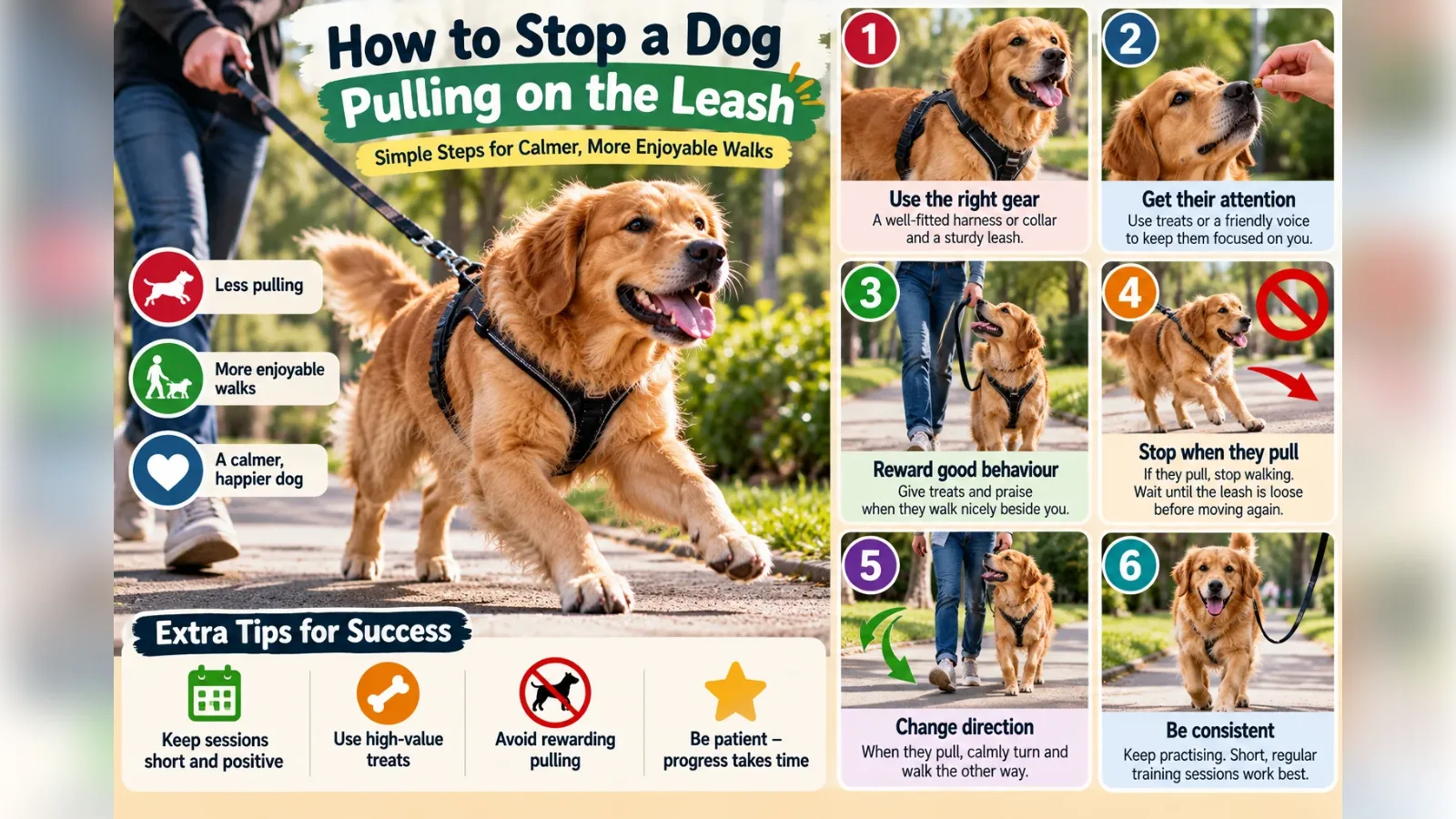
Quick answer: to stop a dog pulling on the leash, reward them often for walking beside you, stop moving the moment the leash goes tight and only move on when it’s slack again. Practice in quiet places first, use a well-fitted harness, and skip choke, prong and shock collars, which work through pain and carry real risks.
Why dogs pull
From a dog’s point of view, people walk painfully slowly. There’s grass to sniff, other dogs to meet and a park up ahead. Dogs also have a natural tendency to lean into pressure, so when a collar tightens, many push forward harder rather than backing off.
Most importantly, pulling usually gets rewarded. Every time a dog strains toward a lamppost and the owner follows, the dog learns that a tight leash means progress. Training is about changing that equation so a loose leash pays better.
Set yourself up before the first session
A few things make training far easier:
- Small, tasty treats. You’ll be handing out a lot of them at first, so use tiny pieces and take them from your dog’s daily food allowance.
- A standard leash. A fixed-length leash of about 6 feet (roughly 2 meters) gives your dog some room while keeping you in control.
- A tired-ish dog. A few minutes of play in the yard or house before training helps an energetic dog focus.
- A quiet place. Start indoors, in the yard or on a calm street, not on the busy route to the dog park.
Teaching loose leash walking
Think of this as three skills layered on top of each other: liking the spot beside you, moving together, and handling distractions.
Make your side a great place to be
Stand still with your dog on the leash. The moment they look at you or come to your side, mark it with a “yes” and give a treat right next to your leg. Repeat until your dog is hanging around that spot on purpose. It often helps to practice this off leash inside the house first, then clip the leash on once your dog has the idea.
Add movement, a few steps at a time
Take a step or two. If your dog stays close and the leash stays loose, reward at your side. Gradually add more steps between treats. You can add a cheerful cue such as “Let’s go” as you set off, so your dog knows walking time has started.
What to do the moment the leash goes tight
Stop. Stand still and quiet, without jerking the leash or repeating commands, and wait. When your dog turns back or steps toward you and the leash slackens, praise and move forward again. If your dog is too fixated to turn around, walk a few steps in the opposite direction, then reward when they catch up beside you.
This is the part that takes consistency. If the leash sometimes gets your dog forward when it’s tight, they’ll keep testing it. Every tight leash needs to mean “we stop.”
Build up to real-world distractions
Once your dog does well in quiet places, practice somewhere a bit busier. You can also set up a distraction on purpose, such as a toy on the ground. If your dog pulls toward it, stop. When they walk calmly toward it on a loose leash, let them have it. Real-life rewards work the same way: a chance to sniff a favorite patch of grass is a great prize for a few steps of nice walking.
Equipment that helps (and what to avoid)
No piece of gear teaches loose leash walking on its own, but the right equipment makes walks safer and more comfortable while you train.
| Equipment | Good for | Things to know |
|---|---|---|
| Flat collar | Dogs that walk nicely already | Pulling puts pressure on the neck. Switch if your dog coughs or gags on walks. |
| Y-shaped harness | Most dogs, especially while training | Choose one that doesn’t sit across the front of the shoulders so the legs move freely. |
| Front-clip harness | Strong pullers | The chest attachment turns the dog slightly toward you when they pull. Some dogs still pull. |
| Head halter | Large, strong dogs, sometimes on professional advice | Needs slow, positive introduction. Attach a second leash to a harness as backup and never jerk it. |
Safety note: choke chains, prong collars and electronic (shock) collars stop pulling by causing pain or discomfort. They can injure the neck and can make dogs fearful or reactive, linking other dogs and people with pain. The American Veterinary Society of Animal Behavior advises that reward-based methods be used for all dog training and that these tools not be used.
Retractable leashes are also a poor choice for a puller. The dog feels constant tension, which teaches that pulling extends the walk, and the thin cord can cause burns and cuts if it wraps around a hand or leg.
Keep sessions short and expectations realistic
Several short sessions a day, even five minutes each, tend to work better than one long, frustrating walk. Loose leash walking is hard for dogs, and progress often wobbles in exciting places.
Life doesn’t always leave time for training. If you need to get somewhere fast, some trainers suggest using a different harness or attachment point for those walks, so the “training” setup always means loose leash rules. Expect this to slow progress a little.
When it’s more than pulling
Some dogs pull and then bark, lunge or spin at the end of the leash when they see other dogs, people or traffic. That’s usually driven by fear, frustration or excitement, and it needs a different approach from basic loose leash training. A qualified reward-based trainer or veterinary behaviorist can help. It’s also worth a vet check if your dog suddenly starts pulling, stopping or refusing to walk, as pain can change how a dog moves.
Starting with a puppy? Short leash sessions slot neatly into their first outings, and there are ideas for keeping those outings positive in our piece on early puppy socialization.
Still deciding what to clip the leash to? Our comparison of dog collars and harnesses explains the pros and cons of each.
Frequently asked questions
How long does it take to stop a dog pulling on the leash?
There’s no set timeline. It depends on the dog, how long they’ve been pulling and how consistent the training is. Some dogs improve quickly with daily practice, while others take much longer, and busy places are usually the last to click.
Is a harness or collar better for a dog that pulls?
A well-fitted harness is usually the more comfortable choice for a dog that pulls, because it spreads pressure across the chest instead of the neck. A front-clip harness can give extra help with strong pullers.
Do no-pull harnesses fix pulling on their own?
No. They can reduce pulling and make walks easier while you train, but your dog still needs to learn that a loose leash is what gets them forward.
Should I jerk the leash when my dog pulls?
No. Leash corrections can hurt your dog’s neck and can create fear or frustration on walks. Stopping still until the leash goes slack, then rewarding, teaches the same lesson without pain.