
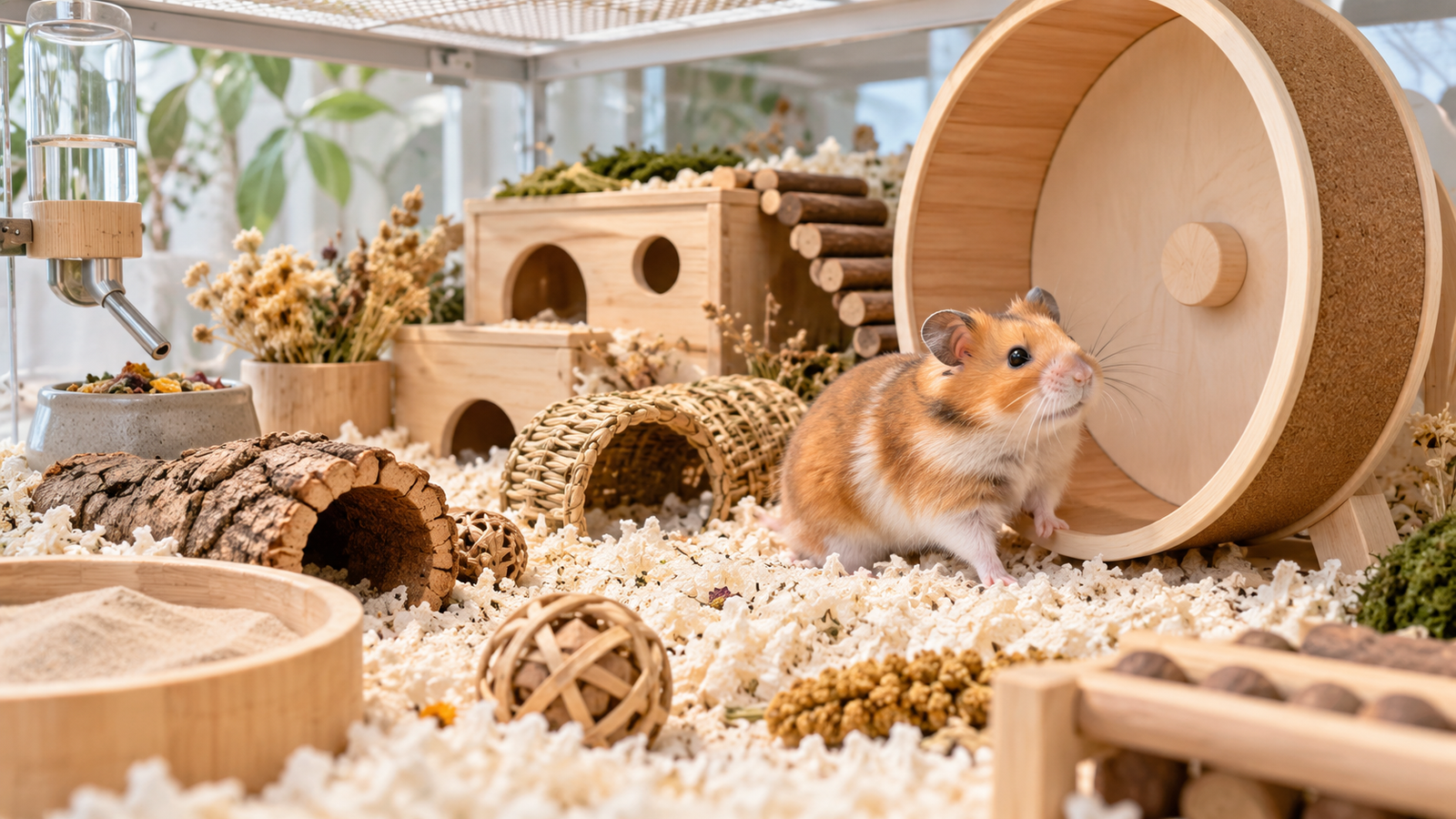

Many cages sold for hamsters are bright, compact and full of tubes, and many of them are far too small. A hamster may look tiny, but it is an energetic, nighttime animal that would naturally cover a lot of ground and dig its own burrows. The home you choose decides whether it can do either.
Choosing a hamster cage and wheel comes down to a few measurements that matter a lot: floor space, bedding depth, bar spacing and wheel diameter. Get those right and the rest (hides, chews, sand baths) is easy to add.
In short: look for at least 100 x 50 cm (about 40 x 20 in) of unbroken floor space, with a base deep enough for around 20–25 cm (8–10 in) of bedding. Choose a solid-surface wheel of at least 20 cm (8 in) for dwarf hamsters or 30 cm (12 in) for Syrians, large enough that your hamster runs with a flat back. Skip small, tube-based multi-level cages and dusty, scented or fluffy bedding.
Floor space comes first
When comparing cages, the number to check is the floor area of the base, not the height or the number of levels. Hamsters live and travel on the ground. Wild hamsters travel widely at night in search of food, and a pet hamster still has that drive to roam.
The PDSA points to a minimum of 100 x 50 cm (roughly 40 x 20 in) of floor space, a figure that comes from a German veterinary animal welfare association. Blue Cross recommends the same minimum floor size. Treat it as a starting point, not a target. Bigger is better, and it applies to dwarf hamsters as much as Syrians. Small hamsters are just as active, and often faster.
Measure the inside of the base, and make sure the space is one continuous area rather than several small rooms joined together. Height matters less, but a cage around 50 cm (20 in) tall gives room for a large wheel and some climbing without creating dangerous drops.
Why small multi-level tube cages fall short
Cages built from colorful pods connected by plastic tubes, or tall cages stacked with shelves, are designed to look fun to people. For hamsters, they tend to cause more problems than they solve:
- Too little ground area. Adding levels does not make up for a small base, because each platform is too small to run, dig or forage properly.
- No room to burrow. Shallow trays cannot hold enough bedding for a hamster to dig tunnels.
- Falls. Hamsters do not see well, so high shelves, ledges and ladders lead to tumbles.
- Poor airflow. Enclosed tubes and pods can trap stale, humid air and are hard to clean.
- Tricky climbs. Steep vertical tubes can be difficult for small dwarf hamsters to manage.
Low platforms can add useful space in a large enclosure. Keep them close to the floor, deep in bedding, and use them as extras rather than the main living area.
Depth for bedding and burrows
Hamsters are burrowers. Given the chance, they dig tunnels and chambers where they sleep, stash food and feel safe. That means the base of the enclosure needs to be deep, not just wide.
Guidance from UK welfare organizations ranges from at least 20 cm (8 in) to around 25 cm (10 in) of bedding in the deepest part. You do not have to fill the whole enclosure to that depth, but at least one generous area should be deep enough for tunnels that hold their shape. A deep base also stops bedding from being kicked out every night.
Comparing common enclosure types
| Type | Good points | Watch out for |
|---|---|---|
| Large glass tank | Holds very deep bedding, escape-resistant, easy to watch your hamster | Heavy; needs a secure, well-ventilated mesh lid |
| Wire-top cage with a deep plastic base | Good airflow, lighter to move | Base is often too shallow for proper burrowing; bar spacing must be narrow |
| Large wooden enclosure with a front viewing panel | Plenty of space and depth | Wood must be sealed or protected so urine does not soak in; check ventilation |
| Small tube or multi-pod cage | Compact and cheap | Too small, shallow and hard to clean for everyday living |
Bar spacing
If you choose a cage with bars or mesh, the gaps should be under 1 cm (less than about 0.4 in). Hamsters, and dwarf hamsters especially, can squeeze through surprisingly narrow spaces, and a hamster that gets its head stuck can injure itself. Some hamsters also chew bars persistently, which is often a sign that the space is too small or too boring.
Choosing a wheel
A wheel is not optional for a pet hamster. It gives a caged animal an outlet for the running it would naturally do at night. But a wheel that is the wrong size or style can do more harm than good.
Size and the straight back rule
The PDSA suggests a wheel of at least 20 cm (8 in) across for dwarf hamsters and at least 30 cm (12 in) for Syrians. Some other welfare groups give slightly different ranges by species, and larger individual hamsters may need more.
The simplest test is to watch your hamster run. Its back should stay flat and level, like a hamster running along the ground. In a wheel that is too small, the curve of the running surface forces the spine to bend upward with every stride. Hamsters can run for long stretches every night, so that repeated arching can put strain on the back over time. If your hamster’s back curves or its head tips upward as it runs, the wheel is too small.
Running surface and setup
- Solid surface only. Wheels with bars, rungs or slats can trap feet and legs and lead to injuries.
- Stable mounting. Set a free-standing wheel on a firm base, or into the bedding so it cannot tip or wobble.
- Smooth and quiet. A wheel that runs freely without catching is safer, and kinder on your sleep too.
Bedding that suits a hamster home
Choose soft, low-dust, unscented bedding such as paper-based bedding, and offer plain hay or shredded paper for nest building. Avoid:
- Pine or cedar shavings, whose aromatic oils can irritate the airways
- Dusty sawdust
- Fluffy, cotton-wool style or kapok nesting material, which can tangle around legs or cause blockages if eaten
- Scented bedding of any kind
Place the enclosure in a quiet room away from loud noise, drafts and direct sunlight, ideally at a steady 64–70°F (18–21°C).
Deep bedding also changes your cleaning routine, since a full clean-out every week would flatten the burrows. Here’s how often to clean a hamster cage and what to spot clean in between.
Frequently asked questions
What size cage does a hamster need?
A floor space of at least 100 x 50 cm (about 40 x 20 in) is widely recommended as a minimum, for both Syrian and dwarf hamsters. Bigger is better, and the base should be deep enough for around 20 to 25 cm of bedding.
What size wheel does a Syrian hamster need?
At least 30 cm (12 in) in diameter, with a solid running surface. The key test is that your hamster’s back stays straight while it runs. If it arches, the wheel is too small.
Are glass tanks good for hamsters?
A large glass tank can work very well, because it holds deep bedding and is hard to escape from. It needs a secure mesh lid for ventilation and should be placed away from direct sunlight so it does not overheat.
Why is my hamster chewing the cage bars?
Bar chewing is often a sign that a hamster has too little space, bedding or enrichment. Check the cage size, add deeper bedding and more to explore, and make sure the wheel is big enough.