
Learning how to choose cat litter is less about finding the product with the most impressive packaging and more about finding a substrate your cat is comfortable standing, digging and eliminating in every day.
For many cats, a good starting choice is a fine-textured, unscented clumping litter. However, individual preferences vary, and some cats prefer a different material or texture.
Clay, paper, wood, silica crystal and plant-based litters all have different practical advantages and disadvantages. The right choice depends on your cat’s preference, age, mobility, paw comfort, household needs and how easily you can keep the litter box clean.
How to Choose Cat Litter at a Glance
| Litter Feature | What to Consider | Who It May Suit |
|---|---|---|
| Fine unscented clumping litter | Soft texture, easy daily scooping and good urine-clump removal | A strong starting choice for many healthy adult cats |
| Non-clumping litter | Urine is absorbed rather than forming removable clumps | Cats already comfortable with it or households with specific preferences |
| Paper litter | Often available as soft pieces or pellets; usually lightweight | May suit certain cats when a veterinarian recommends a softer or different substrate |
| Wood or pellet litter | Larger, firmer pieces; texture and smell differ greatly from sand-like litter | Cats that clearly prefer it, although some dislike coarse pellets |
| Silica crystal litter | Highly absorbent granules with different textures depending on the product | Cats comfortable walking and digging in the crystals |
| Plant-based litter | May use corn, wheat, grass, wood or other plant materials | Owners wanting alternative materials when their cat accepts the texture |
| Scented litter | Added fragrance can be strong from a cat’s perspective | Generally not the first choice when an unscented version is available |
| Low-dust litter | Produces less airborne dust during pouring, digging and scooping | Useful when either the cat or household benefits from reduced dust |
What Type of Cat Litter Do Most Cats Prefer?
Research and feline veterinary guidance generally point toward:
- Fine texture
- Sand-like particles
- Unscented litter
- Clumping material
- A clean litter box
Fine-textured litter is comfortable under the paws and makes normal digging and burying easier for many cats.
However, this is a population-level preference rather than an absolute rule.
Your individual cat may prefer:
- A coarser texture
- A particular material
- A different litter depth
- The litter it used as a kitten
Once you find a substrate that your cat uses comfortably and consistently, avoid unnecessary changes.
Why Litter Texture Matters
Cats do much more than stand briefly in a litter box.
They may:
- Walk across the substrate
- Turn around
- Dig before eliminating
- Balance while urinating or defecating
- Dig again afterward
- Bury waste
A texture that feels unpleasant beneath the paws can discourage normal litter-box behavior.
Fine vs Coarse Cat Litter
Fine litter feels more like sand and is generally preferred by many cats.
Coarse substrates include some:
- Wood pellets
- Paper pellets
- Large crystals
- Other chunky litter materials
Some cats use these without difficulty.
Others may:
- Stand partly outside the box
- Balance on the edge
- Dig less
- Enter and leave quickly
- Search for another place to eliminate
These behaviors can suggest that the substrate deserves another look.
Clumping vs Non-Clumping Cat Litter
One of the main choices is whether the litter forms solid clumps around urine.
Both types absorb moisture, but they are maintained differently.
What Is Clumping Cat Litter?
Clumping litter binds together when exposed to urine.
That allows you to remove:
- Urine clumps
- Feces
while leaving the cleaner surrounding litter in the box.
This makes daily spot cleaning straightforward.
Advantages of Clumping Cat Litter
Potential benefits include:
- Easy urine removal
- Easy daily scooping
- Better ability to identify urine clumps
- Less need to discard all litter after every urination
- Fine texture in many products
The ability to observe urine clumps can also help owners notice major changes in urination patterns.
What Is Non-Clumping Cat Litter?
Non-clumping litter absorbs urine without forming a solid scoopable mass.
Feces can still be removed individually, but urine gradually spreads through the substrate.
As a result, the litter often needs more frequent complete replacement depending on:
- The product
- Number of cats
- Box size
- How heavily the box is used
Is Clumping or Non-Clumping Litter Better?
For many cats, unscented clumping litter is an excellent starting choice.
However, the better option is ultimately the one that:
- Your cat willingly uses
- Feels comfortable beneath the paws
- Allows normal digging
- Can be kept clean consistently
Do not change a cat that uses its current litter perfectly well simply because another product is advertised as superior.
Clay Cat Litter
Clay remains one of the most common cat-litter materials.
Clay products may be:
- Clumping
- Non-clumping
- Fine-textured
- Coarser
- Scented or unscented
Therefore, “clay litter” does not describe one single type of product.
Advantages of Clay Litter
Depending on the formulation, advantages may include:
- Fine sand-like texture
- Strong clumping ability
- Easy availability
- Easy scooping
- Familiarity for many cats
Possible Drawbacks of Clay Litter
These vary by product but may include:
- Dust
- Tracking outside the box
- Heavy bags
- Added fragrances in some products
Choosing an unscented, lower-dust formulation can address some of these concerns.
Paper Cat Litter
Paper litter is commonly made from recycled paper and may come as:
- Pellets
- Soft granules
- Other absorbent forms
It can be useful in certain situations, but the texture differs considerably between products.
When Might Paper Litter Be Useful?
A veterinarian may sometimes recommend a particular paper product or another softer substrate for a cat recovering from certain paw injuries or procedures.
However, not every paper pellet will feel soft to every cat.
Observe how the individual cat walks and digs in it.
Wood and Pellet Cat Litter
Wood-based litter may contain:
- Compressed pellets
- Wood fibers
- Other processed wood material
These products can differ widely in:
- Particle size
- Smell
- Absorbency
- Clumping ability
- Texture
Do Cats Like Wood Pellet Litter?
Some do.
Others strongly prefer a finer substrate.
Feline veterinary guidelines note that some wood and recycled-paper pellet litters have a noticeable smell and that coarse pellets may be uncomfortable for some cats, particularly those with degenerative joint disease or painful paws.
If your cat comfortably uses pellets, there is no need to change simply because another cat prefers sand-like litter.
Silica Crystal Cat Litter
Silica crystal litter contains highly absorbent particles designed to absorb moisture.
Different products use different crystal sizes.
Potential practical advantages can include:
- Strong moisture absorption
- Relatively light weight
- Less frequent complete replacement with some products
Do Cats Like Crystal Litter?
Some cats use it without hesitation.
Others dislike:
- The larger particle size
- The feeling under the paws
- The sound the crystals make while digging
If changing from fine litter to crystals, introduce the new texture gradually rather than assuming immediate acceptance.
Plant-Based Cat Litter
Plant-based litters can be manufactured from materials such as:
- Corn
- Wheat
- Grass
- Wood
- Other plant fibers
Some are clumping, while others are not.
The fact that a litter is plant-based does not automatically tell you whether your cat will like it.
Evaluate:
- Particle texture
- Scent
- Dust
- Clumping
- Tracking
- Your cat’s actual behavior
Natural Does Not Automatically Mean Better
The word “natural” is mainly a product description.
From your cat’s perspective, the more useful questions are:
- Is it comfortable?
- Can I dig in it?
- Does it smell strange?
- Is the box clean?
Choose according to function and preference rather than a single marketing term.
Scented vs Unscented Cat Litter
Unscented litter is generally the better starting choice.
Cats have a much more sensitive sense of smell than people.
A perfume that seems mild or pleasant to you may be intense to your cat.
Why Scented Litter Can Be a Problem
Added fragrances may interfere with the cat’s normal sensory experience around an important resource.
Some cats may avoid:
- Scented litter
- Litter deodorizing powders
- Strong cleaning products
- Air fresheners placed beside the litter box
Good odor management should come primarily from cleaning rather than perfume.
Does Unscented Mean Odorless?
No.
“Unscented” generally means the product does not have fragrance added specifically to perfume the litter.
The raw material may still have its own natural smell.
Wood litter, for example, may smell noticeably different from clay even without added fragrance.
What About Litter Deodorizers?
Deodorizing powders and strongly fragranced additives are usually unnecessary when the box is maintained properly.
They can also alter the litter’s texture and smell.
Instead:
- Scoop waste daily
- Replace litter when needed
- Wash the box appropriately
- Provide enough litter boxes
How Important Is Dust?
Litter dust varies significantly between products.
Dust may become airborne when:
- Pouring fresh litter
- The cat digs
- The owner scoops
- The litter becomes broken down with use
If dust is a problem in your household, consider trying a lower-dust product that your cat still finds comfortable.
“Dust-Free” Does Not Always Mean Zero Dust
Marketing terms can vary.
Even products described as low dust or dust free may create a small amount of fine material during use.
Observe the product in your actual home rather than relying only on the label.
What Is Cat Litter Tracking?
Tracking occurs when pieces of litter leave the box on the cat’s paws or coat.
Small lightweight particles can sometimes travel farther through the home.
Long-haired cats may also carry litter in the fur around their paws.
How to Reduce Litter Tracking
You can try:
- A litter-catching mat
- A larger litter box
- A high-sided box with an accessible entrance
- A litter with slightly different particle characteristics
- Regular vacuuming around the box
Do not solve tracking by switching immediately to a coarse litter your cat dislikes.
Feline comfort is more important than eliminating every grain from the floor.
How Deep Should Cat Litter Be?
Cats need enough substrate to dig and bury waste.
Feline house-soiling guidelines recommend a sand-like clumping litter at a depth of at least around 3 cm (1.25 inches) as a practical starting point.
However, individual preferences vary.
Some cats prefer slightly deeper litter, while others prefer less.
More Litter Is Not Always Better
Filling the box with an extremely deep layer can:
- Feel unstable beneath the paws
- Make the surface move excessively
- Increase waste
Start with a reasonable depth and observe how your cat uses it.
Can Cats Prefer Different Litter Depths?
Yes.
Cats can have preferences for both:
- Litter material
- Litter depth
If you suspect a depth preference, you can test different amounts in otherwise identical boxes.
How to Find Out Which Litter Your Cat Prefers
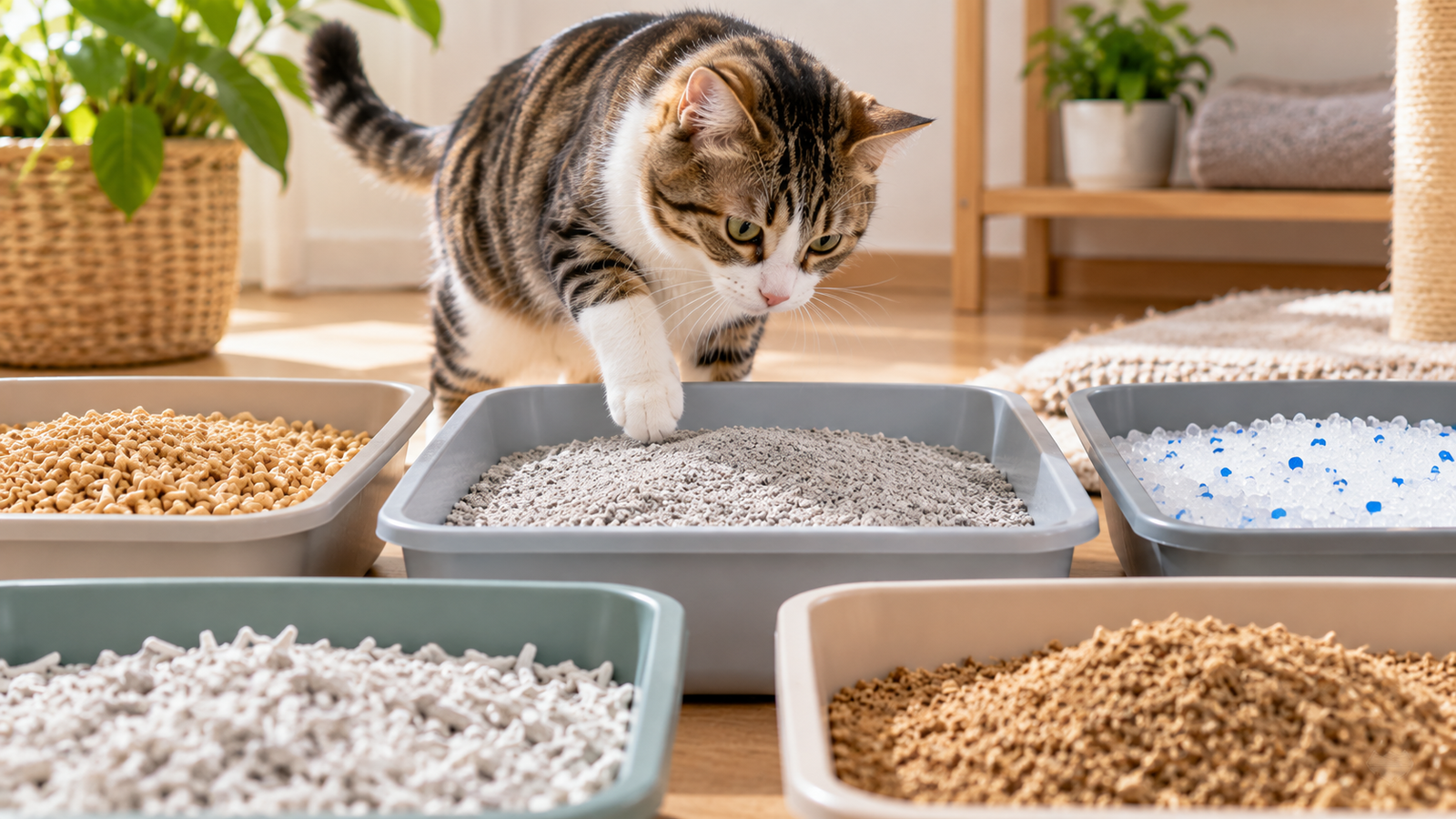
Instead of repeatedly guessing, conduct a simple litter preference test.
Place two or more similar litter boxes beside or near each other temporarily.
Keep everything the same except the litter.
A Simple Litter Preference Test
- Use boxes of similar size and design.
- Place them in the same general environment.
- Put a different litter in each box.
- Use a similar depth in each.
- Keep all boxes equally clean.
- Observe which substrate your cat consistently uses.
This gives the cat an opportunity to express a preference.
Signs Your Cat May Dislike Its Litter
Possible clues include:
- Standing on the edge of the box
- Keeping some paws outside
- Entering and leaving quickly
- Minimal digging
- Not burying waste when the cat previously did
- Shaking the paws after leaving
- Choosing another substrate elsewhere
However, none of these signs proves litter aversion on its own.
Do Not Assume Every Litter-Box Problem Is About the Litter
A cat may avoid the box because of:
- Medical disease
- A dirty box
- An unsuitable location
- A box that is too small
- Difficulty entering the box
- Conflict with another cat
- Fear around the box
- Previous painful urination or defecation
The litter is only one part of the toileting environment.
How to Change Cat Litter Without Causing Problems
If your cat already uses one type successfully, avoid abrupt changes unless there is a compelling reason.
Cats often prefer familiarity.
A gradual transition gives the cat time to investigate the new smell and texture.
Gradual Litter Change Method
One approach is to gradually increase the new litter while decreasing the old litter.
For example:
- Begin mostly with the familiar litter.
- Add a small amount of the new litter.
- Increase the new material gradually over several changes.
- Watch the cat’s litter-box behavior.
If your cat begins avoiding the box, slow the transition.
An Even Better Option: Give the Cat a Choice
If space allows, provide:
- One box with the old litter
- One similar box with the new litter
Your cat’s behavior may quickly reveal which substrate it prefers.
Do Not Change the Box and Litter at the Same Time
Replacing:
- The litter
- The box
- The location
all at once creates several changes together.
If the cat stops using the box, it becomes difficult to identify the problem.
Whenever practical, make changes one at a time.
What Is the Best Cat Litter for Kittens?
For kittens, familiarity and ease of use are important.
Current AAHA/AAFP feline life-stage guidance recommends beginning with:
- Unscented clumping sand-like litter
- And/or the litter the kitten was already using
Kittens can also be offered appropriate alternatives in separate boxes to learn their individual preferences.
Do Kittens Need Non-Clumping Litter?
You may see blanket advice online claiming that every kitten must use non-clumping litter.
Professional feline life-stage guidance does not make that universal recommendation. It specifically lists unscented clumping sand litter as an appropriate starting option for kittens.
However, kittens investigate their environment and individual circumstances vary.
Make the Litter Box Easy for a Kitten to Enter
For very young kittens, box accessibility may matter just as much as litter type.
Choose a box with:
- A low entrance
- Enough room to turn
- Easy access from the kitten’s main living area
For broader kitten guidance, read: Common Health Problems in Kittens .
What Is the Best Cat Litter for Senior Cats?
Senior cats often benefit from a soft, comfortable substrate that is easy to stand and turn on.
This becomes especially important if the cat has:
- Arthritis
- Paw pain
- Reduced balance
- Mobility problems
A fine, soft litter may be more comfortable than large hard pellets for some older cats.
Arthritis Can Change Litter Preferences
A cat that used one litter for years may develop a different preference when standing and digging become uncomfortable.
You may notice:
- Less digging
- Standing near the entrance
- Leaving quickly
- Toileting just beside the box
Also check the box itself.
A low entrance may be necessary for a cat with painful joints.
For broader age-related guidance, read: Common Health Problems in Senior Cats .
What Is the Best Litter for Cats With Sensitive Paws?
When paw contact is uncomfortable, softer fine-grained litter may be easier to tolerate.
Cats with painful paws may dislike:
- Large pellets
- Coarse crystals
- Hard irregular particles
If paw sensitivity is new, investigate why the paws hurt rather than treating litter choice as the only problem.
What About Cats Recovering From Paw Surgery or Injury?
Your veterinarian may recommend a particular substrate during healing.
The advice may depend on:
- Type of procedure
- Location of the wound
- Risk of contamination
- Bandaging
- Individual comfort
Follow the veterinary plan rather than choosing based only on general litter preferences.
What Is the Best Litter for a Declawed Cat?
Cats that have undergone declawing can experience paw sensitivity or chronic discomfort.
A soft, fine substrate may be more comfortable for some individuals than coarse pellets or large crystals.
If a declawed cat develops new litter-box avoidance, limping, reluctance to jump or other signs of discomfort, seek veterinary evaluation rather than simply trying multiple litters indefinitely.
Cat Litter for Multi-Cat Homes
A product labeled “multi-cat” is not automatically better for a household with several cats.
The more important factors are:
- Do the cats like the substrate?
- Are there enough litter boxes?
- Are the boxes separated appropriately?
- Are they scooped frequently?
- Can every cat access them without being blocked?
Do All Cats in the Home Need the Same Litter?
Not necessarily.
One cat may prefer a different substrate from another.
If space allows, providing several litter-box options can accommodate individual preferences.
This can be especially useful when one cat is:
- Older
- Arthritic
- Paw-sensitive
- Recovering from illness
How Many Litter Boxes Do Multiple Cats Need?
Litter type cannot compensate for too few toileting areas.
A commonly used starting guideline is:
One litter box per cat plus one additional box.
For two cats, that usually means three boxes.
For the full setup guide, read: How Many Litter Boxes Do Cats Need? A Simple Guide .
How Often Should You Scoop Cat Litter?
Scoop waste at least daily.
Some heavily used boxes may need scooping more frequently.
Remove:
- Feces
- Urine clumps when using clumping litter
Then top up clean litter when needed to maintain a suitable depth.
Why Cleanliness Matters More Than Perfume
No litter can permanently hide the smell of a dirty box.
Odor control should depend primarily on:
- Frequent scooping
- Enough boxes
- Regular full cleaning
- Appropriate litter replacement
Fragrance does not remove urine or feces.
How Often Should You Completely Change Cat Litter?
There is no single schedule for every litter.
The frequency depends on:
- Clumping vs non-clumping material
- Manufacturer instructions
- Number of cats
- Box size
- How frequently you scoop
- Whether odor or residue remains
Clumping litter often allows clean substrate to stay in the box longer because urine clumps can be removed individually.
Non-clumping litter usually requires more frequent complete replacement.
How Should You Clean the Litter Box?
When a full cleaning is needed:
- Empty the used litter.
- Wash the box.
- Rinse thoroughly.
- Dry it.
- Add clean litter.
Avoid leaving strong chemical smells behind.
Avoid Strong-Smelling Cleaners
Cats use scent extensively to evaluate their environment.
A box that smells heavily of perfume, disinfectant or ammonia-like chemicals may become less attractive.
Use mild cleaning methods and rinse thoroughly.
Do You Need a Litter-Box Liner?
Usually not.
Plastic liners may:
- Catch on claws
- Move while the cat digs
- Create an unfamiliar texture
Feline house-soiling guidance generally recommends avoiding liners when possible.
Should You Use a Litter Mat?
A litter mat outside the box can help collect tracked material.
Choose one that:
- Feels comfortable beneath the paws
- Does not slide
- Is easy to clean
- Does not create a barrier to entering the box
Some cats dislike rough or spiky mats and may hesitate to cross them.
Can You Flush Cat Litter Down the Toilet?
Do not assume a litter is safe to flush simply because it is marketed as biodegradable or plant-based.
Plumbing systems and local wastewater rules vary.
Cat feces may also contain infectious organisms.
Unless both the product instructions and local wastewater guidance clearly support flushing, disposal with household waste is usually the simpler option.
Cat Litter and Pregnancy
Cat feces can contain Toxoplasma gondii, the parasite responsible for toxoplasmosis.
Pregnant people and individuals with weakened immune systems should follow medical advice regarding litter-box handling.
When possible, another household member can manage litter-box cleaning.
If that is not possible, appropriate hygiene and gloves can reduce exposure risk.
Does Cat Litter Control Allergens?
Changing litter will not remove the primary proteins responsible for cat allergy.
However, a very dusty litter may create additional airborne particles in the litter-box area.
A lower-dust product may therefore be more comfortable for some households.
Does Cat Litter Expire?
Unused litter can often remain stable for a long time when stored correctly, but follow the manufacturer’s storage guidance.
Keep litter:
- Dry
- Protected from moisture
- Away from contamination
- In its original packaging or a suitable container
Moisture can affect clumping and absorbency.
Why Did My Cat Suddenly Stop Using Its Usual Litter?
A sudden change does not necessarily mean the litter has become unacceptable.
Possible reasons include:
- Painful urination
- Constipation
- Diarrhea
- Arthritis
- Stress
- Conflict with another cat
- A dirty box
- A new box location
- A different litter formula
Check Whether the Manufacturer Changed the Product
Sometimes packaging looks nearly identical even when the product has changed.
If litter-box avoidance begins after opening a new bag, compare:
- Particle size
- Fragrance
- Color
- Texture
- Packaging information
Your cat may notice a formulation change that seems subtle to you.
Litter-Box Avoidance Can Be a Medical Sign
Seek veterinary care when you notice:
- Repeated straining
- Frequent trips to the litter box
- Crying while urinating
- Blood in the urine
- Very small urine amounts
- No visible urine despite repeated attempts
- Sudden urination outside the box
Male Cats and Urinary Obstruction
Changing litter is not an appropriate response to a suspected urinary blockage.
For more information about inappropriate urination, read: Cat Peeing Outside the Litter Box .
What if Your Cat Poops Outside the Box?
Defecating outside the litter box can also have several causes.
Possibilities include:
- Litter aversion
- Constipation
- Diarrhea
- Pain
- A box that is too small
- Difficulty entering
- Stress
Persistent changes deserve investigation.
What if Your Cat Stops Digging?
Some cats naturally bury waste less than others.
However, a sudden change in digging can suggest:
- Paw discomfort
- Arthritis
- An unpleasant litter texture
- A dirty substrate
Look at the entire situation rather than assuming one cause.
What if Your Cat Perches on the Edge of the Box?
A cat balancing with only one or two feet inside may be trying to reduce contact with the litter.
Possible reasons include:
- Substrate aversion
- Dirty litter
- A box that is too small
- Paw discomfort
Try to identify which factor has changed.
Choosing Cat Litter for an Automatic Litter Box
Automatic litter boxes usually require specific litter characteristics.
Before choosing litter, check the manufacturer’s instructions regarding:
- Clumping ability
- Particle size
- Maximum litter depth
- Materials that should not be used
Using an incompatible litter can interfere with the machine.
Automatic Cleaning Does Not Replace Observation
One advantage of manual scooping is that you see the cat’s urine and feces every day.
If you use an automatic system, continue monitoring:
- How often your cat visits
- Whether urine output changes
- Stool consistency
- Whether the cat begins avoiding the machine
Changes in elimination can provide important health information.
Should You Choose Litter Based on Odor Control?
Odor control matters, but it should not come at the expense of feline acceptance.
A heavily scented litter may seem effective to a person while discouraging the cat from using it.
Better odor control comes from:
- Daily scooping
- Removing urine clumps completely
- Enough litter boxes
- Regular cleaning
- Good ventilation
Should You Choose Litter Based on Price?
Cost is a legitimate household consideration.
However, compare:
- Price per bag
- How quickly the litter is used
- How often complete replacement is needed
- How well the cat accepts it
A cheap litter that your cat refuses to use is not economical.
Should You Buy Litter in Bulk?
Bulk purchasing can reduce cost once you know your cat accepts the product.
Avoid buying a huge supply of an unfamiliar litter before testing it.
First buy enough for a preference trial.
A Practical Cat Litter Buying Checklist
Before choosing a new litter, ask:
- Is it unscented?
- Is the texture comfortable and relatively fine?
- Does my cat already have a known litter preference?
- Does it clump well enough for easy daily cleaning?
- How dusty is it?
- How much does it track?
- Is it comfortable for my cat’s age and mobility?
- Can I keep it clean consistently?
- Will it work with my litter-box design?
- Is it compatible with an automatic box if I use one?
- Can I afford to use it consistently?
Best Starting Setup for Most Cats
If you have no information about your cat’s preference, a reasonable starting setup is:
- A large accessible litter box
- Fine-textured litter
- Unscented litter
- Clumping litter
- Enough depth for normal digging and burying
- No deodorizing powder
- No strongly scented cleaner nearby
Then let your cat’s behavior guide any adjustments.
Common Cat Litter Mistakes
- Choosing litter mainly because it smells pleasant to people
- Using strong deodorizing powders
- Changing litter suddenly when the cat already likes the old one
- Assuming “natural” automatically means better
- Choosing very coarse pellets without considering paw comfort
- Ignoring excessive dust
- Switching the box, litter and location at the same time
- Using too little litter for normal digging
- Filling the box excessively deep
- Failing to scoop every day
- Expecting fragrance to compensate for a dirty box
- Ignoring litter tracking until it becomes frustrating
- Assuming every kitten must use the same substrate
- Ignoring changing needs in senior cats
- Ignoring a cat that balances on the edge of the box
- Assuming house-soiling is spite or revenge
- Changing litter instead of seeking care for urinary straining
- Expecting one litter type to suit every cat in a multi-cat home
Frequently Asked Questions
What type of cat litter is best?
For many cats, a fine-textured, unscented clumping litter is a good starting choice. Individual preferences vary, so your cat’s actual behavior should guide the final decision.
Do cats prefer clumping or non-clumping litter?
Feline veterinary guidance generally reports a preference for clumping litter, particularly fine sand-like unscented products. However, individual cats can prefer other substrates.
Do cats prefer scented or unscented litter?
Unscented litter is generally preferred. Strong fragrances and deodorizing products can be unpleasant to cats because their sense of smell is highly sensitive.
What texture of litter do cats prefer?
Many cats prefer fine, sand-like material that is comfortable beneath the paws and easy to dig in.
Is clay litter good for cats?
Clay litter can work very well, particularly when it is fine-textured, unscented and easy to keep clean. Products vary in dust, particle size and clumping performance.
Is wood pellet litter good for cats?
Some cats use wood pellets comfortably, while others dislike the coarse texture or smell. Cats with painful paws or arthritis may particularly prefer a softer substrate.
Is paper litter good for cats?
Paper litter can be suitable for some cats and may be recommended in certain medical situations. However, paper products vary from soft granules to relatively firm pellets, so individual preference matters.
Is crystal cat litter good?
Silica crystal litter is highly absorbent and can work well for cats that accept its texture. Some cats prefer finer material and may dislike large or coarse crystals.
Is plant-based cat litter better?
Not automatically. Plant-based products can be excellent when they provide a comfortable texture, manageable dust and good cleaning characteristics, but the cat’s preference remains important.
How deep should cat litter be?
A practical starting point is at least around 3 cm or 1.25 inches of litter, with enough material for normal digging and burying. Some cats prefer a different depth.
How often should cat litter be scooped?
Remove feces and urine clumps at least once each day. Heavily used boxes may need more frequent scooping.
How often should I completely replace cat litter?
It depends on whether the litter clumps, the product instructions, number of cats, box size and how frequently you scoop. Non-clumping litter usually requires more frequent complete replacement.
Should kittens use clumping litter?
Current AAHA/AAFP feline life-stage guidance lists unscented clumping sand litter and/or the kitten’s previously familiar litter as appropriate starting options. Monitor young kittens and seek veterinary advice if a kitten repeatedly eats litter.
What litter is best for senior cats?
Many senior cats benefit from a soft, fine substrate that is comfortable beneath the paws. Cats with arthritis also need an easily accessible litter box with a low entrance.
What cat litter is best for arthritis?
A soft, fine litter may be more comfortable than large hard pellets for some cats with painful joints or paws. Box accessibility is equally important.
What is low-dust cat litter?
Low-dust litter is formulated to create less airborne fine material during pouring, digging and scooping. Actual dust levels vary between products.
How can I stop litter tracking?
Try a comfortable litter mat, larger or higher-sided box and regular cleaning around the litter area. You can also test another litter texture, but do not sacrifice your cat’s comfort solely to reduce tracking.
Should I change litter brands?
If your cat reliably uses the current litter and the product works well, there may be no reason to change. When a change is necessary, introduce the new litter gradually or offer both options temporarily.
How can I tell if my cat dislikes its litter?
Possible clues include balancing on the box edge, minimizing paw contact, digging less, leaving quickly or consistently choosing another substrate. Medical and environmental causes should also be considered.
Why is my cat suddenly peeing outside the litter box?
Possible causes include urinary disease, pain, stress, litter aversion, box location, cleanliness or conflict with another cat. A sudden urinary change should receive veterinary attention rather than being assumed to be behavioral.
Is straining in the litter box an emergency?
Repeated straining with little or no urine can indicate urinary obstruction, particularly in male cats. This requires immediate veterinary care.
Can two cats prefer different litters?
Yes. Individual preferences vary. In multi-cat homes, several litter boxes can allow cats to choose between substrates when needed.
The Bottom Line
Choosing cat litter should begin with the cat rather than the advertising on the bag.
For many cats, a fine-textured, unscented clumping litter provides a strong starting point. It feels comfortable beneath the paws, allows digging and burying and makes urine and feces easy to remove during daily scooping.
However, individual preference matters. Some cats comfortably use paper, wood, crystal or plant-based products, while others strongly prefer a soft sand-like texture.
Avoid assuming that scented litter provides better hygiene. Strong fragrance can discourage some cats, while regular scooping and appropriate box cleaning provide much more reliable odor control.
Consider age and mobility too. Kittens need an accessible setup and a familiar, comfortable substrate. Senior or arthritic cats may prefer fine litter rather than coarse pellets and often benefit from a low-entry box.
When changing litter, do it gradually or provide a choice between the old and new substrate. Changing several features at once makes it difficult to understand what your cat prefers.
If your cat begins balancing on the box edge, reducing digging or toileting elsewhere, investigate the litter—but do not stop there. Box size, location, cleanliness, intercat tension, pain and medical disease can produce similar changes.
Most importantly, never assume sudden litter-box problems are simply bad behavior. Straining, frequent attempts to urinate, blood in the urine or production of little to no urine requires veterinary attention, and urinary obstruction is an emergency.
References and Further Reading
2021 AAHA/AAFP Feline Life Stage Guidelines
Litter preferences throughout feline life stages, unscented clumping litter, kitten litter selection, individual preference testing, litter-box accessibility and medical causes of house-soiling.
AAFP/ISFM Guidelines for Diagnosing and Solving House-Soiling Behavior in Cats
Fine sand-like unscented clumping litter, substrate depth, litter preference testing, scented litter avoidance, box maintenance and signs of substrate aversion.
2022 ISFM/AAFP Cat Friendly Veterinary Environment Guidelines
Feline preference for unscented clumping litter, adequate substrate depth, individual litter preference and potential discomfort associated with some coarse pellet litters in cats with degenerative joint disease.
AAFP/ISFM Feline Environmental Needs Guidelines
Importance of toileting resources, feline scent sensitivity, avoiding strongly scented products and providing an environment that respects individual feline preferences.
The Ohio State University College of Veterinary Medicine — Indoor Pet Initiative
Litter substrate selection, preference for fine-grained unscented litter, daily scooping, odor management and maintaining a positive litter-box experience.