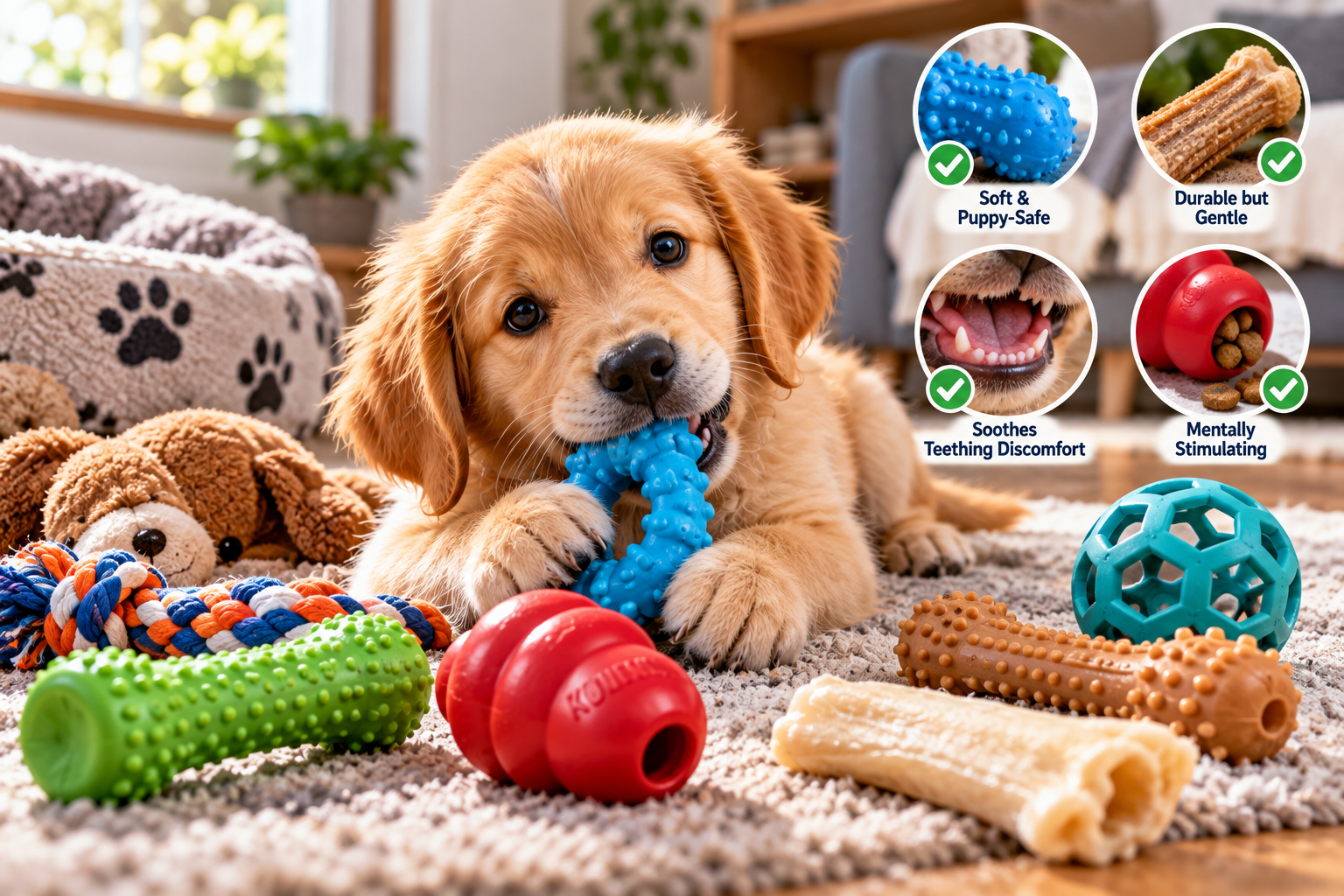

Puppies explore with their mouths, and teething can make chewing especially appealing. A suitable toy offers something better than shoes or hands. Size, texture and supervision matter more than a bright package.
Match size and strength
Choose a toy too large to swallow but comfortable to carry. Check the manufacturer’s age and size guidance. A toy that crumbles, breaks into sharp pieces or loses small parts should be removed immediately.
Inspect the chew after play
A toy that suited your puppy last week may be worn or too small now. Inspect it after every session.
| What you notice | Try this | Check next |
|---|---|---|
| Toy sheds pieces | Remove it immediately | No swallowed fragments |
| Puppy bites hands during play | Pause and redirect to an appropriate toy | Calmer play and breaks |
Offer different safe textures
Some puppies like a flexible rubber chew; others prefer a softer toy for supervised play. Rotate a small number so they stay interesting. Avoid chews so hard that they might damage teeth, and ask your veterinarian about suitable options for your puppy.
Redirect gently
When teeth find a sleeve or chair leg, pause play and offer an appropriate toy. Praise the puppy for taking it. Do not punish or physically force the mouth open. Short rest periods can help an overtired puppy that becomes increasingly mouthy.
Supervise and inspect
Watch the first sessions with any new chew. Remove torn fabric, stuffing, loose squeakers and pieces small enough to ingest. Keep the puppy’s bed as a calm resting place and provide normal walks, play and training alongside chewing opportunities.
Our puppy mouthing guide covers the behavior behind the biting. Blue Cross discusses chew choices and supervision here: Blue Cross guide.
Inspect after every session
Look for loose pieces, sharp edges and material your puppy can swallow. Offer a few textures and rotate them rather than handing over every toy at once. If biting people is the bigger issue, our puppy biting guide covers training and redirection.
A simple toy inspection
After play, turn the toy over in your hands. Look for a seam opening, a loose squeaker, small pieces or edges that have become sharp. A toy can change quickly as a puppy grows stronger, so the first safe session is not a lifetime guarantee.
Offer an appropriate chew before your puppy begins mouthing furniture or hands, then reward the choice to use it. If a piece is missing and you think it may have been swallowed, contact your veterinarian.
Frequently asked questions
Should a puppy toy be very hard?
Avoid items that feel hard enough to risk tooth damage. Ask your veterinarian about a suitable choice for your puppy.
When should I replace a toy?
Replace it when it develops cracks, loose pieces or sharp edges.