
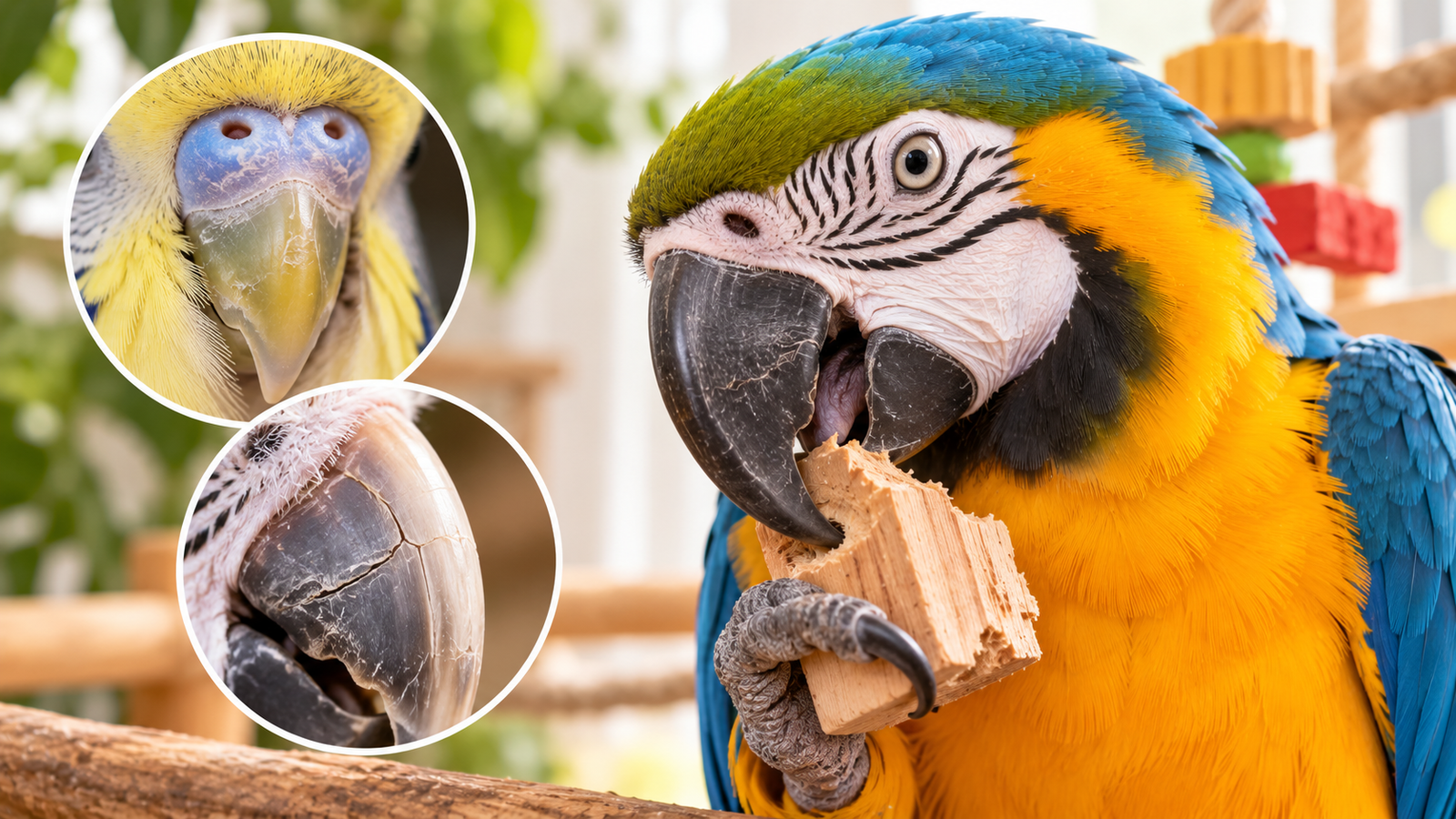

A bird’s beak is much more than a tool for eating. Birds use it to climb, preen, investigate objects, manipulate food, play, communicate and defend themselves.
The beak also grows continuously. In a healthy bird, normal eating, chewing, climbing and beak-wiping usually keep that growth balanced with natural wear.
This means most healthy pet birds do not need routine beak trimming.
Changes in beak length, shape, texture, color or symmetry deserve attention because an overgrown or abnormal beak can sometimes signal an underlying health problem rather than simply a lack of chewing.
What Is a Bird’s Beak Made Of?
The visible outer surface of the beak is primarily a tough keratin covering over deeper living structures.
Keratin is also found in:
- Feathers
- Nails
- Claws
However, the beak is not simply a dead piece of horn.
Deeper tissues contain:
- Blood vessels
- Nerves
- Bone
- Living tissue responsible for growth
This is why a damaged or improperly trimmed beak can bleed and be painful.
Upper Beak vs Lower Beak
The bird’s beak has an upper and lower portion.
The upper beak is often called the upper mandible or maxillary beak, while the lower portion is the lower mandible.
The exact shape differs dramatically between species.
For example:
- Budgies have compact curved beaks
- Cockatiels have strong hooked beaks
- Large parrots have powerful curved beaks for climbing and manipulating food
- Finches have shorter seed-adapted beaks
- Other species may have very different shapes based on natural feeding behavior
Therefore, there is no single beak shape that should be used as the standard for every pet bird.
What Is the Cere?
In many parrots, particularly budgies, the fleshy area surrounding the nostrils above the upper beak is called the cere.
The cere is not simply an extension of the hard beak surface.
Changes around the cere can still be important because conditions such as scaly-face mites may affect the:
- Cere
- Edges of the beak
- Skin around the eyes
- Legs and feet
What Should a Healthy Bird Beak Look Like?
Healthy appearance varies by species, age and individual bird.
In general, look for a beak that:
- Maintains a consistent shape
- Has appropriate upper and lower alignment
- Allows normal eating
- Allows normal preening
- Does not grow excessively long
- Has no deep cracks or wounds
- Has no heavy crusting
- Has no active bleeding
A healthy beak should also remain functional rather than merely looking cosmetically perfect.
Bird Beak Care: Normal vs Concerning Changes
| Often Normal | Needs Closer Attention |
|---|---|
| Beak wiping after eating | Rapid beak overgrowth |
| Gentle beak grinding | Major change in shape |
| Normal chewing and rubbing | Upper and lower beak no longer aligning |
| Minor superficial keratin flaking in some birds | Deep splitting or cracking |
| Species-appropriate coloration | New unexplained discoloration |
| Stable beak length | Repeated need for professional shortening |
| Normal hard surface | Soft, crumbly or severely pitted areas |
| Clean cere and surrounding skin | White honeycomb-like crusts around the cere or beak |
| Normal eating | Dropping food or difficulty eating |
Do Bird Beaks Keep Growing?
Yes.
The beak grows continuously.
In a healthy bird, growth is normally balanced by wear from everyday activities such as:
- Eating
- Chewing
- Climbing
- Playing
- Beak wiping
- Grinding the upper and lower beak together
That is why a healthy bird normally maintains a relatively stable beak length without regular trimming.
What Is Beak Wiping?
After eating, you may see a bird rub the sides of its beak against a perch or another safe surface.
This is called beak wiping.
It can help:
- Remove food residue
- Clean the beak surface
- Contribute to normal wear
Beak wiping is usually a normal behavior.
Why Does My Bird Grind Its Beak?
Birds may rub or grind their upper and lower beak together.
This movement contributes to normal surface wear, particularly of the lower beak.
Some birds also make gentle grinding sounds during quiet periods.
Grinding by itself is generally different from repeatedly rubbing the beak because of:
- Pain
- Crusting
- An injury
- A foreign object
Look at the whole bird rather than interpreting one behavior alone.
Is Bird Beak Peeling Normal?
Some parrots develop mild superficial layering or flaking as the outer keratin surface naturally wears.
Small thin flakes can be less concerning when:
- The underlying beak remains hard
- The beak shape remains normal
- The bird is eating normally
- There is no bleeding
- There is no heavy crusting
- The surrounding skin and cere look healthy
The key word is superficial.
When Beak Flaking Is Not Normal
Arrange veterinary assessment when flaking is accompanied by:
- Deep cracks
- Large pieces breaking away
- Pitting
- Soft areas
- Heavy crusts
- Abnormal growth
- Color changes
- Bleeding
- Changes around the cere
- Difficulty eating
Do not peel loose layers from the beak yourself.
Should You Pick Flakes Off a Bird’s Beak?
No.
Do not pull, scrape or peel keratin layers from the beak.
A piece that looks loose may still be attached to deeper tissue.
Allow ordinary chewing and normal wear to manage superficial keratin unless an avian veterinarian identifies a problem.
What Causes an Overgrown Bird Beak?
An overgrown beak is often more than a grooming issue.
Veterinary references identify possible causes including:
- Liver disease
- Nutritional problems
- Scaly-face mites
- Fungal disease affecting the beak
- Previous trauma
- Abnormal alignment
- Other underlying disease
- Some tumors affecting the beak
This is why simply trimming the beak without investigating the cause may miss an important medical problem.
Liver Disease and Beak Overgrowth
Abnormal beak and nail overgrowth can occur in birds with liver disease.
Liver disease may also cause other signs, depending on the underlying condition.
Possible accompanying changes can include:
- Reduced appetite
- Weight change
- Weakness
- Changes in droppings
- Changes in feather quality
These signs are not specific to liver disease, so diagnosis requires veterinary examination and testing.
Nutrition and Beak Health
A nutritionally inadequate diet can contribute to poor overall health and abnormal keratin structures.
Merck notes that overgrown beaks can be associated with poor nutrition as well as disease.
A balanced species-appropriate diet supports:
- Beak tissue
- Feathers
- Skin
- Nails
- Overall metabolism
Do not attempt to correct beak overgrowth simply by adding random vitamin or mineral supplements.
Excess supplementation can create its own health problems.
Vitamin A and Bird Health
Vitamin A plays an important role in healthy epithelial tissues, including tissues of the mouth and respiratory system.
Birds eating poorly balanced diets may develop nutritional problems.
However, a beak that looks abnormal should not automatically be diagnosed as a vitamin deficiency.
A veterinarian can review the bird’s diet and determine whether nutritional correction is needed.
Scaly-Face Mites Around a Bird’s Beak
Scaly-face disease is caused by Knemidocoptes mites.
It is particularly associated with budgies, although other birds can occasionally be affected.
Typical changes may include:
- White or pale crusting
- Porous or honeycomb-like material
- Crusts around the corners of the mouth
- Changes around the cere
- Crusting around the eyes
- Crusts on the legs or feet
- Beak distortion in advanced cases
Scaly-Face Mites Can Deform the Beak
If untreated, severe crusting and abnormal tissue growth can distort normal beak shape.
Merck notes that beak deformities may remain even after the parasite itself has been successfully treated.
Are All Crusty Budgie Beaks Caused by Mites?
No.
A crusty, abnormal beak or cere can have more than one cause.
The appearance of classic scaly-face lesions can be highly suggestive, but proper veterinary evaluation is still important because treatment and environmental management may be required.
Fungal Disease and Beak Changes
Fungal infection can sometimes involve the layers of the beak and contribute to abnormal growth or texture.
This cannot be diagnosed reliably from appearance alone.
Veterinary testing may be needed when the beak becomes:
- Abnormally rough
- Crumbly
- Thickened
- Misshapen
- Persistently abnormal despite normal husbandry
Previous Trauma Can Change Beak Growth
An old injury can alter the way a bird’s beak grows or wears.
Damage may affect:
- Beak alignment
- Growth direction
- Surface shape
- Normal contact between the upper and lower beak
A bird with permanent structural damage may require periodic professional beak maintenance.
What Is a Misaligned Bird Beak?
The upper and lower beak should meet in a species-appropriate way.
When they no longer align correctly, normal wear can become uneven.
This may lead to:
- One side becoming too long
- Difficulty cracking or holding food
- Abnormal pressure
- Further deformity
What Is Scissor Beak?
Scissor beak is a sideways deviation in which the upper and lower portions do not align normally.
It can occur in young birds and may have developmental, genetic, husbandry or other contributing causes.
Treatment depends on:
- The bird’s age
- Severity
- Species
- Underlying cause
This condition needs professional avian veterinary management rather than home filing.
Can a Bird Be Born With a Beak Deformity?
Yes.
Some young birds develop congenital or developmental abnormalities involving beak alignment.
Early veterinary assessment is particularly useful because some deformities can become more difficult to manage as the bird matures.
Can Tumors Affect a Bird’s Beak?
Although less common than routine husbandry or metabolic problems, tumors can involve tissue around the beak.
Seek veterinary attention for:
- A growing lump
- Unexplained swelling
- A persistent ulcer
- Progressive deformity
- Abnormal tissue around the beak
PBFD and Beak Abnormalities
Psittacine beak and feather disease, or PBFD, is a viral disease affecting parrots.
The name can be misleading because severe beak deformities are not present in every affected bird.
However, a bird with suspicious beak abnormalities together with:
- Abnormal feather growth
- Feather loss
- Abnormal pin feathers
- Other compatible signs
may need testing for infectious disease.
For more information about abnormal feather development, read: Bird Molting: What’s Normal, Pin Feathers & When to Worry .
Can a Bird’s Beak Crack?
Yes.
Minor superficial wear is different from a true structural crack.
Deep beak injuries may result from:
- Falls
- Flying into objects
- Fights with another bird
- Bites from another animal
- Getting the beak trapped
- Chewing inappropriate hard objects
Signs of a Serious Beak Crack
Seek veterinary care when you notice:
- Active bleeding
- A deep split
- A loose portion of beak
- An obvious change in alignment
- Severe pain
- Swelling
- Inability to eat normally
- A large piece missing
What Should You Do if a Bird’s Beak Is Bleeding?
Keep the bird calm and contact an avian veterinarian.
Avoid manipulating the damaged beak unnecessarily.
Beak injuries can involve living tissue and may be more extensive than they first appear.
For general emergency preparation, read: Bird First Aid Basics: What Every Owner Should Know .
Do Not Put Styptic Powder Into a Beak Injury
A beak wound is not the same as a minor nail-tip bleed.
Do not place powders, glue, oils or household products into a damaged beak unless an avian veterinarian specifically directs you to do so.
Can a Bird Survive a Broken Beak?
Many beak injuries can be treated, but the outcome depends on:
- How much tissue is damaged
- Whether deeper structures are involved
- Whether the bird can eat
- Whether infection develops
- Whether the growth zone remains intact
Early veterinary care gives the bird the best chance of maintaining normal function.
Why Is My Bird’s Beak Too Long?
If the beak extends much farther than normal or develops an abnormal curve, do not assume your bird simply needs a harder toy.
A veterinarian should investigate:
- Liver disease
- Nutritional status
- Mites
- Fungal disease
- Old injury
- Abnormal alignment
- Other underlying disease
Can Chewing Toys Fix an Overgrown Beak?
No, not once a true medical overgrowth problem has developed.
Safe chewing activities help healthy birds maintain normal beak wear.
However, VCA notes that true overgrowth is often associated with an underlying medical condition rather than simply a lack of chewing surfaces.
A toy should not be used instead of veterinary evaluation.
Should You Trim an Overgrown Bird Beak at Home?
The veterinarian needs to determine:
- How much keratin can safely be removed
- Where living tissue is located
- Whether the beak is structurally stable
- Why the abnormal growth developed
How Does a Vet Trim an Overgrown Beak?
An avian veterinarian may carefully grind or reshape excess keratin using appropriate professional equipment.
The goal is to restore useful shape without injuring:
- Blood vessels
- Nerves
- Living tissue
- Deeper beak structures
The veterinarian may also recommend diagnostic testing rather than treating the beak cosmetically.
What Tests Might Be Needed?
Depending on the appearance and medical history, evaluation may include:
- Physical examination
- Diet review
- Blood testing
- Radiographs
- Microscopic testing for mites
- Testing for infection
- Other diagnostic tests based on the suspected cause
Finding the underlying cause helps reduce the chance that the problem simply returns after trimming.
Do Budgies Need Their Beaks Trimmed?
A healthy budgie normally should not require routine beak trimming.
Normal activities such as:
- Eating
- Chewing
- Climbing
- Beak wiping
usually maintain normal length.
An overgrown budgie beak deserves veterinary investigation.
Budgie Beaks and Scaly-Face Mites
Budgies are particularly associated with Knemidocoptes scaly-face mites.
Watch for:
- White crusting
- Honeycomb-like lesions
- Changes around the cere
- Crusts around the mouth
- Abnormal beak growth
- Crusting on the legs or feet
Advanced disease can distort the beak.
Do Cockatiels Need Beak Trimming?
A healthy cockatiel should also rarely require routine beak trimming.
Provide:
- Safe chewing opportunities
- Appropriate perches
- Balanced nutrition
- Regular health monitoring
A suddenly long, distorted or abnormal cockatiel beak should be examined rather than simply shortened.
Parrot Beak Care
Parrots use their beaks almost like another limb.
They use them to:
- Climb
- Manipulate objects
- Open food
- Chew wood
- Preen
- Explore
Regular safe chewing opportunities support both beak wear and behavioral enrichment.
Large Parrots Need Strong, Safe Chewing Materials
Larger parrots can destroy weak toys quickly.
Choose items appropriate for the bird’s:
- Species
- Body size
- Beak strength
- Chewing style
Inspect toys regularly for:
- Sharp metal
- Loose pieces
- Unsafe coatings
- Frayed rope
- Entrapment hazards
What Can Birds Chew to Help Maintain Their Beaks?
Appropriate options vary by species but may include:
- Bird-safe wood toys
- Natural bird-safe branches
- Shreddable toys
- Foraging toys
- Other species-appropriate chew items
For complete cage and enrichment guidance, read: How to Set Up a Bird Cage: Size, Perches, Toys & Placement .
Can Natural Wood Perches Help Beak Care?
Yes.
Birds often rub or wipe their beaks against perches.
Safe natural wood also provides useful:
- Texture
- Chewing opportunities
- Foot exercise
- Environmental enrichment
Use wood known to be safe for birds and free from pesticides, toxic treatments and contamination.
What About Cement or Ceramic Perches?
Some textured perches can contribute to natural surface wear.
However, they should not become the bird’s only or most frequently used perch because excessively rough surfaces may irritate the feet.
Perches should vary in:
- Diameter
- Texture
- Position
Does a Cuttlebone Keep a Bird’s Beak Short?
Cuttlebone may provide a chewing and wearing surface for some smaller birds, including budgies, finches, lovebirds and cockatiels.
However, it is not a treatment for a medically overgrown or deformed beak.
A bird whose beak is already abnormal should see an avian veterinarian.
Do Birds Need Mineral Blocks for Beak Care?
Do not use mineral products simply to grind the beak down.
The nutritional value and need for supplements depend on the bird’s complete diet.
If the diet is already balanced, unnecessary supplementation may not provide additional benefit.
How Diet Supports Beak Health
Healthy beak tissue depends on overall nutrition.
Feed a diet appropriate for your bird’s species and life stage.
For example, Petwise has dedicated nutrition guidance for common companion species:
What Do Budgies Eat? A Simple Guide to a Healthy Diet
and:
What Should Cockatiels Eat Every Day? .
Can Seed-Only Diets Affect Beak Health?
An unbalanced seed-heavy diet may contribute to nutritional problems in some companion birds.
The concern is not that seeds physically make the beak long.
Instead, poor nutrition can contribute to diseases or tissue abnormalities that may affect the beak and other parts of the body.
Can a Bird’s Beak Change Color?
Beak color differs greatly by species and can also vary with:
- Age
- Sex
- Natural pigmentation
- Normal species development
Therefore, there is no single “healthy beak color.”
What matters is an unexplained change from your individual bird’s normal appearance.
When Beak Color Changes Need Attention
Contact an avian veterinarian for new:
- Dark patches after trauma
- Unexplained pale areas
- Persistent abnormal discoloration
- Changes occurring with softness or cracking
- Color changes accompanied by illness
Do not diagnose a disease based only on color.
What if a Bird’s Beak Becomes Soft?
A healthy beak should provide enough strength for normal eating and climbing.
Unusual softness, bending or crumbling is not a normal grooming issue.
Possible causes may include nutritional, metabolic, infectious or structural disease.
Arrange veterinary assessment rather than trying to harden the beak with supplements yourself.
What if One Side of the Beak Grows Faster?
Uneven growth may indicate that the upper and lower beak are not wearing against each other correctly.
Possible contributors include:
- Previous trauma
- Abnormal alignment
- Deformity
- Disease
A veterinarian can reshape the beak appropriately and investigate the cause.
Difficulty Eating Is an Important Warning Sign
Birds depend on their beaks for handling and processing food.
A beak problem may cause:
- Dropping food repeatedly
- Difficulty picking food up
- Difficulty cracking food
- Eating much more slowly
- Avoiding hard foods
- Weight loss
- Reduced appetite
Do not assume the bird is simply becoming picky.
Monitor Body Weight if Beak Function Changes
Feathers can hide substantial weight loss.
If a beak problem interferes with eating, regular weight monitoring can help identify deterioration earlier.
A bird losing weight or eating poorly needs prompt veterinary assessment.
Can Beak Problems Affect Preening?
Yes.
Birds use the beak to clean and align their feathers.
A painful, overgrown or misaligned beak may interfere with normal preening.
This can contribute to plumage that appears:
- Untidy
- Dirty
- Poorly aligned
Therefore, feather appearance can sometimes provide an additional clue that beak function is abnormal.
Daily Bird Beak Care
Healthy beak care is mostly about supporting normal behavior rather than performing grooming procedures.
Provide:
- A balanced species-appropriate diet
- Safe chewing toys
- Foraging opportunities
- Safe natural perches
- Regular exercise
- A clean cage environment
- Routine veterinary health checks
Inspect the Beak Regularly
You do not need to restrain your bird every day.
Simply become familiar with its normal:
- Length
- Shape
- Color
- Texture
- Symmetry
- Eating ability
Changes are much easier to notice when you know what is normal for your individual bird.
Take Photos for Comparison
An occasional clear photograph from the front and side can help you notice gradual changes in:
- Beak length
- Curvature
- Alignment
- Surface texture
Photos can also be useful when discussing changes with your veterinarian.
Do Not File a Healthy Beak for Cosmetic Reasons
A normal beak does not need to look perfectly polished.
Do not routinely:
- File the edges
- Clip the tip
- Scrape the surface
- Peel keratin
just because the beak does not look perfectly smooth.
Normal function is more important than cosmetic appearance.
What Not to Put on a Bird’s Beak
Do not routinely apply:
- Petroleum jelly
- Cooking oil
- Mineral oil
- Essential oils
- Human moisturizer
- Antibiotic cream
- Antifungal cream
- Household disinfectants
unless an avian veterinarian specifically prescribes a product.
Birds can ingest substances from their beaks during normal grooming and feeding.
When Should You See an Avian Veterinarian?
Arrange an examination if you notice:
- Rapid beak overgrowth
- Repeated overgrowth after trimming
- Upper or lower beak misalignment
- A sudden change in shape
- Deep cracking
- Bleeding
- Soft or crumbling areas
- Persistent heavy peeling
- Abnormal discoloration
- White crusts around the beak or cere
- A honeycomb-like surface around the cere
- Swelling or a lump
- Difficulty eating
- Weight loss
- Reduced preening
When Is a Beak Problem an Emergency?
Seek urgent veterinary care for:
- Active bleeding that does not stop
- A deep fracture
- A large portion of the beak breaking away
- Severe facial trauma
- A beak caught or partially torn away
- Inability to eat or drink normally
- Severe pain or collapse after trauma
Bird Beak Care Checklist
When checking your bird, ask:
- Has the beak length changed?
- Is the shape still symmetrical?
- Do the upper and lower portions align normally?
- Can my bird eat normally?
- Is the beak hard and structurally sound?
- Is there deep cracking?
- Is there heavy crusting?
- Is the cere clean?
- Is there bleeding or swelling?
- Has the bird’s weight changed?
Common Bird Beak Care Mistakes
- Trimming a healthy beak routinely
- Trying to shorten an overgrown beak at home
- Using nail clippers on the beak
- Filing the beak without knowing where living tissue begins
- Peeling superficial keratin layers away
- Assuming overgrowth only means the bird needs more chewing toys
- Ignoring rapid beak growth
- Treating crusting as mites without diagnosis
- Applying oils or creams to the beak
- Giving random vitamin supplements
- Ignoring difficulty eating
- Ignoring gradual weight loss
- Assuming every color difference is disease
- Ignoring a deep crack because bleeding has stopped
- Trying to glue a broken beak at home
Frequently Asked Questions
Do bird beaks keep growing?
Yes. A bird’s beak grows continuously, but normal eating, climbing, chewing, playing and beak wiping usually wear it down enough to maintain a stable length.
Do pet birds need their beaks trimmed?
Healthy birds rarely need routine beak trimming. An overgrown or misshapen beak should be examined by an avian veterinarian because an underlying health problem may be responsible.
Can I trim my bird’s beak at home?
No. The beak contains blood vessels and nerves. Incorrect cutting or grinding can cause pain, serious bleeding and permanent damage.
Why is my bird’s beak getting too long?
Possible causes include liver disease, nutritional problems, scaly-face mites, fungal disease, previous trauma, abnormal alignment and other underlying conditions. Veterinary evaluation is recommended.
Is it normal for a bird’s beak to peel?
Minor superficial keratin flaking can occur in some birds as the surface wears. Deep cracks, heavy peeling, softness, crusting, deformity or changes in the underlying beak require closer attention.
Should I peel loose material from my bird’s beak?
No. Do not pick or peel material from the beak. Allow normal wear to remove superficial keratin and ask an avian veterinarian about anything that appears excessive.
Why does my bird rub its beak on the perch?
Beak wiping is a normal behavior that can help remove food residue and contribute to normal beak wear.
Why does my bird grind its beak?
Birds naturally rub the upper and lower beak together. This contributes to normal beak wear. Gentle grinding can occur during ordinary quiet behavior.
What does a healthy budgie beak look like?
A healthy budgie beak should maintain normal species-appropriate shape and alignment, remain functional for eating and climbing, and be free from heavy crusting, major deformity, deep cracks or rapid overgrowth.
What causes crust around a budgie’s beak?
Scaly-face mites are an important cause of white, porous or honeycomb-like crusts around the beak and cere in budgies. Other conditions are possible, so veterinary diagnosis is recommended.
Are scaly-face mites contagious?
Knemidocoptes mites can spread between susceptible birds. If one bird is diagnosed, ask your veterinarian about management of cage mates and the environment.
Can liver disease cause an overgrown beak?
Yes. Veterinary references identify liver disease as one possible cause of abnormal beak and nail overgrowth in birds. Testing is needed to determine whether liver disease is actually present.
Can poor nutrition affect a bird’s beak?
Yes. Poor nutrition can contribute to abnormal keratin structures and other health problems. Feed a balanced species-appropriate diet rather than attempting to treat beak problems with random supplements.
Does a cuttlebone keep a budgie’s beak short?
Cuttlebone can provide some smaller birds with a chewing and wearing surface, but it cannot treat a medically overgrown or deformed beak.
Do chewing toys prevent overgrown beaks?
Safe chewing activities support normal beak wear in healthy birds. However, true overgrowth is often associated with an underlying medical or structural problem and should not be treated with toys alone.
What should I do if my bird’s beak cracks?
A minor superficial surface irregularity is different from a deep crack. If the crack is deep, bleeding, painful, loose, changes alignment or interferes with eating, contact an avian veterinarian promptly.
What should I do if my bird’s beak is bleeding?
Minimize handling and contact an avian veterinarian. Significant beak bleeding or trauma can involve living tissue and requires professional assessment.
Can a broken beak grow back?
Some damaged keratin can regrow, but the outcome depends on the location and depth of the injury and whether important growth tissue remains intact. Serious beak injuries need veterinary care.
Why is my bird dropping food?
Beak pain, overgrowth or misalignment can make food difficult to manipulate. Dental-style problems do not explain every case, so a bird repeatedly dropping food or losing weight should be examined by an avian veterinarian.
Can PBFD affect a bird’s beak?
PBFD can be associated with feather abnormalities and sometimes beak changes in parrots, although severe beak deformities are not present in every affected bird. Veterinary testing is required for diagnosis.
When should I worry about my bird’s beak?
Seek veterinary advice for rapid overgrowth, deformity, major asymmetry, deep cracking, bleeding, heavy crusting, soft or crumbly tissue, swelling, abnormal coloration, difficulty eating or unexplained weight loss.
The Bottom Line
A healthy bird’s beak is a continuously growing structure that normally maintains its own functional length through eating, chewing, climbing, playing and beak wiping.
For that reason, routine beak trimming is usually unnecessary in a healthy companion bird.
Safe chewing toys, appropriate natural perches, foraging opportunities and balanced nutrition all support normal beak health. Mild superficial keratin wear can occur, but you should not peel, file or scrape the beak yourself.
A truly overgrown beak deserves more attention. Liver disease, nutritional problems, scaly-face mites, fungal disease, old trauma, abnormal alignment and other medical conditions can interfere with normal beak growth and wear.
Budgie owners should pay particular attention to white or honeycomb-like crusting around the cere and beak because scaly-face mites are especially common in this species.
Never trim an overgrown or misshapen beak at home. Unlike clipping a small dead tip from some nails, beak trimming can injure blood vessels, nerves and deeper living structures.
Finally, watch function as closely as appearance. A bird that cannot manipulate food normally, repeatedly drops food, loses weight, stops preening or develops a painful, bleeding or fractured beak needs veterinary attention.
References and Further Reading
VCA Animal Hospitals — Beak and Nail Care in Birds
Normal beak growth and wear, beak wiping, overgrowth, underlying medical causes, professional beak trimming and safe environmental care.
VCA Animal Hospitals: Beak and Nail Care in Birds
Merck Veterinary Manual — Management of Pet Birds
Beak and nail examination, beak overgrowth, nutrition, liver disease, deformity and professional grooming.
Merck Veterinary Manual: Management of Pet Birds
Merck Veterinary Manual — Grooming and Routine Care of Pet Birds
Normal beak wear, chewing, routine grooming and when veterinary beak trimming is needed.
Merck Veterinary Manual: Grooming and Routine Care of Pet Birds
Merck Veterinary Manual — Parasitic Diseases of Pet Birds
Knemidocoptes scaly-face mites, crusting around the beak and cere, and beak deformity in affected budgies.
Merck Veterinary Manual: Parasitic Diseases of Pet Birds
Merck Veterinary Manual — Skin and Feather Disorders of Pet Birds
Scaly-face disease, PBFD and related changes affecting companion birds.
Merck Veterinary Manual: Skin and Feather Disorders of Pet Birds