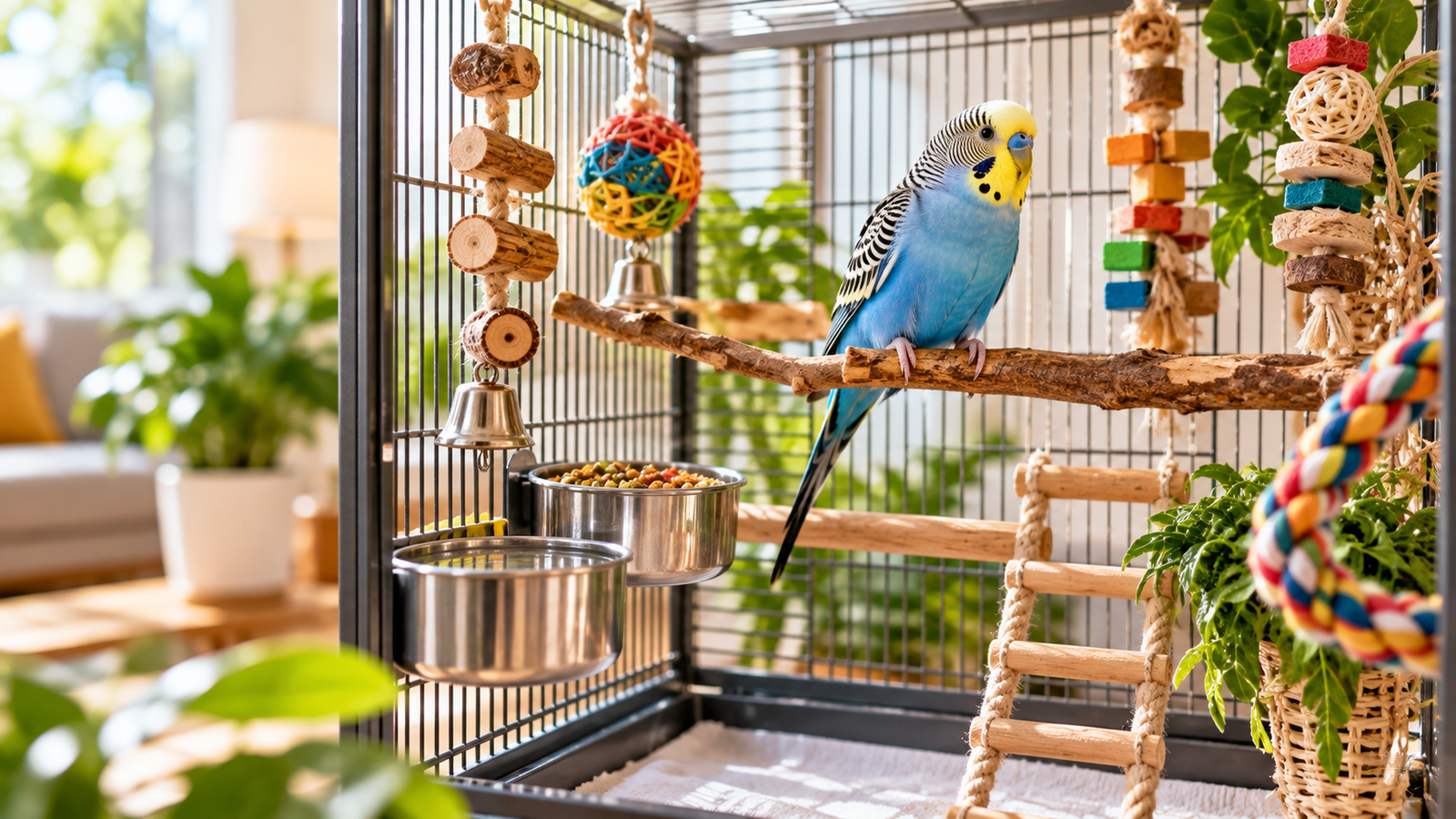

A good bird cage is more than somewhere to keep a pet bird. It is the bird’s main living space, feeding area, resting place, climbing environment and one of its most important sources of security.
A well-designed bird cage should provide enough room for natural movement while also holding safe perches, food and water dishes, toys and foraging opportunities without becoming overcrowded.
The exact setup depends on the species. A budgie, cockatiel, finch, conure and macaw do not need identical cages, bar spacing or accessories.
However, the basic principles remain similar: choose the largest practical safe cage, use species-appropriate bar spacing, provide several suitable perches, position resources carefully, avoid household fumes and give the bird opportunities to move, chew, forage and play.
Bird Cage Setup at a Glance
| Feature | What to Aim For | Why It Matters |
|---|---|---|
| Cage size | The largest safe cage you can reasonably provide | Allows climbing, wing movement, exercise and enrichment. |
| Cage shape | Usually rectangular rather than round | Provides useful corners and more practical horizontal space. |
| Bar spacing | Species-appropriate and narrow enough that the head cannot become trapped | Prevents serious escape and entrapment injuries. |
| Cage material | Reputable bird-safe metal such as suitable stainless steel or bird-safe coated metal | Reduces chewing, corrosion and heavy-metal hazards. |
| Perches | Several safe perches with different diameters and textures | Supports foot health, climbing and natural movement. |
| Food and water | Easy to reach and not positioned beneath perches | Reduces contamination with droppings. |
| Toys | Chewing, climbing, manipulation and foraging options | Provides physical and mental enrichment. |
| Cage floor | Plain disposable paper | Makes cleaning and monitoring droppings easier. |
| Location | Social but safe, with stable temperature and clean air | Helps reduce isolation, drafts, overheating and toxic exposures. |
| Out-of-cage exercise | Regular supervised time in a bird-safe area when appropriate | A cage alone rarely provides all the exercise and stimulation a companion bird needs. |
How Big Should a Bird Cage Be?
In general, bigger is better.
A cage needs enough space for the bird to:
- Stand comfortably
- Turn around
- Climb
- Move between perches
- Fully stretch both wings
- Flap without striking the bars
- Move without the tail rubbing constantly against the cage
Merck Veterinary Manual recommends that a cage be at least approximately one and a half times the bird’s wingspan in all directions as a minimum starting point.
However, a cage that only just meets a minimum measurement should not automatically be considered ideal.
More space gives you room to provide enrichment while preserving open areas for movement.
Do Not Judge Cage Size Before Adding Everything
A cage can look enormous while empty and become cramped after you install:
- Several perches
- Food bowls
- Water bowls
- Swings
- Foraging toys
- Chewing toys
The bird still needs usable open space after everything is installed.
If the bird has to squeeze between toys every time it moves from one side to the other, the setup is too crowded.
Width Can Be More Useful Than Extreme Height
Many birds naturally move horizontally as well as vertically.
A tall narrow cage may provide impressive height while offering limited room for short flights or movement between opposite sides.
This is particularly important for small birds such as:
- Budgies
- Finches
- Canaries
Look at usable length and width rather than choosing a cage only because it is tall.
Rectangular vs Round Bird Cages
Rectangular cages are generally preferable.
They provide:
- Useful corners
- Easier perch arrangement
- More efficient use of space
- Clearer routes across the enclosure
Round cages can make perch placement awkward and provide fewer secure corner areas.
For most companion birds, choose a rectangular enclosure unless an avian professional has recommended another design for a specific reason.
What Bar Spacing Does a Bird Cage Need?
Bar spacing must match the species and size of the individual bird.
The basic safety rule is simple:
Your bird should not be able to push its head through the gap between the bars.
Spacing that is too wide can lead to:
- Escape
- Head entrapment
- Neck injuries
- Leg or wing injuries
A cage designed for a large parrot may therefore be extremely dangerous for a budgie or finch.
Do Not Guess Bar Spacing From Cage Size Alone
A large cage can still be suitable for a small bird when the bars are correctly spaced.
Likewise, a physically smaller cage can still have unsafe gaps.
Check the manufacturer’s bar-spacing specification and compare it with recommendations for your exact species.
Horizontal or Vertical Cage Bars?
Horizontal sections can help many parrots climb because birds frequently use both their feet and beaks to move around cage walls.
However, cage safety and appropriate spacing matter more than bar orientation alone.
Many well-designed cages use:
- Horizontal bars
- Vertical bars
- A combination of both
Choose Safe Cage Materials
Birds frequently use their beaks to explore and climb.
That means cage material can potentially be:
- Chewed
- Scraped
- Ingested
Choose a cage from a reputable manufacturer that is specifically designed for birds.
Suitable stainless-steel cages are often an excellent option because they are durable and relatively easy to clean.
Quality bird-safe coated cages can also work well.
Inspect Cage Coatings Regularly
Check for:
- Flaking paint
- Rust
- Corrosion
- Exposed damaged metal
- Loose welds
- Sharp edges
Lead and zinc exposure can cause serious heavy-metal poisoning in birds.
Be particularly cautious with:
- Old cages
- Unknown metal cages
- Damaged coatings
- Homemade wire enclosures made from materials not confirmed to be bird-safe
Check Every Door and Opening
Intelligent parrots can become extremely good at opening simple cage doors.
Check:
- Main doors
- Feeder doors
- Top-opening sections
- Removable trays
- Breeding-box openings
Larger parrots may require secure bird-safe locking systems.
Avoid hardware that creates pinch, toe or beak entrapment hazards.
Where Should You Put a Bird Cage?
The best location usually combines social interaction with safety.
Many companion birds enjoy being near normal household activity.
However, the busiest possible location is not always the best.
Your bird also needs opportunities to:
- Rest
- Feel secure
- Move away from constant stimulation
A Living Area Can Work Well
A living room or other regularly occupied room can be appropriate when it is:
- Smoke-free
- Free from cooking fumes
- Not excessively noisy
- Maintained at a comfortable stable temperature
- Away from dangerous traffic through doors
The bird can then observe and interact with household members without being isolated.
Do Not Keep a Bird Cage in the Kitchen
Potential hazards include:
- Overheated nonstick pans
- Some air fryers and toaster ovens
- Self-cleaning ovens
- Smoke
- Cooking oils
- Cleaning sprays
- Boiling liquids
- Open flames
Keeping the cage several feet away from the stove is not the same as removing the bird from the source of fumes.
A separate room with clean air is safer.
Avoid Smoke and Aerosols
Bird respiratory systems are highly sensitive.
Keep birds away from:
- Cigarette smoke
- Vape aerosols
- Incense smoke
- Strong perfumes
- Air freshener sprays
- Cleaning aerosols
- Pesticide sprays
- Paint fumes
- Solvents
Clean air should be considered part of the cage setup.
Avoid Drafts and Rapid Temperature Changes
Do not place the cage directly beside:
- Air-conditioning vents
- Heating vents
- Drafty doors
- Frequently opened exterior doors
Healthy pet birds generally tolerate normal comfortable household temperatures well, but rapid or repeated temperature changes can be stressful.
Be Careful With Windows
A window can provide useful visual stimulation, but a cage directly against one can create other problems.
These include:
- Overheating in direct sun
- Cold drafts
- Sudden temperature changes
- Stress from predators or outdoor animals
If your bird enjoys a window view, provide access while making sure there is shade and the bird can move away from direct sunlight.
Do Birds Need Direct Sunlight?
Birds can enjoy natural daylight, but a cage should never become a glass-sided greenhouse.
Direct sunlight can heat a cage quickly.
Whenever sunlight reaches the enclosure:
- Provide shade
- Watch the room temperature
- Make sure the bird can move away from the sunny area
Ask an avian veterinarian about appropriate UV exposure for your species if you are considering specialized lighting.
Where Should the Cage Be at Night?
Birds need a predictable, quiet sleep routine.
If the daytime room remains active late at night, some owners use a separate sleep cage in a quieter room.
For detailed guidance on sleep duration, night frights and cage covering, read: How Much Sleep Do Pet Birds Need? .
Should You Cover a Bird Cage at Night?
A cover is not mandatory for every bird.
Some birds settle well with an appropriate breathable cover, while others do better without one.
If you use a cover:
- Maintain ventilation
- Check for loose threads
- Make sure the bird cannot become tangled
- Do not use the cover as a substitute for a quiet sleeping environment
Observe the individual bird’s response.
How Many Perches Should a Bird Cage Have?
Provide enough perches to allow movement and choice without filling every part of the cage.
A good setup usually includes:
- A comfortable sleeping perch
- A perch near food
- Other perches positioned to encourage climbing and movement
The exact number depends on:
- Species
- Cage size
- Bird size
- Mobility
Use Perches of Different Diameters
Bird feet should not remain in exactly the same position all day.
Natural branches and varied perch diameters help distribute pressure across different parts of the feet.
A correctly sized perch should allow a secure grip rather than forcing the toes to remain fully stretched.
As a general guide, the toes should be able to wrap substantially around the perch.
Why One Smooth Dowel Is Not Enough
Many cages come with a straight wooden dowel of one uniform diameter.
It can be used as one perch, but it should generally not be the bird’s only standing surface.
Constant pressure on the same areas of the feet can contribute to irritation and pressure-related foot problems.
Natural Branch Perches
Bird-safe natural branches are excellent because they provide:
- Diameter variation
- Texture
- Chewing opportunities
- More natural footing
Commercially prepared bird-safe natural perches are often the simplest choice.
Be Careful With Branches Collected Outdoors
Do not place an unidentified branch directly into the cage.
Natural branches can expose birds to:
- Toxic plant compounds
- Pesticides
- Fungi
- Bacteria
- Insects
- Environmental contamination
Verify that the tree species is bird-safe and that the branch has not been sprayed or contaminated.
Clean and disinfect natural branches appropriately before use.
Do Not Use Sandpaper Perch Covers
A bird should have comfortable surfaces rather than spending hours standing on abrasive material.
What About Concrete Perches?
A textured concrete or mineral-style perch may be used as one part of a varied setup for some birds.
However, it should not be the only perch.
Prolonged contact with an abrasive surface can irritate the feet.
Are Rope Perches Safe?
Natural cotton or hemp rope perches can provide a comfortable gripping surface.
They can be especially useful for some older birds with reduced foot comfort.
However, inspect them frequently.
Remove the perch if you see:
- Loose strands
- Fraying
- Loops
- Exposed internal wire
Loose fibers can wrap around toes or feet and may also be swallowed.
Arrange Perches to Encourage Movement
Do not place every important item within one easy reach of a single perch.
For a healthy mobile bird, thoughtful spacing encourages:
- Climbing
- Stepping
- Short flights or hops where cage size allows
- Balance
For species such as finches that move across the cage, widely spaced perches at opposite sides can preserve useful flight space.
Keep the Tail Clear
A perch should not be positioned so close to the cage wall that the bird’s tail constantly rubs against the bars.
Tail rubbing can damage feathers and suggests the perch position may not provide enough usable space.
Do Not Stack Perches Directly Over One Another
A bird sitting on a high perch will naturally pass droppings onto anything beneath it.
Avoid placing lower perches directly under higher ones whenever possible.
This makes the cage easier to keep sanitary.
Where Should Food and Water Bowls Go?
Food and water dishes should be:
- Easy for the bird to reach
- Securely attached
- Easy to remove and clean
- Made from safe, nonporous materials
For many larger parrots, stainless-steel bowls are particularly practical because they are durable and easy to wash.
Do Not Put a Perch Directly Over Food or Water
If a perch sits above a bowl, droppings can fall into:
- Food
- Drinking water
- Fresh vegetables
Arrange the cage so bowls stay as clean as possible.
Change Drinking Water Every Day
Fresh water should remain available at all times.
Change it at least daily and sooner when it becomes contaminated with:
- Food
- Droppings
- Bath water
- Debris
Wash water dishes daily rather than simply topping them up.
Food Bowls Also Need Daily Cleaning
Food residue can support bacterial or fungal growth.
This is particularly important when feeding:
- Fresh vegetables
- Fruit
- Soft foods
- Moistened pellets
Remove perishable food before it spoils.
For budgie nutrition, read: What Do Budgies Eat? A Healthy Diet Guide .
For cockatiels, read: What Should Cockatiels Eat Every Day? .
Do Birds Need More Than One Food Station?
Multiple small feeding locations can be useful in larger cages because they encourage movement and foraging.
However, every feeding location must remain clean and accessible.
If several birds live together, make sure one dominant bird cannot easily control access to all food and water.
What Should You Put on the Bottom of a Bird Cage?
Plain disposable paper is one of the simplest and most useful cage liners.
Options include:
- Plain paper
- Paper towels
- Newspaper
Paper makes it easy to see the bird’s droppings and replace soiled material frequently.
Why Monitoring Droppings Matters
Birds can hide signs of illness until disease has progressed.
The cage floor can therefore provide useful information.
Paper lets you notice changes in:
- Number of droppings
- Size
- Color
- Consistency
- Urine volume
For a detailed health guide, read: Signs of Illness in Pet Birds and When to See an Avian Vet .
Avoid Sandpaper Cage Liners
Sandpaper liners are unnecessary and can create risks if birds pick at and ingest the material.
They also make health monitoring less useful than plain paper.
Avoid Loose Particulate Bedding for Most Indoor Bird Cages
Materials such as:
- Wood shavings
- Corncob bedding
- Clay litter
- Cat litter
- Other deep particulate substrates
are generally poor choices for the floor of a typical companion-bird cage.
Possible problems include:
- Dust
- Accidental ingestion
- Moisture retention
- Hidden spoiled food
- Difficulty examining droppings
Simple paper is usually easier and safer to manage.
How Often Should You Change the Cage Liner?
Replace soiled paper daily.
Very messy birds or cages may need more frequent changes.
Daily changes help you:
- Remove feces
- Remove dropped food
- Reduce moisture
- Monitor health
How Often Should You Clean a Bird Cage?
Cleaning is a combination of daily maintenance and deeper periodic cleaning.
Daily tasks include:
- Changing cage paper
- Cleaning food bowls
- Cleaning water bowls
- Removing spoiled fresh food
- Wiping obvious droppings from heavily used areas
Regular Deep Cleaning
The entire cage should also be thoroughly cleaned on a regular schedule.
Depending on cage size, species and mess level, this may include:
- Removing accessories
- Scrubbing bars
- Cleaning the tray
- Cleaning perches
- Washing suitable toys
- Inspecting hardware
Some veterinary guidance recommends a thorough cage scrub approximately once or twice each month in addition to daily maintenance.
Be Careful With Cleaning Fumes
Move the bird away from:
- Strong disinfectant fumes
- Aerosol cleaners
- Bleach fumes
- Other volatile cleaning products
Follow product directions carefully and rinse cage surfaces as appropriate before the bird returns.
Bird Toys Are Not Optional Decoration
Companion birds are intelligent animals.
A cage containing only:
- One perch
- One bowl
- Water
does not provide much opportunity for natural behavior.
Toys can support:
- Chewing
- Climbing
- Foraging
- Manipulation
- Problem-solving
- Physical activity
Provide Different Types of Enrichment
Rather than buying several versions of the same plastic toy, provide different functions.
Useful categories include:
- Chewing toys
- Foraging toys
- Foot toys for appropriate parrots
- Swings
- Climbing toys
- Shredding materials
- Manipulation toys
Foraging Toys Are Especially Valuable
Wild birds spend large parts of their day searching for and processing food.
A pet bird can finish an easily available meal very quickly.
Foraging activities can extend feeding time and provide mental stimulation.
Examples include:
- Food hidden inside bird-safe paper
- Simple puzzle feeders
- Vegetables clipped in different locations
- Small portions placed at several feeding stations
Start Foraging Easy
A bird that has never used a puzzle may not understand a complicated feeder.
Begin with food that is:
- Visible
- Easy to reach
- Only partly covered
Gradually increase the challenge once the bird understands how the activity works.
Do Not Overcrowd the Cage With Toys
More toys do not automatically mean better enrichment.
An overcrowded cage can reduce:
- Flight space
- Climbing routes
- Access to food
- Safe movement
Use a manageable number of toys and rotate some of them periodically.
Rotate Toys Gradually
Some birds are cautious around unfamiliar objects.
A large new toy placed suddenly beside a favorite sleeping perch may frighten the bird.
For nervous birds:
- Place the new toy outside the cage first.
- Allow the bird to observe it.
- Move it gradually closer.
- Install it once the bird is comfortable.
Inspect Toys Every Day
Bird toys change as birds chew and destroy them.
Look for:
- Loose strings
- Sharp wire
- Broken plastic
- Open chains
- Sharp metal edges
- Small detachable pieces
- Loose bells or clappers
- Dangerous loops
Rope Toy Safety
Rope can provide excellent climbing and chewing enrichment, but frayed rope can become dangerous.
Remove rope items when loose strands could:
- Wrap around toes
- Wrap around legs
- Trap nails
- Be swallowed
Use Safe Toy Attachments
Hardware should not trap:
- Feet
- Toes
- Beaks
- Tongues
Bird-safe stainless-steel quick links that close securely are often preferable to poorly designed spring clips.
Inspect attachment points whenever you rotate or clean toys.
Are Bells Safe for Birds?
Some birds enjoy bells.
However, bell design matters.
Check for:
- Accessible sharp edges
- Loose internal clappers
- Openings where toes or beaks can become trapped
- Unknown metals
Remove a bell if your bird begins dismantling it or accessing unsafe parts.
Are Mirrors Good Bird Toys?
Mirrors are not necessary for good enrichment.
Some birds can become intensely focused on their reflection and may behave as though it is another bird.
Possible problems include:
- Persistent courtship
- Regurgitation
- Territorial behavior
- Frustration
- Reduced interest in healthier enrichment
Interactive play, foraging, chewing and appropriate social interaction are usually more useful enrichment choices.
Do Birds Need a Swing?
A swing can provide:
- Balance practice
- Movement
- A different resting surface
Choose a swing appropriate for the bird’s size and inspect the hanging hardware regularly.
Do not place it where it blocks major movement through the cage.
Should Birds Have a Nest Box or Hut?
A nest box is not a routine cage requirement for most companion birds.
Dark enclosed spaces can stimulate nesting and reproductive behavior in some species.
Fabric huts can also create:
- Loose fiber hazards
- Chewing and ingestion risks
- Entanglement hazards
Do not assume every bird needs a soft enclosed “bed.”
Do Pet Birds Need a Bath?
Many birds benefit from regular opportunities to bathe.
Depending on species and preference, options may include:
- A shallow bathing dish
- Gentle misting
- Wet leafy greens for some smaller birds
Use clean water and remove dirty bathing water promptly.
Keep Bath Water Away From Drinking Water
A bird may bathe enthusiastically and contaminate nearby water or food.
If you provide a bath:
- Supervise when appropriate
- Use a safe shallow container
- Change contaminated drinking water afterward
Does a Bird Need Time Outside the Cage?
For most companion birds, yes.
Even a large cage may not provide all the:
- Exercise
- Flight
- Exploration
- Social interaction
that a healthy bird needs.
Provide regular supervised out-of-cage time when it can be done safely.
Bird-Proof the Room First
Before opening the cage, secure:
- Windows
- Exterior doors
- Ceiling fans
- Hot surfaces
- Open flames
- Electrical cords
- Open toilets
- Deep water
- Unsafe plants
- Other pets
Windows and mirrors can also cause collision injuries if a flying bird does not recognize them as solid surfaces.
Keep Cats and Dogs Under Control
Do not assume that a calm household cat or dog is automatically safe around a bird.
Predatory behavior can appear suddenly.
A bite, scratch or grab from another animal can cause severe injury.
Can Two Birds Share One Cage?
Sometimes, but compatibility should never be assumed.
Consider:
- Species
- Individual temperament
- Body size
- Sex
- History together
- Resource competition
Two birds housed together need substantially more usable space than one bird.
Provide Multiple Resources for Multiple Birds
A shared cage may require:
- Multiple food stations
- Multiple water access points
- Several resting perches
- Several enrichment locations
One bird should not be able to prevent another from eating or resting.
Watch for Bullying
Signs of conflict include:
- Chasing
- Biting
- Guarding bowls
- Driving another bird from perches
- Feather damage
- One bird spending excessive time on the cage floor
Birds that cannot coexist safely need separate housing.
Bird Cage Setup for Older or Disabled Birds
A standard arrangement may need modification when a bird has:
- Arthritis
- Weakness
- Foot problems
- Neurologic disease
- Vision loss
- A history of falling
Useful changes may include:
- Lower perches
- Softer appropriate perches
- Shorter distances between resources
- Easy access to food and water
- A safer cage-floor setup
Ask an avian veterinarian how to modify the cage for a bird with medical limitations.
What About a Sick Bird?
A sick bird may need a temporary hospital-style cage rather than its normal complex setup.
Depending on the condition, an avian veterinarian may recommend:
- Lower or removed perches
- Food and water positioned for easy access
- Reduced climbing requirements
- A warmer controlled environment
- Close monitoring of droppings
Do not assume a sick bird should continue navigating a tall cage normally.
Travel Cage vs Main Cage
A travel carrier or temporary cage has a different purpose from a permanent home cage.
A travel cage may be:
- Smaller
- Simpler
- Easier to secure in a vehicle
- Easier to carry
That does not mean a small travel cage is suitable as the bird’s everyday home.
Keep the Travel Cage Familiar
Introduce the travel cage before an emergency or veterinary appointment.
Allow the bird to:
- See it
- Explore it voluntarily
- Receive treats near or inside it
This can reduce the stress of future transport.
Signs a Bird Cage May Be Too Small
Warning signs include:
- The bird cannot fully spread its wings
- Wing tips repeatedly hit cage bars
- The tail constantly rubs the cage
- Toys block most movement
- There is no open climbing or flight route
- The bird has to squeeze around bowls and accessories
- More than one bird cannot comfortably move away from the other
A cage can be technically large enough to contain a bird while still being too small for good daily welfare.
Signs the Cage Layout Needs Improvement
Even a large cage can be arranged poorly.
Reconsider the layout if:
- Droppings constantly fall into food or water
- Perches are all identical
- Perches block each other
- The bird cannot move without hitting toys
- Rope is badly frayed
- There are no chewing or foraging opportunities
- The favorite perch leaves the tail pressed against the bars
- The cage is directly exposed to drafts or fumes
A Simple Bird Cage Layout
A practical setup might include:
- Upper area: comfortable resting or sleeping perch
- Opposite side: another natural perch to encourage movement
- Middle area: climbing and chewing enrichment
- Food area: clean bowl with no perch directly above it
- Water area: easy access without droppings contamination
- Foraging area: simple puzzle or food-search activity
- Floor: plain disposable paper for easy monitoring
Leave enough open space between these items for normal movement.
Example Setup for Small Active Birds
For a budgie, finch or similar small active bird, prioritize:
- Horizontal movement space
- Safe close bar spacing
- Several lightweight natural perches
- Widely separated perches where safe
- Small climbing or foraging toys
- Open flight paths
Avoid filling a small-bird cage with large bulky toys.
Example Setup for a Parrot
A parrot cage may need:
- Strong bars
- Secure door locks
- Heavy-duty bowls
- Strong natural wood perches
- Chewing toys
- Foraging toys
- Climbing opportunities
The larger and stronger the bird, the more important hardware durability becomes.
A Weekly Bird Cage Safety Check
Once a week, inspect:
- Door locks
- Bar welds
- Paint or coating
- Perches
- Rope fibers
- Toy hardware
- Bells
- Food bowls
- Water bowls
- Cage wheels or stand
Replace damaged items before they cause an injury.
Common Bird Cage Setup Mistakes
- Choosing the smallest cage that physically holds the bird
- Buying a tall narrow cage with very little horizontal space
- Using bar spacing that is too wide
- Buying an old or damaged cage with unknown metal or coating
- Keeping the cage in the kitchen
- Exposing birds to smoke, aerosols or perfume
- Placing the cage directly under an air-conditioning vent
- Leaving the whole cage in intense direct sunlight
- Using only one smooth dowel perch
- Using sandpaper perch covers
- Leaving frayed rope in the cage
- Putting perches directly over food or water
- Using strong-smelling particulate bedding on the cage floor
- Using sandpaper floor liners
- Allowing food to spoil in bowls
- Overcrowding the cage with toys
- Never changing or rotating enrichment
- Ignoring broken toy hardware
- Using a mirror as the bird’s main source of enrichment
- Assuming a large cage eliminates the need for safe exercise
- Allowing another bird to monopolize all resources
Bird Cage Setup Checklist
Before moving your bird into a new cage, check:
- Can the bird fully stretch its wings?
- Is there enough space after the toys and perches are installed?
- Is the bar spacing safe for this species?
- Are the cage materials bird-safe and undamaged?
- Are all doors secure?
- Are there perches of several appropriate diameters?
- Are abrasive sandpaper perch covers absent?
- Are rope perches free from fraying?
- Can the bird reach food and water easily?
- Are bowls protected from droppings?
- Are there safe chewing and foraging opportunities?
- Is there still open space for movement?
- Is the bottom lined with easy-to-change paper?
- Is the cage away from cooking fumes and smoke?
- Is it away from strong drafts and temperature extremes?
- Does the bird have a suitable sleep routine?
- Can you inspect and clean every part of the cage easily?
Frequently Asked Questions
How big should a bird cage be?
Choose the largest safe cage you can reasonably provide. As a minimum starting point, the bird should be able to fully stretch and flap its wings without hitting the sides, toys or perches. Merck also recommends at least roughly one and a half times the bird’s wingspan in all directions.
Is a tall cage better for birds?
Not necessarily. Many birds benefit more from usable horizontal space than extreme height. A wide rectangular cage often provides better opportunities for movement than a tall narrow cage.
Are round bird cages good?
Rectangular cages are generally preferred because they provide useful corners, more practical perch placement and better use of horizontal space.
How do I choose bird cage bar spacing?
Bar spacing should be appropriate for the exact species and small enough that the bird cannot push its head through. Check species-specific recommendations before purchasing a cage.
Where is the best place to put a bird cage?
Choose a room where the bird can participate in normal household life while remaining away from kitchens, smoke, aerosols, strong drafts, direct heat and excessive disturbance.
Can I keep my bird cage in the kitchen?
No. Cooking fumes, overheated nonstick coatings, smoke, cleaners, boiling liquids and open flames make kitchens unsafe locations for companion birds.
Can I put a bird cage beside a window?
A window view can be enriching, but avoid direct overheating, cold drafts and situations where outdoor animals repeatedly frighten the bird. Always provide shade and a stable temperature.
How many perches should a bird have?
Provide several appropriately sized perches with different diameters and textures while preserving open movement space. The exact number depends on the species and cage size.
What are the best perches for birds?
Bird-safe natural wood branches are excellent because their varying diameters help distribute pressure across the feet. Other suitable perches can be added for variety.
Are wooden dowel perches bad for birds?
A smooth dowel can be one perch, but it should not be the only type available. Birds benefit from varied diameters and textures rather than standing on the same surface continuously.
Are sandpaper perches safe?
No. Sandpaper perch covers can irritate and damage the undersides of birds’ feet and are not recommended as a nail-care method.
Are rope perches safe?
Natural cotton or hemp rope perches can be useful when they remain in good condition. Inspect them frequently and remove them when fibers become loose or frayed because strands can trap toes or be swallowed.
Where should bird food bowls go?
Place them where the bird can reach them easily but where droppings from higher perches will not fall into the food.
How often should bird water be changed?
Provide fresh drinking water every day and replace it sooner whenever food, droppings or other debris contaminate it. Wash the water dish daily.
What should I put on the bottom of a bird cage?
Plain disposable paper, paper towels or newspaper are practical choices because they are easy to change and allow you to monitor droppings.
Can I use cat litter in a bird cage?
It is generally better to use plain disposable paper. Cat litter and other loose particulate bedding can create dust, ingestion risks and make droppings harder to monitor.
How often should I clean a bird cage?
Change cage paper and clean food and water bowls daily. Remove visible waste as needed and perform a more thorough cleaning of the cage and accessories regularly.
How many toys should I put in a bird cage?
Provide several toys serving different purposes, such as chewing, climbing and foraging, but leave enough open space for normal movement. Rotation is often better than filling the cage with every toy at once.
Are mirrors good for pet birds?
Mirrors are not necessary and can cause intense social or courtship behavior in some birds. Foraging, chewing, training and appropriate social interaction provide more useful enrichment.
Do birds need toys if they have another bird?
Yes. Another bird does not replace environmental enrichment. Birds still need opportunities to chew, forage, climb, explore and exercise.
Can two birds live in the same cage?
Compatible birds sometimes can, but never assume they will get along. Shared housing requires substantially more space, several resource locations and close monitoring for aggression or blocking.
Do pet birds need time outside the cage?
Most companion birds benefit from regular supervised exercise outside the cage in a properly bird-proofed environment.
Should I cover my bird cage at night?
Some birds settle well with a safe breathable cover, while others do not need one. The important factors are a predictable routine, appropriate darkness, quiet and good ventilation.
How can I tell if my bird cage is too small?
The cage may be too small if your bird cannot fully spread its wings, constantly rubs its tail against the bars, has little room after toys are installed or cannot move comfortably between perches.
The Bottom Line
A good bird cage setup begins with space.
Choose the largest safe rectangular cage you can reasonably provide, with bar spacing appropriate for your bird’s species. The bird should be able to stretch its wings, climb and move freely even after perches, bowls and toys are installed.
Use several safe perches rather than relying on one uniform wooden dowel. Bird-safe natural branches of different diameters provide varied footing, while sandpaper perch covers should be avoided because they can damage the feet.
Arrange perches carefully. Do not place them directly above food and water, and make sure the bird’s tail does not constantly rub against the cage walls.
Use clean, sturdy food and water dishes and wash them every day. Line the cage floor with plain disposable paper so waste can be removed frequently and changes in droppings are easy to notice.
Enrichment should include more than decorative toys. Provide opportunities to chew, climb, manipulate objects and forage for food. Inspect everything regularly for broken hardware, loose strands and entanglement hazards.
Cage placement is equally important. Keep birds away from kitchens, smoke, aerosols, nonstick-cookware fumes, drafts and extreme temperatures. A bird should be able to participate in household life without being exposed to dangerous air or constant disturbance.
Finally, remember that even an excellent cage is still only one part of a bird’s environment. Healthy companion birds usually benefit from regular social interaction, training, foraging and supervised exercise outside the cage in a properly bird-proofed area.
References and Further Reading
Merck Veterinary Manual
Providing a Home for a Bird — cage dimensions, rectangular cage design, placement, environmental temperature, exercise and household safety.
Merck Veterinary Manual
Overview of Pet Birds — appropriate cage size, multiple perches, sanitation, toys, foraging and environmental enrichment.
Merck Veterinary Manual
Household Hazards and Toxicoses of Pet Birds — cooking fumes, overheated nonstick coatings, aerosols, smoke, heavy metals and other household hazards.
Association of Avian Veterinarians
Basic Care for Companion Birds — cage arrangement, sleep environment, perch diameter and variety, natural branches and avoidance of sandpaper perch covers.
Association of Avian Veterinarians
Enrichment Tips — chewing, foraging, moving perches, toy attachment safety and bird-proofing during out-of-cage exercise.
VCA Animal Hospitals
Housing Small and Large Birds — cage shape, cage materials, bar spacing, natural perches, rope safety, food and water placement and enrichment.
VCA Animal Hospitals
Cage Hygiene in Birds — daily cage-bottom paper, cleaning, avoidance of particulate substrates and monitoring droppings.