
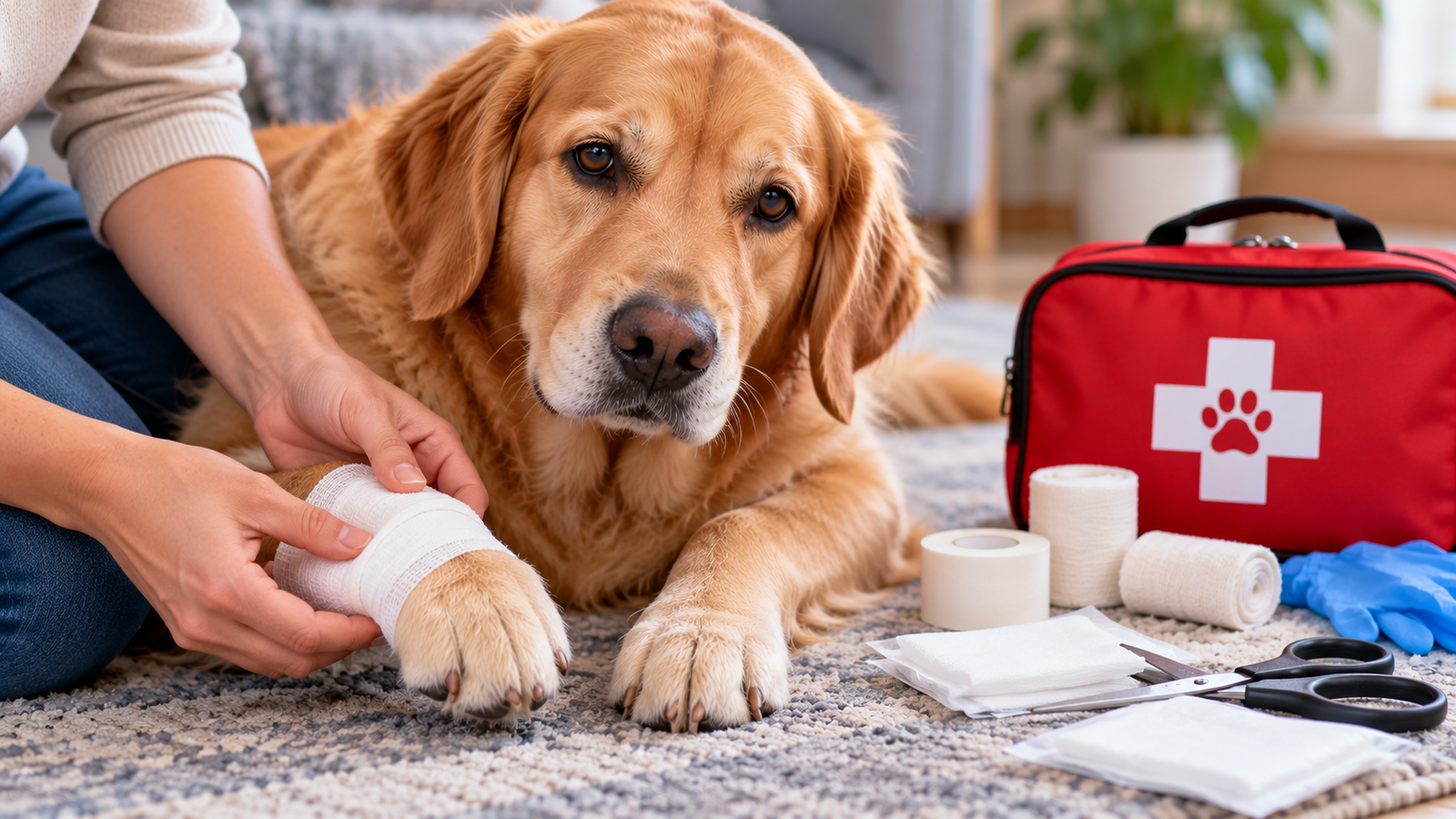

Dog first aid can help protect your dog during the first critical minutes of an emergency. Appropriate first aid may help control severe bleeding, support breathing, limit tissue damage, reduce dangerous overheating, or prevent an injury from becoming worse while professional veterinary care is arranged.
First aid does not replace veterinary treatment. Difficulty breathing, collapse, major trauma, severe bleeding, poisoning, heatstroke, choking, serious burns, seizures, and other rapidly worsening conditions require prompt veterinary attention.
Quick answer: In a dog emergency, first make sure the scene is safe. Check whether your dog responds to you and is breathing regularly. Control severe external bleeding with firm direct pressure, avoid unnecessary movement after major trauma, provide appropriate first aid when safe, and contact a veterinarian or emergency veterinary hospital as quickly as possible.
Important: An injured or frightened dog may bite even if they are normally gentle. Protect yourself and avoid first-aid procedures that would put you at significant risk.
What Is Dog First Aid?
Dog first aid is immediate care provided after an injury or sudden illness before full veterinary treatment becomes available.
The main goals are to:
- Protect life
- Support breathing and circulation
- Control serious external bleeding
- Limit further injury
- Recognize emergencies quickly
- Provide appropriate immediate care
- Get the dog to professional veterinary treatment safely
First aid should never unnecessarily delay transport to veterinary care.
Dog First Aid: What to Do First
- Check the scene. Make sure traffic, electricity, fire, chemicals, aggressive animals, water, or other hazards will not injure you.
- Check responsiveness. Speak to your dog and look for normal awareness or purposeful movement.
- Check breathing. Look for regular chest movement and breathing.
- Look for severe external bleeding. Apply firm direct pressure when appropriate and safe.
- Call for veterinary help. Use speakerphone when practical so your hands remain free.
- Move the dog carefully. Minimize unnecessary movement after major trauma or when spinal injury or fractures are possible.
When possible, contact the veterinary hospital before travelling so the team knows what has happened and can prepare for your arrival.
Dog Emergencies That Need Immediate Veterinary Care
Seek urgent veterinary help for problems including:
- Difficulty breathing
- Collapse or unconsciousness
- Severe or uncontrolled bleeding
- Major trauma or a road accident
- Suspected broken bones
- Heatstroke or severe heat-related illness
- Choking
- Suspected poisoning
- Repeated or prolonged seizures
- Serious thermal, electrical, or chemical burns
- Severe eye injuries
- Blue, grey, purple, or very pale gums
- A swollen abdomen with repeated unsuccessful retching
- Severe pain or rapidly worsening symptoms
How to Approach an Injured Dog Safely
Pain, fear, and confusion can cause even a normally friendly dog to react defensively.
Approach calmly, avoid putting your face near the dog’s mouth, and use only the amount of handling needed to provide safe first aid and transport.
A muzzle may sometimes protect the handler when dealing with a conscious, painful dog. Do not muzzle a dog that has respiratory distress, is vomiting, or has an injury that makes muzzling unsafe. If you are uncertain, follow veterinary instructions.
First Aid for Severe Bleeding
Severe blood loss can become life-threatening rapidly.
- Place clean gauze, a towel, or clean cloth directly over the bleeding area.
- Apply firm, continuous direct pressure.
- Keep pressure in place while veterinary transport is arranged.
- If the material becomes soaked with blood, add additional clean material on top rather than repeatedly lifting the original dressing.
Heavy, spurting, or rapidly soaking bleeding — particularly when accompanied by weakness, pale gums, or collapse — is an emergency.
When Can a Tourniquet Be Used?
Direct pressure should be attempted first.
If severe, potentially life-threatening bleeding from a limb or tail does not stop or greatly improve with firm direct pressure, current RECOVER first-aid guidance supports tourniquet use when it can be performed without putting the rescuer at significant risk.
A tourniquet should not be placed around the head, neck, trunk, genitals, or other areas where it cannot safely isolate an extremity.
Tourniquet placement is painful, and an injured conscious dog may bite. Continue direct pressure and seek urgent veterinary help if attempting a tourniquet would put you in danger.
If a tourniquet is required for uncontrolled life-threatening extremity bleeding, current RECOVER guidance recommends leaving it in place during transport so veterinary professionals can assess and remove it.
First Aid for Cuts and Wounds
For a minor surface wound:
- Keep the dog calm.
- Control bleeding with direct pressure.
- Rinse visible contamination with sterile saline or clean water when appropriate.
- Cover loosely with a clean non-stick dressing if needed.
Avoid repeatedly applying harsh disinfectants to open tissue.
Deep wounds, bite wounds, large skin tears, heavily contaminated injuries, uncontrolled bleeding, or wounds exposing deeper tissues require veterinary examination.
What if an Object Is Embedded in a Wound?
Do not pull out an object that has penetrated deeply into the chest, abdomen, head, or another major body area.
Removing it can worsen tissue damage or severe bleeding. Minimize movement and seek emergency veterinary care.
First Aid for a Choking Dog
Possible signs of foreign-body airway obstruction include:
- Sudden agitation or panic
- Pawing at the mouth or face
- Head and neck extension
- Weak or ineffective coughing
- Gagging without effective airflow
- High-pitched or squeaking breathing sounds
- Pale, blue, or grey gums
- Collapse
If your dog is coughing effectively and moving air, avoid unnecessary intervention and seek veterinary advice.
If a Conscious Dog Cannot Cough Effectively
If choking is strongly suspected and the dog appears unable to move air effectively:
- Do not reach into the mouth of a conscious dog. The dog may bite, and attempting to grab an object can push it farther into the airway.
- Give up to five firm back blows. Deliver them over the rear portion of the chest, to one or both sides of the spine rather than directly onto the spine.
- If five back blows do not clear the obstruction, another choking technique may be attempted. Options described by RECOVER include positioning the head below the body, chest thrusts, or abdominal thrusts. These techniques can cause injury in some animals, so use particular caution with small, thin, or medically fragile dogs.
- If the alternative technique fails and the dog remains conscious, return to back blows and repeat the cycle while arranging immediate veterinary assistance.
If the Choking Dog Becomes Unconscious
Begin chest compressions immediately. Chest compressions may help dislodge the obstruction.
- Give 30 chest compressions at 100–120 compressions per minute.
- After 30 compressions, briefly inspect the mouth and airway. Remove an object only if it is clearly visible and can be safely removed.
- Do not perform a blind finger sweep.
- Give 2 mouth-to-nose rescue breaths within about 5 seconds.
- Immediately resume another cycle of 30 compressions.
Repeat until the obstruction is relieved, the dog begins breathing normally, professional help takes over, or resuscitation can no longer be performed safely.
Any dog that required first-aid assistance for choking should be evaluated by a veterinarian as soon as possible, even if the obstruction appears to have been cleared.
Dog CPR Basics
A dog that is unresponsive and not breathing regularly may be in cardiopulmonary arrest and should receive immediate CPR unless the scene is unsafe.
For a lay rescuer, do not waste valuable time attempting a prolonged pulse check.
Single-Rescuer CPR
- Call for help and place your phone on speaker when possible.
- Begin chest compressions within about 10 seconds of recognizing that the dog is unresponsive and not breathing regularly.
- Give 30 chest compressions at a rate of 100–120 per minute.
- For dogs positioned on their side, compress the chest approximately one-third to one-half of its width at the appropriate compression point.
- Allow the chest to recoil fully after each compression.
- After 30 compressions, give 2 mouth-to-nose rescue breaths within approximately 5 seconds.
- Immediately resume chest compressions.
Chest shape and body size affect correct hand placement. Round-chested, keel-chested, wide-chested, and very small dogs may require different compression techniques.
If mouth-to-nose ventilation would place the rescuer at risk, current RECOVER guidance recommends chest-compression-only CPR rather than exposing yourself to danger.
First Aid for a Seizure
During a seizure:
- Move nearby objects away if this can be done safely.
- Keep the dog away from stairs, pools, and other hazards.
- Reduce bright light and noise where practical.
- Time the seizure.
- Do not forcibly restrain the dog.
- Do not place your hands or objects inside the dog’s mouth.
Seek urgent veterinary care for a prolonged seizure, repeated seizures close together, abnormal recovery, difficulty breathing, suspected poisoning, major trauma, or other serious symptoms.
First Aid for Heatstroke in Dogs
Heatstroke and serious heat-related illness are veterinary emergencies. The longer a dog remains dangerously overheated, the greater the risk of serious tissue and organ injury.
Possible Signs of Heat-Related Illness
- Constant or extreme panting
- Sudden reluctance to continue exercise
- Weakness or lying down unexpectedly
- Restlessness or confusion
- Stumbling or poor coordination
- Heavy salivation
- Vomiting or diarrhea
- Collapse
What to Do
- Stop exercise or activity immediately.
- Move the dog away from the heat and into a cooler environment.
- Begin active cooling on scene when it is safe.
- Run cool water over the body below the neck, concentrating especially on areas with thinner fur such as the underside of the abdomen so the water reaches the skin.
- Avoid running water directly over the face or mouth because of accidental aspiration or drowning risk.
- Contact a veterinarian or emergency veterinary hospital while cooling is underway.
- After appropriate on-scene cooling, pat the dog dry and transport immediately for veterinary assessment.
Do not delay effective cooling while searching for a particular water temperature. Current veterinary guidance prioritizes immediate active cooling with water cooler than the dog’s body.
When Should Active Cooling Stop?
For a dog without stertor or stridor, if rectal temperature can be measured safely, current RECOVER guidance suggests stopping active cooling when the temperature reaches approximately 39.7–40°C (103.5–104°F).
If a dog has stertor or stridor — noisy upper-airway breathing — cooling may be continued until the panting clearly improves or the rectal temperature reaches 38.6°C (101.5°F), whichever occurs first.
Do not continue active cooling below 38.6°C (101.5°F).
If rectal temperature cannot be safely measured outside the veterinary hospital, RECOVER suggests approximately 15 minutes of active cooling before transport. The dog should then be patted dry and transported immediately.
Veterinary assessment is necessary even if the dog appears much better after cooling.
Should You Wrap a Heatstroke Dog in Wet Towels?
Do not cover a heatstroke dog with damp or wet towels and leave them wrapped around the body. This is less effective than active water cooling and may interfere with heat loss.
Apply water directly to the body while avoiding the face and airway.
First Aid for Thermal Burns
Thermal burns can result from flames, hot liquids, hot surfaces, heating equipment, grooming devices, or other sources of excessive heat.
Remove the dog from the heat source only when it is safe for you to do so.
How to Cool a Thermal Burn
- Apply cool, clean running tap water directly to the burned area as soon as possible.
- Continue cooling for at least 20 minutes when this can be done safely.
- Cooling is recommended when it can be started within approximately 3 hours of the burn.
- Avoid running water around the face in the prehospital setting because of aspiration or drowning risk.
- After appropriate cooling, seek veterinary treatment.
Cool running water is preferred over ice water.
If running water is unavailable, current RECOVER guidance allows alternative cooling methods such as a cool water-soaked material or appropriately used cold pack while travelling to veterinary care. Cooling should still continue for approximately 20 minutes when practical and safe.
Do not apply butter, cooking oil, toothpaste, creams, or other household remedies to serious burns unless specifically instructed by a veterinarian.
When a Burn Needs Emergency Veterinary Care
Seek urgent veterinary care for:
- Large or deep burns
- Burns affecting the face or airway
- Electrical burns
- Burns over a substantial area
- Blackened, white, blistered, or severely damaged tissue
- Possible smoke inhalation
- Severe pain, weakness, breathing difficulty, or collapse
Chemical Burns and Caustic Skin Exposure
Chemical exposure can injure both the animal and the person providing first aid.
- Protect yourself first. Use appropriate gloves, protective clothing, and eye or face protection when needed.
- Remove the dog from the source of exposure when this can be done safely.
- If substantial loose powder or removable dry chemical is present, carefully remove it first when safe.
- Irrigate the affected skin with clean running water immediately.
- Continue irrigation for as long as possible, with a minimum of 15 minutes, when safe.
- Do not direct running water around the dog’s face or mouth.
- Prevent licking of contaminated skin when possible.
- After initial decontamination, seek veterinary care promptly.
Do not perform irrigation if doing so places you at significant risk from the chemical. In that situation, protect yourself and arrange professional veterinary assistance immediately.
First Aid for Eye Injuries
Eye injuries can threaten vision quickly.
Do not press on an injured eye and do not attempt to remove an object embedded in the eye.
If a chemical has entered the eye, immediate flushing may be necessary while urgent veterinary care is arranged. Follow veterinary or poison-control instructions whenever available.
First Aid for Suspected Broken Bones
Keep your dog as still as practical and prevent unnecessary walking.
Support the body during transport. A suitable rigid surface or securely supported blanket may sometimes function as a stretcher.
Avoid attempting complicated home splints without professional instruction because poorly placed splints can worsen an injury.
First Aid After a Road Accident or Major Fall
A dog may have serious internal injuries even when external wounds are minimal.
- Keep the dog calm.
- Check whether breathing is regular.
- Control severe external bleeding.
- Minimize unnecessary movement.
- Support the dog during transport.
- Seek emergency veterinary care.
Do not assume a dog is unharmed simply because they can still stand or walk.
First Aid for Suspected Poisoning
Different toxins require different treatment, so avoid applying one home remedy to every poisoning.
- Move the dog away from the substance if this can be done safely.
- Prevent further exposure.
- Contact a veterinarian or animal poison-control service immediately.
- Keep the product package, label, plant, medication container, or ingredient information when possible.
- Tell the veterinary professional what your dog may have encountered, approximately how much, and when exposure occurred.
Do not routinely induce vomiting.
Current RECOVER guidance recommends against routine prehospital use of vomiting-inducing treatments after acute toxin ingestion. Vomiting should be induced only when a veterinarian or animal poison-control professional specifically recommends it for that substance and situation.
Do not automatically give milk, salt, oil, activated charcoal, or another home remedy.
First Aid for a Serious Allergic Reaction
Possible mild reactions include itching, hives, or localized swelling.
Seek immediate veterinary care for:
- Difficulty breathing
- Rapidly worsening facial swelling
- Collapse
- Very pale or blue gums
- Severe weakness
- Repeated vomiting or diarrhea accompanied by other serious symptoms
Do not give human medications unless a veterinarian has told you exactly what product and dose are appropriate for your dog.
Possible Signs of Shock
Signs that may accompany shock include:
- Pale gums
- Weakness
- Collapse
- Rapid heart rate
- Weak pulses
- Cold extremities
- Reduced responsiveness
Keep unnecessary movement to a minimum and seek emergency veterinary care.
Swollen Abdomen and Unproductive Retching
Repeated attempts to vomit with little or nothing coming up, especially with a swollen or painful abdomen, restlessness, drooling, weakness, or collapse, can occur with gastric dilatation-volvulus (GDV).
Do not attempt home treatment. Go to an emergency veterinary hospital immediately.
What if Your Dog Cannot Urinate?
Repeated attempts to urinate with little or no urine can signal a serious urinary problem or obstruction.
Do not squeeze the abdomen or attempt to empty the bladder yourself. Seek urgent veterinary care.
How to Transport an Injured Dog Safely
- Keep unnecessary movement to a minimum.
- Support the body after serious trauma.
- Use a suitable rigid surface or securely supported blanket as a stretcher when appropriate.
- Avoid sudden twisting or jerking.
- Ask another person to help move a large dog whenever possible.
- Never attempt CPR while you are also driving.
What Should Be in a Dog First-Aid Kit?
A basic dog first-aid kit may include:
- Sterile gauze pads
- Gauze rolls
- Non-stick wound dressings
- Medical tape
- Self-adhering bandage wrap
- Disposable gloves
- Sterile saline
- Clean towels
- A lightweight blanket
- Blunt-tip scissors
- Tweezers or forceps
- A digital thermometer
- A flashlight
- A spare leash
- An appropriate muzzle
- Veterinary emergency contact information
Do not automatically give medications from a first-aid kit during an emergency. Human pain medicines and many other drugs can be dangerous without veterinary guidance.
Emergency Information to Keep Ready
- Your regular veterinarian’s telephone number
- The nearest emergency veterinary hospital
- An appropriate animal poison-control service
- Your dog’s current medications
- Known allergies
- Important medical conditions
- Your dog’s approximate weight
Common Dog First-Aid Mistakes
- Putting yourself in danger while attempting to help
- Delaying veterinary treatment while trying repeated home remedies
- Giving human pain medication without veterinary instruction
- Inducing vomiting without professional advice
- Removing deeply embedded objects
- Repeatedly lifting blood-soaked wound dressings
- Using a tourniquet when direct pressure is controlling the bleeding
- Reaching into the mouth of a conscious choking dog
- Performing a blind finger sweep during choking
- Delaying heatstroke cooling
- Continuing heatstroke cooling below the appropriate stopping temperature
- Using ice water instead of the recommended cool running water for a thermal burn
- Cooling a thermal burn for only a few seconds
- Handling dangerous chemicals without appropriate protection
- Putting objects into a dog’s mouth during a seizure
- Forcing a dog with a suspected fracture to walk
Frequently Asked Questions
What should I do first in a dog emergency?
Make sure the scene is safe. Check whether your dog is responsive and breathing regularly, look for severe external bleeding, call for veterinary help, and provide appropriate first aid without unnecessarily delaying professional treatment.
How do I stop severe bleeding from a dog wound?
Apply firm, continuous direct pressure with clean gauze or cloth. If the material becomes soaked, add additional material on top rather than repeatedly removing the original layer.
When is a tourniquet appropriate for a dog?
A tourniquet may be appropriate for severe bleeding from a limb or tail that does not stop or greatly improve with direct pressure. Rescuer safety comes first, and the dog should receive immediate veterinary treatment.
How fast should dog CPR compressions be?
Current RECOVER guidance recommends 100–120 chest compressions per minute.
What is the single-rescuer CPR compression-to-breath ratio?
For single-rescuer out-of-hospital CPR, current RECOVER guidance recommends 30 chest compressions followed by 2 rescue breaths.
Should I check my dog’s pulse before starting CPR?
A lay rescuer should not delay CPR with a prolonged pulse check. If a dog is unresponsive and is not breathing regularly, current RECOVER out-of-hospital guidance recommends beginning basic life support promptly.
Should I put my fingers into the mouth of a conscious choking dog?
No. Current RECOVER guidance specifically advises against reaching into the mouth of a conscious dog suspected of choking. Up to five firm back blows are the recommended first maneuver when intervention is needed.
Should I put something in my dog’s mouth during a seizure?
No. Keep your hands and objects away from the dog’s mouth and protect them from nearby hazards.
Should I make my dog vomit after suspected poisoning?
Not routinely. Only induce vomiting when a veterinarian or animal poison-control professional specifically recommends it for that substance and situation.
When should I stop cooling a dog with heatstroke?
For a dog without stertor or stridor, current RECOVER guidance suggests stopping active cooling at approximately 39.7–40°C (103.5–104°F). If stertor or stridor is present, cooling may continue until panting clearly improves or the temperature reaches 38.6°C (101.5°F), whichever occurs first. Active cooling should not continue below 38.6°C.
What if I cannot measure a heatstroke dog’s temperature?
Current RECOVER guidance suggests approximately 15 minutes of active cooling before transport when rectal temperature cannot be safely measured. The dog should then be patted dry and transported immediately for veterinary care.
How long should I cool a dog’s thermal burn?
Use cool running tap water for at least 20 minutes when safe and practical. Start as soon as possible; current RECOVER guidance supports this treatment when performed within approximately three hours of the injury.
Should I use ice water on a dog’s thermal burn?
No. Current veterinary first-aid guidance prefers cool running tap water over ice water.
How long should a chemical skin burn be rinsed?
For caustic chemical exposure to the skin, irrigate with clean running water for as long as possible, with a minimum of 15 minutes, provided this can be done without putting the rescuer at significant risk.
Does a dog still need a veterinarian after recovering from heatstroke?
Yes. A dog can appear improved while still developing internal complications. Veterinary assessment remains necessary.
The Bottom Line
Dog first aid is intended to provide immediate support until professional veterinary care becomes available.
Start with scene safety. Check responsiveness and regular breathing, control serious external bleeding, minimize unnecessary movement after major trauma, and contact a veterinary professional early.
For heat-related illness, move the dog into a cooler environment and begin active cooling before transport when safe. For a recent thermal burn, cool the affected area with running tap water for at least 20 minutes. For caustic chemical skin exposure, protect yourself and irrigate the affected area with running water for at least 15 minutes when safe.
For choking, do not reach into the mouth of a conscious dog. For an unresponsive dog that is not breathing regularly, begin basic life support promptly rather than spending valuable time attempting a prolonged pulse check.
A prepared first-aid kit, readily available emergency contacts, and practical pet first-aid and CPR training can help you respond more effectively during a real emergency.
Petwise reminder: This article provides general educational first-aid information and does not replace veterinary diagnosis, treatment, hands-on CPR training, or instructions from an emergency veterinary professional.
References and Further Reading
- RECOVER Initiative. RECOVER Guidelines: First Aid for Dogs and Cats. Journal of Veterinary Emergency and Critical Care, 2026. DOI: 10.1111/vec.70138.
- RECOVER Initiative. First Aid in Dogs and Cats: Evidence and Knowledge Gap Analysis With Treatment Recommendations. Journal of Veterinary Emergency and Critical Care, 2026. DOI: 10.1111/vec.70139.
- RECOVER Initiative. Updated Treatment Recommendations for CPR in Dogs and Cats. Journal of Veterinary Emergency and Critical Care, 2024. DOI: 10.1111/vec.13391.
- Merck Veterinary Manual. First Aid and Transport of Small Animals. Reviewed and updated 2025.
- Royal Veterinary College. Heatstroke in Dogs and Cats: Prevention, Symptoms and First Aid.


