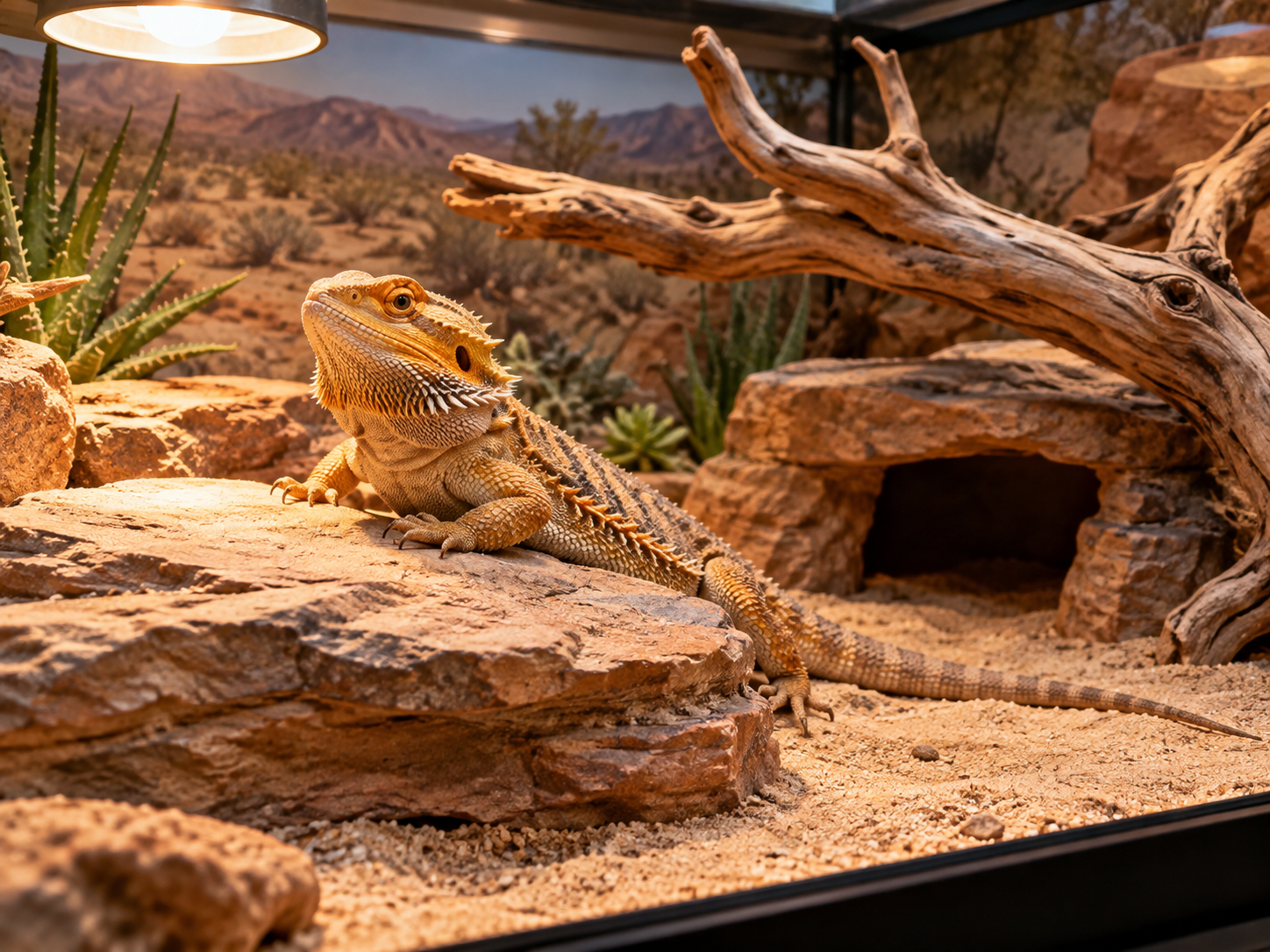

A good bearded dragon enclosure provides strong heat, proper UVB lighting, safe flooring, places to hide and enough room to move around naturally. Getting the setup right from the start is one of the most important things you can do for your dragon’s long-term health.
In short: give an adult dragon an enclosure of at least around 4 × 2 × 2 feet (120 × 60 × 60 cm), a hot basking spot at one end and a cooler side at the other, a strong linear UVB tube, solid or safe flooring and a hide. Measure temperatures with digital tools, and run everything for a few days before your dragon moves in.
Choose the right enclosure
Adult bearded dragons are active lizards that need plenty of floor space to walk, bask and explore. An enclosure of about 4 × 2 × 2 feet (120 × 60 × 60 cm) is widely treated as the minimum for one adult, and many keepers now go bigger.
- Choose an enclosure with good ventilation and a secure lid or front doors.
- Front-opening vivariums make access easier and are less stressful for your dragon than reaching in from above.
- House bearded dragons on their own. Keeping two together often leads to stress, competition for the basking spot and fighting.
A small tank may be fine for a baby for a short while, but they grow quickly. Many owners simply start with the adult-sized enclosure.
Create a basking area and a temperature gradient
Put the heat source at one end of the enclosure so there’s a hot basking spot on one side and a cooler area on the other. This gradient lets your dragon move back and forth to control its body temperature, which is essential for digestion and overall health.
| Area | Target range |
|---|---|
| Basking surface (adults) | Around 100–110°F (38–43°C) |
| Cool side | Around 75–85°F (24–29°C) |
| Night-time | A drop to around 65–75°F (18–24°C) is normal, with no lights on |
These are commonly used care-guide ranges and can vary slightly between sources and with your dragon’s age. Ask a reptile vet if you’re unsure.
Use an overhead basking lamp, placed above a stable flat rock or platform, as the main heat source. Bearded dragons are built to warm up from heat above them. Avoid heat rocks, which can cause burns. Most setups run the lights for around 12–14 hours a day, on a timer.
Use proper UVB lighting
UVB light lets your bearded dragon make vitamin D3, which it needs to absorb calcium. Without enough UVB, dragons can develop metabolic bone disease, a serious condition that weakens the bones.
- Choose a linear UVB tube designed for desert reptiles. T5 high-output tubes are a popular choice.
- Run the tube across a good part of the enclosure’s length, on the same side as the basking spot.
- Don’t place glass or plastic between the bulb and your dragon, as they block UVB. Mesh also reduces it, so follow the manufacturer’s distance guidance.
- Replace the tube as often as the manufacturer recommends, as UVB output fades over time even when the light still looks bright.
Compact coil UVB bulbs usually don’t give enough even coverage for a bearded dragon.
Choose a safe substrate
If you’re new to bearded dragons, a solid floor such as tile, slate or a non-adhesive shelf liner is the easiest option. It’s simple to clean and makes it easy to check your dragon’s droppings.
Avoid calcium sand, crushed walnut shell and similar loose products sold for reptiles. Some experienced keepers use a natural mix of soil and sand, which allows digging, but it takes more care to keep clean and dry.
Add hides and enrichment
- A secure hide, ideally on the cooler side
- Stable rocks or a basking platform under the heat lamp
- Safe climbing branches, firmly fixed so they can’t fall
- Plenty of open floor space to move around
Make sure anything heavy is stable and can’t shift onto your dragon. Keep the basking platform at a height where the surface reaches the right temperature, but not so close to the lamp that your dragon can touch it.
Monitor temperatures
Guessing temperatures by touch isn’t accurate enough. Use:
- Digital thermometers with probes on both the warm and cool sides
- An infrared temperature gun to check the basking surface directly
- A suitable thermostat for any heat source it’s designed to work with, to prevent overheating
Bearded dragons come from dry environments, so keep humidity fairly low, often around 30–40%. A hygrometer helps you keep track. Too much humidity can contribute to respiratory problems.
Keep the enclosure clean
Remove droppings and uneaten food as soon as you see them. Wash food and water dishes regularly, and give the enclosure a deeper clean when needed using a reptile-safe disinfectant, rinsed off and fully dried before your dragon goes back in.
Check everything before your dragon arrives
Run the enclosure for a few days before your bearded dragon moves in. Check that the heating, lighting, timers and thermostat work, and that the basking spot and cool side are holding the right temperatures. It’s far easier to fix problems in an empty enclosure than once your dragon is living in it.
Once the setup is running, our guide on what bearded dragons eat covers insects, greens and calcium.
Frequently asked questions
How big should a bearded dragon enclosure be?
An enclosure of about 4 × 2 × 2 feet (120 × 60 × 60 cm) is widely treated as the minimum for one adult bearded dragon. Bigger is better, as long as you can maintain a proper temperature gradient.
What temperature should a bearded dragon’s basking spot be?
For adults, a basking surface of around 100–110°F (38–43°C) is commonly recommended, with a cool side of around 75–85°F (24–29°C). Measure the basking surface with an infrared temperature gun.
Do bearded dragons need UVB light?
Yes. UVB lets bearded dragons make vitamin D3 so they can absorb calcium. Without it, they can develop metabolic bone disease. Use a linear UVB tube designed for desert reptiles and replace it as the manufacturer recommends.
What is the best substrate for a bearded dragon?
For beginners, solid flooring such as tile, slate or a non-adhesive shelf liner is easiest to clean and monitor. Avoid calcium sand and crushed walnut shell.