
A suitable UVB setup depends on the reptile, the lamp and the enclosure. Brightness alone cannot tell you whether the animal receives an appropriate exposure.
Choose lighting for the exact species you keep, then check how it performs where the animal actually sits or climbs. A percentage printed on a bulb does not establish the UVB level reaching your reptile.
What does UVB do?
Ultraviolet B helps reptiles produce vitamin D3, which supports the absorption and use of dietary calcium. Lighting, diet, supplementation and appropriate temperatures work together; improving one does not automatically correct deficiencies in the others.
Inadequate calcium or vitamin D provision can contribute to nutritional bone disease. However, weakness, abnormal movement or changes in the jaw or limbs need veterinary assessment, not a diagnosis based on the bulb being used. Severe weakness, seizures or a suspected fracture require urgent care.
Do not start high-dose calcium or vitamin D treatment without veterinary advice. An already unwell reptile may need treatment as well as changes to its enclosure.
Start with the species’ needs
A reptile that regularly basks in open sunlight and one that uses shaded habitats should not receive an identical lighting setup. Research the species’ behaviour, enclosure requirements and recommended exposure before choosing equipment.
Being nocturnal or crepuscular does not automatically mean UVB is unnecessary. For example, the RSPCA’s leopard-gecko guidance includes UVB alongside access to shade. Colour morph and health can also affect the advice for an individual animal.
If reliable care references recommend different exposure levels, ask a reptile-experienced veterinarian or specialist lighting adviser to resolve the difference. Do not average conflicting recommendations or select the strongest option.
Choose the complete lamp and fixture
Compare the exact lamp model, output, reflector, coverage and installation instructions. T5, T8 and compact describe different lamp formats, but those labels alone do not tell you the exposure at animal level.
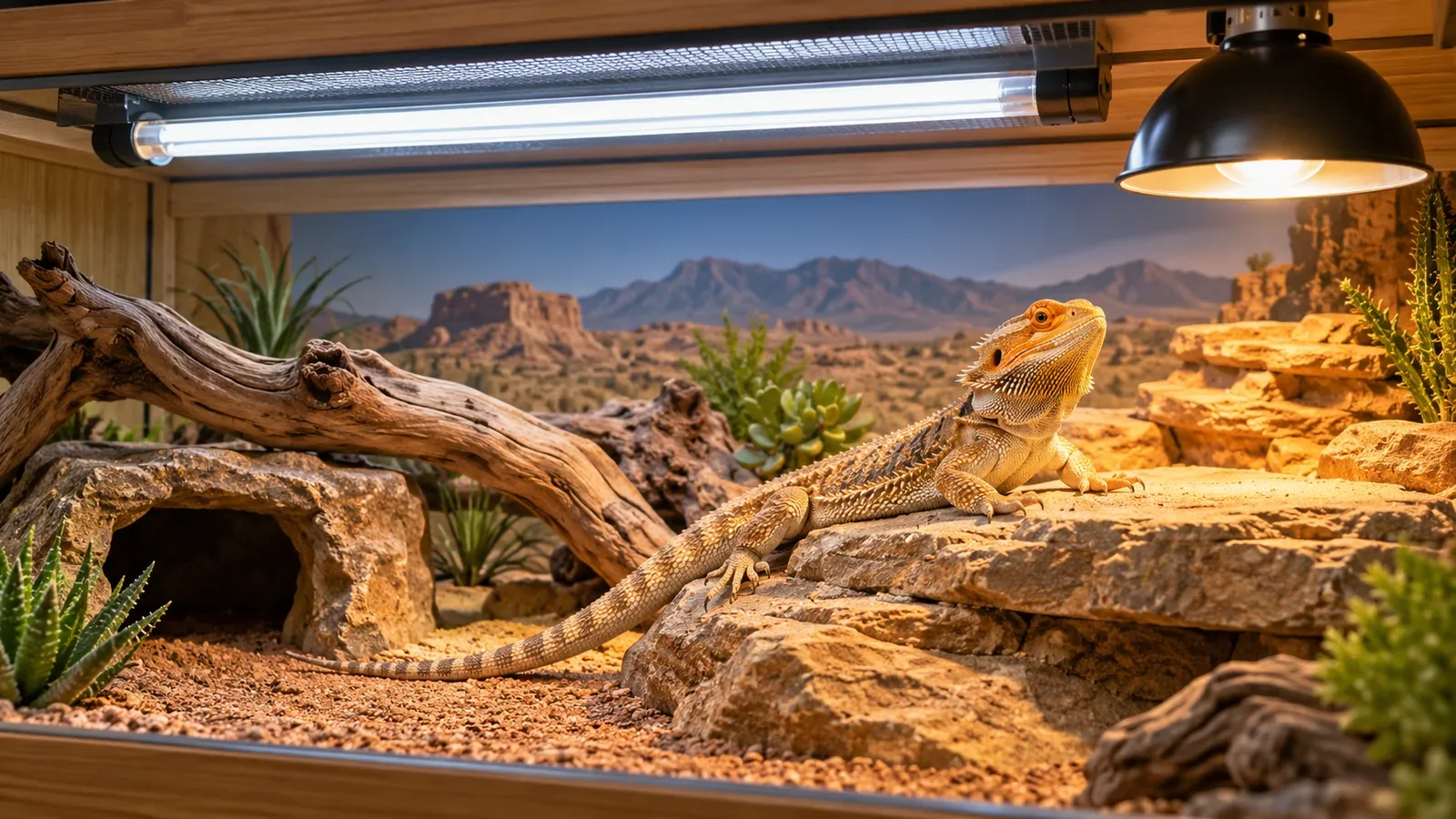
A linear tube can illuminate a broader area than a narrow beam, but its suitability still depends on the enclosure and species. Some lamps combine heat and UVB; others require separate heating equipment.
Ordinary room lighting and standard heat lamps should not be assumed to provide useful UVB. Check what the product is designed to emit rather than rely on descriptions such as “daylight” or “full spectrum.”
Measure distance from the animal, not the floor
Follow the distance guidance for the precise lamp and fitting. Account for the highest position the reptile can reach, including branches, raised platforms and the top of a tortoise’s shell. Rearranging furnishings can change exposure without moving the lamp.
Arcadia’s lighting guide measures distance to the animal’s head or shell and bases its recommendations on specified reflector arrangements inside the enclosure. A chart for that installation should not be transferred unchanged to a different fixture or a lamp above a screen.
Account for glass, plastic and mesh
Ordinary window and enclosure glass block most useful UVB. Sunlight through a closed window is therefore not a dependable substitute for appropriate UVB provision.
Plastic covers and mesh can also change transmission. The effect of mesh depends on its construction and the installation; there is no single percentage adjustment suitable for every lid. Check manufacturer guidance and measure the installed setup where possible.
Use UVI to assess exposure
A suitable UV Index meter helps assess exposure at animal level. UVI is not the same as the UVB percentage on a lamp package. Use the meter according to its instructions and compare readings with guidance appropriate to the species and equipment.
Ferguson zones group reptiles by patterns of sun exposure. They are useful background, but observed field maxima are not universal basking targets. The UV-Tool research distinguishes wild exposure measurements from the gradients appropriate under artificial lighting.
Provide a usable range from the recommended basking exposure to shaded retreats. The animal must be able to leave direct UVB. Stronger lighting across the entire enclosure is not an improvement.
Recheck after replacing a lamp, moving a fixture, changing a reflector or screen, or rearranging climbing surfaces. A measurement from the old arrangement no longer describes the new one.
Coordinate UVB, heat and shade
For basking species, arrange appropriate heat and UVB so the animal can use them together while retaining access to cooler, shaded areas. Check temperatures separately: a UV Index reading does not tell you whether the basking surface is too hot.
Follow equipment instructions for secure mounting, guards, clearance and compatible controls. Not every lamp can be dimmed or switched by every thermostat.
Set a day-and-night lighting schedule appropriate to the species. Do not leave UVB on throughout the night or apply one photoperiod to every reptile.
Replace lamps according to the exact product
A lamp can continue producing visible light after its UVB output has declined. Record the installation date, follow its stated replacement schedule and monitor output with suitable equipment where available.
There is no reliable rule that every expensive lamp lasts a year or every cheaper lamp fails within a few months. Product specifications, use and measured performance are more useful than price.
Keep the model details, installation distances and readings together. These records help a veterinarian or lighting specialist assess the setup without guessing what equipment is in use.
Check the whole enclosure
Before the animal arrives, confirm that it can reach the intended basking area, retreat into shade and avoid contact with hot equipment. Lighting should fit the animal’s movement and behaviour, rather than leave it choosing between suitable warmth and excessive exposure.
For related enclosure planning, see our guides to setting up a bearded dragon tank and creating a safe home for a pet tortoise.