
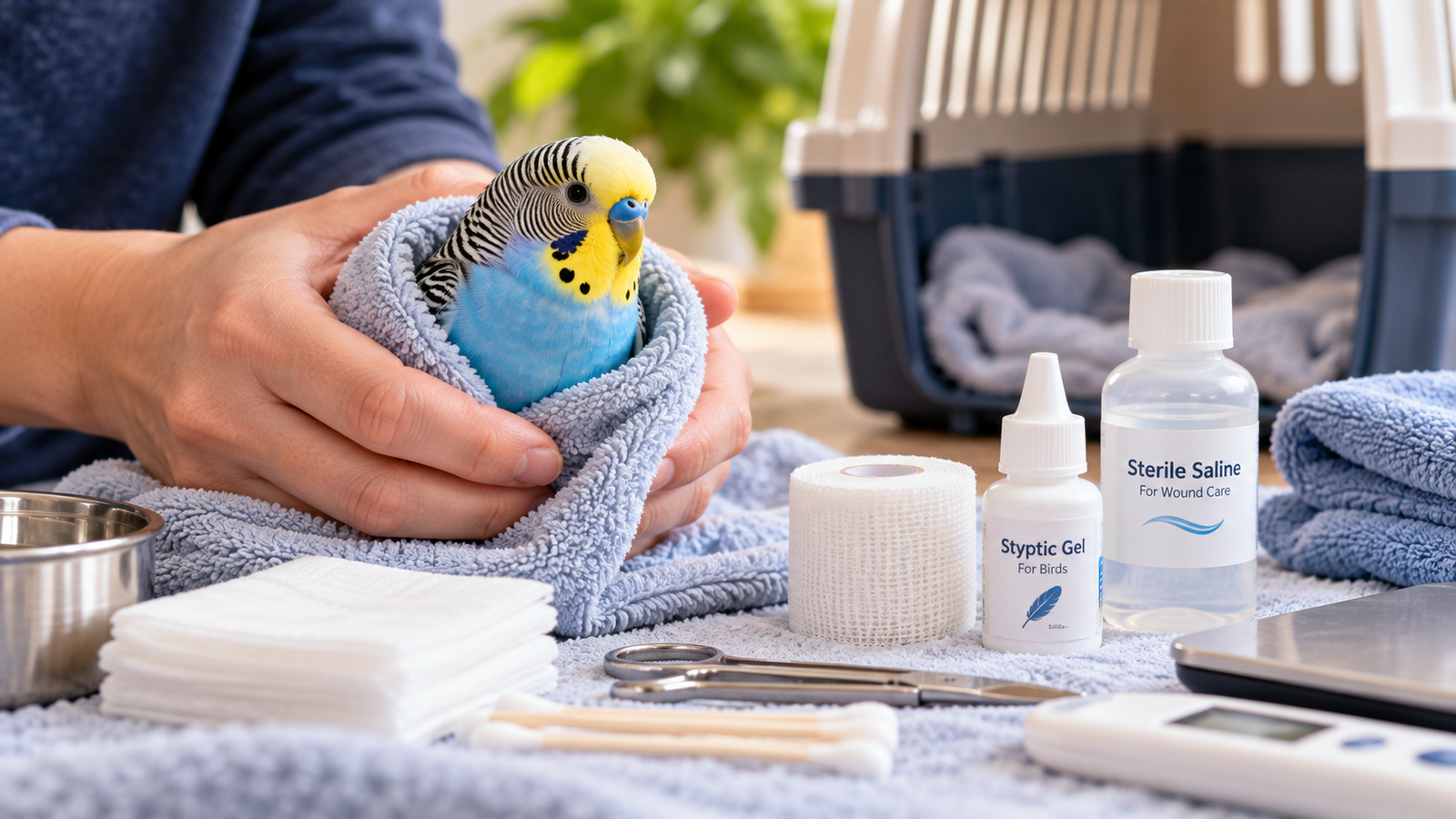

Bird first aid is not about treating a serious injury at home. Its purpose is to keep an injured or critically ill bird as stable and calm as possible while you contact an avian veterinarian and arrange professional care.
This distinction matters because birds can deteriorate quickly. They also tend to hide weakness and illness until a problem becomes advanced.
A bird that suddenly becomes weak, collapses, struggles to breathe, continues bleeding, suffers major trauma or is exposed to a toxin should be treated as an emergency.
- Ongoing or heavy bleeding
- Open-mouth breathing or severe breathing difficulty
- Collapse, severe weakness or unresponsiveness
- A cat or dog bite
- A suspected fracture or major traumatic injury
- A seizure
- Suspected poisoning or toxic-fume exposure
- A serious burn
- Possible egg binding
- Tissue protruding from the vent
- A severe eye injury
- Signs of dangerous overheating
What Is Bird First Aid?
First aid is the immediate support you provide before veterinary treatment becomes available.
It may include:
- Stopping active bleeding
- Reducing stress
- Preventing additional injury
- Providing appropriate warmth when needed
- Moving the bird away from fumes or other hazards
- Preparing safe transport
- Calling the veterinarian with useful information
First aid does not replace diagnosis or treatment.
A bird that appears better after first aid may still have:
- Internal bleeding
- A fracture
- Shock
- Infection
- Organ damage
- Toxin exposure
Why Bird Emergencies Can Become Serious Quickly
Birds have high metabolic rates and relatively small body sizes.
Even a seemingly small amount of blood loss can therefore matter, particularly in a budgie, finch, canary or other small species.
Birds also commonly hide signs of illness or weakness.
By the time a bird is:
- Sitting on the cage floor
- Unable to perch
- Very fluffed and unresponsive
- Struggling to breathe
the condition may already be serious.
For the broader symptom guide, read: Signs of Illness in Pet Birds .
First Step: Call an Avian Veterinarian
If possible, call before leaving home.
Tell the clinic:
- Your bird’s species
- Approximate age
- What happened
- When it happened
- Whether there is active bleeding
- Whether the bird can stand or perch
- How the bird is breathing
- Whether a toxin or fume may be involved
- Whether another animal attacked the bird
Calling ahead gives the veterinary team time to prepare oxygen, warming equipment and other emergency supplies.
Know Where Emergency Bird Care Is Available Before You Need It
Not every emergency veterinary hospital treats birds.
Before an emergency happens, save:
- Your regular avian veterinarian’s number
- An after-hours bird or exotic-animal clinic
- The address and route to the clinic
- A local veterinary poison service, where available
Keep this information with your bird first-aid kit.
How to Handle an Injured Bird Safely
Handle the bird only as much as necessary.
A sick or injured bird can become exhausted by:
- Chasing
- Repeated catching
- Prolonged restraint
- Excessive examination
Prepare the carrier and supplies before picking the bird up whenever possible.
Never Squeeze a Bird’s Chest
Use the minimum restraint required to prevent escape or further injury.
Use a Towel When Appropriate
A small soft towel can help contain many birds during an emergency.
Move calmly and avoid covering the bird’s nostrils or applying pressure across the chest.
Large parrots can inflict serious bites when frightened or injured, so do not put yourself at risk.
How to Transport a Sick or Injured Bird
Use a small, secure and well-ventilated carrier.
For a weak or injured bird, a smaller temporary carrier is often safer than a large cage because it limits climbing and falling.
Line the bottom with:
- Paper towels
- A clean towel
- Another secure nonslip material
Remove High Perches if the Bird Is Weak
A bird that cannot balance normally may fall from a perch.
For transport, consider removing high perches and keeping the bird close to the padded floor.
If a low perch is used, make sure a fall cannot cause further injury.
Keep the Carrier Quiet and Dim
Covering three sides of the carrier with a towel can reduce visual stimulation and stress.
However, ventilation must remain adequate.
Avoid:
- Loud music
- Children handling the carrier
- Dogs or cats approaching it
- Frequent opening of the carrier
Should You Keep an Injured Bird Warm?
Weak and injured birds often benefit from a gently warmed environment because illness and trauma can make it harder to maintain normal body temperature.
Merck Veterinary Manual describes approximately 80–90°F (27–32°C) as a supportive environmental range for many sick birds awaiting examination.
However, this is not appropriate for every emergency.
How to Provide Gentle Warmth
If the bird is weak or cold and your veterinarian advises warmth, heat only part of the carrier.
This allows the bird to move away from the warmer area if necessary.
Possible methods include:
- A warm water bottle wrapped in a towel beside the carrier
- A heating pad used externally on a low setting
- A safely warmed room
Never place an unprotected heating device directly against the bird.
Stop warming if the bird begins:
- Panting
- Holding its wings away from the body
- Becoming restless from heat
Bird Bleeding: What Should You Do?
Active bleeding in a bird deserves prompt attention.
First determine whether you see:
- Fresh active bleeding
- A blood-stained area with bleeding already stopped
If bleeding has already stopped, avoid repeatedly cleaning or picking at the clot because this can restart it.
How to Control Active Bleeding
For an accessible bleeding area:
- Keep the bird as calm as possible.
- Place clean sterile gauze or another clean absorbent pad over the site.
- Apply gentle but steady direct pressure.
- Hold the pressure continuously for several minutes rather than repeatedly lifting the gauze to check.
If bleeding continues, the bird needs emergency veterinary care.
Do Not Keep Removing Blood-Soaked Gauze
Repeatedly pulling material away from the injury may disturb clot formation.
If additional absorbent material is needed, place it over the original layer while maintaining gentle pressure.
When Is Bleeding an Emergency?
Seek immediate veterinary attention when:
- Bleeding does not stop promptly
- Fresh blood continues dripping
- The source cannot be identified
- The wound is deep
- The bird becomes weak or sleepy
- The bird falls from its perch
- The bleeding follows major trauma
- Blood comes from the mouth, vent or another body opening
Broken Blood Feathers
A growing feather is sometimes called a blood feather or pin feather.
While it is developing, the shaft contains an active blood supply.
If the feather breaks, it may bleed significantly.
What to Do for a Bleeding Blood Feather
Keep the bird calm and apply gentle pressure to the bleeding area when you can do so safely.
For bleeding from the damaged feather tip, a veterinarian may recommend an appropriate styptic product or cornstarch as part of temporary first aid.
If fresh blood continues dripping after a few minutes, contact an avian veterinarian immediately.
Do Not Pull a Blood Feather at Home
If the bleeding has stopped, avoid disturbing the clot.
What About a Bleeding Toenail?
Toenails can bleed if they are:
- Trimmed too short
- Torn
- Broken
- Caught in a toy or fabric
For minor nail-tip bleeding, gentle pressure plus a bird-appropriate styptic gel or cornstarch may help.
If the nail is badly damaged or bleeding continues, seek veterinary help.
Be Careful With Styptic Products
Styptic products can be useful for minor bleeding from a nail or damaged feather.
However:
- Do not place styptic material into the eyes
- Do not place it in the mouth
- Do not use it inside a deep open wound
- Avoid creating airborne powder that the bird could inhale
A styptic gel can reduce the risk of inhaling loose powder.
Bird Wounds and Cuts
Small wounds can hide deeper tissue damage.
Deep wounds can also become infected.
After controlling bleeding, protect the area from:
- Dirt
- Continued chewing
- Other birds
- Further trauma
Can You Clean a Bird’s Wound at Home?
A small superficial wound may sometimes be gently flushed with sterile saline while veterinary advice is obtained.
Do not aggressively scrub damaged tissue.
Avoid applying:
- Alcohol
- Household cleaners
- Essential oils
- Unprescribed antibiotic creams
- Greasy ointments
unless an avian veterinarian has specifically advised them.
Cat and Dog Bites Are Emergencies
Cat teeth can leave extremely small punctures that are difficult to see beneath feathers.
The bird may also have:
- Crush injuries
- Internal trauma
- Hidden punctures
- Serious bacterial contamination
Bacteria associated with cat attacks, including Pasteurella species, can cause severe systemic infection in birds.
Dog attacks also require urgent veterinary assessment because crushing injuries can be much greater than the external wound suggests.
Do Not Wait for a Bite Wound to Become Infected
A bird may initially:
- Still perch
- Still vocalize
- Show only a tiny puncture
That does not make the injury minor.
Prompt veterinary treatment may include antibiotics, pain relief and treatment for trauma.
Bird Hit a Window or Wall
Flying birds can collide with:
- Windows
- Mirrors
- Walls
- Doors
- Ceiling fans
After a collision, move the bird into a small, quiet and secure carrier.
Minimize stimulation and arrange veterinary assessment.
Warning Signs After a Collision
Seek emergency care if the bird has:
- Loss of consciousness
- Seizures
- Poor balance
- Head tilt
- Bleeding
- Unequal pupil appearance
- Difficulty breathing
- A drooping wing
- Inability to stand or perch
- Severe weakness
Internal or neurological injuries may not be visible externally.
Suspected Broken Wing or Leg
Possible signs of a fracture include:
- Wing drooping abnormally
- Not using one leg
- Severe swelling
- An abnormal angle
- Pain when moving
- Inability to perch
Do Not Try to Straighten a Broken Limb
Do not:
- Pull on the limb
- Force it back into position
- Attempt a complicated home splint
Improper manipulation can increase:
- Pain
- Bleeding
- Tissue damage
- Fracture displacement
Restrict movement and transport the bird carefully.
Use a Low, Padded Transport Setup for a Suspected Fracture
Remove high perches.
Pad the floor securely and keep the bird from climbing unnecessarily.
An avian veterinarian can determine whether the injury requires:
- Bandaging
- Splinting
- Pain relief
- Imaging
- Surgery
Bird Breathing Emergencies
Breathing difficulty is one of the most serious avian emergencies.
Warning signs include:
- Open-mouth breathing
- Pronounced tail bobbing
- Rapid breathing while resting
- Wheezing or unusual respiratory sounds
- Blue or gray discoloration
- Weakness or collapse
What to Do When a Bird Is Struggling to Breathe
Keep handling to an absolute minimum.
Move the bird away from:
- Smoke
- Aerosols
- Perfume
- Cleaning fumes
- Cooking fumes
Place it in a quiet, well-ventilated carrier and go to a veterinarian immediately.
Many birds in respiratory distress require supplemental oxygen at the veterinary hospital.
Do Not Force Food or Water Into a Bird That Is Struggling to Breathe
PTFE and Nonstick-Fume Exposure
Birds are extremely sensitive to fumes released when some nonstick coatings containing PTFE are severely overheated.
Potential sources can include certain:
- Nonstick cookware
- Air fryers
- Toaster ovens
- Self-cleaning ovens
- Heat lamps
- Other coated heating appliances
Exposure can cause severe respiratory distress or sudden death.
What to Do After Suspected PTFE Exposure
Possible symptoms include:
- Rapid breathing
- Open-mouth breathing
- Wheezing
- Weakness
- Loss of coordination
- Seizures
- Collapse
For environmental prevention, also read: How to Set Up a Bird Cage: Size, Perches, Toys & Placement .
Smoke and Aerosol Exposure
Birds can also be harmed by:
- Cigarette smoke
- Vape aerosols
- Incense
- Strong perfumes
- Air fresheners
- Cleaning sprays
- Paint or solvent fumes
- Burning plastics
Move the bird away from the source and into clean air.
If any respiratory or neurological signs occur, treat the exposure as an emergency.
What to Do if Your Bird May Have Been Poisoned
Birds can be poisoned by:
- Metals
- Human medications
- Household chemicals
- Toxic plants
- Insecticides
- Rodenticides
- Nicotine products
- Some foods
- Fumes
Remove Access to the Suspected Poison
If you can do so safely:
- Remove the bird from the source.
- Prevent other birds from accessing it.
- Save the product label or packaging.
- Note approximately when the exposure happened.
- Contact an avian veterinarian or veterinary poison service immediately.
Do Not Try Home Poison Remedies
The correct treatment depends on the substance involved.
Some treatments that help with one toxin may make another exposure worse.
Bird Seizures
A seizure may involve:
- Falling from the perch
- Loss of balance
- Uncontrolled movements
- Body stiffening
- Wing flapping
- Altered awareness
What to Do During a Bird Seizure
Reduce the risk of injury.
If possible:
- Lower or remove dangerous high perches
- Dim the room
- Keep the environment quiet
- Keep other pets away
- Time how long the episode lasts
Do not place anything inside the bird’s mouth.
Do not tightly restrain a bird while it is actively convulsing unless doing so is necessary to prevent an immediate physical injury.
A Seizure Needs Veterinary Investigation
Possible causes include:
- Toxins
- Trauma
- Metabolic disease
- Low blood sugar
- Heavy-metal poisoning
- Neurological disease
Seek urgent veterinary advice, especially after a first seizure, repeated seizures or failure to return to normal awareness.
Suspected Egg Binding
Female birds can lay eggs even when no male bird is present.
Egg binding occurs when a bird cannot pass an egg normally.
It can become life-threatening quickly, particularly in smaller species.
Signs of Possible Egg Binding
Possible warning signs include:
- Sitting on the cage floor
- Weakness
- Repeated straining
- Swollen abdomen
- Tail bobbing
- Difficulty breathing
- Difficulty standing or gripping a perch
- Reduced droppings
- Tissue or an egg visible near the vent
What Should You Do for a Possibly Egg-Bound Bird?
Keep the bird quiet, minimize handling and contact an avian veterinarian immediately.
Veterinary treatment may include supportive care, fluids, calcium, imaging and assisted egg removal when appropriate.
Vent or Cloacal Prolapse
A prolapse means internal tissue is protruding through the vent and remains outside the body.
This is an emergency.
Prevent the bird from traumatizing the exposed tissue and seek veterinary care immediately.
Do not attempt to force the tissue back inside unless specifically directed by a veterinarian.
Burns in Birds
Burns can result from:
- Hot cookware
- Boiling water
- Heaters
- Open flames
- Electrical sources
- Chemicals
Severe burns require veterinary care because tissue damage may be deeper than it first appears.
First Aid for a Burn
Remove the bird from the source of injury and contact a veterinarian.
Do not apply:
- Butter
- Oil
- Human burn creams
- Essential oils
- Unknown ointments
unless directed by an avian veterinarian.
For a chemical exposure to the skin or eyes, your veterinarian may advise immediate flushing with clean water or sterile saline, depending on the substance.
Heat Stress and Overheating
Birds do not sweat.
When overheated, a bird may:
- Pant
- Hold the wings away from the body
- Become restless
- Become weak
- Lose coordination
- Collapse
A bird that is hot and panting may be experiencing a medical emergency.
What to Do for an Overheated Bird
Move the bird away from:
- Direct sunlight
- A hot vehicle
- A heater
- An overheated room
Move it into a comfortably cool, well-ventilated environment and contact a veterinarian.
Cooling should be gradual.
Eye Injuries
Bird eye injuries deserve prompt veterinary assessment.
Possible emergencies include:
- Scratches
- Bites
- Foreign material
- Chemical exposure
- Bleeding
- Swelling
- An eye held closed after trauma
Do not use human medicated eye drops unless a veterinarian specifically approves them.
For loose debris or some chemical exposures, sterile saline may be useful for flushing while professional advice is obtained.
What if a Bird Gets Caught in String or a Toy?
Strings and frayed rope can wrap around:
- Toes
- Feet
- Legs
- Wings
Restricted circulation can cause serious damage.
If the material is easy to see and remove without injuring the bird, carefully free it.
However, do not pull material that appears deeply embedded in swollen tissue.
A swollen, discolored, bleeding or painful foot requires veterinary treatment.
What if the Leg Band Is Caught?
Do not pull forcefully on a trapped leg.
Support the bird and the trapped limb while preventing further struggling.
If the band cannot be released easily and safely, veterinary removal is preferable.
Should You Give an Injured Bird Food and Water?
Do not force either one.
A bird that is alert and able to swallow normally may have access to familiar food and water during a longer wait if your veterinarian recommends it.
However, a bird that is:
- Collapsed
- Very weak
- Seizing
- Vomiting
- Struggling to breathe
- Unable to swallow normally
should not be syringe-fed or forced to drink.
Why Force-Feeding Can Be Dangerous
Food or liquid can enter the respiratory tract rather than the digestive system.
This is called aspiration and can cause severe respiratory complications.
Syringe feeding should therefore be performed only when a veterinarian has determined that it is appropriate and has shown you the correct technique.
Do Not Give Human Painkillers
Medication safety and dosing can differ greatly between species.
Do Not Use Leftover Antibiotics
A wound or respiratory emergency should not be treated with leftover antibiotics from another pet.
The veterinarian may need to determine:
- The type of infection
- The correct drug
- The correct concentration
- The dose based on the bird’s weight
- The safest route of administration
How to Create a Temporary Recovery Cage
For a weak bird awaiting veterinary care, a temporary low-activity setup can reduce unnecessary effort.
Depending on the injury, it may include:
- A secure small carrier or cage
- Paper or a clean towel on the floor
- No high perches
- Easy access to food and water if the bird can safely eat
- Low noise
- Dim lighting
- Gentle warmth when appropriate
This is temporary supportive care, not treatment for the underlying illness.
Keep Other Birds Separate
A sick or injured bird may benefit from temporary separation from cage mates.
This can:
- Prevent bullying
- Prevent another bird from disturbing a wound
- Make food intake easier to monitor
- Make droppings easier to monitor
- Reduce activity
What Should Be in a Bird First-Aid Kit?
Prepare the kit before an emergency happens.
| Item | Possible Use |
|---|---|
| Sterile gauze pads | Applying direct pressure and covering wounds. |
| Nonstick wound pads | Temporary protection of an open injury. |
| Roll gauze | Bandaging when you have been shown the correct technique. |
| Self-adherent wrap | Temporary bandaging only when used correctly and not too tightly. |
| Styptic gel | Minor nail or feather bleeding. |
| Cornstarch | Temporary help with some minor nail or feather-tip bleeding. |
| Sterile saline | Flushing some superficial wounds or eyes when appropriate. |
| Small clean towels | Gentle restraint and carrier padding. |
| Scissors | Cutting bandaging material or freeing loose material when safe. |
| Tweezers | Removing easily accessible surface debris when appropriate. |
| Digital scale | Monitoring body weight when the bird is stable enough to weigh. |
| Secure travel carrier | Emergency transport. |
| Veterinary contact information | Immediate access to your avian veterinarian and emergency clinic. |
Use Bandages Carefully
A bandage that is too tight can interfere with circulation.
A poorly positioned body wrap can also interfere with breathing.
Unless an avian veterinarian has taught you how to bandage your bird safely, direct pressure followed by rapid transport is often safer than attempting a complicated wrap.
Items Not to Rely On in a Bird Emergency
Avoid turning your first-aid kit into a home pharmacy.
Do not routinely use:
- Human pain medications
- Leftover antibiotics
- Essential oils
- Alcohol
- Greasy ointments
- Unprescribed eye medications
- Home poison remedies
Prepare a Bird Emergency Plan
Good first aid starts before an accident.
Write down:
- Your avian veterinarian’s phone number.
- The nearest after-hours clinic that accepts birds.
- The fastest route to the clinic.
- Your bird’s current medications.
- Known medical conditions.
- Approximate age and species.
Keep a secure carrier ready rather than stored somewhere difficult to access.
Train Your Bird to Accept the Carrier
A carrier should not appear only during frightening emergencies.
When your bird is healthy, allow it to:
- See the carrier
- Explore it voluntarily
- Receive treats around it
- Spend short calm periods inside it
Carrier familiarity can make emergency transport less stressful.
Preventing Common Bird Emergencies
Many accidents can be reduced through good household management.
Important precautions include:
- Keep ceiling fans off when birds are flying.
- Secure windows and exterior doors.
- Make mirrors and large windows visible to flying birds.
- Keep birds away from kitchens.
- Avoid toxic fumes and aerosols.
- Keep cats and dogs separated from free-flying birds.
- Inspect toys and rope for entanglement hazards.
- Use species-appropriate cage-bar spacing.
- Inspect cages for sharp or damaged metal.
- Keep electrical cables inaccessible.
For a detailed housing-safety checklist, read: How to Set Up a Bird Cage .
What Not to Do During a Bird Emergency
- Do not wait for severe breathing difficulty to improve on its own.
- Do not chase an already weak bird around the room.
- Do not squeeze the chest during restraint.
- Do not force food or water into a weak bird.
- Do not automatically pull a broken blood feather.
- Do not repeatedly disturb a stable blood clot.
- Do not straighten a suspected fracture.
- Do not give human medication.
- Do not induce vomiting after suspected poisoning.
- Do not apply household chemicals to wounds.
- Do not massage the abdomen of a potentially egg-bound bird.
- Do not warm an overheated bird.
- Do not assume a tiny cat bite is harmless.
- Do not delay transport while trying complicated home treatments.
Bird Emergency Checklist
When something goes wrong, use this simple sequence:
- Remove the immediate danger.
- Look at breathing and responsiveness.
- Control obvious bleeding with gentle direct pressure.
- Call an avian veterinarian.
- Minimize handling.
- Place the bird in a secure, quiet carrier.
- Provide gentle warmth only when appropriate.
- Do not force food, water or medication.
- Bring toxin packaging or relevant information with you.
- Transport promptly.
Frequently Asked Questions
What should I do first if my bird is injured?
Remove the bird from immediate danger, minimize handling and contact an avian veterinarian. Control active external bleeding with gentle direct pressure and prepare a secure carrier for transport.
When is a bird emergency?
Ongoing bleeding, severe breathing difficulty, collapse, unresponsiveness, seizures, cat or dog attacks, major trauma, suspected fractures, serious burns, toxin exposure and suspected egg binding all warrant urgent veterinary attention.
What should I do if my bird is bleeding?
Apply steady gentle pressure with clean gauze for several minutes. Avoid repeatedly lifting the gauze to check. Continued fresh bleeding requires emergency veterinary care.
Should I pull a broken blood feather?
Not routinely. Current veterinary guidance generally advises against pulling a bleeding blood feather at home because it can cause pain, follicle damage and additional bleeding. Control bleeding and contact an avian veterinarian.
Can I use cornstarch on a bird’s bleeding nail?
Cornstarch may help with minor bleeding from a nail or damaged feather tip. It should not be packed into deep skin wounds, the eyes or the mouth. Persistent bleeding needs veterinary care.
Can I use styptic powder on my bird?
A bird-appropriate styptic product may help control minor nail or feather bleeding. Loose powder can be inhaled, so a gel formulation may be easier to control. Do not use styptic material inside deep wounds.
What if my cat catches my bird but I cannot see a wound?
Treat it as urgent. Tiny puncture wounds can be hidden under feathers, and cat-associated bacteria can cause serious infection in birds. An avian veterinarian should examine the bird as soon as possible.
Should I keep an injured bird warm?
Many weak or injured birds benefit from a gently warmed environment. However, never warm a bird that is already overheated or panting from heat exposure. Monitor closely and follow veterinary advice.
What temperature should a sick bird be kept at?
Veterinary references often use approximately 80–90°F (27–32°C) as a supportive environment for many sick birds before examination. This is not appropriate for heat stress, and the bird must be able to avoid excessive warmth.
What should I do if my bird is having trouble breathing?
Minimize handling, move the bird away from fumes or smoke, place it in a quiet well-ventilated carrier and seek emergency veterinary care. Do not force food, water or medication by mouth.
What should I do after nonstick cookware fumes affect my bird?
Move the bird into clean fresh air immediately and go to an emergency veterinarian. PTFE-related fumes can cause severe respiratory injury and sudden death in birds.
Can I give my bird human pain medication?
No human pain medication should be given unless an avian veterinarian has specifically prescribed the drug and dose for your bird.
Should I syringe-feed a weak bird?
Not without veterinary instruction. A weak bird may inhale food or liquid into the respiratory tract, causing aspiration and serious complications.
What should I do if my bird has a seizure?
Reduce noise and light, prevent falls or collisions, keep other animals away and time the event. Do not put objects into the bird’s mouth. Contact an avian veterinarian urgently.
What should I do if I think my bird broke a wing?
Restrict movement, use a low padded carrier and seek veterinary care. Do not try to straighten the wing or apply a complicated splint unless a veterinarian has shown you exactly how.
What should I do if my bird may be poisoned?
Remove access to the suspected toxin, save the product packaging and contact an avian veterinarian or veterinary poison service. Do not induce vomiting or give home remedies unless specifically instructed.
What are signs of egg binding?
Possible signs include weakness, straining, sitting on the cage floor, abdominal enlargement, reduced ability to perch, tail bobbing and breathing difficulty. Suspected egg binding requires urgent veterinary care.
Can I massage an egg-bound bird?
No. Squeezing or massaging the abdomen can injure the bird or damage the egg and reproductive tract. Keep the bird quiet and seek avian veterinary care.
What should I put in a bird first-aid kit?
Useful items include sterile gauze, nonstick pads, sterile saline, clean towels, a bird-appropriate styptic product, bandage materials, scissors, tweezers, a secure carrier and your veterinarian’s emergency contact information.
The Bottom Line
The most important rule of bird first aid is to avoid turning first aid into prolonged home treatment.
Birds can become critically ill quickly, and their feathers often hide the true extent of an injury.
During an emergency, focus first on keeping the bird alive, calm and protected from further harm.
Control active external bleeding with gentle direct pressure. Reduce handling. Never squeeze the chest. Use a secure carrier with a padded floor and remove high perches if the bird is weak or injured.
Gentle warmth can help many sick or traumatized birds conserve energy, but never warm a bird showing signs of overheating.
Breathing difficulty, ongoing bleeding, collapse, seizures, serious trauma, cat or dog bites, poisoning, severe burns and suspected egg binding all require rapid veterinary attention.
Do not force food or water into a weak bird, give human medication, pull a broken blood feather automatically or attempt complicated splints and procedures at home.
Finally, prepare before an emergency occurs. Find an avian veterinarian, know which local emergency clinic accepts birds, keep a secure carrier ready and maintain a simple bird first-aid kit.
References and Further Reading
Merck Veterinary Manual — Injuries and Accidents of Pet Birds
Emergency warning signs, bleeding, supportive warmth, safe transport, restraint and suggested bird first-aid supplies.
Merck Veterinary Manual: Injuries and Accidents of Pet Birds
Merck Veterinary Manual — Traumatic Injury of Pet Birds
Avian trauma, cat and dog attacks, fractures, stabilization, respiratory assessment and emergency treatment.
Merck Veterinary Manual: Traumatic Injury of Pet Birds
Merck Veterinary Manual — Disorders Affecting Multiple Body Systems of Pet Birds
PTFE and other household fume poisoning, respiratory emergencies and immediate removal from exposure.
Merck Veterinary Manual: Disorders Affecting Multiple Body Systems of Pet Birds
Merck Veterinary Manual — Reproductive Disorders of Pet Birds
Egg binding, cloacal prolapse, emergency symptoms and veterinary treatment.
Merck Veterinary Manual: Reproductive Disorders of Pet Birds
VCA Animal Hospitals — Blood Feathers in Birds
Broken blood feathers, temporary bleeding control and why routine feather removal at home is not recommended.