
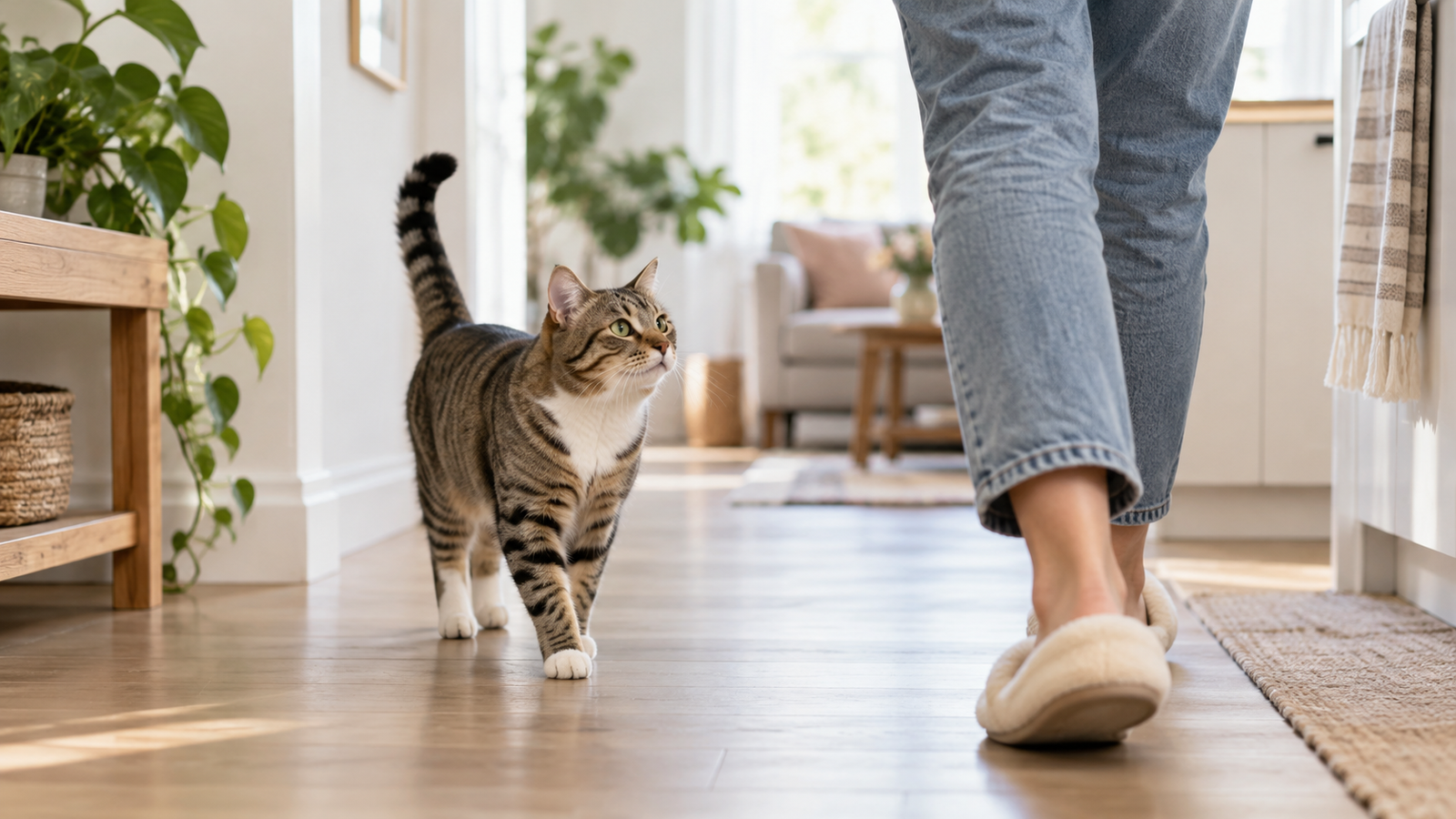

If your cat trails you from room to room, waits outside the bathroom door or appears the moment you sit down, you’re far from alone. Cats have a reputation for being aloof, but many build strong routines and close bonds with the people they trust.
In short: most cats follow their owners out of affection, curiosity, routine or the hope of food, and it’s usually completely normal. It’s worth a closer look if the following starts suddenly and comes with changes in appetite, litter box habits, voice or energy.
Why cats follow their owners
There’s rarely just one reason. Affection, curiosity, routine, food and a simple wish to know what’s going on can all play a part, and most cats follow for a mix of them.
| Reason | Clues to look for |
|---|---|
| Enjoying your company | Relaxed body, slow blinks, settling down near you |
| Expecting food | Following you to the kitchen, especially around mealtimes |
| Curiosity | Watching what you’re doing, sniffing new things you bring in |
| Wanting attention or play | Meowing, rubbing against your legs, bringing you a toy |
| Seeking security | Staying close after a change at home, or in a nervous cat |
They enjoy your company
Many cats genuinely like being near their favorite people. Research backs this up: a 2019 study published in Current Biology found that most of the cats tested showed a secure attachment to their owners, similar to the bonds seen in dogs and human infants. A cat that follows you around, then settles down calmly nearby, is often just choosing to be where you are.
They expect food or treats
Cats learn routines quickly. If you usually feed your cat when you wake up, get home or walk into the kitchen, it may follow you because it’s expecting something good to happen.
They’re curious
Cats are naturally alert to movement and changes around them. Walking into another room, opening a cupboard or closing a door can be enough to make your cat want to find out what you’re up to. That’s also why so many cats wait outside the bathroom: a closed door is interesting, and you’re briefly out of reach.
They want attention
Your cat may be asking for play, petting or company. Meowing, rubbing against your legs, weaving between your feet or bringing you a toy all make this reason easier to spot.
They feel safe around you
A trusted person can become a big part of a cat’s sense of security. You may notice more following in naturally cautious cats, in cats that are still settling into a new home, or after a change such as a house move, a new pet or visitors staying over.
Is it normal for a cat to follow you everywhere?
In most cases, yes. If your cat is eating normally, using the litter box as usual, resting comfortably and otherwise behaving like itself, following you is simply part of normal social behavior.
Some cats are naturally more independent, while others like near-constant company. Personality, breed, age, past experiences and the home environment all affect how closely a cat sticks to its owner.
When should you pay more attention?
A sudden change deserves more attention than a long-standing habit. Consider speaking to your vet if new or increased following comes with:
- Loss of appetite, or eating much more than usual
- Unusual vocalizing, especially at night
- Changes in litter box habits
- Restlessness or hiding
- Weight loss
- Reduced activity
- Other noticeable changes in normal behavior
These changes don’t automatically mean something is wrong, but they’re useful clues. In older cats, for example, a sudden increase in clinginess, appetite or night-time yowling can be linked to conditions such as an overactive thyroid or age-related changes in the brain, which a vet can check for.
Some cats also become distressed when left alone. If your cat seems unsettled whenever you leave, meows constantly, stops eating while you’re out or toilets outside the litter box when alone, mention it to your vet.
Should you encourage the behavior?
You don’t need to stop a healthy cat from following you. Instead, make sure it also has plenty to do on its own, so its world doesn’t revolve entirely around you.
- Schedule regular interactive play, ideally a couple of short sessions a day with a wand toy.
- Offer comfortable resting places around the home, including somewhere high up.
- Provide scratching posts, puzzle feeders and a window perch to watch outside.
- Keep feeding times and daily routines reasonably consistent.
What your cat may be telling you
For most cats, following a person is a mix of trust, curiosity and routine. Look at your cat’s overall body language and daily habits rather than reading too much into one behavior on its own.
If your cat has always followed you and otherwise seems relaxed and healthy, the most likely explanation is a simple one: you have a companion who enjoys being part of whatever you’re doing.
If your cat is new to your home, our guide on helping a new cat settle in may also be useful.
Frequently asked questions
Why does my cat follow me everywhere?
Most cats follow their owners because they enjoy their company, expect food, are curious about what’s happening or want attention. It’s usually normal, especially if your cat is otherwise eating, playing and behaving as usual.
Why does my cat follow me to the bathroom?
Closed doors make cats curious, and the bathroom is somewhere you’re briefly out of reach. Many cats also see it as a good moment for attention, since you’re sitting still.
Is it a bad sign if my cat suddenly starts following me?
Not always, but a sudden change is worth watching. If it comes with changes in appetite, weight, litter box habits, vocalizing or energy, speak to your vet to rule out a health problem.
Do cats get attached to their owners?
Yes. A 2019 study published in Current Biology found that most of the cats tested formed a secure attachment to their owners, similar to the bonds seen in dogs and human infants.