
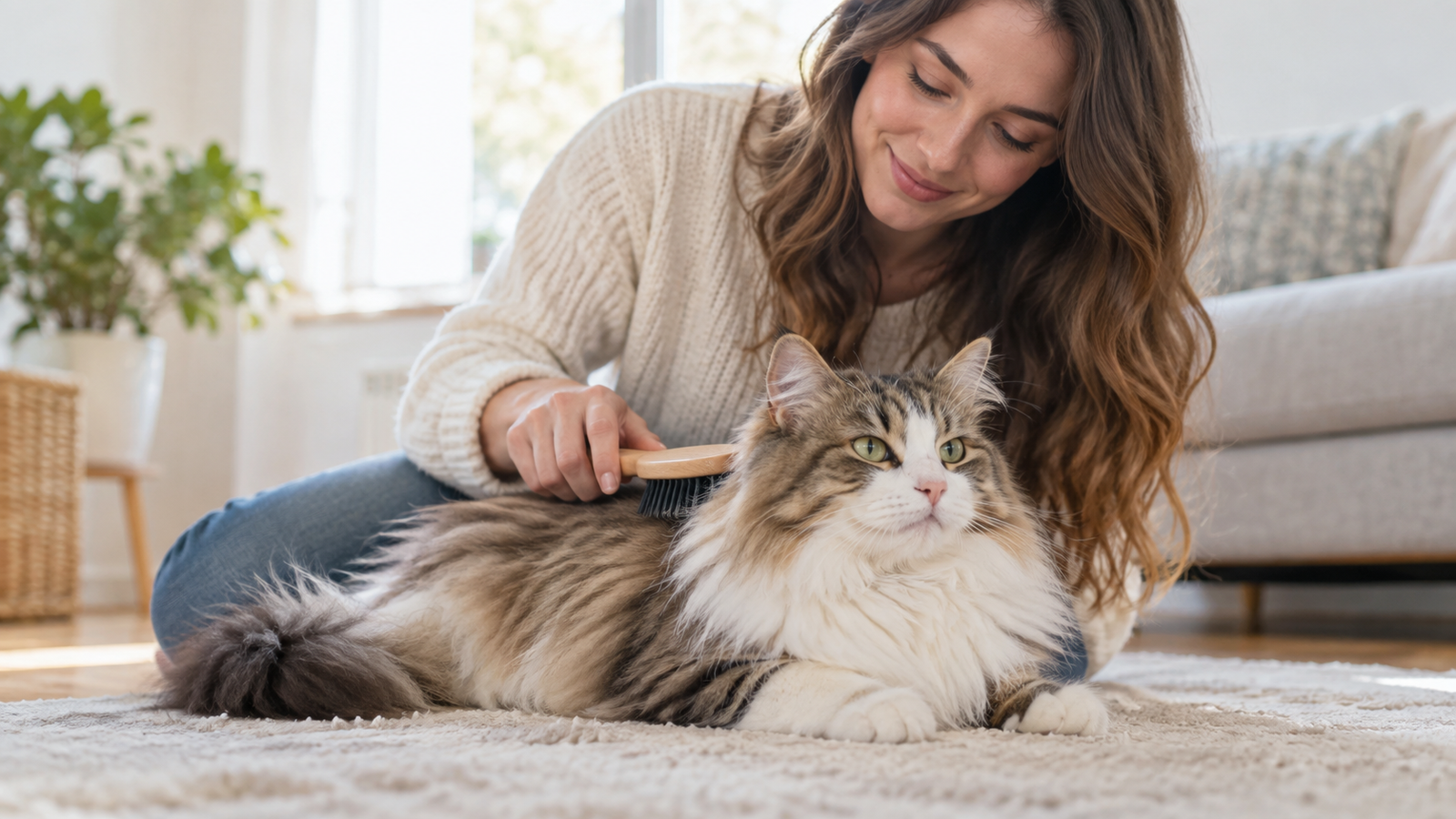

Regular brushing removes loose hair, prevents tangles and gives you a chance to spot any changes in your cat’s skin or coat early. How often you need to brush depends mostly on coat length, how much your cat sheds and its individual needs.
In short: brush most short-haired cats once or twice a week and most long-haired cats daily or close to it. Use a brush suited to the coat, keep sessions short and calm, and never cut out mats with scissors.
| Coat type | How often | Useful tools |
|---|---|---|
| Short hair | Once or twice a week, more during heavy shedding | Rubber grooming brush or mitt, soft bristle brush |
| Medium hair | A few times a week | Slicker brush and a metal comb |
| Long hair | Daily or nearly every day | Wide-toothed metal comb and a slicker brush |
Short-haired cats
Many short-haired cats do well with a brush once or twice a week. Brushing more often during heavy shedding periods, often in spring and autumn, helps keep loose hair under control. Indoor cats may shed steadily all year round.
Brushing also means your cat swallows less loose hair while grooming itself, which can help reduce hairballs.
Long-haired cats
Long-haired cats need much more frequent grooming, because their coats tangle and mat easily. For many, daily or near-daily brushing is the only way to stay ahead of knots. Work through the coat in sections, combing right down to the skin rather than just skimming the top layer, which is where mats often hide.
Start gently
If your cat isn’t used to being brushed, start with very short sessions of a minute or two, focusing on areas it enjoys having stroked, such as the cheeks, back and chest. Use a brush that suits its coat, and pair brushing with treats or praise.
Stop before your cat gets irritated. Signs it has had enough include a twitching or lashing tail, skin rippling along the back, flattened ears or turning to nip. Ending on a good note makes the next session easier.
Watch for mats and skin changes
Tangles form most easily behind the ears, in the armpits, under the legs and around the belly and rear. As you brush:
- Check the skin for redness, scabs or irritation.
- Look for bald patches, thinning fur or unusual dandruff.
- Keep an eye out for fleas or flea dirt, small dark specks that turn reddish-brown on damp white paper.
- Never pull hard on a tight mat.
- Ask a professional groomer or your vet to deal with severe matting.
Don’t cut mats out with scissors. A cat’s skin is thin and gets pulled up into the mat, so it’s very easy to cut it by accident. Small, loose tangles can often be teased apart gently with your fingers or a comb, but leave tight or large mats to a professional.
Bald patches, scabs or heavy dandruff can have a medical cause, such as fleas, allergies, skin infections or stress-related overgrooming. If you notice these, have your vet take a look.
Older cats may need more help
Senior cats, overweight cats and cats with arthritis or other mobility problems often struggle to reach every part of their body when grooming. Their lower back and rear end can become greasy, scurfy or matted. These cats benefit from gentle, regular brushing, with extra care over bony or sore areas.
A sudden drop in self-grooming can also be a sign that a cat is unwell or in pain, so mention it to your vet.
Make grooming part of the routine
Short, calm grooming sessions every few days are much easier than tackling a coat that’s already tangled. Once your cat is comfortable with it, regular brushing can become a relaxing bonding routine for you both.
Setting up for a new cat? Our checklist of new cat essentials includes the grooming tools worth buying.
Frequently asked questions
How often should I brush my cat?
Most short-haired cats need brushing once or twice a week, with more during heavy shedding. Long-haired cats usually need brushing daily or nearly every day to prevent tangles and mats.
Does brushing help with hairballs?
It can. Brushing removes loose hair before your cat swallows it while grooming itself, which can reduce how many hairballs it brings up. If your cat has frequent hairballs, check with your vet.
Can I cut mats out of my cat’s fur?
It’s best not to use scissors. A cat’s skin is thin and easily pulled into a mat, so it’s very easy to cut it by accident. Gently tease out small tangles, and ask a professional groomer or your vet to remove tight or large mats.
What brush is best for a long-haired cat?
A wide-toothed metal comb and a slicker brush are a good combination for long-haired cats. Comb down to the skin in small sections to find and prevent mats.