
A reptile enclosure can look bright and warm and still be missing the one thing many lizards and tortoises need most from their lighting: ultraviolet B. You can’t see UVB, you can’t feel it, and a lamp can keep glowing long after it has stopped producing useful amounts.
Getting UVB lighting for reptiles right isn’t complicated, though. Once you know what the light does and what weakens it on the way to your animal, choosing and placing a lamp becomes fairly straightforward.
Key points: UVB lets reptiles make vitamin D3 in their skin, which they need to absorb calcium. Daytime baskers such as bearded dragons and tortoises need a strong source, and even many nocturnal species benefit from a low level. Long linear tubes give the most natural spread. Glass and plastic block UVB, mesh reduces it, and output fades with age, so replace lamps on schedule. Heat and UVB are separate jobs and usually need separate lamps.
Why reptiles need UVB
When UVB reaches a reptile’s skin, it starts a reaction that produces vitamin D3, with warmth helping to complete the process. The body then uses vitamin D3 to absorb calcium from food. Without enough of it, a reptile can eat a calcium-rich diet and still come up short, because the calcium passes through rather than being taken in.
Over weeks and months, that shortfall leads to metabolic bone disease, where the body draws calcium out of the skeleton to keep blood levels up. Bones soften, limbs and jaws swell or bend, and poor UVB is one of the main causes.
Which reptiles need it
Any reptile that basks in daylight in the wild should have UVB in captivity. That includes bearded dragons, uromastyx, iguanas, chameleons, day geckos, tortoises and aquatic turtles. For these animals a suitable lamp isn’t optional.
Nocturnal and crepuscular species are less clear-cut. Leopard geckos, crested geckos and many snakes were long kept without UVB, relying on vitamin D3 in their diet or supplements. Research has since shown that leopard geckos do make vitamin D3 from UVB, and many exotic vets and keepers now recommend a low-level source with plenty of shade, so the animal can choose its own exposure. If you keep one of these species, ask your reptile vet what they advise for your animal.
Tubes or compact bulbs?
UVB lamps come in a few main shapes, and the shape changes how the light spreads.
- Linear T5 tubes are slim fluorescent tubes. The high output versions are strong enough for desert baskers in taller enclosures and are the usual choice for bearded dragons.
- Linear T8 tubes are wider and weaker. They suit smaller enclosures and species that only need low levels.
- Compact bulbs screw into a standard socket. They throw a narrow cone of UVB, so they only really work in small enclosures, and they leave much of the space unlit.
- Mercury vapor and metal halide lamps produce heat, bright light and UVB together. They can work well in large, tall setups, but output varies between products and positioning takes care.
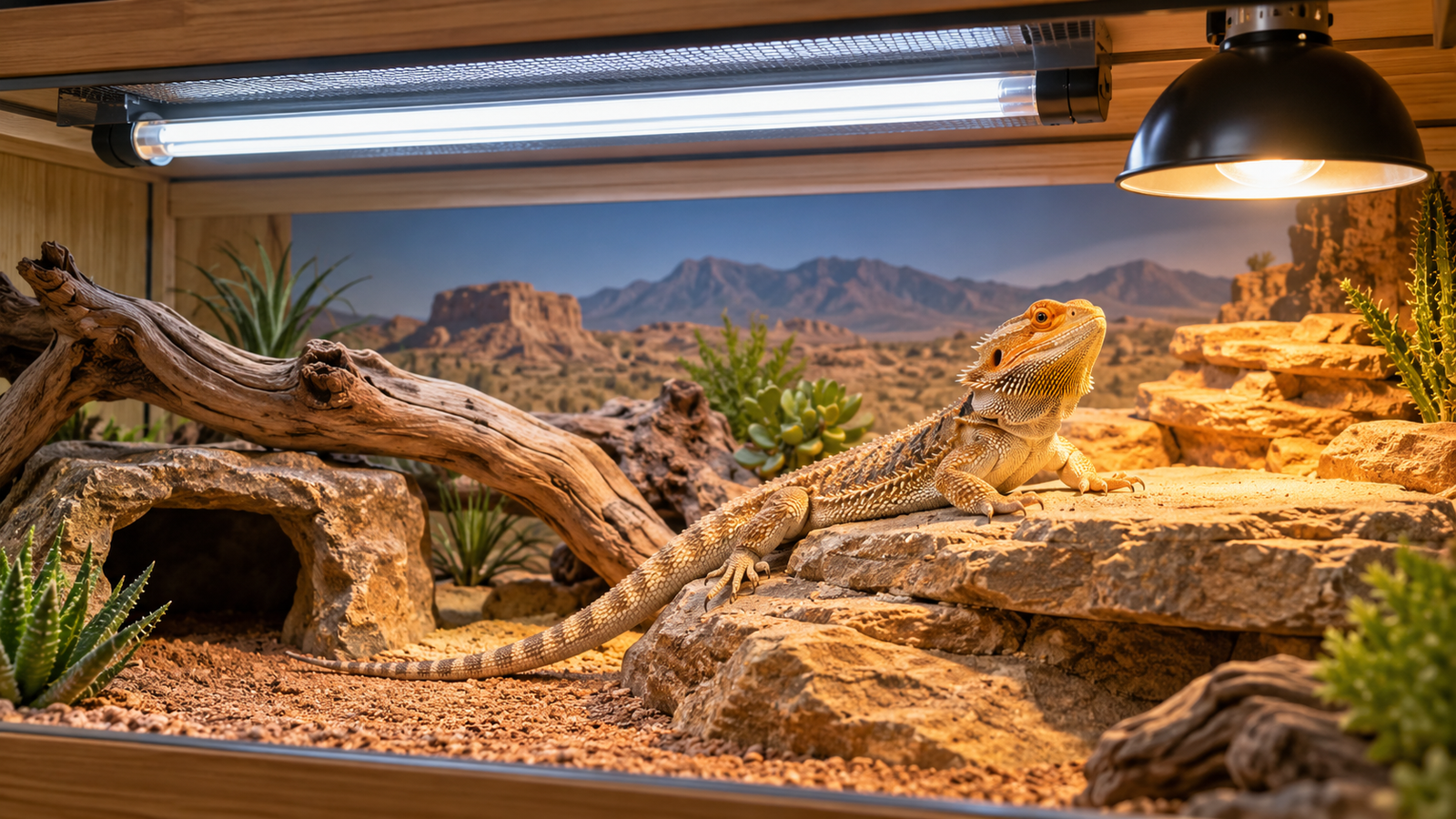
For most pet lizards and tortoises, a linear tube running up to about half the length of the enclosure, mounted over the warm end, gives the best result. It mimics a patch of sunlight and leaves shade to retreat to.
Distance, mesh and glass
UVB drops off quickly as it travels away from the lamp. A tube that delivers the right level at a basking spot a short way below it may give very little a foot or so further down. The correct mounting distance depends on the strength of the lamp, so follow the manufacturer’s guidance for your species rather than a general rule.
Three things quietly reduce what reaches your pet:
- Glass, including ordinary window glass and vivarium glass, blocks UVB completely. A sunny windowsill does not provide it.
- Most clear plastics block all or most UVB too, so a lamp should never sit behind a plastic cover that wasn’t designed for UV.
- Mesh screen tops let UVB through but absorb a noticeable share. Measurements on common reptile screens show losses from about a quarter to nearly half, depending on how fine the mesh is.
If your lamp sits above a mesh lid, you’ll usually need a stronger lamp or a closer basking spot than you would with the lamp inside the enclosure. Mounting it too close, though, risks eye and skin damage, so aim for the target level rather than simply “more.”
UV index and Ferguson zones, simply put
Keepers and vets measure UVB at animal level using the UV index (UVI), the same scale used in weather forecasts. Research on wild reptiles sorted species into four groups, known as Ferguson zones, based on how much sun they seek out:
| Zone | Typical behavior | Highest UVI at basking spot | Examples |
|---|---|---|---|
| 1 | Shade dweller, active at dusk or night | About 0.6–1.4 | Leopard gecko, crested gecko |
| 2 | Occasional or partial-sun basker | About 1.1–3.0 | Green anole, ornate box turtle |
| 3 | Regular basker in morning or partial sun | About 2.9–7.4 | Yemen chameleon, leopard tortoise |
| 4 | Basks in full midday sun | About 4.5–9.5 | Uromastyx, chuckwalla |
These highest values apply only at the basking spot. Elsewhere, the level should fall away gradually to zero in the shade. For a bearded dragon, for example, RSPCA guidance suggests a UVI of roughly 3–5 in the basking zone. Check the recommended zone for your species with a reptile vet or a reputable care guide.
A handheld UV index meter is the only way to know what your lamp is really delivering. It takes the guesswork out of positioning and shows when a lamp is fading.
Replacing lamps before they fade
UVB output declines steadily with use, while the visible glow stays much the same. A lamp that looks fine may be giving your reptile a fraction of what it needs. Good-quality lamps typically need replacing about once a year, and some guidance suggests every 9–12 months. Cheaper lamps can fade within a few months. Follow the manufacturer’s schedule, write the fitting date on the lamp or in a notebook, and if you own a meter, test at the basking spot every month or two.
Important: if your reptile shows reduced appetite, weakness, swollen limbs, a soft or swollen jaw, or twitching, book a visit with a reptile vet. These can be signs of metabolic bone disease, which needs veterinary treatment as well as a lighting fix.
Heat and UVB are separate jobs
A common mistake is assuming the basking bulb takes care of UVB. Standard heat bulbs and halogen lamps give warmth and visible light but no useful UVB, and ceramic heat emitters give heat only. Most UVB tubes, on the other hand, produce very little heat. So most setups need two lamps working side by side: one for heat, one for UVB. The exception is mercury vapor and metal halide lamps, which provide both.
Position the two so they overlap over the basking area. Reptiles naturally take in warmth and UVB together, so a basking spot outside the UVB zone gives one without the other. Put both on a timer so day length stays consistent.
Bearded dragon owners can see where the UVB tube fits into a full enclosure in how to set up a bearded dragon tank properly. Keeping a tortoise instead? Lighting is part of setting up a safe home for a pet tortoise too.
Frequently asked questions
Can my reptile get UVB from sunlight through a window?
No. Ordinary glass blocks UVB completely, so sunlight through a window gives light and warmth but none of the UVB your reptile needs. Unfiltered outdoor sunlight does provide UVB, but only with careful supervision, shade and a secure enclosure.
How often should I replace a reptile UVB bulb?
Follow the manufacturer’s schedule. Good-quality lamps typically need replacing about every 9–12 months, and cheaper ones can fade sooner. The lamp will still glow after its UVB output has dropped, so don’t wait for it to fail.
Does a heat lamp provide UVB?
Usually not. Standard heat bulbs, halogen lamps and ceramic heat emitters give no useful UVB. Mercury vapor and metal halide lamps are the main types that provide heat and UVB together.
Do leopard geckos need UVB lighting?
Leopard geckos can survive with dietary vitamin D3, but research shows they can make vitamin D3 from UVB, and many vets now recommend a low-level UVB source with plenty of shade. Ask your reptile vet what suits your gecko.