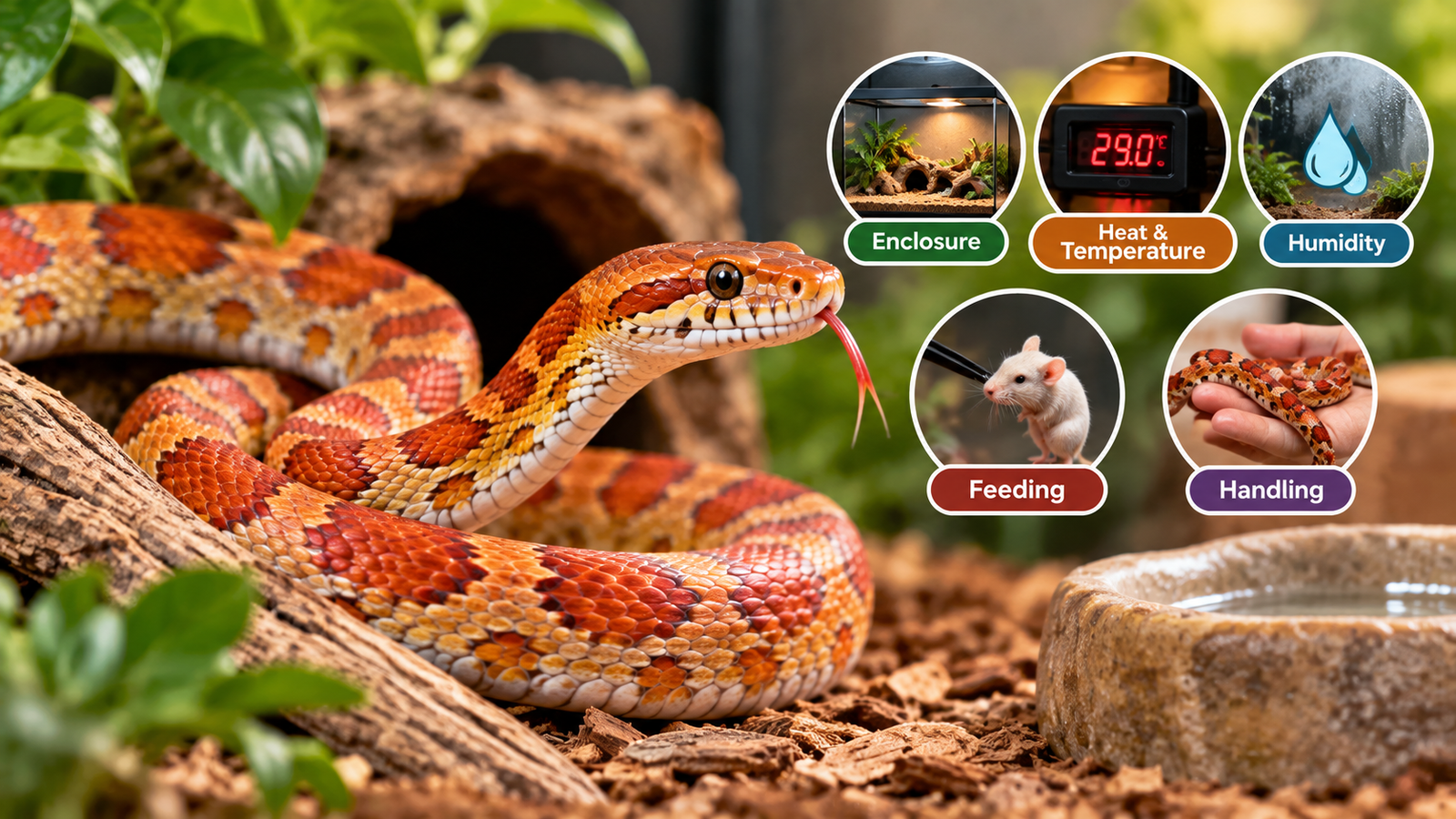

Corn snakes are among the most popular pet snakes for beginners. They are nonvenomous, usually calm with appropriate handling, relatively straightforward to feed and available in many colors and patterns.
Easy to care for does not mean maintenance-free, though.
A corn snake still depends entirely on its enclosure for the temperature, shelter, humidity, light and security it needs. Incorrect heating, poor ventilation, unsuitable humidity or an insecure enclosure can quickly turn a simple setup into a health problem.
This corn snake care guide covers the essentials for beginners, including enclosure size, heating, humidity, lighting, substrate, hides, feeding, shedding, handling, cleaning and signs that your snake needs a reptile veterinarian.
Corn Snake Care at a Glance
| Care Area | Beginner Guideline |
|---|---|
| Scientific name | Pantherophis guttatus |
| Adult length | Commonly around 120–150 cm (4–5 ft), although individuals vary |
| Lifespan | A long-term pet; many captive corn snakes live well into their teens and some exceed 20 years |
| Enclosure | Secure vivarium allowing the snake to fully stretch out |
| Basking area | About 28–30°C (82–86°F) |
| Cool end | About 20–24°C (68–75°F) |
| Humidity | Moderate; roughly 40–60% is a practical starting range, plus a humid hide |
| Diet | Appropriately sized frozen-thawed whole prey, usually mice |
| Feeding | Young snakes more frequently; adults commonly every 7–14 days |
| Housing | Keep individually |
| Handling | Gentle, supported handling after the snake settles in; avoid for at least 48 hours after feeding |
Are Corn Snakes Good Pets for Beginners?
Corn snakes are often considered suitable first snakes because their basic husbandry is less demanding than that of many more specialized reptiles.
They are usually:
- Nonvenomous
- Relatively manageable in size
- Good feeders
- Tolerant of gentle handling once settled
- Active enough to be interesting to observe
However, beginners still need to be comfortable feeding whole rodents and maintaining reptile-specific heating equipment.
A corn snake is also a long-term commitment rather than a short-lived starter pet.
How Big Do Corn Snakes Get?
Adult corn snakes are long, slender snakes.
Many reach roughly 120–150 cm, or around 4–5 feet, although some individuals may be smaller or larger.
Their slim body can make them appear much smaller than a heavy-bodied snake of the same length.
Do not choose an enclosure based only on the snake’s size when you buy it. Plan for the space the adult will eventually require.
How Long Do Corn Snakes Live?
Corn snakes can live for many years in captivity.
Published care sources vary in the lifespan they quote, but well-cared-for individuals can live through their teens and some survive for more than 20 years.
Before getting one, make sure you are prepared for the long-term costs of:
- Housing
- Heating
- Lighting
- Frozen prey
- Substrate
- Veterinary care
Corn Snake Enclosure Size
The enclosure should allow your corn snake to fully stretch its body rather than forcing it to remain permanently curled.
A useful welfare-based minimum guideline is:
- Enclosure length at least approximately the snake’s full length
- Width at least about one-third of the snake’s length
- Height at least about one-third of the snake’s length
For example, a 150 cm adult would need an enclosure around 150 cm long and approximately 50 cm wide and 50 cm high as a minimum starting point.
Larger is beneficial when the enclosure remains secure, well furnished and properly heated.
Do Corn Snakes Need a Large Enclosure?
Yes.
Corn snakes may spend significant time hidden, but that does not mean they need little space.
They naturally:
- Explore
- Burrow under cover
- Move between temperature zones
- Climb
- Search for shelter
A larger, well-furnished enclosure allows more natural behavior than a bare enclosure that only provides enough room to coil.
What About a Baby Corn Snake?
Hatchlings need to feel secure.
A young snake can be housed in a smaller escape-proof enclosure and upgraded as it grows, or it can use a larger enclosure if you provide plenty of tight hides, foliage and ground cover.
The important point is security.
A large empty enclosure may feel exposed, while a large enclosure filled with safe cover can provide both space and protection.
Make the Enclosure Escape-Proof
Corn snakes are excellent at finding gaps.
A secure enclosure needs:
- Tightly fitting doors
- Secure ventilation openings
- No gaps around cables
- Locks or clips where necessary
- No loose lid corners
Young corn snakes can fit through surprisingly small openings.
Set Up the Enclosure Before Bringing the Snake Home
Do not build the habitat after the snake arrives.
Run the complete enclosure in advance so you can confirm:
- The thermostat works
- The basking area reaches the correct temperature
- The cool end remains cool enough
- Humidity is stable
- Lighting timers work
- The enclosure is escape-proof
The RSPCA recommends running a new corn snake vivarium for about a week before introducing the snake.
Corn Snake Temperature Gradient
Corn snakes are ectothermic.
They depend on environmental heat rather than producing enough internal heat to regulate their body temperature like a mammal.
The enclosure should therefore have a warm end and a cool end.
| Area | Target Temperature |
|---|---|
| Basking / warm area | About 28–30°C (82–86°F) |
| Cool end | About 20–24°C (68–75°F) |
| Night | A natural drop can occur; around 16–20°C (61–68°F) can be acceptable when the enclosure and snake are otherwise healthy |
The purpose of the gradient is choice.
Your snake should be able to warm itself and then move to a cooler area without leaving the security of its enclosure.
Use a Thermostat With Every Heat Source
Every powered heat source should be controlled by a suitable thermostat.
This includes:
- Heat lamps
- Ceramic heat emitters
- Heat mats
- Other reptile heaters
The thermostat helps prevent dangerous overheating if room temperature changes or equipment becomes hotter than expected.
How to Measure Corn Snake Temperatures
Use digital equipment rather than relying only on inexpensive stick-on analog dials.
A practical setup includes:
- A digital thermometer at the warm end
- A digital thermometer at the cool end
- An infrared temperature gun for checking surface temperatures
Check temperatures regularly, especially after:
- Changing bulbs
- Changing substrate depth
- Moving the enclosure
- Seasonal room-temperature changes
What Is the Best Heat Source for a Corn Snake?
An overhead heat source positioned at one end of the enclosure can create an effective basking zone and temperature gradient.
Suitable systems may include a properly installed:
- Heat lamp
- Halogen basking lamp
- Non-light-emitting heater when nighttime heat is genuinely required
Any exposed heater must be positioned or guarded so the snake cannot touch a dangerously hot surface.
Can You Use a Heat Mat?
A heat mat can be used in some corn snake setups, particularly smaller grow-out enclosures.
However, it must be connected to an appropriate thermostat.
Never assume a heat mat is safe simply because its packaging describes it as low wattage.
Temperature must still be measured where the snake actually rests.
Avoid Heat Rocks
Do not use an electric heat rock as the primary heat source.
Localized heating devices can create surfaces hot enough to cause thermal burns if poorly regulated.
A properly controlled enclosure-wide temperature gradient is safer and more useful.
Does a Corn Snake Need Heat at Night?
Not necessarily.
If the room stays safely within the species’ nighttime range, heating can usually be reduced or switched off at night.
If the room becomes too cold, use a thermostat-controlled heat source that does not produce visible light.
Do not leave bright white, red or blue lights running all night.
Corn Snake Humidity
Humidity recommendations vary somewhat between reputable sources.
The RSPCA recommends around 40–50%, while other veterinary references allow a broader range.
For a beginner enclosure, roughly 40–60% relative humidity is a practical general target, provided the snake sheds cleanly and the enclosure remains well ventilated.
Use a digital hygrometer rather than guessing.
Do Not Chase One Exact Humidity Number
Humidity naturally changes during the day.
Small temporary changes are less important than avoiding conditions that are persistently:
- Very dry
- Wet
- Poorly ventilated
The enclosure floor should not remain constantly saturated.
Excessive dampness combined with poor ventilation can contribute to skin and respiratory problems.
Provide a Humid Hide
A humid hide creates a small area with higher humidity without making the entire enclosure wet.
It can be especially useful around shedding.
Use a secure hide containing slightly damp:
- Sphagnum moss
- Paper towel
- Another reptile-safe moisture-holding material
The material should be damp rather than dripping wet.
Replace it regularly if it becomes dirty or moldy.
Do Corn Snakes Need UVB?
Corn snakes have historically been kept successfully without strong dedicated UVB lighting, particularly because they obtain nutrients from whole prey.
However, modern welfare guidance increasingly supports providing a natural light-dark cycle and appropriate low-level UVB exposure.
The RSPCA recommends a low-output reptile UVB source with a gradient from low UV exposure near the basking area to complete shade elsewhere.
How Much UVB Should a Corn Snake Have?
The RSPCA suggests low-output UVB, generally in the 2–7% lamp range depending on the enclosure, distance and equipment.
The intended exposure is low compared with a strong desert-basking reptile.
Always provide shaded areas where the snake can completely avoid UVB.
Albino and other light-sensitive morphs may need even gentler exposure.
For more detail on lamp positioning, mesh, distance and replacement schedules, read: Reptile UVB Lighting: How It Works and Setup .
Give Your Corn Snake a Day-Night Cycle
A regular light cycle helps provide predictable environmental cues.
Around 12 hours of light and 12 hours of darkness is a simple starting schedule for general pet care.
Use a timer so the routine remains consistent.
All visible enclosure lighting should switch off at night.
Can Sunlight Through a Window Replace UVB?
No.
Ordinary window glass blocks most useful UVB.
Direct sunlight through glass can also overheat a reptile enclosure very quickly.
Keep the vivarium away from direct window sun unless temperature exposure is carefully controlled.
How Many Hides Does a Corn Snake Need?
Provide at least two secure hides:
- One at the warm end
- One at the cool end
A third humid hide is also useful.
This allows the snake to choose temperature and humidity without having to sacrifice security.
What Makes a Good Snake Hide?
Corn snakes often prefer snug spaces rather than large open caves.
The hide should:
- Allow the snake to fit completely inside
- Feel enclosed
- Remain stable
- Have no sharp edges
- Be easy to inspect and clean
Additional cover can make the snake more confident about exploring.
Do Corn Snakes Climb?
Yes.
Although often described as mainly terrestrial, corn snakes are capable climbers and benefit from safe opportunities to move above ground level.
You can add:
- Secure branches
- Cork bark
- Platforms
- Strong artificial vines
- Elevated hides
Everything must be stable enough to support the snake without falling.
Enrichment for Corn Snakes
Enrichment gives a snake opportunities to perform normal behavior rather than living in a bare container.
Useful enrichment includes:
- Multiple hides
- Branches
- Leaf litter
- Cork bark
- Artificial or reptile-safe live plants
- Burrowing substrate
- Different textures
- Visual barriers
Do not overcrowd the enclosure so heavily that you cannot inspect the snake or clean safely.
Best Substrate for a Corn Snake
Several substrates can work when maintained properly.
Options include:
- Reptile-safe organic soil mixes
- Suitable soil-and-sand blends
- Leaf litter over appropriate natural substrate
- Aspen bedding kept clean and dry
The substrate should allow some natural burrowing while remaining easy enough to monitor and maintain.
Paper Towel for New or Sick Snakes
Paper towel or newspaper can be useful temporarily when:
- A new snake is being monitored
- The snake is in quarantine
- You need to inspect droppings
- A veterinarian recommends simplified housing during treatment
It is easy to replace and makes waste obvious.
However, it provides little opportunity for natural digging and should not automatically be treated as the best permanent substrate for a healthy snake.
Substrates to Avoid
Avoid materials with unnecessary risk, including:
- Cedar shavings
- Aromatic pine shavings
- Corn cob bedding
- Crushed walnut shell
- Sand used by itself
- Sharp gravel
Some materials can irritate the skin or respiratory system, hold mold when damp, or cause problems if swallowed.
Fresh Water
Provide clean drinking water at all times.
Use a heavy, stable bowl that is difficult to tip.
The bowl should be large enough for the snake to enter if it chooses, without creating a drowning or entrapment risk.
Change the water at least daily and immediately if the snake soils it.
What Do Corn Snakes Eat?
Corn snakes are carnivores.
Captive pets are commonly maintained on appropriately sized whole rodents, with mice forming the staple diet for most individuals.
Whole prey provides:
- Muscle meat
- Organs
- Bone
- Fat
- Other nutrients
Because the prey is nutritionally complete as a whole animal, a healthy corn snake eating suitable rodents usually does not require routine calcium or vitamin powder.
Frozen-Thawed Prey Is Safer Than Live Prey
Use pre-killed or frozen-thawed rodents rather than live mice whenever possible.
A frightened live rodent can bite and seriously injure a snake.
Rodent bites may cause:
- Deep wounds
- Infection
- Eye injury
- Permanent scarring
How Big Should a Corn Snake’s Mouse Be?
Choose prey based on the snake’s body size rather than simply its age.
A common guideline is to offer prey approximately equal to, or slightly wider than, the snake’s widest body section.
The prey should create a modest temporary bulge after swallowing rather than an extreme stretch.
Corn Snake Feeding Schedule
Feeding frequency changes as the snake grows.
| Life Stage | General Feeding Pattern |
|---|---|
| Hatchling | Appropriately sized pinky mouse about every 5–7 days |
| Growing juvenile | Appropriately sized prey roughly every 7 days, adjusted for growth and condition |
| Adult | Appropriately sized prey commonly every 7–14 days |
These are starting guidelines rather than fixed rules.
Adjust the schedule according to:
- Prey size
- Snake size
- Age
- Activity
- Body condition
- Veterinary advice
Do Not Overfeed a Corn Snake
Corn snakes often have good appetites, which makes overfeeding easy.
Regularly weigh your snake and watch its body condition.
A healthy corn snake should look rounded but not thick and sausage-like.
The spine should not be sharply visible, but the body should also not develop heavy fat rolls or an exaggerated rounded shape.
Feed With Tongs
Use long feeding tongs to present prey.
This keeps your fingers away from the feeding response and reduces the chance that your hand smells like food.
Wash your hands after preparing prey and before handling your snake.
Should You Feed a Corn Snake Inside Its Enclosure?
Yes, feeding inside the normal enclosure is acceptable.
The RSPCA specifically recommends offering prey inside the vivarium with tongs.
Moving a snake to a separate feeding box is not necessary for routine feeding and means handling the snake around mealtime.
The more important habits are:
- Use feeding tongs
- Use correctly sized prey
- Do not smell strongly of rodent when handling
- Leave the snake undisturbed after eating
How Long Should You Wait to Handle After Feeding?
Wait at least 48 hours after a meal before routine handling.
Handling too soon can disturb digestion and increase the risk of regurgitation.
What if Your Corn Snake Refuses Food?
One missed meal is not automatically an emergency.
Temporary appetite changes can occur around:
- Shedding
- Stress after moving
- Seasonal changes
- Incorrect temperatures
First check the enclosure conditions.
If food refusal continues, especially with weight loss or other signs of illness, contact a reptile-experienced veterinarian.
Do Corn Snakes Need Food Supplements?
A corn snake eating good-quality whole prey normally does not need routine calcium powder or multivitamin supplements.
Whole prey already includes bone, organs and other nutrient-rich tissues.
Do not add supplements unless a reptile veterinarian identifies a specific need.
Bringing a New Corn Snake Home
The first few days should be quiet.
Place the snake into its prepared enclosure and allow it to explore without unnecessary interference.
During the first week:
- Keep handling minimal
- Maintain stable temperatures
- Keep fresh water available
- Observe breathing and movement
- Check for mites or visible injuries
- Allow the snake to use its hides
Do not repeatedly remove the snake simply because it remains hidden.
Hiding is normal behavior.
When Should You Start Handling a New Corn Snake?
Give a new snake time to adjust first.
A week without unnecessary handling is a reasonable minimum starting point for many newly arrived corn snakes.
It is even better to wait until the snake appears settled and is feeding normally before beginning frequent handling.
How to Handle a Corn Snake
Approach calmly and scoop the snake up from underneath rather than grabbing it tightly from above.
Support different sections of the body with both hands.
Allow the snake to move through your hands rather than trying to hold it rigidly in one position.
Never Grab the Head or Tail
Do not routinely restrain a corn snake by:
- The head
- The neck
- The tail
Firm restraint creates stress and can injure the snake.
Head restraint should generally be reserved for situations where a trained veterinarian or experienced professional genuinely needs it.
How Long Can You Hold a Corn Snake?
Short sessions are best, especially at first.
Around 10–15 minutes can be a reasonable handling period in a comfortable room.
Return the snake sooner if it becomes:
- Very restless
- Cold
- Defensive
- Repeatedly trying to escape
Signs a Corn Snake Does Not Want to Be Handled
A stressed or defensive corn snake may:
- Pull its head and neck into an S-shaped position
- Strike
- Move away rapidly
- Remain unusually tense
- Musk
If the snake is clearly defensive, leave it alone and try again another day.
Avoid Handling During Shed
Snakes often become more defensive while preparing to shed because their vision becomes temporarily reduced as the eye caps turn cloudy.
They may also prefer to remain hidden.
Keep handling to a minimum until shedding is complete.
Corn Snake Shedding
Healthy snakes periodically shed the outer layer of their skin.
Young growing snakes usually shed more frequently than adults.
Before shedding, you may notice:
- Duller body color
- Cloudy or blue-looking eyes
- More hiding
- Reduced appetite
- Greater defensiveness
Why Do the Eyes Turn Blue Before a Shed?
Snakes have transparent scales over their eyes called spectacles or eye caps.
During the shedding process, fluid develops beneath the old skin and can make the eyes look cloudy or bluish.
The eyes may become clearer again shortly before the actual shed begins.
Helping a Corn Snake Shed Properly
Good shedding depends heavily on husbandry.
Provide:
- Appropriate baseline humidity
- A humid hide
- Fresh drinking water
- Safe rough surfaces such as cork bark or branches
The snake should normally remove the old skin without being peeled by the owner.
Check the Shed Skin
After the snake sheds, inspect both the snake and the old skin.
Pay particular attention to whether the shed appears to include:
- Both eye caps
- The tail tip
- The rest of the skin without tight retained rings
What if the Eye Caps Do Not Shed?
Do not pull retained eye caps off with tweezers or tape.
The transparent spectacle protecting the eye can be injured if the wrong layer is removed.
Correct the husbandry and have persistent retained eye caps assessed by a reptile veterinarian.
Cleaning the Corn Snake Enclosure
Good hygiene reduces exposure to waste, mold and infectious organisms.
Remove:
- Droppings
- Urates
- Soiled substrate
- Regurgitated food
- Contaminated shed material
as soon as you notice them.
Daily Cleaning
Each day:
- Check and replace drinking water
- Remove visible waste
- Check for wet or moldy substrate
- Check temperature and humidity
- Confirm the enclosure remains locked
Deep Cleaning
Periodically perform a more complete clean of:
- Enclosure surfaces
- Water bowls
- Hides
- Branches
- Other washable furnishings
The RSPCA recommends a thorough enclosure clean around monthly in addition to ongoing spot cleaning.
Use a reptile-safe disinfectant according to its instructions, then rinse and dry surfaces before returning the snake.
Wash Your Hands After Handling
Reptiles can carry Salmonella without appearing sick.
Wash your hands thoroughly with soap and water after:
- Handling the snake
- Touching substrate
- Cleaning the enclosure
- Handling bowls or decorations
Children should be supervised around reptiles and should also wash their hands afterward.
Should Corn Snakes Live Together?
No.
Corn snakes are best housed individually.
Keeping one snake per enclosure makes it much easier to monitor:
- Feeding
- Weight
- Droppings
- Shedding
- Illness
It also removes competition for hides, warm areas and other resources.
Quarantine New Reptiles
If you already keep reptiles, do not immediately place a newly acquired corn snake near the rest of the collection.
Merck Veterinary Manual recommends quarantine periods of approximately 3–6 months for newly acquired reptiles because incubation periods for some reptile diseases are uncertain.
During quarantine:
- Use separate equipment
- Wash hands between animals
- Monitor feeding and weight
- Check droppings
- Watch for mites
- Arrange a reptile veterinary examination
How to Tell if a Corn Snake Is Healthy
A healthy corn snake usually has:
- Clear eyes when not preparing to shed
- Smooth, intact skin
- A clean vent
- Regular tongue flicking
- Good muscle tone
- No abnormal swellings
- Quiet, clear breathing
- A stable body condition
Knowing what is normal for your individual snake makes changes easier to spot.
Common Corn Snake Health Problems
Corn snakes can develop several common reptile health problems, including:
- Abnormal shedding
- Respiratory infections
- Mouth infections
- External parasites such as snake mites
- Internal parasites
- Burns
- Skin infections
- Constipation or gastrointestinal obstruction
- Cloacal prolapse
- Egg-binding in females
- Injuries
Correct husbandry prevents many problems but cannot replace veterinary treatment once disease develops.
Respiratory Infection Signs
Contact a reptile veterinarian if your snake develops:
- Wheezing or unusual respiratory noise
- Mucus or bubbles around the nose or mouth
- Open-mouth breathing
- Repeatedly holding the head elevated
- Lethargy
- Loss of appetite with respiratory signs
Mouth Rot in Corn Snakes
Infectious stomatitis is commonly called mouth rot.
Possible signs include:
- Redness around the mouth
- Swelling
- Excess saliva
- Sores
- Blood or discharge
- Difficulty eating
- Loss of appetite
Mouth rot requires veterinary treatment.
Do not place human antiseptic creams, antibiotics or household chemicals inside a snake’s mouth.
Snake Mites
Snake mites are small external parasites.
Possible clues include:
- Tiny dark moving specks
- Specks around the eyes or skin folds
- Frequent rubbing
- Poor sheds
- Unusual soaking
- Reduced condition in heavy infestations
Mites can spread between reptiles, which is another reason quarantine matters.
Thermal Burns
Reptiles can remain against a dangerously hot surface long enough to cause serious burns.
Burns are more likely when:
- A heater has no thermostat
- A hot bulb is accessible
- A heat mat overheats
- Temperature probes are badly positioned
Blisters, reddened skin, dark damaged areas or open wounds need veterinary assessment.
Regurgitation
A corn snake may regurgitate a meal if digestion is disturbed.
Possible contributors include:
- Handling too soon after feeding
- Incorrect temperature
- Prey that is too large
- Stress
- Underlying disease
Repeated regurgitation is not normal and should be discussed with a reptile veterinarian.
When Should a Corn Snake See a Vet?
Arrange veterinary care for:
- Persistent refusal to eat with weight loss
- Repeated regurgitation
- Wheezing or nasal bubbles
- Open-mouth breathing
- Mouth swelling or discharge
- Persistent stuck shed
- Retained eye caps
- Skin blisters or ulcers
- Burns
- Mites
- Unexplained lumps
- Discharge from the vent
- Prolapsed tissue
- Sudden weakness or inability to move normally
Annual Reptile Health Checks
An annual examination with a reptile-experienced veterinarian is useful even when your corn snake appears healthy.
A veterinary visit can include evaluation of:
- Body condition
- Skin
- Mouth
- Eyes
- Breathing
- Diet
- Temperature setup
- Humidity
- Parasite risk
Taking photos of the enclosure, heaters, thermostat and lighting can help your veterinarian assess husbandry.
Daily Corn Snake Care Routine
- Check temperatures
- Check humidity
- Provide fresh water
- Remove visible waste
- Confirm doors and locks are secure
- Look briefly for unusual behavior or injury
Weekly Routine
- Inspect substrate condition
- Clean furnishings as needed
- Check heater and thermostat operation
- Inspect the snake’s skin and body condition
- Record feeding and shedding
Keep Simple Records
A corn snake care log can include:
- Feeding date
- Prey size
- Body weight
- Shed date
- Droppings
- Temperature changes
- Health observations
These records are especially useful if a health problem develops later.
Common Corn Snake Care Mistakes
- Using an enclosure that is too small
- Leaving gaps that allow escape
- Heating the entire enclosure to one temperature
- Using heat without a thermostat
- Using a heat rock
- Relying on inaccurate analog gauges
- Providing only one hide
- Keeping the substrate permanently wet
- Keeping humidity too low during shedding
- Leaving bright lights on at night
- Feeding prey that is too large
- Feeding live rodents unnecessarily
- Overfeeding adults
- Handling immediately after feeding
- Pulling retained eye caps off manually
- Housing multiple corn snakes together
- Skipping quarantine when adding another reptile
- Ignoring breathing changes or repeated food refusal
Frequently Asked Questions
Are corn snakes easy to care for?
Corn snakes are relatively straightforward compared with many reptiles, which makes them popular with beginners. They still need carefully controlled heat, a secure enclosure, suitable humidity, hiding places and an appropriate whole-prey diet.
What size enclosure does an adult corn snake need?
The enclosure should be long enough for the snake to fully stretch out. A useful welfare guideline is an enclosure length at least approximately equal to the snake’s body length, with width and height around one-third of its length or greater.
What temperature should a corn snake enclosure be?
A useful starting gradient is around 28–30°C (82–86°F) at the basking area and approximately 20–24°C (68–75°F) at the cool end.
Do corn snakes need a thermostat?
Yes. Every powered heat source should be controlled by an appropriate thermostat to reduce the risk of overheating and burns.
What humidity does a corn snake need?
Published recommendations vary, but moderate humidity is appropriate. Roughly 40–60% is a useful general starting range for many pet setups, together with good ventilation and access to a humid hide.
Do corn snakes need UVB?
Corn snakes have historically been maintained without dedicated UVB, but current welfare guidance increasingly recommends low-level UVB and a normal day-night light cycle. If UVB is used, provide plenty of shade and follow the lamp manufacturer’s distance guidance.
How many hides does a corn snake need?
Provide at least one secure hide at the warm end and one at the cool end. A third humid hide is useful, particularly during shedding.
What is the best substrate for a corn snake?
Appropriate choices can include reptile-safe natural soil mixtures or aspen maintained correctly. Paper towel can be useful temporarily for new, sick or quarantined snakes. Avoid cedar, aromatic pine, corn cob and sand used alone.
What do corn snakes eat?
Pet corn snakes are normally fed appropriately sized whole rodents, most commonly frozen-thawed mice.
How often should I feed a corn snake?
Hatchlings are commonly fed approximately every 5–7 days, growing juveniles around weekly, and adults every 7–14 days. Prey size, age and body condition should determine the final schedule.
Can corn snakes eat live mice?
Live prey is not recommended when safe pre-killed or frozen-thawed prey is available. A live rodent can bite and seriously injure a snake.
Should I feed my corn snake in a separate container?
It is not necessary. A corn snake can be fed inside its normal enclosure using feeding tongs. Moving the snake immediately before and after feeding can create unnecessary handling around digestion.
How long should I wait to handle a corn snake after feeding?
Wait at least 48 hours after feeding before routine handling so the snake can begin digesting its meal without disturbance.
Why are my corn snake’s eyes blue?
Cloudy or bluish eyes are normal shortly before shedding. The eye caps become temporarily cloudy during the shedding cycle. Eyes should return to their normal appearance after the process is complete.
What should I do about stuck shed?
Check temperature and humidity and provide a suitable humid hide. Persistent retained skin or eye caps should be discussed with a reptile veterinarian. Do not forcibly peel retained eye caps away.
Can two corn snakes live together?
Routine cohabitation is not recommended. Corn snakes are best kept individually so they do not compete for resources and so feeding, shedding and health can be monitored accurately.
How often should I handle my corn snake?
Once settled, short gentle handling sessions a few times per week are enough for many pet corn snakes. Avoid unnecessary handling during shedding, illness or for at least 48 hours after feeding.
Why is my corn snake hiding all day?
Hiding is normal snake behavior. Corn snakes naturally use protected spaces and may become more active during quieter parts of the day. Constant hiding becomes more concerning when combined with weight loss, abnormal breathing, poor shedding or other signs of illness.
Why is my corn snake not eating?
Temporary food refusal can occur during shedding, after moving or during seasonal changes. Check husbandry first. Continued refusal combined with weight loss or other health changes warrants veterinary assessment.
Do corn snakes need calcium powder?
A healthy corn snake fed complete whole prey normally does not require routine calcium dusting because bones and organs are already included in the prey.
How do I know if my corn snake is sick?
Warning signs include abnormal breathing, mucus around the nose or mouth, repeated food refusal with weight loss, regurgitation, skin sores, persistent stuck shed, mites, mouth swelling, unexplained lumps, prolapse or sudden weakness.
The Bottom Line
Good corn snake care begins with the enclosure.
Give your snake enough room to fully stretch and explore, but fill that space with secure hides, ground cover and climbing opportunities so it never has to choose between movement and safety.
Create a genuine temperature gradient rather than heating the entire enclosure evenly. A basking area around 28–30°C (82–86°F) with a cooler zone around 20–24°C (68–75°F) gives the snake the opportunity to regulate its own temperature.
Every heat source needs a thermostat, and temperatures should be verified with digital thermometers.
Moderate humidity is usually appropriate. Rather than keeping the entire enclosure wet, provide good ventilation and a dedicated humid hide that your snake can use around shedding.
Feed appropriately sized frozen-thawed whole prey. Hatchlings need smaller, more frequent meals, while healthy adults usually eat less often. Avoid routine live feeding, do not overfeed, and leave the snake undisturbed for at least 48 hours after a meal.
Gentle handling can make many corn snakes calm and manageable pets, but handling is not their main welfare need. A secure, enriched environment matters more.
Finally, learn your snake’s normal weight, appetite, breathing, shedding and behavior. Changes such as wheezing, mucus, repeated regurgitation, mouth swelling, persistent stuck shed, unexplained weight loss or skin lesions deserve attention from a reptile-experienced veterinarian.
References and Further Reading
RSPCA — How to Care for a Corn Snake
Species-specific guidance covering enclosure dimensions, temperature gradients, humidity, UVB, feeding, enrichment, handling, shedding and cleaning.
RSPCA: How to Care for a Corn Snake
Merck Veterinary Manual — Management and Husbandry of Reptiles
Veterinary guidance on reptile enclosure design, heating, humidity, nutrition, individual housing and quarantine.
Merck Veterinary Manual: Management and Husbandry of Reptiles
Merck Veterinary Manual — Routine Health Care of Reptiles
Preventive veterinary care, husbandry, signs of illness and reptile shedding.
Merck Veterinary Manual: Routine Health Care of Reptiles
PetMD — Corn Snake Care Sheet
Veterinarian-reviewed guidance covering corn snake feeding, housing, shedding, handling and common medical problems.
PetMD — Snake Mouth Rot
Veterinary information about infectious stomatitis, including redness, swelling, discharge, appetite changes and treatment.