
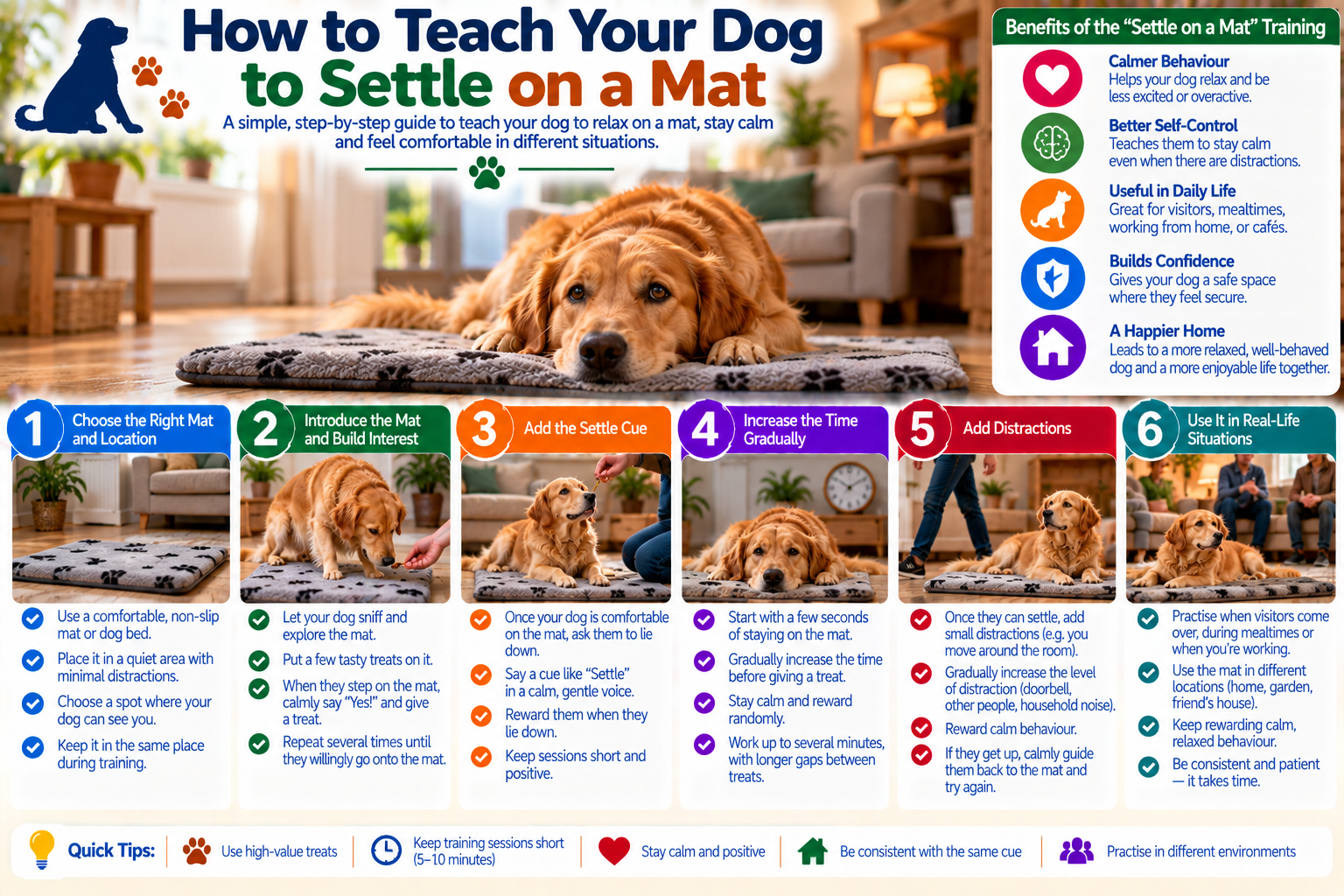

A dog lying down can still be watching every movement, ready to leap up. Teaching your dog to settle means creating conditions for genuine relaxation, then gradually making that skill useful during meals, conversations, and quiet outings. A portable mat gives the exercise a familiar starting point.
Quick answer: Start in a quiet, comfortable place after your dog’s basic needs are met. Reward voluntary calm behaviour on a nonslip mat. Build duration before adding movement or distractions, and let your dog leave instead of holding them in place.
Choose a moment when relaxation is possible
Check the basics first: a toilet opportunity, fresh water, comfortable temperature, and suitable activity. A mat is not a substitute for exercise, sleep, social contact, or pain treatment. Practising immediately beside a noisy doorway may be too difficult even for a dog who settles easily elsewhere.
Use a washable mat large enough for a relaxed posture. Put it on stable flooring beside your chair, away from foot traffic. If your dog chews or swallows fabric, choose a safer setup with professional guidance rather than leaving a loose blanket available.
Reward calm choices
- Sit quietly beside the mat with small food rewards ready. Avoid repeatedly calling your dog or waving food over it.
- Notice a voluntary approach, standing on the mat, or a comfortable lie-down. Place the reward gently on the mat.
- Watch for softer body language: resting a hip, lowering the head, or looking away from the food hand. Quietly reward those moments.
- Allow a small pause between rewards when your dog remains comfortable. If they pop up to demand the next treat, make the next session simpler.
- End with a consistent release such as “all done,” then put the mat away if you use it specifically for practice.
For example, your first session may contain just two relaxed moments while you sit with a drink. That is useful information. A short success is more valuable than stretching the exercise until the dog is whining or repeatedly leaving.
Add the cue after the pattern is familiar
When your dog reliably goes to the mat and relaxes in that setting, say a quiet cue such as “settle” as the familiar behaviour begins. Avoid chanting the word while your dog paces. The cue should come to predict an achievable routine.
Keep rewards small and include them in the daily food allowance. Some dogs become too excited about a particularly tasty treat; ordinary food may support a calmer session. Food is useful for teaching, but do not overlook comfortable positioning and a predictable environment.
| Challenge | Start here | Make it easier if |
|---|---|---|
| Duration | A few quiet moments beside your chair | The dog repeatedly rises to seek food |
| Your movement | Shift your feet or lift a cup | Every movement triggers following |
| A familiar person | Someone sits far away | The dog cannot disengage from them |
| A new location | A quiet room or sheltered outdoor spot | The dog scans, pants, or cannot rest |
Take the skill beyond the living room
Move the mat a short distance before trying an entirely different venue. Return to brief sessions and frequent rewards whenever the surroundings change. At an outdoor café, select a quiet time, ample space, shade where needed, and a place where people will not step over the dog. Keep appropriate lead control without tying the dog where they could become trapped or tangled.
Plan an exit. If your dog cannot relax, taking the drink away and going home is a sensible outcome. Public settling is optional; some dogs are happier resting at home while a trusted person cares for them.
Separate training difficulty from distress
A dog who leaves the mat once may simply need a shorter exercise. Persistent panting unrelated to heat, trembling, pacing, or inability to get comfortable warrants a different response. Check the environment and speak with your vet about sudden or ongoing restlessness.
Do not force stillness: Holding a frightened dog on a mat does not teach relaxation. Increase distance from the trigger and get qualified help when fear or pain may be involved.
If rest is difficult specifically when you leave, see our separation anxiety guide. For younger dogs, positive crate training is a separate skill and should also progress at the puppy’s pace.
Frequently asked questions
Is a settle the same as a down-stay?
No. A down-stay describes a position maintained until release. Settling focuses on relaxed behaviour; a dog can remain in a down while tense or highly alert.
Should I reward every few seconds forever?
No. Gradually vary and lengthen the pauses as relaxation becomes reliable. If the dog becomes frustrated or restless, reduce difficulty rather than suddenly removing all rewards.
Can I use the normal dog bed?
Yes, if it is comfortable and the dog enjoys it. A separate portable mat can make the routine easier to take to another safe location.