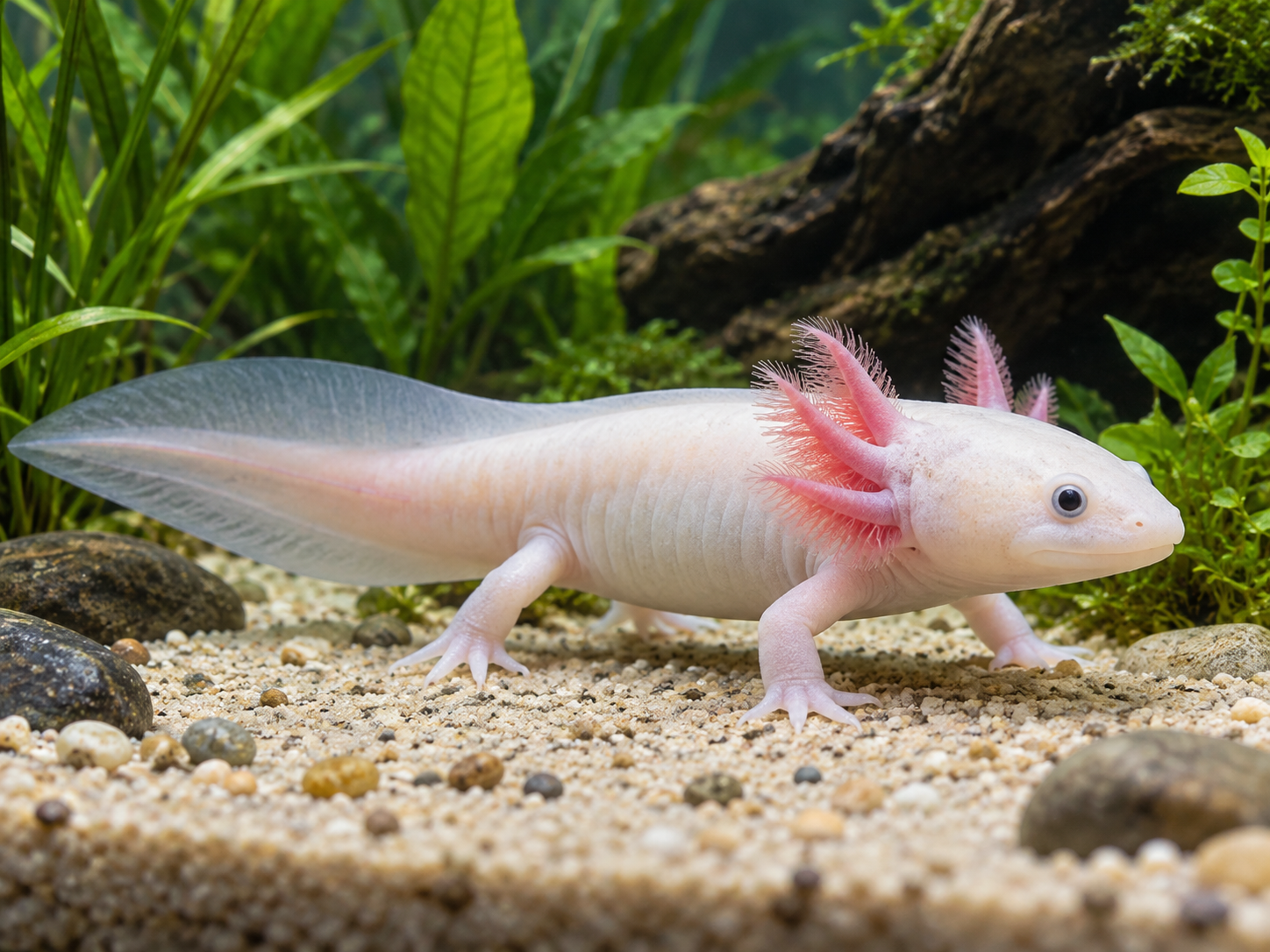

Axolotls are unusual aquatic amphibians with care needs that are quite different from those of most common pets. Their health depends heavily on the aquarium around them, especially water quality, temperature, filtration and diet.
If you are new to axolotl care, the most important thing is to prepare the aquarium before bringing the animal home. Once the environment is stable, everyday care becomes much easier to manage.
Axolotl Care at a Glance
| Care Area | What an Axolotl Needs |
|---|---|
| Environment | A fully aquatic freshwater aquarium |
| Water | Clean, dechlorinated and biologically established |
| Temperature | Cool and stable, with overheating avoided |
| Filtration | Effective filtration with gentle water movement |
| Food | Appropriate animal-based foods such as earthworms and suitable pellets |
| Handling | Minimal handling |
Prepare the Tank Before Your Axolotl Arrives
An axolotl spends its entire life in water, so its aquarium is more than a container — it is the animal’s complete living environment. Give it enough floor space to move comfortably and include smooth hiding places where it can rest away from bright light.
Avoid decorations with sharp edges. Small gravel and pebbles are also a poor choice because axolotls can accidentally swallow loose material while feeding, which may lead to an intestinal blockage.
A simple setup is often better than an overcrowded one. Safe hiding areas, suitable filtration and stable water conditions matter much more than decorative features.
Keep the Water Cool and Stable
Axolotls are cool-water amphibians and do not cope well with excessive heat. Water that becomes too warm can cause stress and make them more vulnerable to health problems.
Keep the aquarium away from direct sunlight, radiators and other sources of heat. During hot weather, a fan, air-conditioned room or aquarium chiller may be needed to prevent the temperature from climbing too high.
Water Quality Is One of the Most Important Parts of Axolotl Care
Amphibians have sensitive skin and are continually exposed to the water around them. Chlorine, ammonia and nitrite can all create serious problems, which makes regular water testing essential.
A properly cycled aquarium contains beneficial bacteria that process toxic waste. This biological cycle needs time to become established before an axolotl is added.
- Ammonia: should not be detectable in an established aquarium.
- Nitrite: should not be detectable.
- Nitrate: should be controlled with routine maintenance and partial water changes.
- Tap water: should be treated appropriately to remove chlorine or chloramine before use.
Test the aquarium regularly rather than relying on how the water looks. Poor water quality is not always visible.
Use Gentle Filtration
Axolotls benefit from filtration, but they do not need a strong current. Rapid or forceful water movement can cause stress and may damage their exposed external gills.
Choose a filter that keeps the aquarium clean without constantly pushing the axolotl around. Sponge filters and appropriately adjusted aquarium filters are commonly used options.
If your axolotl appears to struggle against the current, reassess the filter flow.
What Do Axolotls Eat?
Axolotls are carnivorous. Earthworms are commonly used as part of a suitable diet, along with appropriately formulated sinking pellets and other safe animal-based foods.
Young axolotls generally need to eat more frequently than healthy adults. The amount and frequency should also take the animal’s size, body condition and food type into account.
Remove leftover food before it begins to break down. Uneaten food adds waste to the aquarium and can reduce water quality.
Lighting and Hiding Places
Axolotls do not require intense aquarium lighting. A brightly lit tank without sheltered areas can make them uncomfortable.
Provide places where the axolotl can retreat from light, such as smooth caves, suitable plants or aquarium-safe shelters. Any decoration should be stable and free from sharp surfaces.
Can Axolotls Live With Other Animals?
For a beginner, a species-only aquarium is usually the simplest option. Fish may be eaten, some species may nip an axolotl’s delicate gills, and new animals can introduce parasites or disease.
Housing axolotls together also requires care. Differences in size, limited space and competition during feeding can lead to nipping or injury.
Keeping one axolotl on its own makes feeding, observation and health monitoring easier for a new owner.
Should You Handle an Axolotl?
Routine handling is best avoided. Axolotls have delicate skin and a protective mucus layer, and unnecessary handling can cause stress or injury.
If the animal must be moved for veterinary care or essential tank maintenance, minimize direct contact and use a clean, suitable container whenever possible.
Signs Your Axolotl May Need Attention
A change in appearance or behavior does not automatically identify a particular illness, but it can tell you that something is wrong.
Watch for changes such as:
- Persistent loss of appetite
- Unusual lethargy
- Difficulty maintaining a normal position in the water
- Persistent or uncontrolled floating
- Skin damage, redness or unusual patches
- Significant deterioration of the external gills
- Unexpected swelling or major changes in body condition
Check the water temperature and water quality promptly if your axolotl begins behaving unusually.
Simple Routine Maintenance
Axolotl tanks do not need to be completely stripped and cleaned every few days. Regular, moderate maintenance is safer for a stable aquarium.
- Check the water temperature regularly.
- Remove uneaten food and visible waste.
- Test the water routinely.
- Perform appropriate partial water changes.
- Check that the filter is working normally.
- Watch for changes in appetite, skin, gills and behavior.
Be careful when cleaning or replacing filter media. Beneficial bacteria living in an established filtration system play an important role in processing waste.
Common Axolotl Care Mistakes
- Adding an axolotl before the aquarium is cycled
- Allowing the water to become too warm
- Using small gravel or swallowable pebbles
- Creating excessive filter flow
- Using untreated tap water
- Overfeeding
- Leaving uneaten food in the tank
- Adding unsuitable tank mates
- Handling the axolotl unnecessarily
- Ignoring poor water-test results
Frequently Asked Questions
Are axolotls good pets for beginners?
They can be suitable for a well-prepared beginner, but they are not a pet that should be purchased before the enclosure is ready. Understanding aquarium cycling, water testing and temperature control is important.
Do axolotls need a heater?
Usually not. Axolotls prefer cool conditions, so preventing the aquarium from becoming too warm is generally a greater concern than adding heat.
Can I use tap water for an axolotl?
Tap water may be suitable after it has been treated correctly to remove chlorine or chloramine. Because water chemistry varies by location, routine testing remains important.
Can I hold my axolotl?
Routine handling is not recommended. Their skin and protective mucus layer are delicate, so unnecessary contact should be avoided.
Final Thoughts
Successful axolotl care is mostly about creating a stable environment. A properly cycled aquarium, clean dechlorinated water, cool temperatures, gentle filtration and an appropriate diet provide the foundation.
For a new owner, preparing the aquarium completely before bringing the axolotl home is one of the best ways to prevent avoidable problems. Once those basics are established, everyday care becomes much more straightforward.
Sources and Further Reading
- VCA Animal Hospitals — Axolotls as Pets
- MSD Veterinary Manual — Housing for Amphibians
- MSD Veterinary Manual — Environment and Husbandry for Amphibians