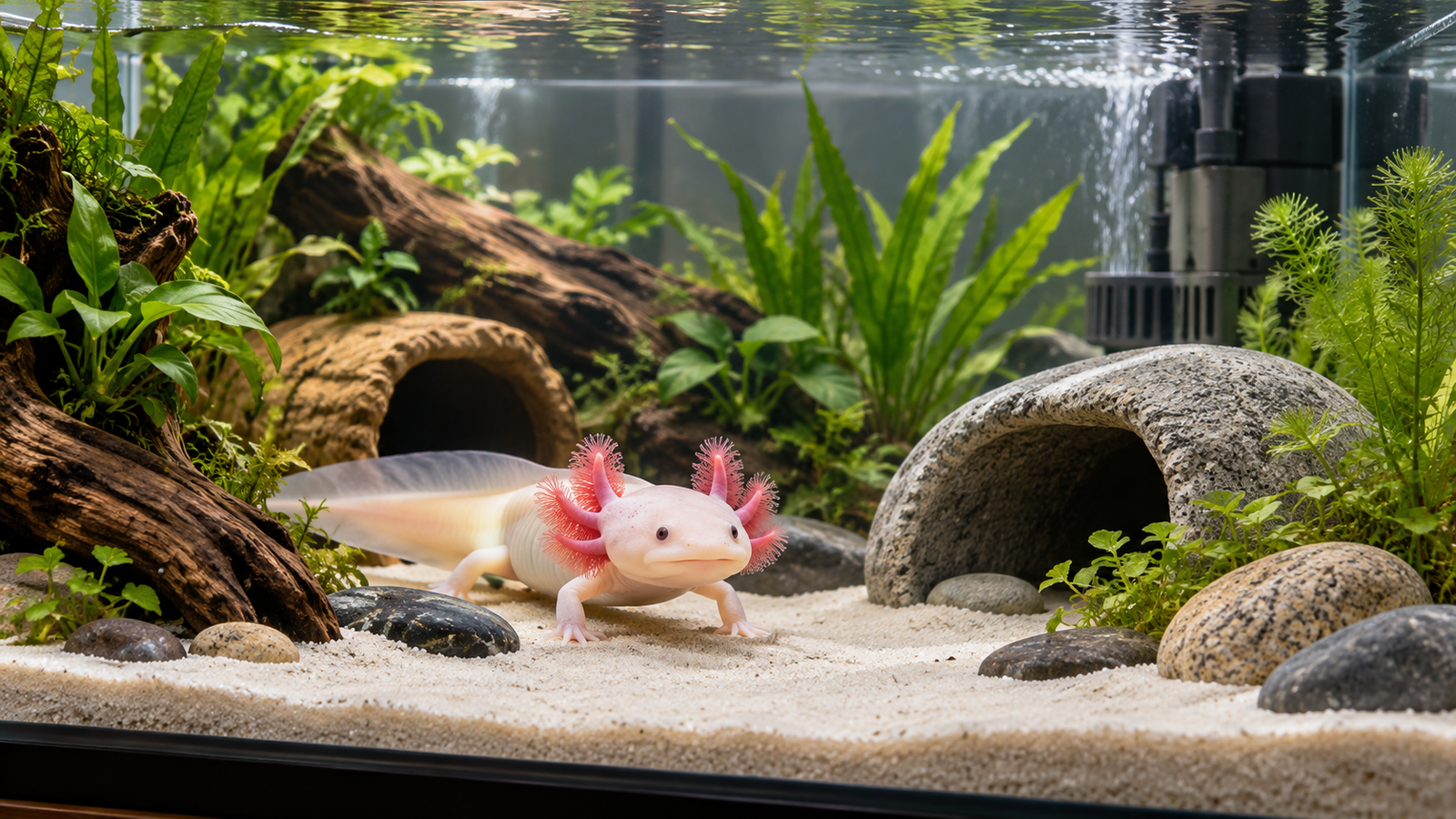

A good axolotl tank does not need to be complicated, but it does need to be planned carefully. Tank space, substrate, filtration, hiding places and water stability all affect how comfortable and healthy an axolotl can be.
The safest approach is to prepare the aquarium completely before the axolotl arrives. That gives you time to establish the biological cycle, test the equipment and make sure the water remains cool and stable.
Axolotl Tank Setup at a Glance
| Tank Feature | What to Aim For |
|---|---|
| Tank size | At least about 78 L (20 US gallons) for one adult, with larger tanks offering greater water stability |
| Water movement | Gentle rather than strong |
| Substrate | Bare bottom or another carefully chosen option that cannot easily be swallowed |
| Hiding places | At least one secure, smooth retreat away from bright light |
| Filtration | Appropriate for the tank volume with the output adjusted or diffused |
| Lighting | Low-level lighting with shaded areas available |
Choose Enough Tank Space
Adult axolotls can grow to a substantial size and spend much of their time moving along the bottom of the aquarium. Floor space is therefore especially useful when choosing a tank.
Veterinary care sheets commonly recommend a minimum of around 78 litres, or 20 US gallons, for one adult axolotl. A larger aquarium can be even easier to manage because a greater volume of water tends to change more slowly when waste builds up or temperature shifts.
Tank size should not be judged only by the number of litres. A longer aquarium with useful bottom area is often more practical than a tall, narrow tank with the same volume.
Make Sure the Tank Is Secure
Axolotls are completely aquatic, but they can still make sudden movements near the surface. A secure aquarium cover can help prevent accidental escapes while also protecting the tank from household debris.
Any lid or cover should still allow the equipment to operate safely and should not trap excessive heat. Temperature should always be monitored after making changes to the top of the aquarium.
Choose the Substrate Carefully
Substrate is one of the most important setup decisions because axolotls feed by gulping. Loose material can enter the mouth along with food.
Small gravel and pebbles that can fit into the axolotl’s mouth should be avoided. If swallowed, they may cause an intestinal blockage.
Bare-bottom tanks
A bare-bottom aquarium is one of the simplest options, especially for a new keeper. Waste and uneaten food are easy to see and remove, which can make routine cleaning straightforward.
The disadvantage is that a smooth glass floor may provide less traction, so the overall setup should still include secure hides and appropriate furnishings.
Large rocks
Some veterinary husbandry guidance also allows rocks that are clearly too large for the axolotl to swallow. They must be stable, smooth and positioned so they cannot shift or trap the animal.
Waste can collect between large rocks, so these setups may require more careful cleaning.
What about fine sand?
Recommendations on fine sand vary between veterinary care resources. Some specialist guidance includes very fine aquarium sand as an option, while other axolotl-specific veterinary guidance advises avoiding sand because it can still be swallowed.
For a beginner who wants the simplest risk-management approach, a bare bottom or another clearly non-swallowable flooring option is easier to assess. If you plan to use sand, discuss the setup with an experienced amphibian or aquatic veterinarian and consider the axolotl’s size and feeding habits.
Add Smooth, Secure Hiding Places
Axolotls benefit from places where they can retreat from light and activity. A hide can be simple as long as it is safe.
Suitable options may include:
- Smooth aquarium caves
- Appropriately sized PVC shelters
- Stable pieces of aquarium-safe décor
- Soft live or artificial plants that provide shade
Run your fingers over decorations before adding them. Sharp edges, narrow gaps and unstable rocks can injure delicate skin or external gills.
The axolotl should also be able to enter and leave a hiding place easily without becoming wedged inside.
Choose a Filter With Gentle Flow
Axolotls produce waste, so effective filtration is important. The challenge is keeping the water clean without creating a powerful current.
Strong or rapid water movement can stress axolotls and may damage their delicate external gills. The filter should therefore be appropriate for the aquarium volume while producing gentle movement.
Sponge filters are commonly used because they can provide biological filtration with relatively mild flow. Other aquarium filters can also work when their output is adjustable or safely diffused.
Ways to reduce excessive flow
- Lower the adjustable filter output when possible.
- Use a suitable spray bar to spread the return flow.
- Position safe tank décor so it helps break up the current.
- Watch the axolotl rather than judging flow only by the filter specification.
If the animal is continually pushed by the current or appears to struggle against it, the setup needs adjustment.
Cycle the Aquarium Before Adding the Axolotl
A filter does not become biologically established simply because it has been switched on. Beneficial bacteria need time to develop and process waste products.
During the nitrogen cycle, ammonia is converted into nitrite and then into nitrate. Ammonia and nitrite are harmful and should not be detectable in an established axolotl aquarium.
Use a reliable aquarium test kit while cycling the tank. Do not add the axolotl until the biological filtration is working consistently and the water parameters are stable.
Use Dechlorinated Water
Municipal tap water may contain chlorine or chloramine. These chemicals must be dealt with appropriately before the water is used in an amphibian aquarium.
Use a suitable aquarium water conditioner according to its instructions and test your local water when necessary. Do not assume that tap water is safe simply because it is safe for people to drink.
Keep Lighting Low
Axolotls do not require bright lighting. If aquarium lights are used for viewing or live plants, make sure the axolotl has shaded areas where it can retreat.
Low-heat lighting is preferable because the aquarium also needs to remain cool. Avoid placing the tank in direct sunlight, which can contribute to unwanted heating and algae growth.
Do Not Overcrowd the Tank
A heavily decorated aquarium may look attractive, but the axolotl still needs room to move along the bottom.
Keep the layout simple enough that you can see and remove waste easily. Large decorations should be stable and should not create narrow gaps where the animal could become trapped.
Plants and hides can be useful, but every item should serve a purpose without making maintenance unnecessarily difficult.
A Simple Axolotl Tank Setup Order
- Choose an appropriately sized aquarium.
- Place it away from direct sunlight and major heat sources.
- Add a safe substrate or leave the tank bottom bare.
- Position smooth, stable hiding places.
- Install filtration and adjust the water flow.
- Fill the aquarium with properly treated water.
- Begin and complete the aquarium cycling process.
- Test ammonia, nitrite and nitrate regularly.
- Confirm that the water temperature remains suitable.
- Introduce the axolotl only after the aquarium is stable.
Common Tank Setup Mistakes
- Choosing the smallest possible aquarium
- Adding the axolotl before the tank is cycled
- Using swallowable gravel or pebbles
- Using a filter that creates strong water flow
- Placing the aquarium in direct sunlight
- Using untreated tap water
- Adding sharp or unstable decorations
- Providing no hiding places
- Overcrowding the tank with décor
- Assuming clear water means good water quality
Frequently Asked Questions
What size tank does one adult axolotl need?
Specialist veterinary care sheets commonly recommend at least about 78 litres, or 20 US gallons, for one adult. Larger aquariums can provide more usable space and generally make water parameters easier to keep stable.
Can an axolotl live in a bare-bottom tank?
Yes. A bare-bottom aquarium is a simple option and makes waste easy to see and remove. It also avoids the risk of swallowing gravel or small stones.
Does an axolotl need a filter?
Filtration is highly useful for maintaining water quality and supporting biological filtration. The important point is to keep the filter flow gentle enough that it does not continually push or stress the axolotl.
Does an axolotl need hiding places?
Yes. Hides give the axolotl somewhere to retreat from light and activity. They should be smooth, stable and large enough for the animal to enter safely.
Can I put gravel in an axolotl tank?
Small gravel should be avoided because an axolotl may swallow it while feeding. Swallowed stones can cause an intestinal blockage.
Final Thoughts
A successful axolotl tank setup is built around function rather than decoration. Give the animal enough space, choose a substrate carefully, provide secure hiding areas and use filtration that keeps the water clean without producing a strong current.
Most importantly, finish cycling and testing the aquarium before the axolotl arrives. A stable environment from the beginning is much easier to maintain than trying to correct water-quality problems after the animal is already in the tank.
Sources and Further Reading
- The Unusual Pet Vets — Axolotl Care Sheet
- LafeberVet — Care of the Axolotl
- VCA Animal Hospitals — Axolotls as Pets
- MSD Veterinary Manual — Environment and Husbandry for Amphibians