
How often should you bathe a cat? For most healthy adult cats, there is no need to follow a weekly or monthly bathing schedule.
Cats spend a considerable amount of time grooming themselves. Their tongues, teeth and paws help remove loose hair, debris and excess material from the coat. As a result, a healthy indoor cat may rarely need a full bath.
Bathing becomes more useful when a cat is unusually dirty, gets something sticky or unpleasant on the coat, cannot groom effectively, has certain skin conditions, or needs a veterinarian-prescribed medicated shampoo.
The right bathing frequency therefore depends on the individual cat rather than the calendar.
How Often Should You Bathe a Cat? Quick Guide
| Cat or Situation | Typical Bathing Approach | Main Consideration |
|---|---|---|
| Healthy indoor adult cat | Usually only when genuinely needed | Most healthy cats maintain their own coats effectively. |
| Long-haired cat | Bath as needed rather than automatically on a frequent schedule | Regular brushing is usually more important for preventing tangles and mats. |
| Senior cat | Individualized | Arthritis, illness or reduced mobility may make self-grooming difficult. |
| Overweight cat | Occasional assistance may be needed | The cat may struggle to reach the back or hindquarters. |
| Hairless cat | May need more regular skin cleaning | Skin oils are not absorbed by a normal coat, so care differs from furry cats. |
| Cat with skin disease | Follow the veterinarian’s schedule | Medicated shampoos may require specific frequency and contact time. |
| Cat contaminated with a possible toxin | Treat as an exposure, not a normal grooming bath | Prevent licking and contact a veterinarian or animal poison service for appropriate decontamination instructions. |
Do Cats Actually Need Baths?
Most healthy cats need far fewer baths than dogs or people.
Normal feline grooming helps maintain the coat by removing:
- Loose hair
- Small amounts of dirt
- Surface debris
- Loose skin material
That means routine bathing is usually unnecessary when the coat remains:
- Clean
- Comfortable
- Free from significant odor
- Free from contamination
- Free from excessive oil or debris
Should You Bathe an Indoor Cat?
A healthy indoor cat may go long periods without needing a full bath.
Indoor cats are less likely to encounter:
- Mud
- Grease
- Outdoor contaminants
- Plant debris
- Other environmental material
If your indoor cat’s coat is clean and the cat grooms normally, there is generally no reason to bathe simply because a certain number of weeks has passed.
What About Outdoor Cats?
Cats that spend time outdoors may occasionally become dirty enough to need additional grooming.
For example, a bath may be useful after contact with:
- Mud
- Greasy residue
- Strong unpleasant odors
- Sticky material
- Some environmental contaminants
However, the substance involved matters.
If you suspect your cat has contacted a pesticide, household chemical, paint, oil or another potentially toxic substance, do not treat the situation as an ordinary bath.
When Does a Cat Really Need a Bath?
A full bath can be reasonable when:
- The coat is heavily soiled
- Urine or feces are stuck in the fur
- An unpleasant or greasy material covers a significant part of the coat
- The cat cannot groom adequately
- Your veterinarian has prescribed bathing
- A hairless cat needs skin-oil management
For a small dirty area, spot cleaning may be easier and less stressful than bathing the whole cat.
When Spot Cleaning May Be Enough
If only one small part of the coat is dirty, you may not need a full bath.
Depending on what caused the dirt, you may be able to use:
- A soft damp cloth
- A cat-safe grooming wipe
- A veterinarian-recommended waterless product
Avoid strongly scented human wipes or cleaning products unless your veterinarian confirms they are safe for cats.
Should You Bathe a Long-Haired Cat?
Long-haired cats do not automatically need frequent baths.
Their main grooming requirement is often regular brushing and combing.
Brushing helps remove:
- Loose undercoat
- Tangles
- Small debris
- Hair that might otherwise contribute to matting
For a full guide, read: How Often Should You Brush a Cat? .
Brush Before the Bath
If you are going to bathe a long-haired cat, gently remove loose tangles first whenever possible.
Water can tighten some tangles and make existing mats harder to manage.
Do not pull hard at mats.
Do Senior Cats Need More Baths?
Not simply because they are older.
However, some senior cats become less effective groomers.
Possible reasons include:
- Arthritis
- Spinal discomfort
- Dental pain
- Obesity
- General weakness
- Chronic illness
- Cognitive or behavioral changes
You may notice:
- A greasy coat
- Clumped hair
- Dandruff
- Urine or fecal staining
- Reduced grooming
Occasional bathing or spot cleaning may help, but the underlying reason should also be investigated.
For broader guidance, read: Common Health Problems in Senior Cats .
Overweight Cats May Struggle to Groom
An overweight cat may find it difficult to reach the:
- Lower back
- Tail base
- Hind legs
- Area around the anus
This can result in greasy fur, dandruff or contamination around the hindquarters.
Cleaning can improve comfort, but repeated hygiene problems should also prompt attention to body condition and mobility.
Do Hairless Cats Need Baths?
Hairless and nearly hairless cats can have different grooming needs from fully coated cats.
In coated cats, hair absorbs and distributes some natural skin oils.
Hairless cats can accumulate more oil directly on the skin.
As a result, breeds such as the Sphynx may need more regular skin cleaning or bathing.
However, there is still no perfect bathing interval that applies to every hairless cat.
Bathing too frequently can dry or irritate the skin.
Ask your veterinarian what schedule and product best suit your individual cat.
Do Kittens Need Baths?
Healthy kittens usually do not need routine full baths simply because they are young.
However, kittens can become dirty while learning normal grooming and litter-box habits.
A bath or careful cleaning may occasionally be necessary if a kitten has:
- Feces in the coat
- Urine contamination
- Food stuck in the fur
- Another substance that should be removed
Keep Young Kittens Warm
Small kittens lose body heat more easily than healthy adult cats.
If bathing is necessary:
- Use comfortably warm water
- Keep the room warm
- Make the bath brief
- Towel-dry thoroughly
- Keep the kitten warm afterward
Very young, sick or weak kittens deserve extra caution.
For broader kitten health information, read: Common Health Problems in Kittens .
Can You Bathe a Cat With Fleas?
Flea shampoos exist, but bathing alone is generally not a complete flea-control strategy.
Fleas can also exist in the environment as:
- Eggs
- Larvae
- Pupae
Effective control usually requires an appropriate cat-safe flea-management plan rather than repeatedly shampooing the cat.
For detailed guidance, read: Fleas and Ticks on Cats: Signs, Removal & Prevention .
Never Use a Dog Flea Product on a Cat Unless It Is Specifically Labeled for Cats
Can You Bathe a Cat With Skin Allergies?
Sometimes, but the product and frequency matter.
Veterinarians may prescribe topical treatment for conditions involving:
- Allergic skin disease
- Bacterial skin infection
- Yeast overgrowth
- Other dermatologic problems
A medicated shampoo is treatment, not simply a cleaning product.
For more information about allergic skin disease, read: Cat Skin Allergies: Signs, Causes & How to Help .
How Often Should You Use Medicated Shampoo?
Follow the veterinarian’s directions.
The schedule depends on:
- The condition being treated
- The active ingredients
- The severity of disease
- The cat’s skin response
- Whether other medication is being used
Some dermatologic treatments require repeated baths, while other products have completely different schedules.
Do not invent your own frequency based on ordinary grooming advice.
Contact Time Matters With Medicated Shampoo
Some therapeutic shampoos need to remain on the skin for a specified period before rinsing.
The correct contact time should come from:
- Your veterinarian
- The prescription instructions
- The product label
Do not assume every medicated shampoo should be rinsed off immediately.
What Shampoo Should You Use on a Cat?
For an ordinary bath, use a mild product specifically formulated and labeled for cats.
A suitable product should be:
- Cat-safe
- Appropriate for the cat’s age
- Suitable for its skin and coat
- Used according to label instructions
For sensitive cats, your veterinarian may recommend a hypoallergenic or fragrance-free product.
Can You Use Human Shampoo on a Cat?
Routine use is not recommended.
Human shampoo is formulated for human skin and scalp rather than feline skin.
A cat-safe shampoo is the better option because it is designed for feline skin and coat.
Can You Use Baby Shampoo on a Cat?
Do not make baby shampoo your regular cat-grooming product.
Products designed specifically for cats are preferable because their formulations are intended for feline skin.
If you have no cat-safe shampoo and believe immediate cleaning is necessary, contact your veterinarian for advice rather than improvising with household products.
Can You Use Dish Soap to Give a Cat a Normal Bath?
Dish soap is not the preferred product for ordinary routine grooming.
A cat-specific shampoo is more appropriate.
There are situations involving oily or chemical contamination where veterinary poison specialists may recommend a mild liquid dish soap as part of decontamination.
That is different from ordinary bathing.
What if Your Cat Gets a Chemical or Toxic Substance on Its Fur?
Depending on the exposure, professionals may recommend:
- Protective gloves for the person handling the cat
- Specific washing instructions
- Thorough rinsing
- Immediate veterinary treatment
If the cat is having seizures, difficulty breathing, severe weakness or other serious symptoms, seek emergency veterinary care.
What About Paint, Oil, Glue or Other Sticky Substances?
These situations deserve caution because the cat may ingest the material while grooming.
Do not use:
- Paint thinner
- Gasoline
- Turpentine
- Industrial solvents
- Strong household cleaners
Call your veterinarian or poison-control service for substance-specific instructions.
How to Bathe a Cat Safely
Preparation is more important than speed.
Before bringing the cat into the bathing area, collect everything you need.
Useful supplies include:
- Cat-safe shampoo
- Several clean towels
- A non-slip bath mat
- A cup or gentle low-pressure sprayer
- A brush or comb if appropriate
- A clean dry area for afterward
Having supplies ready means you do not need to leave a wet cat unattended.
Step 1: Choose a Quiet, Warm Room
A cold or chaotic bathing area makes the experience harder.
Close unnecessary doors and reduce:
- Loud music
- Children running through the room
- Other pets
- Sudden noises
Keep clean towels within reach.
Step 2: Use a Non-Slip Surface
A slippery sink or bathtub can make a cat feel insecure.
Place a rubber mat or folded towel beneath the cat’s feet so it has traction.
Feeling stable can reduce frantic scrambling.
Step 3: Brush the Coat First When Appropriate
Before wetting a long or dense coat:
- Remove loose hair
- Gently work out small tangles
- Check for mats
- Look for irritated skin
Do not force a brush through painful or severe matting.
Step 4: Use Lukewarm Water
The water should feel comfortably warm, not hot or cold.
You do not need to fill a deep bathtub.
Many cats feel more secure standing on a non-slip surface while water is applied gradually.
Step 5: Wet the Body Gradually
Start slowly rather than suddenly pouring water over the entire cat.
Focus on the body and avoid spraying water directly into the:
- Eyes
- Nose
- Ear canals
Many cats are especially sensitive about water around the face.
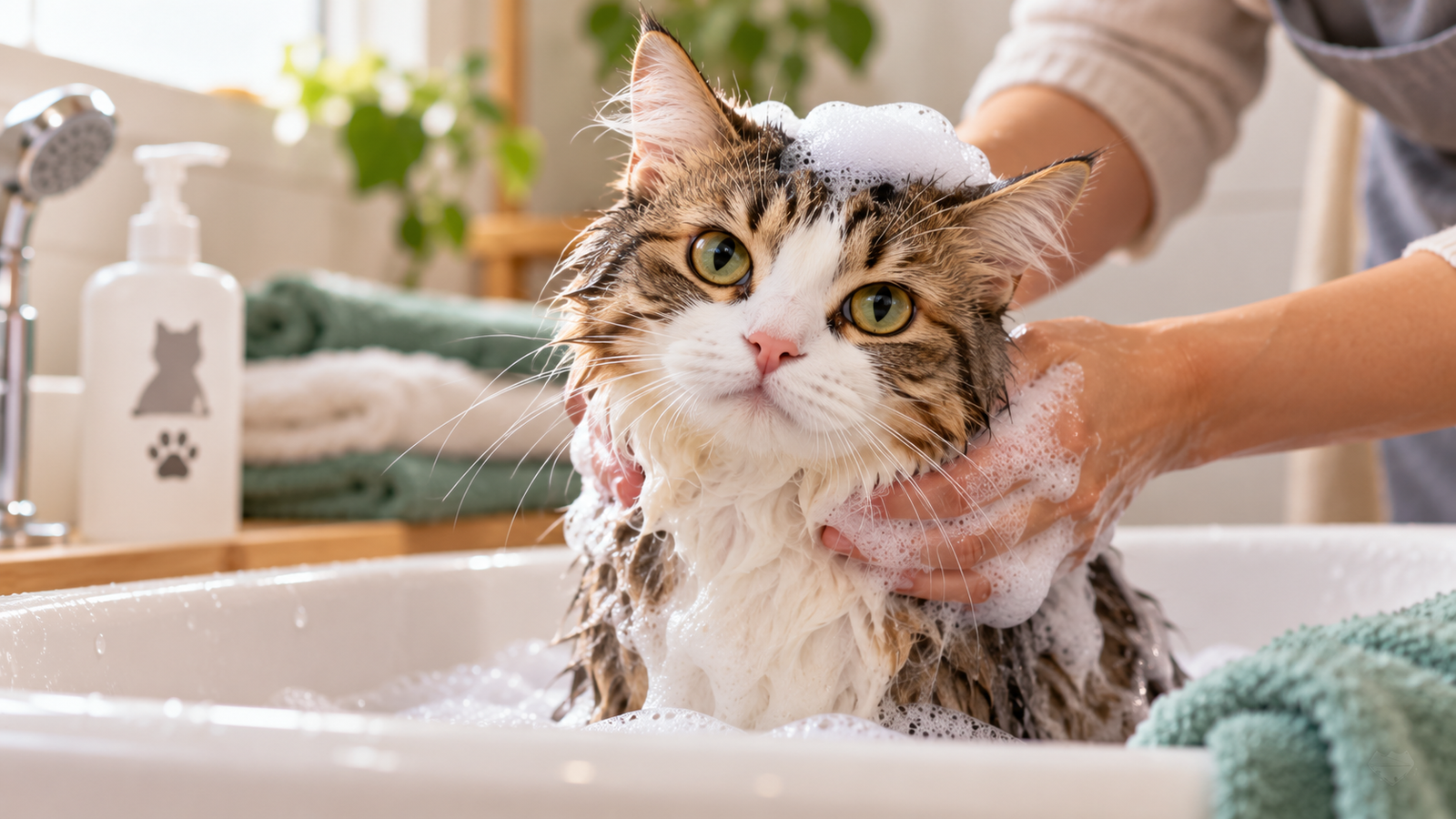
Step 6: Apply Cat-Safe Shampoo
Use only the amount directed by the product.
Work it gently through the coat and down toward the skin without aggressive rubbing.
Pay particular attention to genuinely dirty areas.
Step 7: Follow Medicated-Shampoo Instructions Exactly
If the product is medicated, follow the prescribed contact time.
Do not rinse too early unless directed.
Likewise, do not leave the shampoo on longer because you assume that more time means better treatment.
Step 8: Rinse Extremely Thoroughly
This is one of the most important parts of the bath.
Cats normally groom themselves after bathing.
Any product left on the coat may therefore be licked and swallowed.
Continue rinsing until the coat feels free of shampoo residue.
Step 9: Clean the Face Separately
You generally do not need to pour shampoo and water over the cat’s face.
If the face needs ordinary cleaning, use a soft damp cloth and work carefully around the eyes, nose and mouth.
If there is persistent eye or nasal discharge, the issue may require veterinary attention rather than a bath.
Step 10: Towel-Dry the Cat
Wrap the cat gently in a clean dry towel.
Blot and absorb water rather than aggressively rubbing the coat.
You may need more than one towel for a long-haired cat.
Keep the Cat Warm Afterward
Allow your cat to finish drying in a:
- Warm room
- Draft-free space
- Quiet area
Do not place a wet cat outside.
Should You Use a Hair Dryer?
Many cats find the noise and airflow from a hair dryer frightening.
Hot air can also irritate or burn skin.
Towel drying in a comfortably warm room is usually the simpler option for routine home care.
If a cat has a special grooming need that requires mechanical drying, an experienced groomer or veterinary team can advise on safer handling and equipment.
Do Not Scruff or Force a Panicking Cat
Bathing should use the least restraint necessary.
If your cat begins:
- Thrashing
- Trying desperately to escape
- Open-mouth breathing
- Repeatedly biting
- Showing extreme fear
stop the procedure if it is safe to do so.
Forcing a terrified cat through a routine bath can injure both the cat and the person handling it.
A Calm Bath Is Better Than a Perfect Bath
The goal is not to hold the cat down until every hair has been washed.
For routine cleaning, it can be better to:
- Clean only the necessary area
- Use a damp cloth instead
- Split grooming into shorter sessions
- Seek professional help when needed
Respectful handling helps protect future grooming experiences as well.
Can You Train a Cat to Accept Baths?
Some cats can learn to tolerate bathing more comfortably through gradual positive experiences.
Start before an actual bath is urgently needed.
For example:
- Allow the cat to explore the dry bathroom.
- Reward calm behavior.
- Place the cat briefly on a non-slip mat.
- Reward again.
- Introduce a damp cloth on another day.
- Gradually introduce small amounts of water.
Progress at the cat’s pace.
Do Not Force Bath Training
If the cat becomes frightened, return to an easier stage.
Bath training should rely on:
- Choice
- Predictability
- Rewards
- Short sessions
- Gentle handling
This is particularly useful for cats that may need repeated medicated baths later.
Can You Use Treats During Bath Training?
Yes, if the cat is relaxed enough to eat.
Tiny high-value treats can reward:
- Entering the bathroom
- Standing on the bath mat
- Tolerating gentle handling
- Allowing a paw to become wet
A cat that refuses a normally valuable reward may be telling you that the situation is already too stressful.
How Often Is Too Often to Bathe a Cat?
There is no single number that defines excessive bathing for every cat.
However, unnecessary repeated bathing can strip oils from the skin and coat and may contribute to:
- Dryness
- Flaking
- Irritation
- Itching
- Coat changes
If you believe your cat needs frequent non-medicated baths, speak with your veterinarian.
Why Does My Cat Smell Even After a Bath?
Persistent odor can have causes that shampoo will not solve.
Possible sources include:
- Dental disease
- Ear disease
- Skin infection
- Urine contamination
- Anal-area contamination
- Wounds
- Difficulty grooming
If odor repeatedly returns soon after bathing, investigate the cause rather than simply bathing again.
Why Is My Cat’s Coat Suddenly Greasy?
A greasy or poorly groomed coat can occur when a cat stops normal grooming.
Potential reasons include:
- Pain
- Arthritis
- Obesity
- Dental disease
- Illness
- Stress
Skin disease itself can also alter the coat.
A sudden persistent change deserves attention.
What if Your Cat Has Dandruff?
A few flakes do not automatically mean the cat needs repeated baths.
Dandruff may be associated with:
- Dry skin
- Poor grooming
- Obesity
- Parasites
- Skin disease
- Other health problems
Bathing without knowing the cause can sometimes make dryness worse.
What if Your Cat Is Itchy?
Do not assume shampoo is the solution.
Itching can be caused by:
- Fleas
- Other parasites
- Allergic skin disease
- Skin infection
- Ringworm
- Other dermatologic conditions
Persistent scratching, hair loss, scabs or skin lesions deserve veterinary evaluation.
Bathing Does Not Replace Parasite Control
Washing fleas from a cat does not necessarily control the entire infestation.
Likewise, ordinary shampoo does not treat every mite, fungal infection or other cause of itching.
Use an appropriate diagnosis and treatment plan rather than repeatedly bathing irritated skin.
Can a Bath Help With Cat Allergens?
Bathing may temporarily remove some material from the coat, but it is not a permanent way to eliminate cat allergens.
People who are allergic to cats react to proteins produced by the cat, not simply visible fur or dirt.
Repeatedly bathing a cat for human allergy control can also be stressful and may irritate the cat’s skin.
Bathing and Ear Care Are Different Tasks
Do not pour bath water or shampoo into the ear canals.
If the ears contain:
- Dark debris
- Strong odor
- Discharge
- Redness
- Swelling
the cat may have an ear problem that needs separate evaluation.
Read: Cat Ear Problems: Infections, Ear Mites & When to See a Vet .
Bathing Around the Eyes
Avoid getting shampoo directly into the eyes.
Persistent:
- Redness
- Squinting
- Cloudiness
- Eye pain
- Heavy discharge
should not be treated simply by washing the face.
These signs may require veterinary assessment.
What if Your Cat Has Urine or Feces in the Fur?
Small amounts can often be removed by careful spot cleaning.
More extensive contamination may require a bath.
However, repeated contamination can indicate another problem.
Possible causes include:
- Diarrhea
- Constipation
- Obesity
- Long fur around the hindquarters
- Arthritis
- Mobility problems
If the problem keeps returning, address the cause rather than treating bathing as the only solution.
What if Your Cat Hates Water?
A full bath is not always necessary.
Depending on the situation, alternatives may include:
- Spot cleaning
- Brushing
- A damp cloth
- A cat-safe grooming wipe
- A veterinarian-recommended waterless shampoo
- Professional grooming
Choose the least stressful method that safely solves the problem.
Are Waterless Shampoos Safe for Cats?
Some products are formulated specifically for cats and can be useful for light cleaning.
However, check that the product:
- Is labeled for cats
- Is appropriate for the cat’s age
- Does not contain ingredients your veterinarian has told you to avoid
- Is used according to instructions
Remember that cats lick their coats, so products left on the fur must be suitable for feline use.
Avoid Essential Oils in DIY Cat Grooming Products
Should You Bathe a Cat Before Applying Flea Treatment?
This depends on the specific flea product.
Some topical medications have instructions about bathing before or after application.
Always follow the label or your veterinarian’s directions.
Bathing at the wrong time can potentially interfere with some topical treatments.
Should You Bathe a Cat After Flea Treatment?
Again, check the specific product.
Different medications have different recommendations about water exposure.
Do not use one general rule for every flea and tick product.
If the cat develops a suspected reaction after treatment, contact your veterinarian promptly.
When Should You Use a Professional Groomer?
Professional help may be appropriate when:
- The coat is severely matted
- Your cat becomes highly distressed during grooming
- The cat is difficult to handle safely
- A long or dense coat needs extensive cleaning
- You are uncomfortable using grooming tools
Choose someone experienced with cats rather than assuming all dog groomers routinely handle feline clients.
When Should a Veterinarian Handle Grooming?
A veterinary team may be more appropriate when:
- The cat is painful
- Skin underneath mats is inflamed
- There are wounds or sores
- A medical skin condition is present
- Safe grooming may require veterinary medication or sedation
- The cat has another significant health problem
Do not give sedatives or calming medication without veterinary direction.
When Does a Dirty Coat Need a Vet Instead of Another Bath?
Contact your veterinarian when coat changes are accompanied by:
- Persistent itching
- Hair loss
- Scabs
- Open sores
- Redness
- Swelling
- Strong persistent odor
- Greasy skin that repeatedly returns
- Weight loss
- Reduced appetite
- Reduced mobility
- A major decline in grooming
For broader illness warning signs, read: Signs Your Cat Is Sick: Symptoms You Should Not Ignore .
A Simple Cat Bath Checklist
Before bathing, confirm that you have:
- A genuine reason for the bath
- A warm and quiet room
- A non-slip surface
- Cat-safe shampoo
- Lukewarm water
- Several clean towels
- Removed manageable tangles beforehand
- A plan to keep water away from the eyes and ears
- A warm drying area
If any part of the procedure becomes unsafe, stop and seek professional help.
Common Cat Bathing Mistakes
- Bathing a healthy cat simply because a month has passed
- Using human shampoo routinely
- Using strongly scented products
- Using a dog flea product on a cat
- Using very hot or cold water
- Putting the cat into deep water unnecessarily
- Using a slippery bathtub without traction
- Pouring water directly over the cat’s face
- Getting shampoo into the eyes or ears
- Failing to rinse shampoo thoroughly
- Trying to cut tight mats with scissors
- Forcing a panicking cat to remain in the bath
- Scruffing or using excessive physical restraint
- Using essential oils in homemade shampoos
- Bathing repeatedly instead of investigating a greasy or smelly coat
- Assuming flea shampoo alone solves a flea infestation
- Ignoring a sudden decline in self-grooming
- Using household chemicals to remove sticky substances
Frequently Asked Questions
How often should you bathe a cat?
Most healthy adult cats do not need baths on a fixed schedule. Bathe when there is a genuine need, such as significant dirt, contamination, difficulty self-grooming or a veterinarian-prescribed skin treatment.
Do indoor cats need baths?
Many healthy indoor cats rarely need a full bath because they keep themselves clean through normal grooming.
Is it okay to never bathe a cat?
Some healthy cats may go very long periods without requiring a full bath. What matters is whether the skin and coat remain clean and healthy rather than following a fixed bathing calendar.
Can I bathe my cat once a month?
A monthly bath is usually unnecessary for a healthy self-grooming cat unless there is a specific reason. Cats needing frequent routine baths should have their skin, coat, health and grooming ability assessed.
Do long-haired cats need baths?
Sometimes, but regular brushing is usually more important. Baths may be helpful when the coat is genuinely dirty, but they do not replace prevention and removal of tangles and mats.
Do Sphynx cats need baths?
Hairless cats such as the Sphynx may need more regular skin cleaning because natural oils can accumulate on the skin. The appropriate frequency varies, and excessive bathing can cause dryness or irritation.
Do senior cats need more baths?
Some do if arthritis, obesity or illness makes self-grooming difficult. A sudden decline in grooming should also prompt consideration of an underlying health problem.
Can you bathe a kitten?
Yes, when necessary, but young kittens need special attention to warmth and gentle handling. A small dirty area may be better managed with spot cleaning rather than a full bath.
What shampoo should I use on my cat?
Use a mild shampoo specifically formulated and labeled for cats. Medicated shampoos should be used according to veterinary instructions.
Can I use human shampoo on my cat?
Human shampoo is not recommended for routine feline bathing. Cat-specific shampoo is designed for feline skin and coat and is the safer choice.
Can I use baby shampoo on a cat?
Do not use baby shampoo as your regular cat shampoo. Choose a product specifically formulated for cats or ask your veterinarian what to use when special cleaning is needed.
Can I use dish soap to bathe my cat?
Dish soap is not the preferred product for routine grooming. Veterinary poison specialists may recommend a mild liquid dish soap for certain chemical or oily contaminations, but that should be treated as decontamination rather than ordinary bathing.
What temperature should cat bath water be?
Use comfortably lukewarm water. Avoid water that feels noticeably hot or cold.
Should I wash my cat’s face with shampoo?
Usually no. Keep shampoo away from the eyes, nose and mouth. For ordinary facial cleaning, a soft damp cloth is generally more appropriate.
Should I clean my cat’s ears during a bath?
Do not pour bath water or shampoo into the ear canals. Ear cleaning should be treated as a separate task using an appropriate feline ear product when needed.
Why does my cat smell bad even after a bath?
Persistent odor may come from skin disease, dental disease, ear problems, urine or fecal contamination, wounds or reduced self-grooming. Repeated bathing without addressing the cause may not solve the problem.
Why has my cat stopped grooming itself?
Pain, arthritis, obesity, dental problems, illness, weakness or stress can reduce grooming. A persistent change, especially in a senior cat, deserves veterinary attention.
Can bathing help a cat with allergies?
Veterinarians sometimes prescribe medicated or therapeutic bathing for feline skin disease. The shampoo, frequency and contact time should match the diagnosed condition.
Can bathing remove fleas from a cat?
Bathing may remove some fleas, but it does not usually control the full flea life cycle in the cat’s environment. Use a veterinarian-recommended flea-control plan appropriate for cats.
What should I do if my cat gets a chemical on its fur?
Prevent licking and contact your veterinarian or an animal poison-control service promptly. Different chemicals require different decontamination methods, so do not apply solvents or household cleaners to the coat.
What if my cat becomes extremely frightened during a bath?
Stop if continuing can be done safely. Extreme restraint can increase fear and create an injury risk. Spot cleaning, professional grooming or veterinary assistance may be better options.
Can I use a hair dryer after bathing my cat?
Towel drying in a warm room is often simpler because many cats dislike the noise and airflow of hair dryers, and hot air can injure the skin. Seek professional advice if your cat has grooming needs that require mechanical drying.
How do I keep my cat calm during a bath?
Prepare everything beforehand, use a quiet warm room and non-slip surface, introduce water gradually, handle gently and keep the procedure as short as practical. Do not force a panicking cat through a routine bath.
The Bottom Line
Most healthy adult cats do not need frequent scheduled baths.
Their normal self-grooming usually keeps the coat clean enough for everyday life. Therefore, bath frequency should be based on actual need rather than a weekly or monthly calendar.
A bath may be appropriate when the coat becomes significantly dirty, greasy or contaminated, when urine or feces are stuck in the fur, when a cat has difficulty grooming itself, or when a veterinarian has prescribed topical treatment.
Long-haired cats usually benefit more from consistent brushing than frequent bathing. Senior and overweight cats may need additional grooming assistance when mobility limits their ability to reach parts of the body.
Hairless cats are an important exception because skin oils can accumulate without a full coat to absorb them. Their cleaning routine should be individualized to avoid both excessive oil buildup and over-bathing.
When bathing is necessary, use lukewarm water, a non-slip surface and shampoo formulated specifically for cats. Keep products away from the eyes and ears, rinse thoroughly and towel-dry the cat in a warm environment.
Avoid forcing a frightened cat through routine bathing. Gentle handling, short sessions and gradual positive exposure are safer than scruffing or heavy restraint.
Finally, pay attention to why your cat needs bathing. A coat that suddenly becomes greasy, smelly, matted or poorly maintained can sometimes indicate pain, obesity, skin disease or another health problem. In those cases, another bath may hide the symptom without addressing the cause.
References and Further Reading
VCA Animal Hospitals
Grooming and Coat Care for Your Cat — normal feline self-grooming, when cats may need baths, cat-safe shampoos, coat care, matting and bathing technique.
VCA Animal Hospitals
How to Bathe Cats With Medicated Shampoo — veterinary indications for medicated bathing, lukewarm water, contact time, thorough rinsing and drying.
Merck Veterinary Manual
Principles of Topical Treatment in Animals — cleansing, antiparasitic and medicated shampoos, topical dermatologic treatment and safe product use.
Feline Veterinary Medical Association (FelineVMA)
2026 Respectful Handling of Cats to Minimize Fear and Pain — minimizing restraint, respecting feline choice and avoiding aversive handling techniques.
U.S. Food and Drug Administration
Safe Use of Flea and Tick Products in Pets — species-specific product selection, label directions and veterinary advice after adverse reactions.
ASPCA Animal Poison Control
Pet Decontamination at Home — management of potentially toxic substances on skin or fur and the importance of substance-specific veterinary or poison-control guidance.