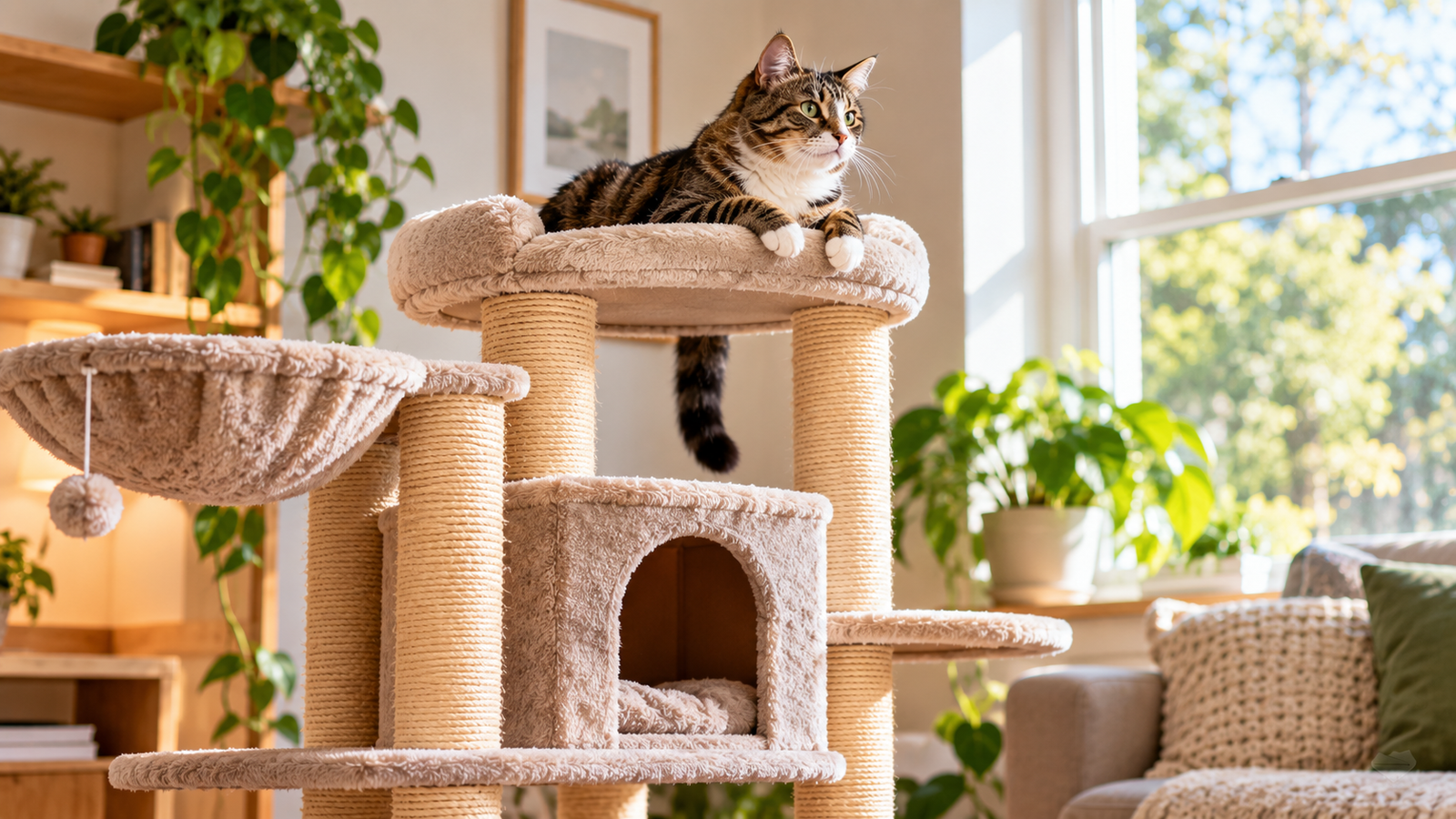

Choosing a cat tree is easier when you stop thinking about how impressive it looks and start thinking about how your cat will actually use it.
A good cat tree should provide stable climbing, comfortable resting platforms and useful vertical territory. Depending on the design, it may also offer scratching surfaces, hiding spaces, window viewing and separate resting areas for more than one cat.
Height matters, but the tallest cat tree is not automatically the best one. Stability, platform size, climbing routes, scratching height, placement and your cat’s age and mobility are equally important.
How to Choose a Cat Tree at a Glance
| Feature | What to Look For | Why It Matters |
|---|---|---|
| Base | Wide, heavy and stable | Helps prevent rocking and tipping during jumping or climbing. |
| Height | Matched to your cat’s confidence and mobility | Provides useful vertical territory without making access difficult. |
| Platforms | Large enough for your cat’s whole body | Allows comfortable resting, turning and observation. |
| Platform spacing | Easy stepping or jumping distances | Especially important for kittens, seniors and cats with limited mobility. |
| Scratching surface | Sturdy sisal, cardboard, wood or another preferred material | Supports normal scratching and stretching behavior. |
| Construction | Strong joints, secure hardware and minimal wobble | Improves safety and confidence. |
| Resting areas | Open platforms, beds or enclosed cubbies | Allows cats to choose between observation and privacy. |
| Placement | Near activity, a favorite resting area or a secure window | A well-placed tree is more likely to be used. |
Why Do Cats Need Vertical Space?
Cats often use elevation to observe their surroundings, rest away from activity on the floor and create distance from people or other animals.
Vertical territory can make the usable environment feel larger without increasing the physical size of the room.
A cat tree may provide:
- Climbing opportunities
- Elevated resting areas
- Observation points
- Scratching surfaces
- Hiding areas
- A place for interactive play
For indoor cats in particular, vertical space can form an important part of an enriched home.
For broader environmental ideas, read: How to Keep an Indoor Cat Happy and Active .
Start With Your Cat, Not the Cat Tree
Before comparing towers, measure and observe your cat.
Consider:
- Body size
- Age
- Weight
- Activity level
- Climbing confidence
- Preferred sleeping positions
- Scratching preferences
- Mobility limitations
- Whether other cats will use the tree
The right tree for an athletic 10-month-old cat may be completely different from the best option for a 15-year-old cat with reduced mobility.
How Tall Should a Cat Tree Be?
There is no universal height that suits every cat.
Healthy, active adults often enjoy higher observation points, especially when they already seek the tops of furniture, shelves or window ledges.
However, height should only be added when the structure remains stable and the cat has an easy way to move between levels.
A tall tower with poorly positioned platforms may be less useful than a slightly shorter tree with a well-designed climbing route.
Does a Cat Tree Need to Reach the Ceiling?
No.
Floor-to-ceiling trees can provide useful vertical territory, particularly in smaller homes, but they are not necessary for every cat.
A freestanding tree can work very well when it provides:
- A desirable elevated perch
- Stable climbing
- Comfortable resting space
- Appropriate scratching opportunities
Choose the structure based on how your cat uses space rather than assuming taller is always better.
How High Do Cats Like to Sit?
Preferences vary.
Some cats consistently choose the highest available platform.
Others prefer a middle level that gives them a clear view without being far from the household.
A nervous cat may particularly value an elevated position where it can observe without being approached from several directions.
Providing more than one height gives the cat a choice.
Stability Is One of the Most Important Features
A cat may leap onto a tree rather than climb it slowly.
That creates sideways and downward forces that can make a lightweight tower wobble.
A stable cat tree should feel solid during normal use.
Look for:
- A broad base
- A relatively low center of gravity
- Strong supporting columns
- Tight hardware
- Well-supported upper platforms
- Secure connections between levels
How Can You Test a Cat Tree for Stability?
Before allowing your cat to use a newly assembled tree, gently test it with your hands.
Apply light pressure from several directions.
The structure should not:
- Rock excessively
- Twist at the joints
- Lean to one side
- Allow upper platforms to rotate unexpectedly
Some movement in soft materials is normal, but the overall structure should remain secure.
Should a Cat Tree Be Anchored to the Wall?
Some tall cat trees include anti-tip straps or wall-mounting hardware.
When the manufacturer provides an anchoring system, install it according to the instructions.
Wall anchoring can be especially useful for:
- Tall, narrow cat trees
- Heavy cats
- Multiple cats using the same structure
- Energetic cats that leap onto upper platforms
Do not improvise unsafe wall attachments.
Use appropriate hardware for the wall type and follow the manufacturer’s recommendations.
Choose a Wide Enough Base
The base supports everything above it.
As cat trees become taller, a narrow footprint can make instability more noticeable.
A wide base helps distribute weight and resist tipping.
The exact dimensions depend on the height, design and weight distribution of the tree, so there is no single base size that fits every model.
Platform Size Matters
A perch may look generous in a product photograph but still be too small for a large cat.
The cat should ideally be able to:
- Sit comfortably
- Turn around
- Lie down without hanging awkwardly over the edge
- Change sleeping position
Check actual product dimensions rather than relying only on pictures.
Measure Your Cat Before Buying
A simple measurement can help.
Observe how much space your cat uses when lying in a relaxed curled or stretched position.
Compare that with the dimensions of:
- Top perches
- Hammocks
- Enclosed cubbies
- Intermediate platforms
Large cats need more usable surface area than a small kitten.
Check the Weight Capacity
If the manufacturer provides a weight limit, follow it.
This becomes particularly important when:
- You have a large cat
- Several cats may use the tree together
- The design includes suspended hammocks
- The upper levels extend far from the main support
For a multi-cat household, consider the combined weight of cats that may occupy the structure at the same time.
Choosing a Cat Tree for a Large Cat
Large cats need more than a taller tower.
Look for:
- A wide, heavy base
- Thick support columns
- Large platforms
- Generous cubbies
- Strong hammock attachments
- A suitable manufacturer weight rating
A large cat should not need to balance on a perch designed only for a kitten-sized body.
What About Maine Coons and Other Large Breeds?
Large-framed cats such as Maine Coons, Norwegian Forest Cats and other substantial individuals may need oversized platforms and stronger structural support.
Pay particular attention to:
- Platform width
- Cubby openings
- Hammock size
- Post thickness
- Total weight capacity
Breed alone does not determine the correct size, so measure the individual cat whenever possible.
Platform Spacing Can Matter More Than Total Height
A cat tree is only useful if your cat can move through it comfortably.
Look at the vertical and horizontal gaps between platforms.
A healthy adult may happily leap between widely spaced levels.
A kitten, senior cat or cat with mobility limitations may need:
- Lower first steps
- Closer platform spacing
- Wider landing areas
- Ramps or intermediate shelves
Choose an Easy Route Up and Down
Owners sometimes focus on how easily a cat can reach the top but forget about the route back down.
Descending can require different movement and confidence.
A well-designed tree should provide predictable landing points rather than forcing a cat to make one large jump to the floor.
Cat Trees for Kittens
Kittens are curious but still developing coordination.
Choose a structure with:
- Stable low and middle levels
- Easy climbing routes
- No dangerous gaps
- No loose strings that can become entangled
- Platforms that provide secure footing
Supervise young kittens when introducing a tall structure.
A very high, complex tower is not automatically necessary during the earliest stage.
Will a Kitten Outgrow a Small Cat Tree?
Possibly.
If you are buying a long-term structure, consider the kitten’s expected adult size.
A tree that works perfectly at four months may have platforms and cubbies that feel cramped when the cat reaches adulthood.
Choosing a Cat Tree for a Senior Cat
Older cats can still enjoy vertical space.
The goal is usually to make favorite elevated areas easier to reach.
Helpful features include:
- Lower overall height when needed
- Closely spaced platforms
- Low first steps
- Ramps
- Broad resting areas
- Non-slip surfaces
- Stable construction
A senior cat should not have to make a difficult jump simply to reach its favorite bed.
Arthritis Can Change Climbing Preferences
Cats may change how they climb, jump and scratch when joint discomfort develops.
A cat that once jumped directly to a high platform may begin using furniture as an intermediate step.
Likewise, a cat that previously preferred vertical scratching may begin favoring horizontal surfaces.
If an older cat suddenly stops climbing or hesitates before jumping, do not assume it has simply lost interest.
For broader age-related guidance, read: Common Health Problems in Senior Cats .
Look for Useful Scratching Surfaces
Many cat trees combine climbing and scratching.
Common scratching materials include:
- Sisal rope
- Sisal fabric
- Carpet
- Wood
- Cardboard components
Cats have individual material preferences.
A cat that loves shredding cardboard may not show the same enthusiasm for carpet.
How Tall Should the Scratching Section Be?
For vertical scratching, the usable scratching area should allow the cat to stretch upward fully without immediately reaching the top of the scratching surface.
Feline scratching guidance emphasizes sturdy vertical surfaces that extend above the cat’s stretched height.
Therefore, look at the length of the exposed scratching section rather than the total height of the cat tree.
A six-foot tower can still have an awkwardly short scratching post if platforms interrupt the usable surface.
Is Sisal Good for Cat Trees?
Sisal is commonly used because it provides a rough surface that many cats can grip and shred.
However, it is not the only acceptable material.
The best choice depends partly on what your cat already likes to scratch.
For detailed scratching guidance, read: How to Get a Cat to Use a Scratching Post Instead of Furniture .
Sisal Rope vs Sisal Fabric
Both can work.
Sisal rope creates raised ridges around a post, while woven sisal fabric provides a flatter scratching surface.
Some cats clearly prefer one texture.
Whichever type you choose, inspect it regularly for loose fibers or sections that have detached from the post.
Is Carpet Good on a Cat Tree?
Carpet can provide traction and a comfortable resting surface.
Some cats also enjoy scratching it.
However, carpet is not automatically every cat’s preferred scratching material.
If your main goal is to redirect scratching away from furniture, consider a tree that also provides sisal, cardboard or another texture your cat already prefers.
Should a Cat Tree Have an Enclosed Cubby?
An enclosed space can be valuable for cats that enjoy resting somewhere partially hidden.
It may provide:
- Privacy
- A sense of security
- A quiet sleeping area
- Separation from household activity
However, some cats rarely use enclosed spaces and prefer open elevated platforms.
A tree with both open and enclosed options provides more choice.
Make Sure the Cubby Is Large Enough
Check both:
- The internal dimensions
- The entrance size
A large cat may fit through the entrance but still be unable to turn around comfortably inside.
Are Hammocks Good on Cat Trees?
Many cats enjoy fabric hammocks and basket-style beds.
Before choosing one, check:
- The manufacturer’s weight rating
- How the hammock attaches
- Whether the fabric can be removed for cleaning
- Whether your cat has enough room to lie comfortably
Inspect the attachment points over time because fabric and stitching can wear.
Should a Cat Tree Have a Top Bed?
A top perch is often one of the most popular areas on a cat tree.
Look for a perch that:
- Feels stable
- Provides enough surface area
- Has a secure edge when appropriate
- Does not rotate or tilt
Some cats like padded rims because they can rest the head against them while watching the room.
Where Should You Put a Cat Tree?
Placement can determine whether a cat tree becomes a favorite piece of furniture or an expensive object your cat ignores.
Good locations often include:
- Near a secure window
- In a living room where the family spends time
- Near a favorite resting area
- Close to a place where the cat already tries to climb
- Near an appropriate scratching location
Think about where your cat already chooses to spend time.
Is a Window the Best Place for a Cat Tree?
For many cats, yes.
A secure window can provide changing visual stimulation such as:
- Birds
- People
- Insects
- Trees
- Weather
The cat tree can then function as both a climbing structure and an observation point.
Should You Put a Cat Tree in a Quiet Room?
It depends on the cat and the purpose.
A shy cat may enjoy a quiet tree where it can rest undisturbed.
A highly social cat may prefer a tree in the living room where it can observe people while staying elevated.
If space allows, provide elevated options in more than one part of the home.
Avoid Unusable Locations
Even a high-quality tree may go unused when placed:
- In a room the cat rarely enters
- Beside loud machinery
- Where a dog repeatedly blocks access
- Where another cat controls the approach
- In direct intense heat
- Where the structure interferes with a doorway
The cat should be able to approach and leave comfortably.
Cat Trees for Small Apartments
A small home can benefit greatly from vertical furniture.
Instead of choosing the widest possible structure, look for:
- A compact footprint
- Useful vertical height
- Multiple functions in one structure
- Integrated scratching surfaces
- An elevated sleeping area
The goal is to add usable territory without blocking normal movement around the room.
Corner Cat Trees
A corner can be a useful location when the tree still provides a good view and comfortable access.
Before buying, confirm:
- The base actually fits the corner
- Platforms do not hit nearby walls
- Your cat can approach from a comfortable direction
- The top level does not interfere with curtains or blinds
Floor-to-Ceiling Cat Trees
Some designs use a tension system between the floor and ceiling.
These can save floor space, but correct installation is essential.
Check:
- Compatible ceiling height
- The manufacturer’s installation instructions
- Whether the ceiling surface can safely support the system
- Whether tension needs periodic rechecking
Do not use a tension-mounted product outside the manufacturer’s specified conditions.
Wall-Mounted Cat Trees and Shelves
Wall-mounted systems can create excellent vertical routes without a large floor footprint.
However, installation quality is critical.
Use suitable structural mounting points and hardware for the wall type.
If you are uncertain whether the wall can support the system, use professional installation rather than guessing.
Choosing a Cat Tree for Multiple Cats
A multi-cat tree needs enough usable space that cats are not forced into unwanted close contact.
Useful features include:
- Several resting levels
- More than one route up or down
- Multiple scratching surfaces
- Large platforms
- Strong weight capacity
- Separate resting areas
More Platforms Do Not Automatically Prevent Conflict
A structure may have six platforms but still create competition if every cat must pass through one narrow route to reach them.
Watch for bottlenecks.
Whenever possible, cats should have alternative ways to leave an elevated area rather than being trapped by another cat below.
Do You Need More Than One Cat Tree?
Sometimes.
In a larger or multi-cat home, one structure may not provide enough elevated territory.
Instead of buying one enormous tower, you may get better use from:
- Two cat trees in different rooms
- A tree plus window perches
- A tree plus secure wall shelves
Distributing resources can reduce competition and give cats more choices.
How to Introduce a New Cat Tree
Place the tree in a useful location and allow your cat to investigate voluntarily.
You can make it more interesting by:
- Placing a familiar blanket on a platform
- Using a wand toy around the lower levels
- Leaving a few treats on accessible platforms
- Adding catnip or silver vine if your cat responds positively
Do not force your cat onto the tree.
What if Your Cat Ignores the New Cat Tree?
The problem may be the location rather than the tree itself.
Try moving it near:
- A favorite window
- The sofa
- A sleeping area
- An existing climbing location
Also consider whether:
- The structure wobbles
- The platforms are too small
- The first step is too high
- The surface feels unfamiliar
- Another pet blocks access
Do Not Carry Your Cat to the Top
Allow the cat to explore at its own pace.
Placing a nervous cat directly onto the highest perch may make the structure feel unsafe rather than appealing.
Reward voluntary exploration instead.
How Long Does It Take a Cat to Use a New Tree?
Some cats investigate immediately.
Others may take days or weeks.
A cautious cat may first:
- Sniff the base
- Scratch one post
- Sit on the lowest platform
- Explore higher levels later
Gradual exploration is normal.
How to Make an Old Cat Tree Interesting Again
If your cat has stopped using a structurally sound tree, try changing the experience.
Options include:
- Moving it to a better location
- Adding a familiar blanket
- Using interactive play around it
- Replacing a worn scratching surface
- Cleaning accumulated fur and debris
Do not make sudden major changes if the tree is also an important safe resting area.
How to Clean a Cat Tree
Regular cleaning helps remove:
- Loose fur
- Dust
- Food crumbs
- Litter particles
- Other debris
Vacuum fabric areas and wipe hard surfaces according to the manufacturer’s cleaning instructions.
Remove washable cushions or covers when the design allows.
Avoid Strong Fragrances
Cats have a highly developed sense of smell.
Strongly scented cleaners can make a familiar resting area less appealing.
Choose cat-safe cleaning products and rinse or dry surfaces appropriately before allowing access again.
Inspect the Cat Tree Regularly
Wear happens gradually.
Periodically check:
- Screws and bolts
- Wall anchors
- Support posts
- Platform connections
- Hammock stitching
- Loose carpet
- Sisal rope
- Exposed staples or fasteners
When Should You Replace a Cat Tree?
Replacement or substantial repair may be necessary when:
- The frame becomes unstable
- Structural panels crack
- Support columns loosen repeatedly
- Platforms sag
- Hardware can no longer be tightened securely
- Exposed fasteners create a hazard
Cosmetic wear is different from structural failure.
A heavily scratched sisal post may still be usable, but a loose supporting column should be addressed promptly.
Can You Replace the Sisal Instead of the Whole Tree?
Sometimes.
Some cat trees have replaceable posts or scratching panels.
For other models, owners may be able to repair the scratching surface while preserving the original structural post.
Any repair should leave:
- No exposed sharp fasteners
- No loose rope loops
- No unstable joints
Should You Buy a Cheap or Expensive Cat Tree?
Price alone does not determine whether a tree is suitable.
A simpler structure can be an excellent choice when it is:
- Stable
- Properly sized
- Well placed
- Made from appropriate materials
Likewise, a large expensive tower may be a poor choice if it wobbles or has tiny platforms.
Features Worth Prioritizing
Spend your attention first on:
- Stability
- Platform dimensions
- Weight capacity
- Climbing route
- Useful scratching surfaces
- Ease of cleaning
Decorative details should come after those basics.
Cat Tree vs Scratching Post
A cat tree and a scratching post serve overlapping but different purposes.
A scratching post focuses primarily on:
- Scratching
- Stretching
- Claw maintenance
- Territorial marking
A cat tree may combine scratching with:
- Climbing
- Resting
- Hiding
- Observation
A cat tree does not automatically replace a dedicated scratching post.
If the tree’s scratching areas are too short, poorly positioned or made from a texture your cat dislikes, a separate scratcher may still be necessary.
Cat Tree vs Window Perch
A window perch provides an elevated viewing position but usually offers less climbing, scratching and hiding than a full tree.
For a small home, the two can complement each other.
A compact tree can provide scratching and climbing while a separate window perch provides an observation point.
Cat Tree vs Wall Shelves
Wall shelves can provide more flexible vertical routes, while a freestanding cat tree is usually easier to move.
A combined setup may work well for highly active cats.
Whichever option you choose, stability and safe access matter more than appearance.
Common Cat Tree Buying Mistakes
- Choosing the tallest tree without checking stability
- Buying platforms that are too small for the cat
- Ignoring the manufacturer’s weight rating
- Choosing a narrow base for a heavy or energetic cat
- Forgetting to measure the available floor space
- Ignoring ceiling height for tension-mounted trees
- Buying a large tower with no easy climbing route
- Expecting a senior cat to make large jumps
- Assuming every cat likes carpet for scratching
- Choosing a scratching section too short for a full stretch
- Placing the tree in an unused room
- Blocking the tree with furniture
- Failing to anchor a structure when the manufacturer requires it
- Ignoring loose hardware after assembly
- Buying based only on product photographs
- Assuming one tree provides enough resources for several cats
A Cat Tree Buying Checklist
Before ordering a cat tree, confirm:
- Your cat’s approximate body size and weight
- The dimensions of the largest perch
- The size of enclosed cubbies
- The manufacturer’s weight capacity
- The overall height
- The footprint of the base
- The distance between levels
- The scratching materials
- The usable length of scratching sections
- Whether covers can be cleaned
- Whether replacement parts are available
- Whether wall anchoring is recommended
- Where the tree will go in your home
Frequently Asked Questions
How do I choose the right cat tree?
Choose a tree according to your cat’s size, age, activity level and mobility. Prioritize stability, appropriate platform dimensions, a safe climbing route, useful scratching surfaces and a location your cat already enjoys.
How tall should a cat tree be?
There is no single ideal height. Healthy active cats often enjoy taller observation points, while seniors and cats with limited mobility may benefit from lower or more closely spaced platforms. Stability is more important than maximum height.
Is a taller cat tree always better?
No. A slightly shorter but stable tree with large platforms and a good climbing route may be much more useful than a very tall, narrow structure that wobbles.
How stable should a cat tree be?
It should remain secure during normal climbing and jumping without significant rocking, twisting or tipping. Check the base, support columns and fasteners before use.
Should I attach my cat tree to the wall?
If the manufacturer provides anti-tip or wall-anchoring hardware, use it according to the installation instructions. Anchoring can be particularly useful for tall structures and homes with large or highly active cats.
What size cat tree does a large cat need?
Large cats need broad resting platforms, strong supports, generous cubbies and a suitable weight capacity. Measure the individual cat and compare those measurements with the manufacturer’s dimensions.
What should I look for in a cat tree for a Maine Coon?
Prioritize oversized platforms, strong structural supports, a wide stable base, large cubbies and an appropriate weight rating. Maine Coons vary considerably in size, so individual measurements remain important.
What is the best cat tree for an older cat?
Senior cats often do well with stable trees that have lower first steps, closely spaced platforms, broad resting areas and non-slip surfaces. Ramps can also help cats with reduced mobility.
Can senior cats still use tall cat trees?
Some can, provided they remain mobile and have an easy route between levels. If jumping has become difficult, add lower steps, ramps or choose a more accessible design.
What scratching material is best on a cat tree?
Many cats like sisal, but preferences vary. Some prefer cardboard, rough fabric, carpet or wood. Observe what your cat already chooses to scratch.
How tall should a scratching post on a cat tree be?
A vertical scratching area should be long enough for your cat to stretch fully upward while scratching. Look at the usable scratching section rather than the overall height of the tower.
Where is the best place to put a cat tree?
Place it where your cat already spends time. Near a secure window, favorite resting area or family living space often works well.
Should a cat tree go by a window?
A window can be an excellent location because it combines vertical territory with visual stimulation. Make sure the window and screen are secure.
Why won’t my cat use the new cat tree?
The location may be uninteresting, the structure may wobble, the platforms may be difficult to access or another pet may be blocking the area. Try improving placement and encouraging voluntary exploration with play or treats.
How do I get my cat interested in a cat tree?
Place familiar bedding on it, use interactive toys around the platforms and reward voluntary exploration. If your cat responds to catnip or silver vine, a small amount may also make the structure more interesting.
Should I put my cat on top of the tree?
It is better to let the cat explore voluntarily. Forcing a nervous cat onto a high platform can make the structure feel less safe.
How many cat trees do I need for two cats?
There is no fixed number. Two cats may share a large structure comfortably, but some households benefit from multiple trees, window perches or elevated resting areas distributed around the home.
Are floor-to-ceiling cat trees safe?
They can be when installed according to the manufacturer’s instructions and used within the specified ceiling height and weight limits. Check the tension and hardware regularly.
How often should I tighten a cat tree?
Check the hardware regularly and whenever you notice new movement or wobbling. Follow any maintenance schedule provided by the manufacturer.
When should I replace a cat tree?
Replace or repair it when structural components crack, support posts become unstable, platforms sag, hardware cannot remain secure or exposed fasteners create a hazard.
The Bottom Line
The best cat tree is not necessarily the tallest, largest or most expensive one.
Start with your individual cat. Consider body size, weight, mobility, scratching preferences, climbing confidence and favorite resting positions.
Then prioritize stability. A broad base, strong support columns and secure hardware matter more than decorative extras. If the manufacturer provides wall-anchoring or anti-tip hardware, install it correctly.
Check platform dimensions carefully, especially for large cats. Your cat should have enough room to sit, turn and rest comfortably. Also examine the spacing between levels so the route up and down suits your cat’s mobility.
If the cat tree includes scratching areas, choose useful textures and make sure at least one vertical surface allows a full-body stretch. However, remember that a cat tree does not automatically replace a separate scratching post.
Placement matters just as much as design. A well-built tree hidden in an unused room may attract less interest than a simple structure beside a secure window or near the family’s main living space.
Finally, inspect the tree over time. Tighten hardware when needed, monitor scratching surfaces and stop using the structure if it develops significant instability or structural damage.
References and Further Reading
Feline Veterinary Medical Association (FelineVMA)
Setting Up the Environment for Success — vertical space, hiding opportunities, scratching surfaces, resource placement and adapting the environment to feline preferences and life stage.
AAFP/ISFM Environmental Needs Guidelines
Guidance on providing safe places, elevated territory, environmental resources, scratching opportunities and feline-appropriate home environments.
FelineVMA Claw Friendly Educational Toolkit
Scratching preferences, vertical and horizontal surfaces, sturdy scratching structures, appropriate materials and the importance of allowing a full vertical stretch.
The Ohio State University College of Veterinary Medicine — Indoor Pet Initiative
Scratching-post selection, vertical scratching height, sturdy construction, material preferences and appropriate placement.
FelineVMA 2024 Indoor/Outdoor Lifestyle Position Statement
Environmental requirements for indoor cats, including vertical territory, safe resting spaces, play, foraging and other opportunities to express normal feline behavior.