
The filter and heater do most of the quiet work in a fish tank. One keeps the water clean enough to live in, the other keeps it at a steady temperature. Get them wrong and you can end up chasing cloudy water, stressed fish and illness.
Knowing how to choose an aquarium filter and heater comes down to three things: the size of your tank, the fish you plan to keep and how much flow those fish can handle. Start with the fish, then match the equipment to them.
Quick answer: every aquarium needs a filter, and the right type depends on tank size and your fish. A flow that turns the water over around three to five times an hour is a common starting point, but gentle-flow fish like bettas need less. Tropical fish need a thermostat-controlled heater, often sized at roughly 2.5–5 watts per gallon, plus a thermometer you check daily. Goldfish usually don’t need a heater at normal room temperature.
What a filter actually does
Fish produce waste constantly, and that waste breaks down into ammonia, which is toxic to them. A filter handles this in two main ways. Mechanical filtration traps floating debris in sponge or floss. Biological filtration relies on beneficial bacteria living in the filter media, which convert ammonia into nitrite and then into less harmful nitrate. Some filters also hold chemical media such as activated carbon, which removes some dissolved substances and odors.
The biological part matters most, and it takes time to build up. A new filter needs to be cycled, ideally without fish, until tests show ammonia and nitrite rising and then dropping back to zero. That takes at least two weeks and often closer to four to six. Even with a good filter, you still need regular partial water changes to keep nitrate down.
Aquarium filter types compared
| Filter type | How it works | Good for | Drawbacks |
|---|---|---|---|
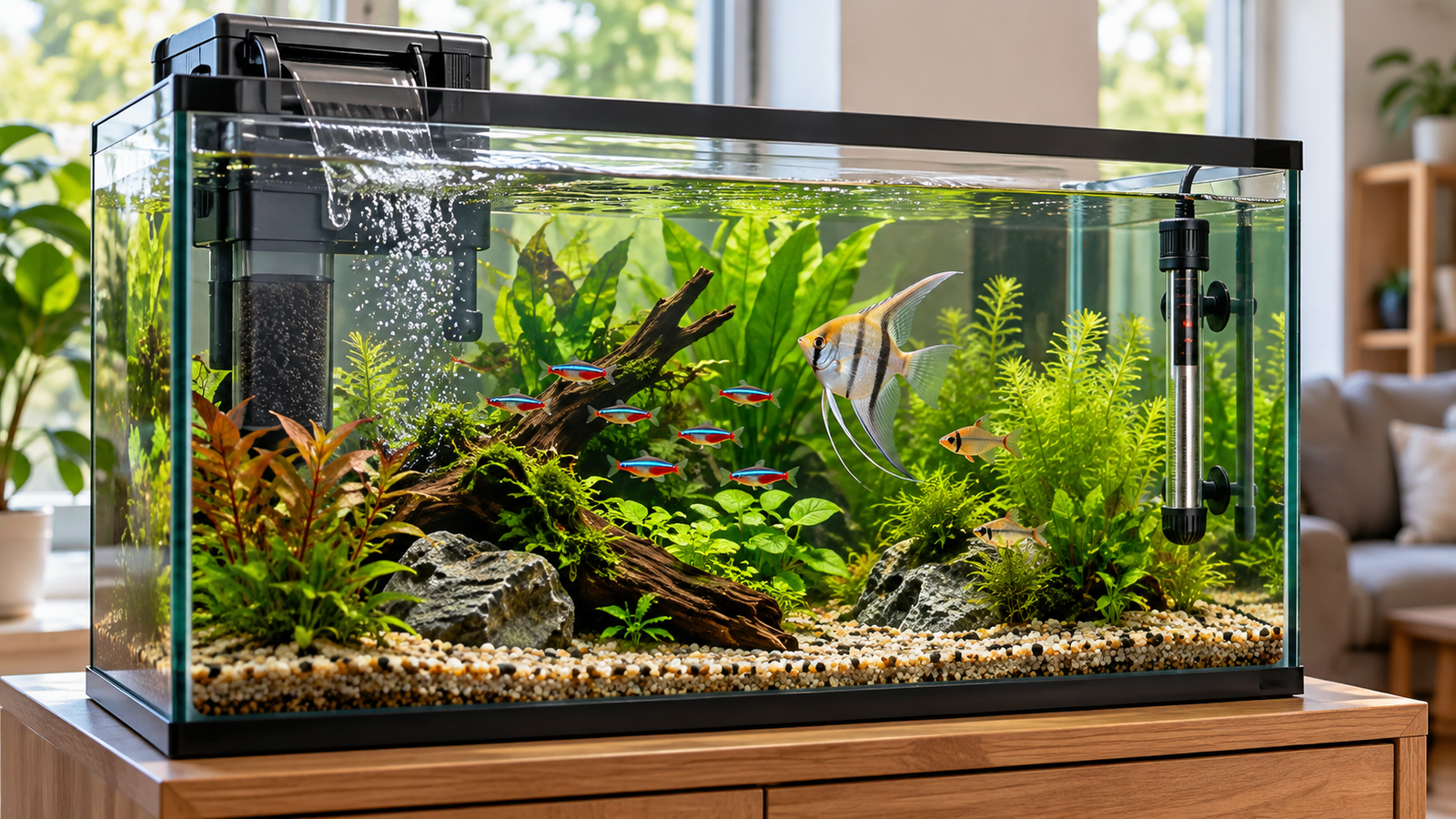
| Hang-on-back | Hangs on the rim, pulls water up through media and returns it as a waterfall | Most small to medium tanks; easy to maintain | Needs space behind the tank; surface flow can be strong for bettas |
| Canister | Sealed unit below the tank, connected by hoses | Larger tanks and messy fish; holds lots of media | Costs more; cleaning takes longer; hoses must be checked for leaks |
| Internal | Small powered unit that sits inside the tank | Smaller tanks | Takes up swimming space; limited media capacity |
| Sponge | Air pump pulls water through a sponge that houses bacteria | Bettas, fry, shrimp, quarantine and hospital tanks | Needs an air pump; no chemical filtration; less suited to heavy waste loads |
For a typical beginner community tank, a hang-on-back filter is often the simplest choice. Canisters make more sense for bigger tanks and messy fish. Sponge filters are cheap and gentle, which is why many keepers use them for bettas and small species.
Flow rate and turnover: a rough guide
Filters are usually rated in gallons per hour (GPH) or liters per hour. A common rule of thumb is that the filter should move the tank’s full volume around three to five times every hour. For a 20-gallon (76-liter) tank, that works out at roughly 60–100 GPH.
Treat this as a starting point, not a precise target, since real flow drops once media is packed in and starts to clog. Messy fish like goldfish benefit from the higher end, or a filter rated for a bigger tank. Fish from slow, still water need the opposite.
Fish that need gentle flow
Bettas are the classic example. They come from slow-moving water, breathe partly from the surface, and long-finned varieties are weak swimmers. A filter that churns the surface or pushes them around the tank causes stress. Choose a filter with adjustable flow, or a sponge filter. If a betta struggles to hold its position, the current is too strong. Fancy goldfish with round bodies and long fins can also struggle in strong currents.
Which fish need a heater?
Tropical fish need warm, steady water all year round. Guppies, tetras, bettas, rasboras, corydoras and most common community fish fall into this group, and their needs usually sit somewhere between about 72 and 82°F (22–28°C), depending on the species. Room temperature is rarely warm or stable enough, especially overnight and in winter, so a heater is not optional for these fish.
Goldfish are coldwater fish. RSPCA guidance puts them at 50–70°F (10–21°C), while some US care sheets suggest a slightly warmer 65–75°F (about 18–24°C) for fancy varieties. In a home kept at a normal indoor temperature they usually don’t need a heater. Some keepers still use one in a very cold room to stop the temperature swinging, since sudden changes are more stressful than a steady, cooler temperature. Keep coldwater and tropical fish in separate tanks rather than trying to find a middle ground.
Choosing and sizing a heater
Look for a submersible heater with a built-in thermostat that you can set to a specific temperature. The usual sizing guide is roughly 2.5–5 watts per gallon (about 0.7–1.3 watts per liter). Use the higher end if your room is cool, the tank has no lid, or you need to raise the water well above room temperature. Treat this as a rough guide and check the tank sizes listed on the heater’s packaging.
- A 10-gallon (38-liter) tank typically falls somewhere around 25–50 watts.
- A 20-gallon (76-liter) tank typically falls around 50–100 watts.
- For larger tanks, two smaller heaters at opposite ends spread heat more evenly, and if one fails the other is less likely to overheat or chill the whole tank on its own.
Always use a thermometer
Heaters can fail, either by switching off or by sticking on, and the dial is not always accurate. A separate thermometer, placed away from the heater, tells you what the water is really doing. A digital one is easy to read. Check it every day, ideally at the same time, so you notice problems early.
Heater placement and safety
- Place the heater where water flows past it, such as near the filter outlet, so warm water spreads around the tank.
- Unplug the heater before water changes. A heater running out of water can crack or burn out.
- Many manufacturers advise letting a new heater sit in the tank water for a while before plugging it in, so the glass adjusts to the temperature. Follow the instructions that come with yours.
- A heater guard (a plastic sleeve around the heater) can stop fish that like to rest against equipment from getting burned and protects the heater from knocks by large fish or decorations.
Safety note: if the water feels hot, your fish are gasping or darting about, or the thermometer reads far above the set temperature, unplug the heater and bring the temperature down gradually with small partial water changes. Overheated water holds less oxygen and can kill fish quickly.
If you are planning a coldwater setup, our guide on setting up a goldfish tank properly covers tank size and layout in more detail. Betta keepers may find our advice on how often to change betta fish water useful once the tank is running.
Frequently asked questions
Does every fish tank need a filter?
Yes. Fish waste breaks down into ammonia, which is toxic, and a filter houses the bacteria that make it less harmful. Tanks still need regular partial water changes, even with a good filter.
What size heater do I need for my aquarium?
A common rough guide is 2.5–5 watts per gallon, using the higher end for cool rooms or tanks without lids. Check the heater’s packaging for the tank sizes it is designed for, and use a separate thermometer to confirm the temperature.
Do goldfish need a heater?
Usually not. Goldfish are coldwater fish and do well at normal indoor temperatures. A heater may help in a very cold room to prevent big temperature swings, but they should not be kept at tropical temperatures.
What is the best filter for a betta fish?
A filter with gentle or adjustable flow. Many keepers use sponge filters because they are quiet and create very little current. If your betta struggles to swim or hides from the flow, the current is too strong.
Should I turn my aquarium filter off at night?
No. The filter should run all the time. The beneficial bacteria in the media need a steady flow of oxygenated water, and switching the filter off for long periods can let them die back.