
Rabbits are tidier than many people expect. Left to themselves, most pick one or two favorite spots to use as a toilet and go back to them again and again. Litter training is less about teaching a new skill and more about making sure that favorite spot is a tray you can empty.
If you want to know how to litter train a rabbit, the short answer is that setup does most of the work. Get the tray, the litter and the hay right, keep the space small at first, and most rabbits get the idea with a little patience. Hormones, stress and the wrong litter are what usually get in the way.
At a glance: neutered rabbits are much easier to litter train. Use a large, low-sided tray with a paper-based rabbit litter, and put fresh hay in or right next to it, because most rabbits graze and toilet in the same sitting. Avoid clumping or clay cat litter and aromatic softwood shavings. Start in a small area, move stray droppings into the tray, and expect some accidents along the way.
Start with neutering
Unneutered rabbits use urine and droppings to mark territory, and that urge becomes stronger once they reach sexual maturity. A rabbit that is marking is not being naughty or failing to learn. It is doing exactly what its hormones tell it to do, and no amount of tray placement will fully override that.
Neutering (spaying females and castrating males) usually makes a big difference to toilet habits, as well as to general behavior and, in females, long-term health. Your vet can advise on the right age for your rabbit. Hormone levels take a while to settle after the operation, so be patient if habits do not change overnight.
Older rabbits often train faster than young ones. Baby rabbits have shorter attention spans and less control, so if you have a youngster, focus on setting up good habits and expect more accidents until it matures.
Choosing and setting up the tray
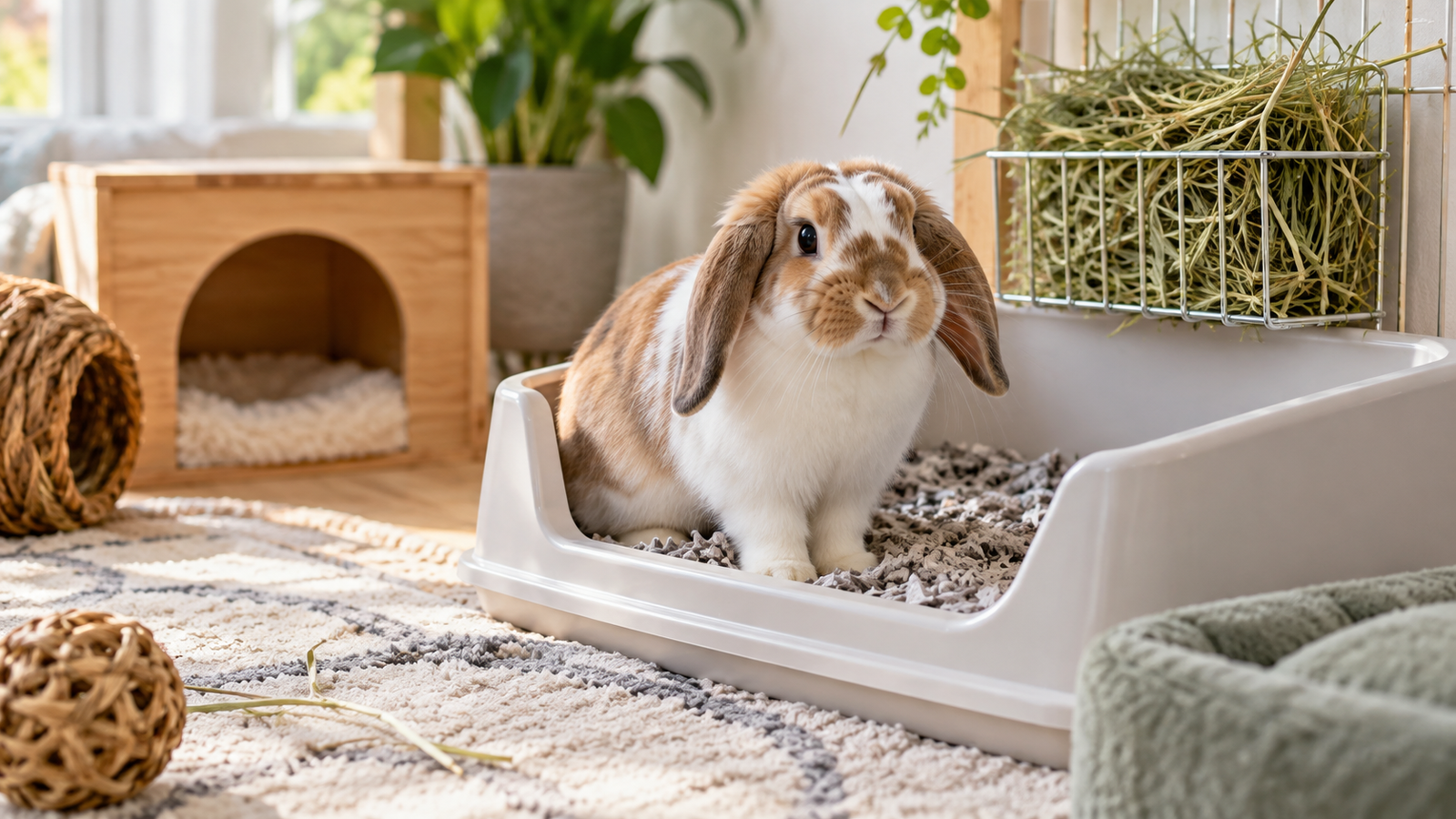
Many small corner trays sold for rabbits are too cramped. Your rabbit should be able to sit fully inside the tray, turn around and stretch out, with room left over for hay. A large cat litter tray or a shallow plastic storage box often works better than a corner tray designed for rabbits.
What to look for:
- A low entry point. One lower side makes it easy to hop in, which matters for small, young, older or arthritic rabbits.
- Higher sides elsewhere if your rabbit tends to kick litter out or reverses up to the edge and misses.
- No wire grids. Grates are uncomfortable on rabbit feet and trap mess underneath.
- Easy-clean plastic that does not soak up smells.
Aim for at least one tray per rabbit to start with. A bonded pair may happily share a big tray, but it helps to have a spare in another part of their space.
Rabbit-safe litter (and what to avoid)
Rabbits spend a lot of time sitting in their trays, and they will nibble what is in them. The litter needs to be safe to breathe and safe if a little gets eaten.
| Litter type | Suitable? | Why |
|---|---|---|
| Paper-based pellets or recycled paper litter | Yes | Absorbent, low dust and relatively harmless if nibbled |
| Straw, hay or grass-based pellets | Yes | Natural and edible, though less absorbent, so change it more often |
| Clumping or clay cat litter | No | Can cause a gut blockage if eaten, and can be dusty |
| Pine or cedar shavings | No | Aromatic oils can irritate the airways |
| Scented or deodorizing litters | No | Added fragrance may irritate a rabbit’s sensitive nose and airways |
A good routine is a layer of paper-based litter in the base of the tray with a generous pile of hay on top. The litter soaks up urine, and the hay gives your rabbit a reason to be there.
Training step by step
- Reduce the space. Start with your rabbit’s enclosure or one small area rather than the whole room. It is much easier to succeed in a small territory and then expand.
- Watch where your rabbit chooses to go. Most rabbits prefer a corner, often away from where they sleep. Put the tray there rather than where you would like it to be.
- Add hay. Pile fresh hay in the tray, or hang a hay rack directly over it, and top it up once or twice a day. Rabbits tend to graze and toilet at the same time, so this is the single most useful trick.
- Make the tray smell right. Put a few droppings and a small piece of urine-soaked bedding into the clean tray. The familiar scent tells your rabbit this is the toilet.
- Move stray droppings into the tray. Each time you find droppings elsewhere, pick them up and put them in the tray. Clean wet patches thoroughly (see below).
- Reward good choices. A small piece of a favorite green when your rabbit uses the tray helps. Never punish accidents.
- Expand gradually. Once your rabbit uses the tray reliably, give access to more space a bit at a time. When you open up a large room, add a second tray in the new area, at least at first.
Dealing with accidents
Some scattered droppings are normal, especially when a rabbit moves into a new space or meets a new rabbit. These are often territory markers and tend to reduce once your rabbit feels at home. Urine outside the tray is a bigger training issue than a few stray droppings.
Clean up urine with a pet-safe enzyme cleaner or a mix of white vinegar and water. These break down the smell so your rabbit does not keep returning to the spot. Skip strongly scented household cleaners, which can irritate a rabbit’s airways.
Also keep the tray itself clean. A tray that is full or smelly will be avoided. Most trays need emptying and rinsing every day or two, depending on how many rabbits use them.
When a trained rabbit starts having accidents
If a rabbit that was reliably using its tray suddenly stops, look for a reason. Common triggers include a move, a new pet or rabbit, a change of litter, or a tray that has been moved or is not being cleaned often enough.
Health problems can also be the cause. Arthritis, obesity or back pain can make it hard to climb into a tray or position properly, and urinary problems can cause dribbling or accidents. See a vet if you notice straining, blood in the urine, urine scalding around the back end, or a rabbit that seems uncomfortable when it toilets.
Once the tray habit sticks, you can safely give your rabbit more of the house. Planning that space, with hideaways and grippy flooring, is covered in how to set up a comfortable rabbit home.
Frequently asked questions
How long does it take to litter train a rabbit?
It varies from rabbit to rabbit. Neutered adults usually learn fastest, while young or unneutered rabbits can take much longer. Keeping the space small at first and the hay by the tray speeds things up.
Can I use cat litter for my rabbit?
Not clumping or clay-based cat litter, which can cause blockages if eaten. Paper-based litters sold for cats or small animals are usually fine, as long as they are unscented.
Why does my rabbit poop outside the litter box?
A few stray droppings are normal, especially in a new space, because rabbits use them to mark territory. Frequent accidents often point to hormones, a tray that is too small or dirty, stress, or a health problem that makes the tray hard to use.
Should I put hay in the litter box?
Yes. Most rabbits nibble hay while they toilet, so fresh hay in or right above the tray encourages them to use it. Top it up once or twice a day so it stays clean and appealing.