
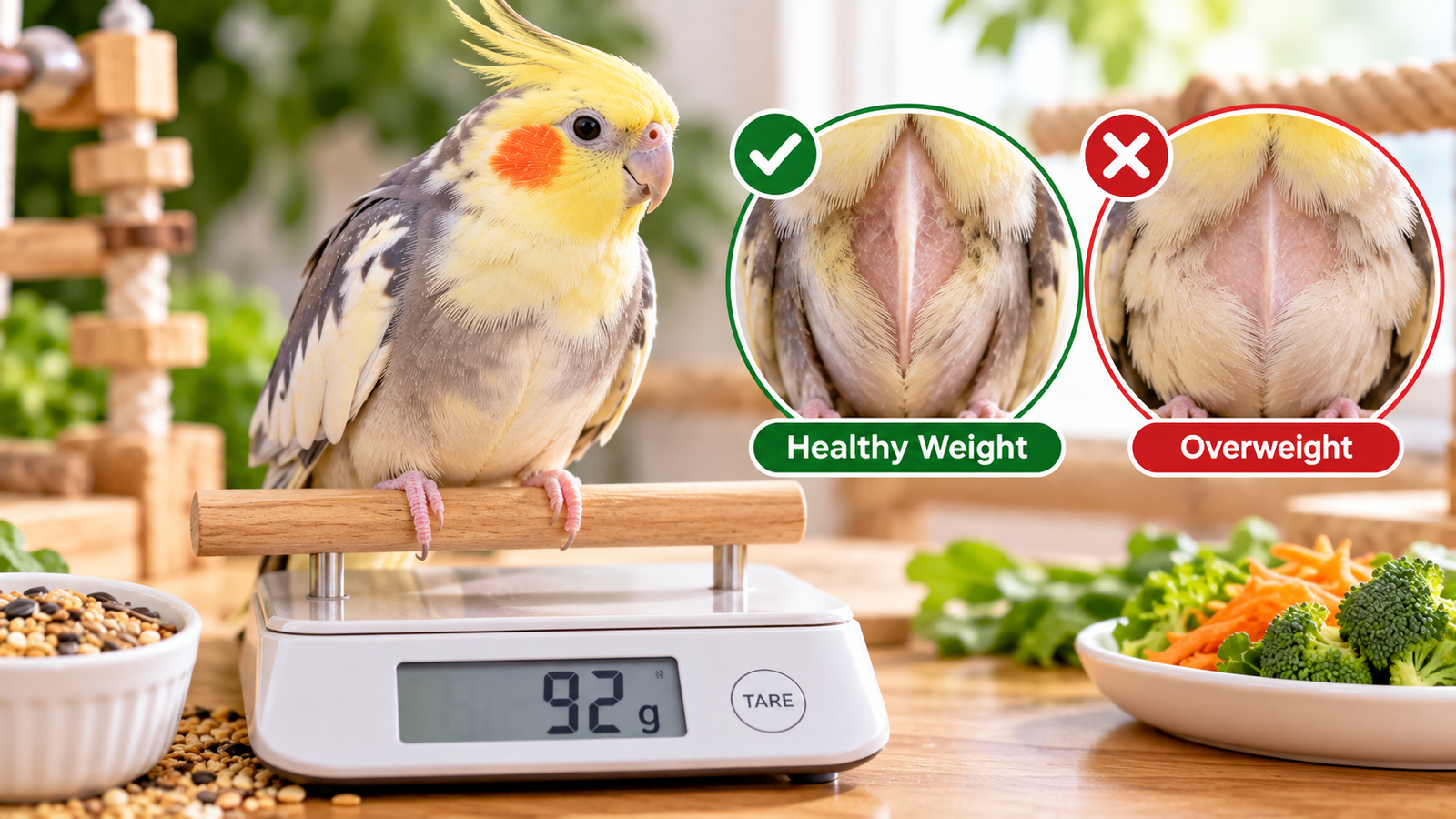

It can be surprisingly difficult to tell whether a pet bird is overweight simply by looking at it.
Feathers hide the shape of the body, and a bird that looks round and fluffy may actually be lean underneath. On the other hand, an apparently normal-looking bird can carry excess fat around the chest, abdomen, neck or thighs.
For that reason, healthy weight in birds is assessed using more than a number on a scale.
Body weight trends, the amount of muscle around the keel bone, fat deposits, species, age, diet, activity and overall health all help determine whether a bird is at an appropriate body condition.
Why It Is Hard to See Obesity in Birds
A cat or dog often becomes visibly wider as body fat increases.
Birds are different because feathers conceal much of the underlying body shape.
A bird’s apparent size can also change dramatically when it:
- Fluffs its feathers
- Preens
- Rests
- Feels cold
- Becomes excited
This means visual appearance alone is unreliable.
A better assessment considers:
- Body weight
- Weight trend
- Keel prominence
- Pectoral muscle condition
- Fat deposits
- Activity level
- Diet
- Veterinary examination
What Is the Keel Bone?
The keel is the prominent central part of a bird’s breastbone.
Large flight muscles sit on either side of it.
Because of this anatomy, the relationship between the keel, breast muscles and surrounding fat provides useful information about body condition.
Where Is the Keel Bone?
The keel runs along the center of the chest.
If you gently feel the breast of a healthy bird, you can usually identify:
- The central ridge of the keel
- Pectoral muscle on the left
- Pectoral muscle on the right
How prominent that ridge feels compared with the tissue on either side helps estimate body condition.
How Bird Body Condition Scoring Works
Avian veterinarians commonly use a keel or body-condition scoring system.
A 1–5 scale is frequently used.
| Score | General Interpretation | Typical Feel |
|---|---|---|
| 1/5 | Emaciated | Keel is extremely prominent with severe loss of breast muscle. |
| 2/5 | Thin | Keel is prominent and breast muscles are reduced. |
| 3/5 | Appropriate for most pet birds | Keel can be felt while the chest remains well muscled. |
| 4/5 | Above ideal | Keel becomes less prominent as additional tissue and fat accumulate. |
| 5/5 | Obese | Keel can be difficult to appreciate and substantial fat deposits may be present. |
How to Feel Your Bird’s Keel Safely
If your bird is accustomed to handling, you may be able to gently feel the breast with a fingertip.
Use very light pressure.
You are trying to identify:
- The central keel
- The muscle on either side
- Whether excess soft tissue is covering the area
Do not squeeze the bird’s chest.
What Should an Ideal Bird’s Chest Feel Like?
In a bird near appropriate body condition, the keel should be easy enough to locate without feeling extremely sharp or buried beneath excessive tissue.
There should be healthy pectoral muscle on both sides.
The exact shape varies between:
- Species
- Age groups
- Flight ability
- Activity levels
- Individual birds
That is why comparison with your own bird’s healthy baseline is valuable.
Signs a Bird May Be Overweight
Possible clues include:
- Increasing body weight over time
- Keel becoming increasingly difficult to feel
- Fat deposits over the chest
- Fat around the abdomen
- Fat around the thighs
- Fat deposits around the neck in severely obese birds
- Reduced willingness to fly
- Reduced stamina
- Difficulty climbing
- Breathing heavily after mild activity
- Reduced overall activity
None of these signs alone proves obesity.
Breathing difficulty or reduced activity can also occur with serious disease, so unexplained changes should not simply be blamed on body weight.
Fat Deposits in Birds
Excess fat does not always accumulate evenly.
Veterinary examination may reveal fat around areas such as:
- The abdomen
- Chest
- Thighs
- Neck
Some birds also develop localized fatty masses.
What Is a Lipoma?
A lipoma is a benign mass composed largely of fat.
Lipomas are particularly familiar in some overweight budgies.
They may appear as:
- Soft swellings
- Rounded masses
- Lumps beneath the skin
However, not every lump is a lipoma.
Any new mass should be examined by an avian veterinarian rather than diagnosed at home.
What Is a Xanthoma?
A xanthoma is another type of fatty lesion that can occur in birds.
It may look different from an ordinary lipoma and can become irritated or damaged.
VCA notes that both lipomas and xanthomas are seen more often in overweight birds.
A visible lump or abnormal skin area requires veterinary assessment.
Weigh Your Bird Regularly
A gram scale is one of the most useful tools a bird owner can have.
Birds often conceal illness and weight changes beneath their feathers.
Regular weighing can reveal trends before the difference becomes visually obvious.
Use Grams Rather Than Pounds
Small companion birds can experience meaningful changes of only a few grams.
For that reason, use a digital scale that measures in grams.
A bird scale with a perch is convenient, although a stable kitchen scale can also work when used safely.
How to Weigh a Pet Bird
- Place the scale on a stable surface.
- Add a secure perch or lightweight container if required.
- Tare the scale back to zero.
- Ask the bird to step onto the perch or scale.
- Record the weight in grams.
Use positive reinforcement rather than forcing the bird onto the scale.
Weigh Under Similar Conditions
For the most useful comparisons, weigh your bird under reasonably consistent conditions.
For example, use roughly the same:
- Time of day
- Scale
- Perch
- Routine
Body weight can fluctuate after eating, drinking or passing droppings.
Consistency makes the trend easier to interpret.
Keep a Bird Weight Log
A simple record can contain:
- Date
- Weight in grams
- Body-condition observations
- Diet changes
- Activity changes
- Relevant health notes
The trend is often more useful than one isolated measurement.
There Is No Universal Healthy Weight for Every Bird
Do not search for one number online and assume your bird should weigh exactly that amount.
Individuals of the same species can differ in:
- Frame size
- Sex
- Muscle mass
- Genetics
- Age
- Activity
Two healthy cockatiels, budgies or parrots can therefore have different appropriate weights.
Use Your Bird’s Healthy Baseline
A particularly useful number is the weight your individual bird maintains when:
- Healthy
- Well muscled
- At an appropriate body condition
- Eating an appropriate diet
Your avian veterinarian can help establish this baseline.
Do Not Judge Obesity From Weight Alone
Suppose two birds of the same species both weigh the same amount.
One may have:
- Strong pectoral muscle
- A larger frame
- An appropriate body condition
while the other may have:
- Less muscle
- More body fat
- A smaller frame
That is why body weight and body condition should be assessed together.
What Causes Obesity in Pet Birds?
The basic problem develops when calorie intake repeatedly exceeds energy use.
Common contributing factors include:
- High-fat diets
- Too much food
- Seed-heavy feeding
- Frequent high-calorie treats
- Large amounts of nuts
- Little exercise
- Limited flight
- Small or poorly arranged environments
- Constant easy access to calorie-dense foods
Seed-Heavy Diets and Bird Obesity
Seeds can be useful components of some species-appropriate feeding plans, but many commonly fed seed mixtures are calorie dense and high in fat.
A bird allowed to select favorite seeds may repeatedly choose high-fat items while leaving less-preferred foods behind.
This can contribute to both:
- Excess calorie intake
- Nutritional imbalance
Seeds Are Not Automatically Bad
The problem is not that every seed is harmful.
The concern is feeding a diet dominated by high-fat seeds when the species requires a broader nutritional balance.
Diet recommendations differ between bird species, so feeding plans should be species-specific.
Nuts Are Healthy but Calorie Dense
Some parrots can eat appropriate nuts as part of a balanced diet.
However, nuts contain substantial energy.
A few extra nuts every day can add a significant number of calories to a smaller bird’s diet.
Use high-value nuts thoughtfully rather than offering unlimited amounts.
Human Food Can Add Hidden Calories
Owners sometimes carefully measure the main diet while forgetting calories from:
- Table food
- Bread
- Crackers
- Cheese
- Training rewards
- Seeds given by hand
- Nuts
These extras count toward total intake.
Free Feeding Can Make Intake Difficult to Measure
Keeping large quantities of calorie-dense food constantly available makes it difficult to know how much the bird actually eats.
This is especially true when the bird:
- Selects only favorite ingredients
- Throws unwanted food out
- Shares a cage with another bird
A measured feeding plan may make weight management easier.
Why Inactivity Contributes to Obesity
Wild birds spend considerable energy:
- Flying
- Foraging
- Searching for food
- Climbing
- Exploring
- Interacting socially
A companion bird may instead have food placed directly beside its favorite perch and little reason to move.
That dramatic difference in activity can influence calorie requirements.
Exercise Is Part of Healthy Bird Weight Management
Appropriate exercise can include:
- Flight when safe and physically appropriate
- Climbing
- Moving between perches
- Foraging
- Recall training
- Target training
- Exploring a safe play area
Foraging Can Turn Food Into Activity
Instead of serving every piece of food in one easy bowl, use some of the measured daily food for safe foraging.
Examples include:
- Simple puzzle feeders
- Food wrapped loosely in bird-safe paper
- Small feeding stations in different locations
- Vegetables clipped in different safe areas
Start easy and gradually increase the challenge.
Do Not Add Extra Calories for Foraging
Food used in a puzzle still counts as food.
Take it from the bird’s planned daily allowance instead of adding it on top.
Use the Cage to Encourage Movement
In a sufficiently large cage, thoughtful arrangement can encourage a bird to move between:
- Perches
- Food stations
- Water
- Foraging areas
- Toys
However, the cage should not be arranged as an obstacle course that creates falls or blocks normal movement.
For detailed setup guidance, read: How to Set Up a Bird Cage: Size, Perches, Toys & Placement .
Which Pet Birds Are Prone to Obesity?
Any companion bird can become overweight when calorie intake consistently exceeds energy expenditure.
Veterinary sources particularly report obesity in species or groups including:
- Budgies
- Cockatiels
- Amazon parrots
- Macaws
- Galahs
- Quaker parrots
This does not mean every bird in these groups will become overweight.
Individual diet and activity still matter greatly.
Overweight Budgies
Budgies can gain excess weight, particularly when fed unrestricted high-fat seed mixtures and given little opportunity for exercise.
Obesity in budgies is also associated with problems such as:
- Fatty liver disease
- Lipomas
- Reduced stamina
For species-specific feeding guidance, read: What Do Budgies Eat? A Simple Guide to a Healthy Diet .
Overweight Cockatiels
Cockatiels can also gain excess body fat when:
- Seeds dominate the diet
- Portions are excessive
- Treats are frequent
- Exercise is limited
A cockatiel’s fluffy plumage can make visual judgment especially difficult.
Use weight trends and body condition rather than appearance alone.
For feeding guidance, read: What Should Cockatiels Eat Every Day? .
Overweight Amazon Parrots
Amazon parrots are frequently mentioned in avian veterinary references as being prone to obesity.
They benefit from careful management of:
- Calorie-dense foods
- Nuts
- Treats
- Portion size
- Daily activity
Regular weight monitoring is particularly useful.
Overweight Macaws
Macaws are large parrots with substantial individual variation.
Some veterinary references also identify them as birds in which obesity is commonly encountered.
Do not judge a macaw’s condition simply from a generic weight chart.
Body condition and individual frame size matter.
Why Is Bird Obesity Unhealthy?
Excess body fat can affect much more than appearance.
Veterinary literature associates obesity with increased risk of conditions including:
- Fatty liver disease
- Atherosclerosis
- Arteriosclerosis
- Heart disease
- Arthritis
- Pododermatitis
- Reduced exercise tolerance
- Respiratory difficulty in severely affected birds
- Lipomas and other fatty lesions
- Greater anesthetic risk
Fatty Liver Disease in Birds
Hepatic lipidosis, commonly called fatty liver disease, can occur when excess fat accumulates in the liver.
Obesity and high-fat diets are important risk factors.
Possible signs may include:
- Reduced activity
- Weakness
- Poor appetite
- Changes in droppings
- Breathing difficulty if the abdomen becomes enlarged
However, these symptoms can occur with many diseases.
A veterinarian needs to establish the diagnosis.
Obesity and the Cardiovascular System
Obese birds have a greater risk of cardiovascular disease, including atherosclerosis.
Atherosclerosis involves abnormal fatty changes in major arteries.
Severe disease can affect normal blood flow and cardiovascular function.
This is one reason obesity is a medical issue rather than simply a cosmetic concern.
Obesity and Bird Feet
Extra body weight places additional load on the feet.
Obesity can contribute to or worsen problems such as:
- Arthritis
- Pododermatitis
- Reduced mobility
- Reluctance to climb
Perch quality also matters, so both body condition and cage setup should be assessed when foot problems occur.
Obesity Can Affect Breathing
Severe abdominal fat can interfere with normal respiratory movement.
Merck notes respiratory problems as one possible clinical consequence in obese birds.
However, breathing difficulty should never automatically be blamed on weight.
How to Help an Overweight Bird Lose Weight Safely
The safest plan starts with an avian veterinary examination.
The veterinarian can:
- Confirm that the bird is actually overweight
- Assess body condition
- Set an appropriate target weight
- Review the existing diet
- Look for underlying disease
- Create a safe feeding plan
- Recommend an exercise program
- Monitor progress
Step 1: Record the Current Diet
Before changing anything, write down everything the bird normally eats.
Include:
- Main diet
- Seed
- Pellets
- Vegetables
- Fruit
- Nuts
- Treats
- Human food
- Training rewards
This gives you and your veterinarian a clearer picture of actual intake.
Step 2: Measure Food Rather Than Guessing
Large bowls encourage accidental overfeeding because it becomes difficult to know how much food is offered.
Measure the daily ration when your veterinarian recommends portion control.
If multiple birds live together, individual intake may need separate monitoring.
Step 3: Improve Diet Quality
For many common companion parrots, veterinary weight-management plans involve moving away from an all-seed or heavily seed-based diet toward a more balanced species-appropriate diet.
The exact diet depends on the species.
Do not assume that the same pellet, seed percentage or fresh-food combination suits every bird.
Change Diets Gradually
Birds can be extremely selective about unfamiliar food.
A bird offered only a completely unfamiliar diet may eat far less than the owner realizes.
Monitor actual food intake and body weight during diet changes.
Step 4: Reduce High-Calorie Extras
Depending on the species and diet plan, this may mean limiting excessive:
- Sunflower seeds
- Other high-fat seeds
- Nuts
- Processed human foods
- Frequent treats
Do not remove nutritionally important foods simply because they contain calories.
The overall diet still needs to remain balanced.
Step 5: Increase Safe Activity
Exercise should match the bird’s current fitness and health.
Options may include:
- More climbing
- Target training
- Recall exercises
- Foraging
- Supervised flight where appropriate
- Movement between play stations
Start Slowly With Sedentary Birds
An obese bird may also be poorly conditioned.
Do not suddenly demand intense flight from a bird that has barely exercised.
Instead, gradually increase activity and watch for:
- Excessive breathing effort
- Weakness
- Loss of balance
- Reluctance to continue
Step 6: Use Training as Exercise
Short positive-reinforcement sessions can create movement without frightening the bird.
For example:
- Step between two perches
- Walk toward a target
- Climb onto a play stand
- Recall short distances when flight is appropriate
Use part of the planned daily food as reinforcement whenever possible rather than adding unlimited extra treats.
Step 7: Monitor Weight and Body Condition
Weight loss should be evaluated as a trend.
Your veterinarian may recommend regular:
- Weigh-ins
- Body-condition checks
- Muscle-condition assessment
- Diet adjustments
The goal is controlled improvement while maintaining good nutrition and muscle.
Why Rapid Weight Loss Is a Problem
A drastic drop in food intake can cause:
- Nutritional deficiencies
- Loss of muscle
- Weakness
- Stress
- Other metabolic complications
A bird should not be starved to achieve a target weight quickly.
Do Not Skip Meals to Make a Bird Lose Weight
Weight management means changing the quality and quantity of food appropriately, not withholding nutrition for prolonged periods.
If your bird refuses a new diet or suddenly stops eating, contact your avian veterinarian.
Do Not Copy Another Bird’s Weight-Loss Plan
A feeding plan appropriate for an obese Amazon parrot may be completely unsuitable for:
- A budgie
- A cockatiel
- A macaw
- A finch
- A pigeon
- Another species
Species, body size and natural feeding ecology matter.
What if Your Bird Is Gaining Weight Despite Eating Well?
Check whether extra calories are entering the diet from:
- Other family members
- Training sessions
- Shared food bowls
- High-calorie treats
- Nuts
- Table food
Also consider activity.
If unexplained weight gain continues, veterinary evaluation is appropriate.
Weight Gain Is Not Always Fat
An increasing number on the scale does not automatically mean obesity.
Apparent weight gain or abdominal enlargement can also occur with:
- Egg development
- Organ enlargement
- Fluid accumulation
- Masses
- Other medical conditions
This is another reason body condition and veterinary examination matter.
What if Your Bird Is Losing Weight?
Unplanned weight loss is different from veterinary-managed weight reduction.
It can be an important sign of illness.
Possible causes include:
- Reduced food intake
- Digestive disease
- Infection
- Organ disease
- Chronic illness
- Difficulty eating
For other warning signs, read: Signs of Illness in Pet Birds .
Do Not Diet a Bird That Is Losing Weight Unexpectedly
A bird becoming lighter without an intentional veterinary plan needs investigation.
Do not further restrict food because you previously thought the bird looked overweight.
Muscle Condition Matters Too
A bird can carry excessive fat while having poor muscle development.
This is especially possible in sedentary birds.
Therefore, a successful weight-management program should aim to:
- Reduce excess body fat
- Maintain or improve muscle
- Increase safe activity
- Provide complete nutrition
Why Flight Muscle Matters
The large pectoral muscles beside the keel power flight and contribute significantly to the bird’s body condition.
A bird that rarely moves or flies may have relatively poor muscle despite a high body weight.
This explains why weight alone cannot distinguish muscle from fat.
Should You Feel Your Bird’s Abdomen for Fat?
Avoid pressing or repeatedly manipulating the abdomen yourself.
An avian veterinarian can examine the bird safely and determine whether apparent fullness represents:
- Fat
- Normal anatomy
- An egg
- Organ enlargement
- A mass
- Another abnormality
Can You Tell if a Bird Is Overweight From Photos?
Not reliably.
Feather position can dramatically change apparent body size.
A photograph can sometimes reveal obvious fat deposits or mobility problems, but it cannot replace:
- Weight measurement
- Keel assessment
- Muscle assessment
- Physical examination
Can an Overweight Bird Still Fly?
Yes.
Ability to fly does not prove ideal body condition.
However, excess weight can make flight more demanding and may reduce:
- Stamina
- Agility
- Willingness to exercise
What if Your Overweight Bird Cannot Fly?
Do not force prolonged flight sessions.
There may be several reasons the bird does not fly well, including:
- Poor fitness
- Excess weight
- Wing-feather condition
- Previous wing trimming
- Pain
- Illness
- Lack of flight experience
Ask your veterinarian which forms of exercise are safe.
Can Clipped Birds Exercise?
Yes.
A bird that cannot currently fly normally can still benefit from appropriate:
- Climbing
- Walking
- Foraging
- Training
- Safe play-stand movement
Make the environment safe for the bird’s actual mobility.
Multi-Bird Households and Weight Control
Weight management becomes harder when several birds eat together.
One bird may:
- Eat faster
- Steal high-value foods
- Guard a bowl
- Consume another bird’s portion
Meanwhile, another bird may eat too little.
Separate Feeding May Be Necessary
When individual birds need different portions or diets, consider:
- Separate cages during meals
- Different feeding stations
- Supervised mealtimes
- Individual weighing
The goal is to know which bird is actually eating which food.
How to Prevent Bird Obesity
Prevention is easier than treating established obesity.
Useful habits include:
- Feed a species-appropriate balanced diet
- Avoid unlimited high-fat treats
- Monitor portions
- Weigh the bird regularly
- Learn the bird’s normal body condition
- Provide daily movement
- Use foraging activities
- Schedule regular avian veterinary examinations
Make the Bird Work a Little for Food
Healthy enrichment can recreate part of the activity involved in natural foraging.
Instead of every meal appearing beside the favorite perch, encourage safe:
- Searching
- Climbing
- Manipulation
- Problem-solving
without making access to essential nutrition excessively difficult.
Do Not Use Hunger as Enrichment
Foraging should make feeding interesting, not prevent a bird from obtaining enough food.
A bird should always be able to meet its nutritional needs.
When Should an Overweight Bird See a Vet?
A veterinary examination is appropriate whenever you suspect significant excess weight.
It is especially important when the bird:
- Has difficulty breathing
- Becomes tired very quickly
- Has trouble perching
- Has foot sores
- Has a new lump
- Has a swollen abdomen
- Shows abnormal droppings
- Has a rapid weight change
- Stops eating normally
- Has never had a formal body-condition assessment
Bird Weight and Body-Condition Checklist
Regularly ask:
- What does my bird weigh today?
- Is the long-term trend stable?
- Can I appropriately feel the keel?
- Are the breast muscles well developed?
- Has the bird become less active?
- Are there visible or palpable fat deposits?
- How much seed, nuts and treats does the bird receive?
- Is food measured?
- Does the bird get daily exercise?
- Has an avian veterinarian assessed body condition recently?
Common Bird Weight-Management Mistakes
- Judging body condition only by appearance
- Using one online weight number for every bird of a species
- Never weighing the bird
- Assuming a fluffy bird is fat
- Assuming a thin-looking bird cannot be overweight
- Feeding unlimited high-fat seed
- Giving too many nuts or treats
- Ignoring calories from training rewards
- Changing diets too quickly
- Removing familiar food before confirming the bird eats the replacement
- Crash-dieting an overweight bird
- Forcing intense exercise on an unfit bird
- Ignoring muscle condition
- Assuming weight gain is always fat
- Ignoring unexplained weight loss
- Trying to manage severe obesity without veterinary guidance
Frequently Asked Questions
How can I tell if my bird is overweight?
Combine regular weight measurements with body-condition assessment. Feel the keel and breast muscles gently, ideally after an avian veterinarian has demonstrated the technique. Excess tissue covering the keel, increasing weight and abnormal fat deposits can indicate overweight body condition.
What is a healthy body-condition score for a bird?
On a commonly used 1–5 keel-scoring system, approximately 3/5 is considered appropriate for most pet birds. Body-condition systems are not perfectly standardized, so the score should be interpreted with the individual bird in mind.
What should a bird’s keel feel like?
The keel should be identifiable without feeling extremely sharp or completely buried beneath excess tissue. Healthy breast muscle should be present on both sides.
Can you tell if a bird is overweight by looking at it?
Not reliably. Feathers can hide both excess fat and muscle loss. Weight trends and hands-on body-condition assessment provide much better information.
How often should I weigh my bird?
Regular home weighing is useful for establishing trends. The ideal frequency depends on the bird’s health and whether weight management is underway. Your veterinarian may recommend more frequent monitoring during diet changes or treatment.
Should birds be weighed in grams?
Yes. A digital gram scale is useful because even relatively small changes can be meaningful in small companion birds.
What causes obesity in pet birds?
Common causes include excess calorie intake, high-fat seed-heavy diets, large amounts of nuts or treats, overfeeding and limited physical activity.
Are seed diets making my bird overweight?
Seed-heavy diets can contribute to obesity because many seeds are calorie dense and high in fat. They can also be nutritionally incomplete when they make up most of the diet for species that require a broader feeding plan.
Which birds are prone to obesity?
Obesity can affect any pet bird, but veterinary references commonly mention budgies, cockatiels, Amazon parrots, macaws, galahs and Quaker parrots among birds frequently affected.
How do I know if my budgie is overweight?
Use regular gram-scale measurements together with assessment of the keel and breast muscles. Do not rely on the budgie’s fluffy appearance alone.
How do I know if my cockatiel is overweight?
Track body weight and have the keel and muscle condition assessed. Cockatiel feathers can hide excess body fat, so visual appearance alone is unreliable.
Can obesity cause fatty liver disease in birds?
Yes. Obesity and high-fat diets are important risk factors for hepatic lipidosis, commonly called fatty liver disease.
Can overweight birds have breathing problems?
Severe obesity can contribute to respiratory difficulty, including effects from excessive abdominal fat. However, any significant breathing difficulty should be evaluated promptly because many other serious conditions can cause it.
Can bird obesity cause foot problems?
Excess weight can increase stress on the feet and joints and may contribute to problems including arthritis and pododermatitis.
How can I help my overweight bird lose weight?
Have an avian veterinarian confirm the body condition and establish a target. Weight management usually involves an appropriate balanced diet, measured food, control of calorie-dense extras, increased safe exercise and regular monitoring.
Should I feed my overweight bird less seed?
Often a seed-heavy diet needs modification, but the correct feeding plan depends on species and current diet. Make changes gradually and with veterinary guidance rather than abruptly removing familiar food.
Can I stop feeding my bird for part of the day to make it lose weight?
Do not use starvation or prolonged food withholding as a weight-loss strategy. Birds need complete nutrition, and calorie restriction should be carefully planned.
How fast should a bird lose weight?
There is no single safe rate for every species and individual. An avian veterinarian should set the target and monitor the trend, particularly in a substantially overweight bird.
Does flying help an overweight bird lose weight?
Appropriate flight can provide valuable exercise, but not every bird can safely begin intensive flying. Activity should match the bird’s fitness, mobility and health.
Can a clipped bird still exercise?
Yes. Depending on mobility, suitable options can include climbing, walking between play areas, foraging and positive-reinforcement training.
Can weight gain mean something other than obesity?
Yes. Egg development, organ enlargement, fluid accumulation or a mass can also change weight or abdominal size. Unexpected changes should be assessed by an avian veterinarian.
Why is my bird losing weight even though I thought it was overweight?
Unplanned weight loss may indicate illness or inadequate intake. Do not continue restricting food until an avian veterinarian has evaluated the bird.
The Bottom Line
You cannot reliably tell whether a bird is overweight simply by looking at its feathers.
Regular weight measurements and body-condition assessment provide much better information.
On a commonly used 1–5 keel-scoring system, around 3/5 is considered appropriate for most companion birds. The keel should remain identifiable while healthy pectoral muscle fills the chest on either side.
Higher body-condition scores, increasing body weight and fat deposits around the abdomen, thighs or neck may indicate excess body fat.
Diet and activity are the main preventable contributors to bird obesity. High-fat seed-heavy diets, excessive nuts and treats, unrestricted calories and sedentary living can all play a role.
Obesity matters because it is associated with important medical problems, including fatty liver disease, cardiovascular disease, arthritis, pododermatitis, reduced exercise tolerance and increased anesthetic risk.
Do not solve the problem with severe food restriction. A safe weight-management plan maintains complete nutrition while reducing unnecessary calories and gradually increasing appropriate exercise.
Most importantly, work with your avian veterinarian to determine your individual bird’s healthy weight and body condition. Species averages are useful context, but your bird’s frame, muscle mass, diet, activity and medical history determine what a healthy target actually looks like.
References and Further Reading
Merck Veterinary Manual — Management of Pet Birds
Keel and body-condition scoring, pectoral muscle assessment, fat distribution and physical examination of companion birds.
Merck Veterinary Manual: Management of Pet Birds
Merck Veterinary Manual — Nutritional Diseases of Pet Birds
Obesity, high-fat diets, overfeeding, sedentary behavior, fatty liver disease, arthritis, pododermatitis and species predispositions.
Merck Veterinary Manual: Nutritional Diseases of Pet Birds
Merck Veterinary Manual — Nutritional Disorders of Pet Birds
Companion-bird obesity, measured feeding, balanced nutrition and exercise for overweight birds.
Merck Veterinary Manual: Nutritional Disorders of Pet Birds
VCA Animal Hospitals — Obesity in Birds
Body-condition scoring, obesity-prone species, seed-heavy diets, cardiovascular disease, fatty liver disease, lipomas, xanthomas and weight management.