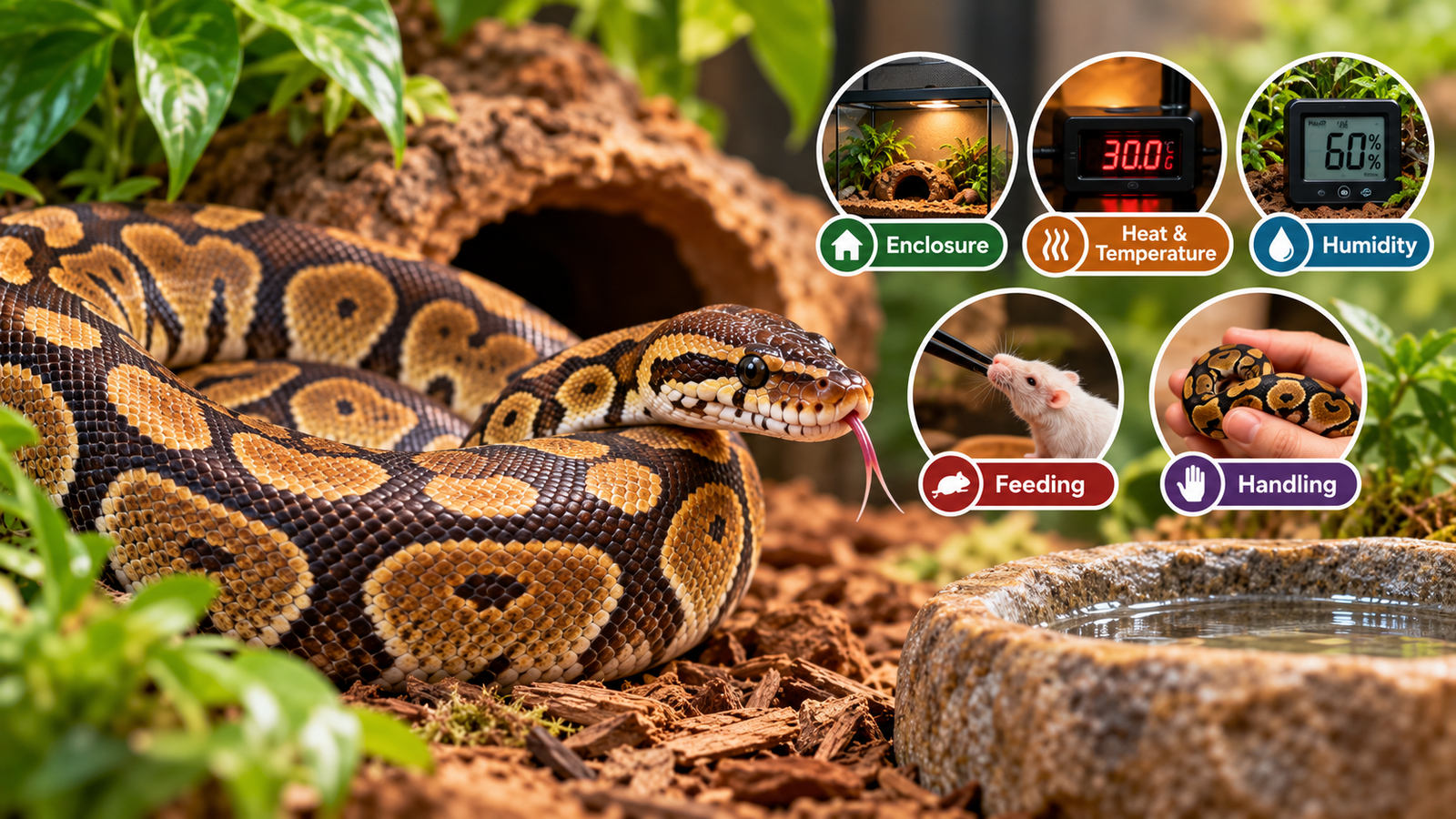

Ball pythons are one of the world’s most popular pet snakes. They are usually calm, manageable in size and relatively straightforward to feed once their enclosure is set up correctly.
They are also called royal pythons, and their scientific name is Python regius.
Although they are often recommended to beginners, ball pythons have more specific humidity and security needs than many first-time keepers expect. Poor temperatures, low humidity, an exposed enclosure or excessive handling can contribute to shedding problems, stress and refusal to eat.
This ball python care guide covers enclosure size, heating, humidity, lighting, substrate, hides, feeding, handling, shedding, fasting, cleaning and the health problems every beginner should know about.
Ball Python Care at a Glance
| Care Area | Beginner Guideline |
|---|---|
| Scientific name | Python regius |
| Other name | Royal python |
| Adult length | Often around 120–150 cm (4–5 ft), with individual variation |
| Lifespan | Potentially 20–30 years or more with good care |
| Adult enclosure | At least long enough for the snake to fully stretch out; larger, well-furnished enclosures are preferable |
| Basking / warm zone | About 30–32°C (86–90°F) |
| Cool end | About 24–26°C (75–79°F) |
| Humidity | Normally around 50–60%, with higher humidity available during shedding and inside a humid hide |
| Lighting | Regular day-night cycle; low-level UVB can be beneficial when set up correctly |
| Diet | Appropriately sized frozen-thawed whole rodents |
| Adult feeding | Commonly every 7–14 days, adjusted to prey size and body condition |
| Housing | Keep individually |
| Handling | Gentle supported handling; wait at least 48 hours after feeding |
Are Ball Pythons Good Pets for Beginners?
Ball pythons can make good first snakes for owners who are prepared to manage a proper reptile enclosure.
Their advantages include:
- Generally calm behavior
- Nonvenomous
- Manageable adult size
- Slow, predictable movement
- Relatively simple whole-prey diet
However, they are not a pet that can simply live in a small tank with a heat pad.
Successful care requires:
- Accurate heating
- A temperature gradient
- Reliable humidity
- Secure hides
- Enough space to stretch and explore
- Appropriate frozen-thawed prey
- Regular monitoring
How Big Do Ball Pythons Get?
Many adult ball pythons reach around 120–150 cm, or approximately 4–5 feet.
Adult females are often larger and heavier than males, although individual size varies.
Ball pythons have relatively heavy bodies compared with slender snakes such as corn snakes, so enclosure furnishings and climbing structures need to support their weight safely.
How Long Do Ball Pythons Live?
A ball python is a long-term pet.
With appropriate care, many live for two decades or longer, and some captive individuals can reach around 30 years or beyond.
Before getting one, consider the long-term cost of:
- A full-sized enclosure
- Heating equipment
- Thermostats
- Lighting
- Substrate
- Frozen prey
- Veterinary care
Ball Python Enclosure Size
A ball python should be able to fully stretch out inside its enclosure.
A useful welfare-based minimum is:
- Enclosure length approximately equal to the snake’s full length
- Width at least about one-third of the snake’s length
- Height at least about one-third of its length
For example, a 120 cm snake should have an enclosure at least around 120 cm long.
A practical adult enclosure around 120 × 60 × 60 cm (4 × 2 × 2 ft) gives more room for hides, climbing features and a reliable temperature gradient than a very narrow setup.
Do Ball Pythons Get Stressed in Large Enclosures?
A common myth says ball pythons become stressed simply because an enclosure is large.
The real problem is often a large empty enclosure.
Ball pythons naturally seek enclosed spaces and cover.
A larger enclosure can work well when it contains:
- Several snug hides
- Branches
- Plants or artificial foliage
- Cork bark
- Visual barriers
- Leaf litter
- Areas of shade
The snake should be able to move through the enclosure without feeling exposed from every direction.
Baby Ball Python Enclosures
Young ball pythons can live in smaller secure enclosures and move into larger housing as they grow.
Alternatively, a youngster can use a larger enclosure if you provide enough appropriately sized hides and ground cover.
Security matters more than simply making the enclosure small.
Make the Enclosure Escape-Proof
Ball pythons are strong snakes.
Make sure the enclosure has:
- Secure doors
- Reliable locks or catches
- No gaps around cables
- Secure ventilation openings
- No loose lids
Check the enclosure before the snake arrives rather than learning about a weak door after an escape.
Run the Enclosure Before Bringing Your Snake Home
Set everything up in advance.
Running the complete enclosure for several days to a week lets you test:
- Basking temperature
- Cool-end temperature
- Night temperature
- Humidity
- Thermostat function
- Lighting timers
- Ventilation
Correcting a setup is easier before a snake is living inside it.
Ball Python Temperature Gradient
Ball pythons are ectothermic, which means they rely on environmental heat to regulate their body temperature.
Do not heat the entire enclosure to one temperature.
Create a warm end and a cool end so the snake can move between different temperatures.
| Area | Target |
|---|---|
| Basking / warm area | About 30–32°C (86–90°F) |
| Warm hide | Warm but protected, within the appropriate warm-side range |
| Cool end | About 24–26°C (75–79°F) |
| Night | Lights off; maintain safe temperatures with non-light-emitting heat if the room becomes too cold |
Why a Temperature Gradient Matters
The snake needs different temperatures for different activities.
It may warm itself to:
- Digest food
- Support normal metabolism
- Remain active
and then move to a cooler area when it no longer needs additional heat.
A gradient gives the snake control over this process.
Use a Thermostat With Every Heat Source
The correct thermostat type depends on the heater.
For example, some overhead heat sources work best with dimming or proportional thermostats, while certain mats are commonly controlled with appropriate on/off thermostats.
Follow the equipment manufacturer’s guidance.
A Thermostat Does Not Replace a Thermometer
A thermostat controls the heater.
A thermometer tells you what temperature the snake is actually experiencing.
Use both.
A useful monitoring setup includes:
- Digital thermometer on the warm side
- Digital thermometer on the cool side
- Infrared thermometer for checking surfaces
- Digital hygrometer for humidity
Best Heat Source for a Ball Python
Overhead heating can create an effective warm zone while also warming the surrounding air.
Options may include properly installed:
- Halogen or reptile basking lamps for daytime heat
- Ceramic heat emitters where non-light heat is needed
- Radiant heat panels in suitable enclosures
Any heater installed inside the enclosure must be protected so the snake cannot wrap around or touch a dangerously hot surface.
Can Ball Pythons Use Heat Mats?
Heat mats can have a limited role in some setups, particularly small enclosures, but they should never be used without a thermostat.
A mat heats a relatively small surface area and may not create good ambient temperatures in a large adult enclosure.
For that reason, overhead heating is often more useful for creating a complete warm zone.
Avoid Heat Rocks
Do not use an electric heat rock as the main heat source.
A snake can remain in contact with an excessively hot surface and suffer a serious thermal burn.
Use controlled heating that creates a proper environmental gradient instead.
Ball Python Heating at Night
All visible lights should switch off at night.
Do not leave red, blue or bright white bulbs on continuously.
If the room becomes too cold overnight, use a thermostat-controlled heat source that produces no visible light.
Ball Python Humidity
Humidity is particularly important in ball python care.
A practical baseline for many enclosures is approximately 50–60% relative humidity.
A humid hide and temporary increases toward roughly 70–80% can be useful during shedding.
Merck’s veterinary husbandry table gives a broader 50–80% range for ball pythons.
The goal is not to chase one exact number every minute. Instead, provide appropriate moisture without creating a permanently wet, stagnant enclosure.
Measure Humidity at the Cool End
Use a digital hygrometer.
Humidity varies with:
- Temperature
- Ventilation
- Substrate
- Water bowl size
- Room conditions
Measurements are usually most useful around the cooler half of the enclosure, where relative humidity tends to be higher.
Signs Humidity May Be Too Low
Possible husbandry clues include:
- Repeated incomplete sheds
- Retained eye caps
- Dry retained skin
- Difficulty shedding the tail tip
Repeated shedding problems deserve a review of the entire setup rather than simply spraying more water once.
Can Humidity Be Too High?
Yes.
High humidity combined with poor ventilation, dirty substrate or constantly wet surfaces can promote:
- Mold
- Bacterial growth
- Skin problems
- Unhealthy enclosure conditions
The enclosure should be humid enough for the species while still receiving good airflow.
How to Increase Humidity Safely
Useful methods include:
- Using moisture-retentive substrate
- Providing a humid hide
- Adding clean leaf litter
- Increasing substrate depth
- Adjusting ventilation carefully
- Adding moisture to the substrate when needed
Avoid turning the entire floor into a swamp.
Provide a Humid Hide
A humid hide gives your ball python access to a small area with extra moisture.
Add slightly damp:
- Sphagnum moss
- Paper towel
- Another safe moisture-holding material
The material should feel damp rather than dripping wet.
Replace it if it becomes dirty or moldy.
How Many Hides Does a Ball Python Need?
Provide at least:
- One snug hide at the warm end
- One snug hide at the cool end
A separate humid hide is also useful.
Multiple hides allow the snake to regulate temperature without sacrificing security.
What Makes a Good Ball Python Hide?
Ball pythons often prefer close-fitting hides.
The snake should be able to coil inside with much of its body touching the walls.
Avoid a huge open cave when a smaller snug shelter would provide better security.
As the snake grows, replace undersized hides.
Do Ball Pythons Need UVB?
Ball pythons can obtain calcium and vitamin D-related nutrients from complete whole prey, so historically they have often been kept without dedicated UVB.
However, modern welfare guidance supports providing low-level UVB as part of a naturalistic light environment.
The RSPCA recommends a low-output reptile UVB source with a gradient from approximately UVI 1.0 in the basking area to zero in full shade.
Some light-sensitive morphs, including albino animals, may require lower exposure.
Always Provide Shade From UVB
UVB should never cover every part of the enclosure equally.
Your snake needs places where it can completely escape:
- UVB
- Bright visible light
- Direct heat
This creates a photogradient as well as a temperature gradient.
UVB Lamp Placement Matters
UVB intensity changes depending on:
- Lamp type
- Distance
- Reflector
- Mesh screening
- Lamp age
Follow the manufacturer’s distance recommendations rather than choosing a percentage and placing the lamp randomly.
For a deeper explanation, read: Reptile UVB Lighting: How It Works and Setup .
Ball Python Day and Night Cycle
Provide a predictable light-dark cycle.
Around 12 hours of light followed by 12 hours of darkness is a simple general routine.
A plug-in timer makes this easy to maintain.
Best Substrate for a Ball Python
A good ball python substrate should help maintain appropriate humidity without remaining waterlogged.
Useful choices can include:
- Reptile-safe organic soil
- Coconut husk
- Cypress mulch
- Appropriate naturalistic soil mixtures
A deeper layer holds moisture more steadily than a paper-thin covering.
What About Aspen?
Aspen is used successfully in some snake setups, but it does not retain humidity as well as soil, coconut-based substrates or cypress mulch.
It also becomes unsuitable if allowed to stay wet.
For a species requiring moderate humidity, many keepers find moisture-retentive substrate easier to manage.
Paper Towel for Quarantine
Paper towel can be useful temporarily when:
- A snake is newly acquired
- You are monitoring droppings
- The animal is receiving medical treatment
- You are checking for mites
It is easy to replace and makes waste visible.
For long-term housing, a safe naturalistic substrate provides more opportunity for normal exploration and moisture management.
Substrates to Avoid
Avoid:
- Cedar
- Aromatic pine shavings
- Sharp gravel
- Crushed walnut shell
- Sand used as the sole substrate
These materials may create irritation, ingestion hazards or unsuitable humidity conditions.
Ball Python Enrichment
Ball pythons are sometimes treated as animals that only need a dark plastic box and food.
That approach overlooks normal exploratory behavior.
A well-designed enclosure can include:
- Branches
- Cork bark
- Low platforms
- Plants
- Leaf litter
- Several hides
- Different textures
- Visual barriers
Do Ball Pythons Climb?
Yes.
Ball pythons can and do climb, particularly under low-light conditions.
Provide sturdy branches that can support the snake’s full weight.
Avoid narrow unstable structures or excessive fall heights.
Fresh Water
Provide fresh drinking water at all times.
The water bowl should be:
- Stable
- Easy to clean
- Large enough for the snake to enter if it chooses
- Positioned where it does not constantly flood the substrate
Replace the water daily and immediately if it becomes contaminated.
What Do Ball Pythons Eat?
Ball pythons are carnivores.
Captive pets are normally fed whole rodents such as:
- Mice
- Rats
- Other appropriate captive-bred whole prey when suitable
Whole prey provides muscle, organs, bone, fat and other nutrients in one package.
Frozen-Thawed Prey Is Preferred
Use frozen-thawed or otherwise humanely pre-killed prey instead of live rodents whenever possible.
A live mouse or rat can bite a snake badly enough to cause:
- Open wounds
- Eye injury
- Infection
- Permanent scarring
How Big Should Ball Python Prey Be?
A useful starting guideline is to offer prey that is approximately equal to or slightly wider than the widest part of the snake’s body.
The correct prey size depends on:
- Snake size
- Age
- Body condition
- Feeding frequency
Ball Python Feeding Schedule
| Life Stage | General Starting Pattern |
|---|---|
| Young ball python | Appropriately sized prey roughly every 5–7 days |
| Growing juvenile | Usually around weekly, adjusted to growth and body condition |
| Adult | Approximately every 7–14 days, depending on prey size and condition |
These intervals are guidelines rather than a requirement to feed on an exact calendar day.
Monitor the snake’s body condition and growth.
Do Not Overfeed a Ball Python
Ball pythons have relatively low energy requirements compared with many mammals.
A snake that accepts food enthusiastically does not necessarily need more food.
Overfeeding may lead to:
- Excess body fat
- Poor muscle condition
- Reduced activity
- Long-term health problems
Monitor Body Condition
A healthy ball python should have a muscular, softly rounded body rather than appearing extremely thin or extremely circular.
Regular weighing can help identify trends.
Record:
- Date
- Weight
- Prey size
- Feeding frequency
- Refused meals
- Shed dates
Should You Feed a Ball Python in a Separate Container?
Routine transfer to a separate feeding box is not necessary.
You can feed the snake inside its normal enclosure using long feeding tongs.
This avoids unnecessary handling immediately before and after eating.
Use Feeding Tongs
Long feeding tongs keep your fingers away from the prey and feeding response.
Wash your hands after handling rodents and before handling the snake.
How Long Should You Wait to Handle After Feeding?
Wait at least 48 hours after a meal before routine handling.
Handling too soon may disturb digestion and increase the chance of regurgitation.
Why Do Ball Pythons Refuse Food?
Ball pythons have a reputation for occasional fasting.
Possible reasons include:
- Stress after moving
- Inadequate hides
- Incorrect temperature
- Incorrect humidity
- Shedding
- Seasonal changes
- Prey preference
- Overfeeding
- Illness
Do not immediately assume that every missed meal means disease.
However, a sudden change should always make you review the enclosure and the snake’s overall condition.
When Does Food Refusal Become Concerning?
Contact a reptile-experienced veterinarian when food refusal is accompanied by:
- Progressive weight loss
- Abnormal breathing
- Mouth discharge
- Diarrhea
- Regurgitation
- Swelling
- Weakness
- Major behavioral change
Body weight is more useful than counting missed meals alone.
Do Not Force-Feed at Home
Do Ball Pythons Need Calcium Powder?
A healthy ball python eating nutritionally appropriate whole prey usually does not need routine calcium or vitamin powder.
Whole prey already contains:
- Bone
- Muscle
- Organs
- Fat
- Minerals
Do not add supplements unless a reptile veterinarian identifies a specific reason.
Bringing a New Ball Python Home
Give a newly arrived snake time to settle.
During the first week:
- Keep handling minimal
- Maintain stable temperatures
- Maintain appropriate humidity
- Provide several secure hides
- Provide fresh water
- Observe breathing and movement
- Watch for mites or obvious injuries
A snake hiding for long periods after moving is not automatically a problem.
When Should You Start Handling?
Avoid unnecessary handling during roughly the first week.
Allow the snake to learn where the hides, water and temperature zones are.
Once it appears settled and is feeding normally, gradually introduce short handling sessions.
How to Handle a Ball Python
Approach calmly.
Gently scoop the snake up rather than grabbing it tightly.
Support the body at several points with both hands.
Allow the snake to move through your hands at its own pace.
How Long Should Handling Sessions Be?
Around 10–15 minutes can be enough for a routine session, particularly for a new or young snake.
Room temperature matters because a snake removed from its heated enclosure will gradually cool down.
Return it sooner if it becomes:
- Very restless
- Cold
- Defensive
- Repeatedly trying to escape
Signs a Ball Python Wants to Be Left Alone
A defensive snake may:
- Pull its head back into an S-shaped posture
- Hiss
- Strike
- Become unusually tense
- Rapidly retreat
Do not punish defensive behavior.
Return later when the snake feels more secure.
Why Do Ball Pythons Curl Into a Ball?
Their name comes from a characteristic defensive behavior.
When frightened, a ball python may coil tightly and protect its head inside the center of its body.
Occasional defensive curling is normal.
Frequent defensive behavior may mean the snake needs more security, less handling or a husbandry review.
Ball Python Shedding
Like other snakes, ball pythons periodically shed the outer layer of their skin.
Young growing animals shed more frequently than adults.
Before shedding, you may notice:
- Duller coloration
- Cloudy or bluish eyes
- More hiding
- Reduced appetite
- Greater defensiveness
Why Do the Eyes Turn Blue?
Snakes have transparent scales over their eyes called spectacles or eye caps.
During the shedding cycle, fluid develops between skin layers and makes the eyes appear cloudy or blue.
The eyes may clear again shortly before the old skin is actually shed.
How to Support a Healthy Shed
Provide:
- Correct baseline humidity
- A humid hide
- Fresh drinking water
- Rough but safe surfaces such as cork or branches
The snake should normally remove the old skin itself.
Check the Shed Afterwards
Inspect the snake after shedding.
Pay particular attention to:
- Eye caps
- Tail tip
- Neck
- Any areas where retained skin remains tight
Retained Eye Caps
Persistent retained spectacles should be assessed by a reptile-experienced veterinarian.
Should You Soak a Ball Python With Stuck Shed?
Improving humidity and providing a humid hide are preferable first steps for mild retained shed.
If soaking is needed, keep it shallow, lukewarm and supervised.
Repeated shedding problems usually mean the enclosure setup needs correction.
Can Ball Pythons Live Together?
Ball pythons are naturally solitary and should normally be housed individually.
Separate housing prevents:
- Competition for hides
- Competition for heat
- Feeding confusion
- Difficulty tracking droppings
- Difficulty monitoring individual weight
- Stress from forced proximity
Quarantine a New Ball Python
If you already keep reptiles, quarantine every new snake rather than placing it immediately near your established animals.
During quarantine:
- Use separate equipment
- Wash hands between animals
- Monitor feeding
- Record weight
- Check droppings
- Look carefully for mites
- Arrange a reptile veterinary examination
Cleaning the Enclosure
Remove waste as soon as you notice it.
Spot clean:
- Feces
- Urates
- Wet substrate
- Regurgitated prey
- Contaminated bedding
Daily Ball Python Care
Each day:
- Check temperatures
- Check humidity
- Provide clean water
- Remove visible waste
- Confirm the enclosure is secure
- Observe the snake briefly
Deep Cleaning
Clean the enclosure, glass, walls and washable furnishings periodically, with a more thorough clean around monthly being a useful general routine for conventional setups.
Use a reptile-safe disinfectant according to its instructions.
Rinse thoroughly and allow surfaces to dry before returning the snake.
Wash Your Hands After Handling
Reptiles can carry Salmonella while appearing completely healthy.
Wash your hands with soap and water after:
- Handling the snake
- Cleaning the enclosure
- Touching substrate
- Handling water bowls
- Handling frozen-thawed prey
How to Tell if a Ball Python Is Healthy
A healthy ball python generally has:
- Clear eyes when not shedding
- Quiet breathing
- Regular tongue flicking
- Intact skin
- A clean vent
- No unexplained lumps
- Good muscle tone
- Stable body condition
Common Ball Python Health Problems
Problems seen in pet ball pythons include:
- Incomplete shedding
- Retained eye caps
- Respiratory infections
- Snake mites
- Internal parasites
- Mouth infections
- Thermal burns
- Skin infections
- Constipation
- Regurgitation
- Obesity
- Egg-binding in females
- Prolapse
- Other infectious diseases
Respiratory Infection Signs
Contact a reptile veterinarian if you notice:
- Wheezing or whistling
- Clicking respiratory sounds
- Mucus or bubbles around the nose or mouth
- Repeatedly holding the head unusually high
- Open-mouth breathing
- Lethargy
- Loss of appetite with breathing changes
Mouth Rot
Infectious stomatitis is commonly called mouth rot.
Warning signs include:
- Red or swollen gums
- Thick saliva
- Discharge
- Blood around the mouth
- Bad-smelling material
- Difficulty eating
- Refusal of food
Mouth infections require veterinary treatment.
Snake Mites
Snake mites are small external parasites that can spread between reptiles.
Possible clues include:
- Tiny dark moving specks
- Mites around the eyes or under scales
- Frequent rubbing
- Unusual soaking
- Restlessness
- Poor body condition with a heavy infestation
A snake spending unusually long periods submerged in its water bowl can be one reason to inspect carefully for mites.
Thermal Burns
Burns are commonly associated with improperly controlled heating.
Possible signs include:
- Red skin
- Blisters
- Dark damaged scales
- Open wounds
- Areas of abnormal shedding
A suspected thermal burn needs veterinary assessment.
Constipation
Ball pythons do not defecate on the same schedule as mammals.
Long intervals between bowel movements can sometimes be normal.
However, constipation accompanied by:
- Abdominal swelling
- Repeated straining
- Loss of appetite
- Weakness
- Pain
deserves veterinary attention.
Inadequate hydration and temperatures that are too low for normal digestion can contribute to digestive problems.
Regurgitation
Possible reasons for regurgitation include:
- Handling too soon after feeding
- Incorrect temperature
- Excessively large prey
- Stress
- Underlying disease
Repeated regurgitation is not normal.
Ball Python Obesity
A heavy-bodied snake can look impressive without being healthy.
Watch for excessive:
- Body roundness
- Fat rolls when the snake bends
- Soft tissue around the tail base
- Weight gain without corresponding growth
A reptile veterinarian can help distinguish healthy muscle from excess fat.
Special Considerations for Ball Python Morphs
Ball pythons have been selectively bred into many color and pattern morphs.
Most basic husbandry needs remain the same, but some morphs can have additional considerations.
For example, very light or albino animals may require lower UVB exposure than normally pigmented snakes.
Before buying a particular morph, research whether that genetic line is associated with any known health or neurological problems.
When Should a Ball Python See a Vet?
Arrange veterinary care for:
- Progressive weight loss
- Open-mouth breathing
- Wheezing or nasal bubbles
- Persistent food refusal with declining condition
- Repeated regurgitation
- Mouth swelling or discharge
- Severe stuck shed
- Retained eye caps
- Mites
- Skin ulcers or blisters
- Burns
- Unexplained lumps
- Prolapsed tissue
- Sudden weakness or abnormal movement
Routine Reptile Veterinary Care
A reptile-experienced veterinarian can examine:
- Body condition
- Skin and scales
- Eyes
- Mouth
- Breathing
- Parasite risk
- Diet
- Enclosure temperatures
- Humidity
- Lighting
Taking photographs of your enclosure and equipment can make husbandry discussions much more useful.
Ball Python Daily Care Checklist
- Check warm-side temperature
- Check cool-side temperature
- Check humidity
- Change drinking water
- Remove visible waste
- Confirm heaters and thermostats are functioning
- Check enclosure security
- Observe breathing and general behavior
Weekly and Ongoing Care
- Inspect substrate for damp or moldy areas
- Check hides and branches
- Clean furnishings as needed
- Record meals
- Track body weight periodically
- Record sheds
- Inspect for mites
- Review equipment after seasonal temperature changes
Common Ball Python Care Mistakes
- Keeping an adult in an enclosure too short to stretch out
- Using a large but completely bare enclosure
- Providing only one hide
- Heating the entire enclosure evenly
- Using a heater without a thermostat
- Using a heat rock
- Relying on one inaccurate analog thermometer
- Keeping humidity chronically too low
- Keeping the enclosure permanently wet
- Providing poor ventilation
- Leaving visible lights on at night
- Feeding unnecessarily large prey
- Using live rodents when frozen-thawed prey is available
- Overfeeding adults
- Handling immediately after meals
- Force-feeding a snake that misses meals
- Pulling retained eye caps off manually
- Housing multiple ball pythons together
- Ignoring unexplained weight loss during fasting
- Skipping quarantine when adding another reptile
Frequently Asked Questions
Are ball pythons good for beginners?
Yes, they can be good beginner snakes when the owner is prepared to manage accurate heat, humidity, secure hides and appropriate whole-prey feeding. Their care is straightforward once the enclosure is set up correctly.
Are ball pythons and royal pythons the same snake?
Yes. Python regius is commonly called the ball python in North America and the royal python in the UK and some other countries.
How big do ball pythons get?
Many adults reach approximately 120–150 cm, or around 4–5 feet, although individual size varies and females are often larger than males.
How long do ball pythons live?
Ball pythons are long-lived snakes. With good care, many can live for 20 years or more, and some captive individuals reach around 30 years or beyond.
What size enclosure does a ball python need?
The enclosure should be at least long enough for the snake to fully stretch out. For many adults, an enclosure around 120 cm long or larger is appropriate, with enough width and height for hides, climbing and a proper temperature gradient.
What temperature does a ball python need?
A practical target is a basking or warm area around 30–32°C (86–90°F) and a cool end around 24–26°C (75–79°F).
What humidity does a ball python need?
Around 50–60% is a useful normal target for many setups, with higher humidity available during shedding and in a humid hide. Merck gives a broader species range of roughly 50–80%.
Does a ball python need a humid hide?
A humid hide is strongly useful, particularly around shedding. Fill a snug hide with lightly damp sphagnum moss or another safe moisture-holding material and replace it if it becomes dirty or moldy.
Do ball pythons need UVB?
They have historically been kept without dedicated UVB, but modern welfare guidance supports providing low-level UVB with plenty of complete shade. The RSPCA recommends approximately UVI 1.0 in the basking area and zero in shaded areas.
How many hides does a ball python need?
Provide at least one snug hide on the warm side and another on the cool side. A separate humid hide is also beneficial.
What is the best substrate for a ball python?
Moisture-retentive reptile-safe soils, coconut husk and cypress mulch can work well. The substrate should support moderate humidity without staying waterlogged.
What do ball pythons eat?
Captive ball pythons are normally fed appropriately sized whole frozen-thawed rodents such as mice or rats.
How often should I feed a ball python?
Young ball pythons commonly eat roughly every five to seven days. Adults are usually fed less often, around every seven to fourteen days depending on prey size, body weight and condition.
Should I feed a ball python live mice?
Frozen-thawed prey is safer. Live rodents can bite and seriously injure a snake, particularly if the snake does not eat immediately.
Should a ball python be fed outside its enclosure?
No. Routine separate feeding is unnecessary. Feeding inside the normal enclosure with long feeding tongs avoids handling the snake immediately before or after a meal.
How long should I wait to handle after feeding?
Wait at least 48 hours after feeding before routine handling to reduce the chance of disturbing digestion or causing regurgitation.
Why won’t my ball python eat?
Ball pythons may refuse food because of stress, shedding, seasonal changes, unsuitable temperatures or humidity, prey preference, overfeeding or illness. Monitor body weight and seek veterinary advice if fasting is accompanied by weight loss or other signs of disease.
How long can a ball python go without eating?
Healthy adult ball pythons can sometimes fast for surprisingly long periods, but there is no single safe duration that applies to every animal. Weight trend and body condition matter more than the number of missed meals.
Should I force-feed my ball python if it refuses food?
No. Do not force-feed at home. Significant or prolonged food refusal with weight loss needs investigation by a reptile-experienced veterinarian.
Why is my ball python hiding all day?
Hiding is normal. Ball pythons naturally use burrows and sheltered spaces and are most active around lower-light periods. Constant hiding becomes more concerning when combined with weight loss, breathing problems or other illness signs.
Why does my ball python curl into a ball?
Curling tightly into a ball is a defensive behavior used when the snake feels threatened or insecure. Frequent defensive curling can indicate stress or excessive handling.
Can ball pythons climb?
Yes. Ball pythons can climb and benefit from sturdy branches and elevated enrichment, provided structures are strong enough for their heavy bodies and do not create dangerous falls.
Can two ball pythons live together?
Routine cohabitation is not recommended. Individual housing avoids competition and makes it much easier to monitor feeding, weight, shedding and health.
What are signs of a sick ball python?
Warning signs include wheezing, open-mouth breathing, mucus, progressive weight loss, repeated regurgitation, mouth swelling, skin lesions, severe retained shed, mites, prolapse, unexplained lumps or sudden weakness.
The Bottom Line
Successful ball python care begins with giving the snake choices.
The enclosure should allow your python to fully stretch, but it should also contain enough hides, foliage and visual cover to make the snake feel secure.
Create a genuine thermal gradient with a basking area around 30–32°C (86–90°F) and a cooler zone around 24–26°C (75–79°F). Control every heat source with a thermostat and verify temperatures independently with digital measuring equipment.
Humidity is another major part of ball python husbandry. A baseline around 50–60% works well in many setups, while a humid hide and temporarily higher humidity support normal shedding. Keep the enclosure humid enough without allowing it to remain permanently wet or poorly ventilated.
Provide at least a warm hide and cool hide, plus safe climbing opportunities and other environmental enrichment. A ball python should not have to choose between the right temperature and feeling secure.
Feed appropriately sized frozen-thawed whole prey. Young snakes normally eat more frequently than adults, while adult feeding often falls around every 7–14 days. Monitor body condition rather than assuming a snake needs food simply because it will accept another meal.
Food refusal is relatively common in ball pythons, but fasting should never be dismissed when the snake is losing weight or showing other signs of illness.
Finally, learn what is normal for your individual snake. Stable body weight, quiet breathing, clean skin, successful sheds and normal activity provide useful clues that the setup is working.
References and Further Reading
RSPCA — How to Care for a Royal Python
Species-specific guidance covering enclosure dimensions, basking and cool-side temperatures, humidity, UVB, feeding, enrichment, handling, shedding and common health concerns.
RSPCA: How to Care for a Royal Python
Merck Veterinary Manual — Management and Husbandry of Reptiles
Veterinary guidance covering temperature gradients, humidity, enclosure management, reptile housing, hygiene and nutrition.
Merck Veterinary Manual: Management and Husbandry of Reptiles
Merck Veterinary Manual — Important Husbandry Requirements for Selected Reptiles
Species-specific reference ranges listing ball python preferred temperature and humidity requirements.
Merck Veterinary Manual: Reptile Husbandry Requirements
PetMD — Ball Python Care Sheet
Veterinarian-reviewed information about ball python housing, heating, feeding, shedding, handling and common health concerns.
Petwise — Reptile UVB Lighting: How It Works and Setup
Additional guidance on UV index, lamp positioning, mesh, bulb replacement and creating a safe UVB gradient.