
Lovebirds are small, but they’re busy, clever and surprisingly strong chewers. A tiny cage with a couple of toys won’t keep them healthy or happy. A good setup gives them room to fly short distances, climb, chew, play and rest safely.
In short: choose the widest cage you can fit, with bar spacing of about ½ inch (1.2 cm). Add natural wooden perches, chewable toys you rotate regularly, and bowls placed away from droppings. Put the cage in a bright, draft-free spot away from the kitchen, and clean it little and often.
Choose a spacious cage
Pick a sturdy, well-ventilated cage that’s wider than it is tall, because lovebirds fly from side to side rather than straight up. Bigger is always better, especially if you keep a pair.
| Feature | Guideline |
|---|---|
| Size | As large as you can fit. Around 30 inches (76 cm) wide is a commonly suggested minimum for one or two lovebirds, and more is better. |
| Shape | Rectangular and wider than it is tall, with room in the middle for short flights |
| Bar spacing | About ½ inch (1.2 cm) or less, so your bird can’t get its head stuck |
| Material | Sturdy, powder-coated or stainless steel. Avoid old or painted cages that might contain zinc or lead. |
| Doors and latches | Secure latches. Lovebirds are clever and many learn to open simple doors. |
Cage size guidance varies between sources. Treat these figures as a starting point, not a limit.
Don’t fill every space with accessories. Your lovebird still needs open room to stretch its wings and move freely.
Provide natural perches
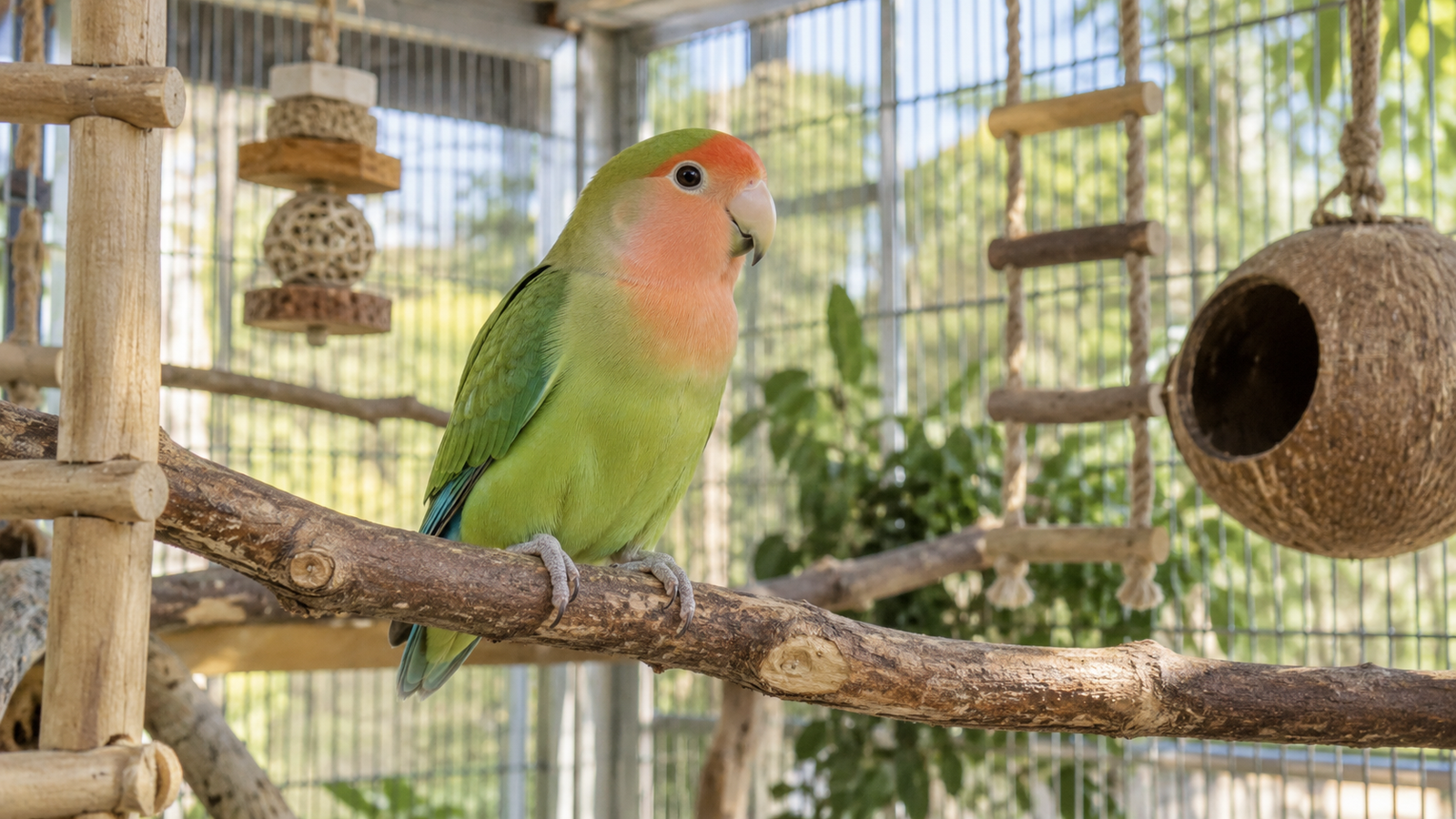
Use several perches in different thicknesses and textures. Natural wooden branches from bird-safe trees are ideal, because their uneven shape gives feet a workout and helps prevent sore spots from gripping the same smooth dowel all day. Lovebirds will chew them, which is healthy, so expect to replace them from time to time.
- Place perches at different heights and at both ends of the cage to encourage hopping and short flights.
- Don’t put perches directly above food or water bowls.
- Skip sandpaper perch covers, which can irritate the feet.
Add enrichment
Lovebirds love to chew, shred and explore. Give them a few toys at a time and swap them every week or two to keep things interesting. Good options include:
- Foraging toys that hide food
- Shreddable toys made from paper, cardboard, palm leaf or soft wood
- Swings
- Ladders and other safe climbing toys
Check toys regularly and remove any with frayed rope, loose threads or broken parts that could trap a toe or be swallowed. Choose toys made for small parrots, with stainless steel fittings rather than cheap metal.
Place food and water carefully
Keep food and water bowls easy to reach and away from perches, so droppings don’t fall into them. Stainless steel or ceramic bowls are easiest to keep clean. Wash them daily and give fresh water every day, or more often if it gets dirty.
Choose a good location
Put the cage in a bright, comfortable room where your lovebird can see household activity, as that’s part of its entertainment. Place it against a wall rather than in the middle of the room, so your bird feels secure.
- Avoid strong drafts, air conditioning vents and radiators.
- Don’t leave the cage in direct sun all day, where it can overheat.
- Keep it away from constant loud noise.
- Give your bird a dark, quiet place to sleep for around 10 to 12 hours each night.
Keep lovebirds out of the kitchen. Fumes from overheated non-stick (PTFE) cookware can be fatal to birds, and cooking fumes, aerosol sprays and scented candles can also harm their sensitive airways.
Keep the cage clean
| How often | What to do |
|---|---|
| Every day | Wash food and water bowls, remove fresh food leftovers and change the cage liner if it’s dirty |
| Every week | Wipe down perches, toys and cage bars, and replace worn or damaged toys |
| As needed | Give the whole cage a deeper clean with warm water and a bird-safe cleaner, then rinse and dry fully |
Plain paper or newspaper makes a simple, safe cage liner and lets you keep an eye on your bird’s droppings, which is a useful health check.
Don’t forget company and time outside the cage
Lovebirds are very social. A single lovebird needs a lot of daily interaction with you, while a pair keeps each other company when you’re busy. Either way, aim for daily supervised time outside the cage in a bird-safe room with windows closed, ceiling fans off and other pets kept out.
If you’re adding a second lovebird, introduce them gradually with separate cages at first. Lovebirds can be territorial, and some don’t get along straight away.
Keep the setup balanced
A roomy cage, safe natural perches, rotating toys, a good location and regular interaction give your lovebird a strong foundation for a healthy, active life.
For more bird care ideas, see our guides on keeping a budgie happy and stimulated and how much sleep pet birds need.
Frequently asked questions
How big should a lovebird cage be?
As large as you can fit, and wider than it is tall. Around 30 inches (76 cm) wide is a commonly suggested minimum for one or two lovebirds, with bar spacing of about ½ inch (1.2 cm) or less.
What perches are best for lovebirds?
Natural wooden branches from bird-safe trees, in a few different thicknesses, are best. They exercise the feet and give your lovebird something safe to chew. Avoid sandpaper perch covers.
Where should I put my lovebird’s cage?
In a bright, comfortable room against a wall, away from drafts, direct all-day sun and constant noise. Keep it out of the kitchen, as fumes from overheated non-stick cookware can be fatal to birds.
Should lovebirds be kept in pairs?
Lovebirds are very social. A single lovebird can do well with plenty of daily attention, but if you’re often busy or away, a pair can keep each other company. Introduce new birds gradually, as lovebirds can be territorial.