
Budgies are busy, sociable and endlessly curious little birds. A good cage is a start, but it isn’t enough on its own. To stay healthy and happy, a budgie needs chances to fly, explore, play and interact every day.
In short: give your budgie a wide cage, a mix of natural perches, a rotating set of safe toys, daily time out of the cage and plenty of company, whether that’s you or another budgie.
Give your budgie enough space
Your budgie needs room to stretch and flap its wings and hop freely between perches. Budgies fly from side to side rather than up and down, so a wide cage is far more useful than a tall, narrow one.
| Feature | Guideline |
|---|---|
| Shape | Wider than it is tall, with a flat roof and a rectangular floor |
| Size | As large as you can fit; around 30 × 18 × 18 inches (76 × 46 × 46 cm) is a commonly cited minimum for one or two budgies |
| Bar spacing | No more than about ½ inch (1.2 cm), so your budgie can’t get its head stuck |
| Layout | Enough open space in the middle for short flights between perches |
Use a variety of perches
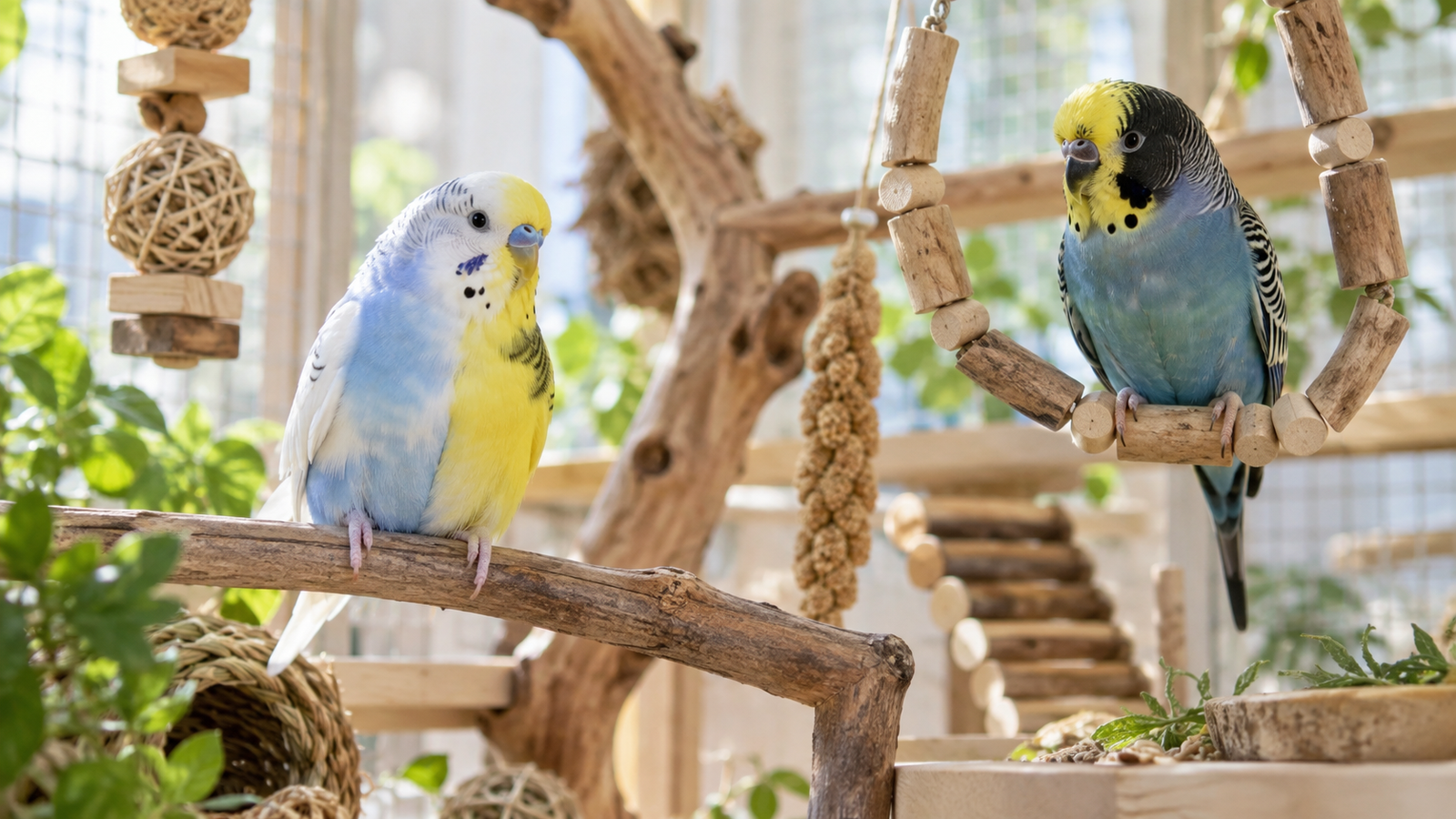
Offer perches in a few different thicknesses and textures. Natural wooden branches from bird-safe trees are ideal, because their uneven shape gives your budgie’s feet a workout and helps prevent pressure sores from gripping the same smooth dowel all day.
Place perches at different heights and distances so your budgie has to hop and flutter between them, but don’t put them directly above food or water bowls.
Rotate toys regularly
Budgies get bored when the same toys sit in the same spot for months. Rather than cramming the cage full, keep a few toys in at a time and swap them every week or two. Good options include:
- Foraging toys
- Shreddable toys made from paper, cardboard or soft wood
- Swings
- Ladders and other safe climbing toys
- Simple puzzle feeders
Check toys regularly and remove any with frayed rope, loose threads or broken parts that could tangle a toe or be swallowed.
Encourage foraging
In the wild, budgies spend much of their day searching for food. You can recreate that by hiding small amounts of seed or treats in foraging toys, twists of plain paper or small cardboard boxes, so your bird has to work for part of its meal. Start easy, then make it more challenging as your budgie gets the idea.
Spend time together
Budgies are flock birds and don’t cope well with being alone for long stretches. Talking to your budgie, gentle training and supervised time out of the cage all give it valuable mental stimulation, especially once it’s comfortable being handled. If you’re out for most of the day, keeping budgies in pairs gives them company when you can’t.
Aim for daily time outside the cage in a bird-safe room. Before you open the door:
- Close windows and outside doors.
- Switch off ceiling fans.
- Keep other pets out of the room.
- Cover large windows and mirrors your budgie might fly into.
- Move anything toxic or small enough to swallow out of reach.
Choose the right spot for the cage
Put the cage somewhere your budgie can watch everyday household life, as that’s part of its entertainment. Avoid places with constant loud noise, cold drafts, direct sun all day or frequent disturbance.
Keep budgies out of the kitchen. Fumes from overheated non-stick (PTFE) cookware can be fatal to birds, and cooking fumes and sudden temperature changes are harmful too.
Watch your budgie’s behavior
A healthy, content budgie is usually bright, alert and interested in what’s going on around it. Birds are good at hiding illness, so small changes matter. Contact an avian vet promptly if your budgie:
- Sits fluffed up for long periods or sleeps much more than usual
- Stays on the cage floor
- Bobs its tail with each breath or breathes with effort
- Eats less or its droppings change noticeably
- Goes unusually quiet
Simple variety makes a difference
You don’t need a cage packed with toys to keep a budgie engaged. Room to move, company, varied perches, foraging and a regularly refreshed set of toys can make everyday life far more interesting for your bird.
For the rest of your budgie’s care, see our guides on what budgies eat and how much sleep pet birds need.
Frequently asked questions
How big should a budgie cage be?
As large as you can manage, and wider rather than taller. Around 30 × 18 × 18 inches (76 × 46 × 46 cm) is a commonly cited minimum for one or two budgies, with bar spacing of no more than about ½ inch (1.2 cm).
Should budgies be kept in pairs?
Budgies are flock birds and do best with company. A single budgie can be happy if you spend a lot of time with it every day, but if you’re away for much of the day, a pair is usually a better choice.
How often should I change my budgie’s toys?
Swapping a few toys every week or two helps keep your budgie interested. Keep only a few in the cage at a time so there’s still room to move and fly.
What are signs of a sick budgie?
Warning signs include sitting fluffed up for long periods, sleeping more than usual, staying on the cage floor, tail bobbing while breathing, eating less and changes in droppings. Birds hide illness well, so contact an avian vet promptly if you notice any of these.