
Ask how much to feed a cat and you’ll usually get a number off the back of a bag. That number is a reasonable place to begin, but it was worked out for an average cat, and very few cats are exactly average. Age, neutering, activity, the food itself and your cat’s own metabolism all shift the answer.
The most reliable approach is simple: start from the label, measure accurately, then watch your cat’s body and adjust.
The short version: treat the feeding guide on the pack as a starting point, not a rule. Weigh the food, split it into two or more meals, and keep treats to no more than about 10% of daily calories. Check your cat’s body shape every few weeks and adjust by small amounts. If your cat needs to lose weight, do it slowly with your vet’s help, because cutting food sharply can trigger a dangerous liver condition.
Why there’s no single right amount
Two cats of the same weight can need noticeably different amounts of food. A young, playful cat burns more than a sleepy indoor cat. Neutered cats generally need fewer calories than intact ones, which is one reason many cats gain weight after surgery if their portions stay the same. And foods differ hugely in how many calories they pack into a scoop or a pouch.
For a rough sense of scale, calculators used by vets put a typical neutered adult of about 10 lb (4.5 kg) somewhere in the region of 200–300 kcal a day, depending on the formula used and how active the cat is. Your own cat may genuinely need more or less. If your cat is holding a healthy shape on what they eat now, that matters more than any formula.
Using the pack guide sensibly
Feeding guides are more useful once you know how they are meant to be read:
- The amount is for the whole day, not per meal. Divide it between meals.
- Feed for the weight your cat should be. If your cat is overweight, feeding for their current weight keeps them there. Ask your vet what a healthy target is.
- Mixing foods means splitting the totals. If you feed wet and dry, each pack’s guide assumes it is the only food. Feeding half the wet amount plus half the dry amount is a sensible starting point.
- Look for calories on the label. Many foods list kcal per can, pouch or cup, which makes comparing foods and counting treats much easier.
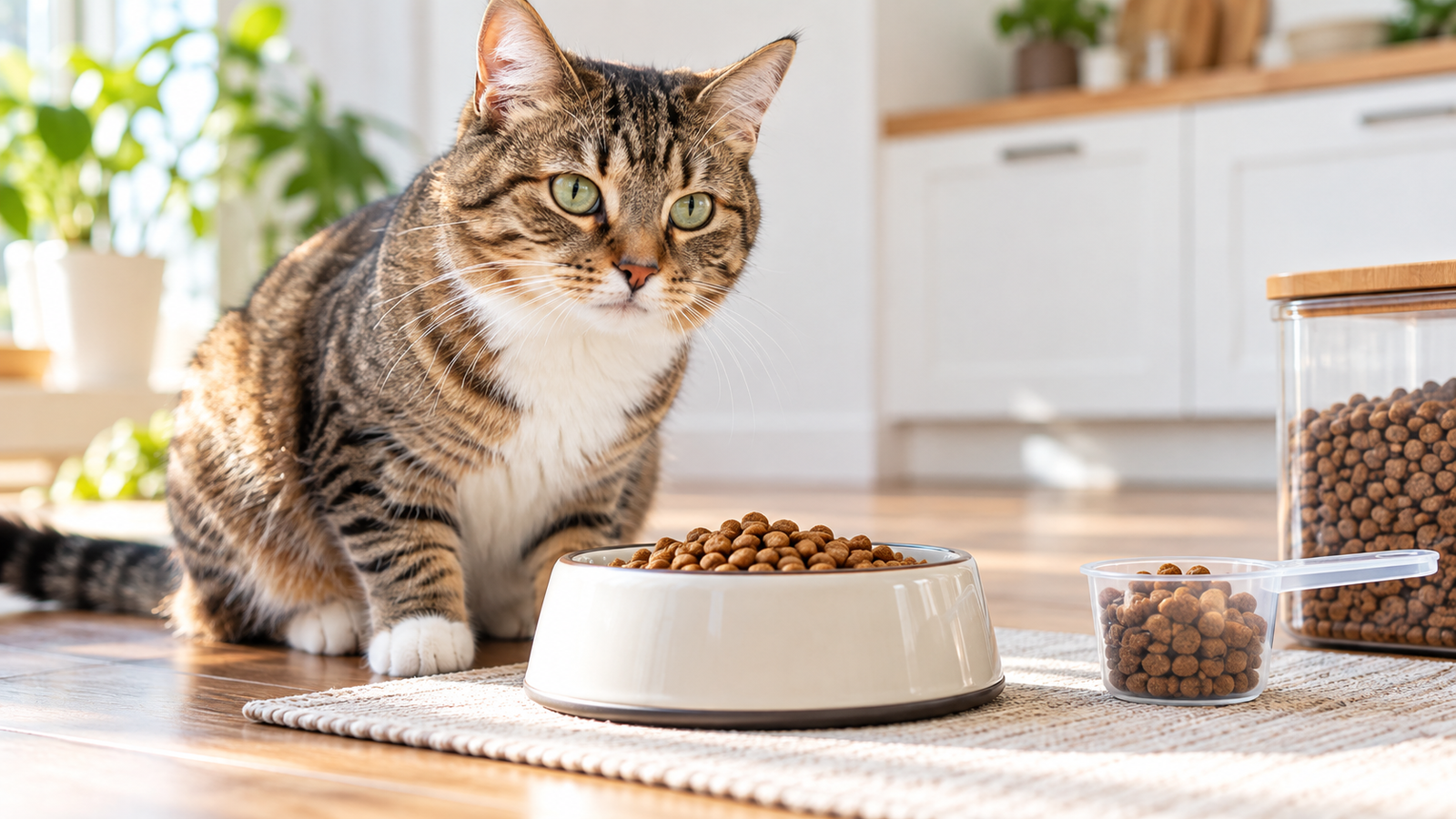
Weigh the food, don’t scoop it
Measuring cups are surprisingly inaccurate, and a heaped scoop of dry food can easily hold much more than a level one. Because dry food is so calorie-dense, a small overpour every day adds up. A cheap digital kitchen scale solves this. Weigh out the day’s dry food in the morning into a container and feed from that, so nobody in the household accidentally doubles up.
How to tell if the amount is right
Your cat’s body tells you more than the bowl does. Every few weeks, run through three quick checks:
- Ribs: stroke along the side of the chest. You should feel the ribs easily under a light covering, without pressing hard, but not see them sticking out.
- Waist: look down from above. There should be a gentle inward curve behind the ribs.
- Belly: from the side, the tummy should tuck up slightly rather than hang low or swing. A small, loose flap of skin low on the belly is normal in many cats and isn’t the same as fat.
Weighing your cat monthly helps you spot slow changes. If your cat is gradually gaining, cut the daily amount by a small step and recheck in a few weeks. If they are slowly losing weight without trying, see your vet rather than simply adding more food.
Kittens, adults and older cats
| Life stage | What changes | Practical tips |
|---|---|---|
| Kittens (up to about 12 months) | Higher energy and nutrient needs for growth | Feed a food labeled for growth or kittens. Around three meals a day until about 6 months, then usually two or more. |
| Adults (1 to about 7 years) | Needs settle, and weight gain becomes the main risk, especially after neutering | Measured meals, regular body checks, plenty of play. |
| Mature cats (about 7 to 10 years) | Often less active, so many need fewer calories | Watch for creeping weight gain. |
| Seniors (roughly 11 years and older) | Many find it harder to keep weight and muscle on | Some need more calories, not fewer. Unexplained weight loss needs a vet check. |
Wet, dry or both
Both can be complete and balanced, and many cats do well on a mix. The practical difference is concentration. Wet food is mostly water, so a pouch or can holds far fewer calories than the same volume of kibble. That’s why switching a cat from wet to dry “in the same amount” can lead to rapid weight gain. Wet food also adds to your cat’s daily water intake, which can help cats who don’t drink much.
Whatever you choose, make any change of food gradually over about a week to avoid an upset stomach.
How often to feed
Left to themselves, cats tend to eat several small meals across the day and night. Most adult cats manage well on two or more measured meals a day. Topping up a bowl whenever it looks empty, often called free feeding, makes it very hard to control intake and is a common route to weight gain. If your cat likes to graze, measure the day’s total and use a puzzle feeder or a timed feeder to spread it out.
Treats and extras count
A widely used guideline is that treats should make up no more than about 10% of a cat’s daily calories. For a small cat that can be only a handful of commercial treats, so check the calories per piece on the pack. Anything else your cat eats, from puzzle-feeder kibble to a lick of tuna or cheese, comes out of the same daily budget.
When your cat needs to lose weight
Extra weight is linked to diabetes, arthritis, heart disease and a shorter life, and it makes grooming harder, so it’s worth tackling. But it must be done slowly. Vets usually aim for a cat to lose around 1–2% of body weight per week, and sometimes less for very overweight cats. Your vet can set a target weight, choose a food and check progress.
Important: never put a cat on a crash diet or cut food drastically. When a cat, especially an overweight cat, eats little or nothing for a few days, fat can build up in the liver and cause hepatic lipidosis (fatty liver disease), which is life-threatening. If your cat stops eating or eats much less than normal for more than a day or so, contact your vet promptly.
A cat eating more wet food often visits the water bowl less, which is usually nothing to worry about. When a low intake might mean something more, why a cat might not drink much water walks through the signs.
Frequently asked questions
How much should I feed my cat a day?
Start with the daily amount on your cat food label for your cat’s ideal weight, weigh it with a kitchen scale and split it into two or more meals. Then check your cat’s ribs, waist and weight every few weeks and adjust in small steps. Your vet can give a personal calorie target.
Is it OK to leave dry food out all day?
For some cats it works, but many overeat when food is always available. Measuring the daily amount and splitting it into meals, or putting it in a puzzle feeder, makes weight much easier to control.
How many times a day should I feed a kitten?
Young kittens do best with around three meals a day of kitten food until about 6 months of age. After that, two or more meals a day is usually fine until they move to adult food at about a year old.
How fast should an overweight cat lose weight?
Slowly. Vets usually aim for about 1 to 2 percent of body weight per week, and sometimes less. Losing weight too fast, or not eating, can cause fatty liver disease, so any weight-loss plan should be made with your vet.