
Birds explore the world with their beaks. Anything you hang in the cage will be bitten, shredded, pulled apart and, sometimes, partly swallowed. That is exactly what a good toy is for, but it also means a bird toy has to survive being destroyed without becoming a hazard along the way.
Choosing safe toys for pet birds comes down to three questions: what is it made of, how is it put together, and is it the right size for your bird? Once you know what to look for, you can judge almost any toy in a few seconds, including the ones you make yourself.
Key points: pick toys made from untreated wood, plain paper or cardboard, and natural fibers, held together with stainless steel hardware. Avoid anything that could contain zinc or lead, small parts that come loose, and threads or frayed rope that can wrap around toes. Size each toy to your bird, rotate toys regularly and check them every day for wear.
Materials worth looking for
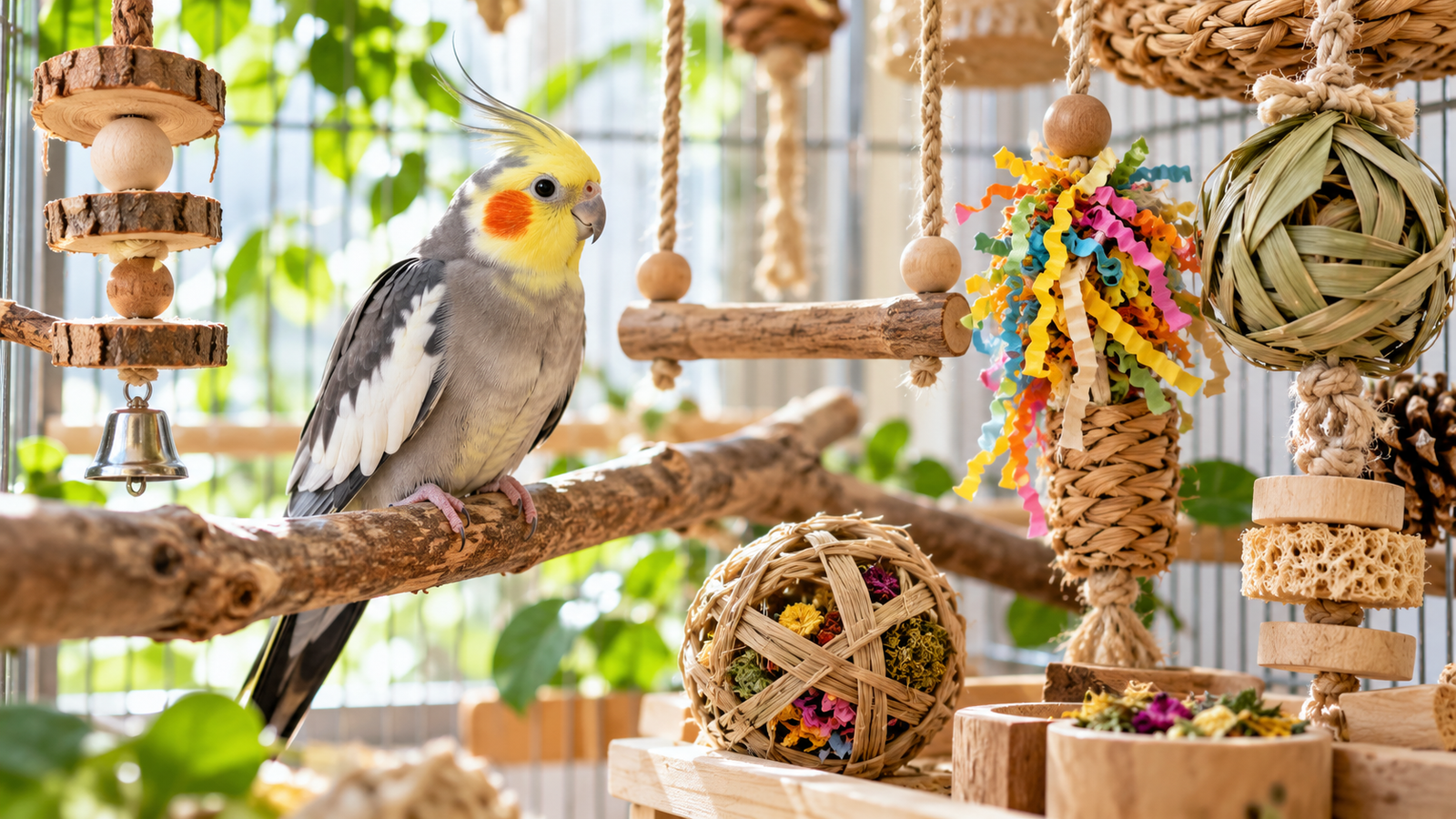
Since your bird will chew whatever you offer, the material matters more than the shape or color. These are generally considered safe choices:
- Untreated wood from bird-safe species. It should be unpainted and unvarnished, or colored only with food coloring or vegetable dyes. Skip plywood and other glued, pressed boards.
- Plain paper and cardboard. Shreddable paper toys are cheap, satisfying for most birds and easy to replace. Leave out glossy, heavily printed or taped pieces.
- Natural fibers such as cotton, hemp, jute and sisal, used for rope, weaves and knots.
- Vegetable-tanned leather, but not dyed or chemically tanned leather.
- Hard acrylic for foraging puzzles and larger birds, as long as the pieces are too big and too tough to bite off.
Soft woods such as balsa are fine for small birds that like to whittle, but a large parrot can reduce them to splinters in minutes. That is not necessarily a problem, as long as the bird is chewing and spitting out rather than eating the pieces.
Metal parts: the zinc and lead problem
Heavy metal poisoning is one of the better-known toy dangers in birds. Zinc is found in galvanized (zinc-coated) metal, and veterinary references list galvanized toys, chains, bells and mesh among common sources. Lead can turn up in solder, some bell clappers, weights and old paint. A bird that mouths or nibbles these parts over days or weeks can build up enough metal to become ill.
When buying or making toys, look for stainless steel hardware and fasteners. If you cannot tell what a shiny metal part is made of, it is safer to leave it out. Bells deserve a second look: small jingle bells with slots can trap toes or beaks, and a loose clapper is both a swallowing risk and a possible metal source.
Important: signs of metal poisoning in birds can include loss of appetite, regurgitation, weight loss, diarrhea, weakness, unusual thirst and wobbliness or seizures. If your bird shows any of these, especially after chewing a new toy, see an avian vet promptly and bring the toy with you if you can.
How the toy is put together
A toy made of safe materials can still be dangerous if it is badly designed. Before a new toy goes in, handle it the way your bird will:
- Tug the small parts. Beads, bell clappers, bits of chain and anything else your bird can pry off should stay firmly attached. If it comes off in your hand, it will come off in the cage.
- Check the fasteners. Split key rings and spring-loaded clips can catch a toe, tongue or beak. Quick links (the screw-closed kind) are a better choice, tightened well, because many birds learn to undo them.
- Look at the gaps. Rings, chain links and holes should be either too small for a head to go through or large enough that the head passes freely. Gaps that are just a little too narrow are where heads and toes get stuck.
- Watch the length. Keep any rope, chain or string short enough that it cannot loop around your bird’s neck.
A closer look at rope and fabric
Rope toys are popular and many birds love them, but they need more supervision than wood or paper. New rope is usually fine. The trouble starts as it wears: loose strands can wind around a leg or foot tightly enough to injure it, and some birds snip off bits of fiber and swallow them.
Stick to natural fibers, trim any short frays and replace the toy once it starts to unravel in earnest. Avoid fabric toys with loose threads, fleece that pulls into strings, and rope made from nylon or other synthetic fibers. If you notice your bird eating fibers rather than just chewing them, rope toys may not suit that bird at all.
Sizing toys to your bird
Toys labeled for a particular bird size are a useful starting point, but the real test is how the toy fits your bird’s beak and body. Two common mistakes go in opposite directions.
A toy that is too small for a big bird gets crushed quickly, and the broken pieces can be swallowed. A toy built for a macaw, hung in a budgie’s cage, has chain links and rings that a small bird can put its head through. Heavy toys can also swing into a small bird or pin it against the bars.
Temperament matters too. A shy bird may be frightened by a large, noisy toy and do better with something small and quiet at first. A determined chewer needs sturdier, thicker materials so the toy lasts long enough to be worth the money.
Rotating and checking toys
Birds lose interest in toys they see every day, so rotation keeps things fresh. A simple approach is to keep a handful of toys in the cage (roughly three to five per bird is a common starting point) and swap some out every week. Move the rest into a box, and bring older favorites back later so they feel new again.
Make a quick safety check part of your daily routine, when you change food and water:
- Look for fraying rope, loose threads and strands hanging down.
- Check that fasteners and quick links are still tight.
- Remove toys that have been chewed down to sharp splinters, small loose pieces or bare hardware.
- Throw away anything soiled with droppings or food that cannot be cleaned.
Chewing a toy to pieces is not a problem. It means the toy did its job. Just replace it before what is left becomes the hazard.
Homemade toys
Many good bird toys cost nothing. Plain cardboard tubes, paper cups, small cardboard boxes and scrunched plain paper hiding a favorite treat all make simple foraging toys. Use the same rules as for shop-bought toys: no tape, staples, glue-heavy layers or glossy print, no string long enough to tangle, and no pieces small enough to be swallowed whole.
Even the best toy box is only part of the picture. Foraging, training and time out of the cage matter just as much, and keeping a budgie happy and mentally stimulated has ideas that suit most small parrots.
Frequently asked questions
Are rope toys safe for birds?
They can be, if they are made of natural fibers and kept in good condition. Trim loose strands, replace rope once it starts to unravel, and stop using rope toys if your bird swallows the fibers rather than just chewing them.
Are bells safe in bird toys?
Some are and some are not. Avoid small jingle bells with slots that can trap toes, and bells whose clappers can be pulled out. Choose bells made from stainless steel rather than unknown or galvanized metal.
How often should I change my bird’s toys?
Many owners swap some toys every week to keep interest high. Check every toy daily and remove any that are frayed, broken down to small pieces or have loose hardware, whatever their age.
Can I give my bird toys meant for another bird size?
It is best not to. Toys made for large parrots can have rings and links that trap a small bird’s head, while toys made for small birds can be broken into swallowable pieces by a large bird.