
Learning how to socialize a kitten means helping the kitten develop positive, safe associations with the people, animals, sounds, handling and everyday experiences it may encounter throughout life.
Good kitten socialization is not about exposing a young cat to as many things as possible in one day. It is about introducing new experiences gradually while the kitten remains comfortable enough to explore, eat, play and recover normally.
The earliest weeks of life are particularly important. However, socialization does not suddenly become impossible when that early period ends. Older kittens can still learn, build confidence and develop new positive associations, although some may need a slower approach.
Kitten Socialization at a Glance
| Experience | How to Introduce It | Main Goal |
|---|---|---|
| Different people | Short, calm interactions with gentle adults and supervised children | Help the kitten learn that people can be safe and predictable. |
| Handling | Brief touches to paws, ears, mouth and body followed by rewards | Prepare for grooming, examinations and future care. |
| Household sounds | Begin at low intensity and allow distance | Build comfort around ordinary home activity. |
| Carrier | Leave it open with bedding, treats and toys | Teach that the carrier is a safe place rather than a warning of a stressful trip. |
| Car travel | Use brief, secure and positive practice trips when appropriate | Reduce fear associated with future transport. |
| Other cats | Use a gradual introduction with appropriate health precautions | Allow controlled, positive feline social experience. |
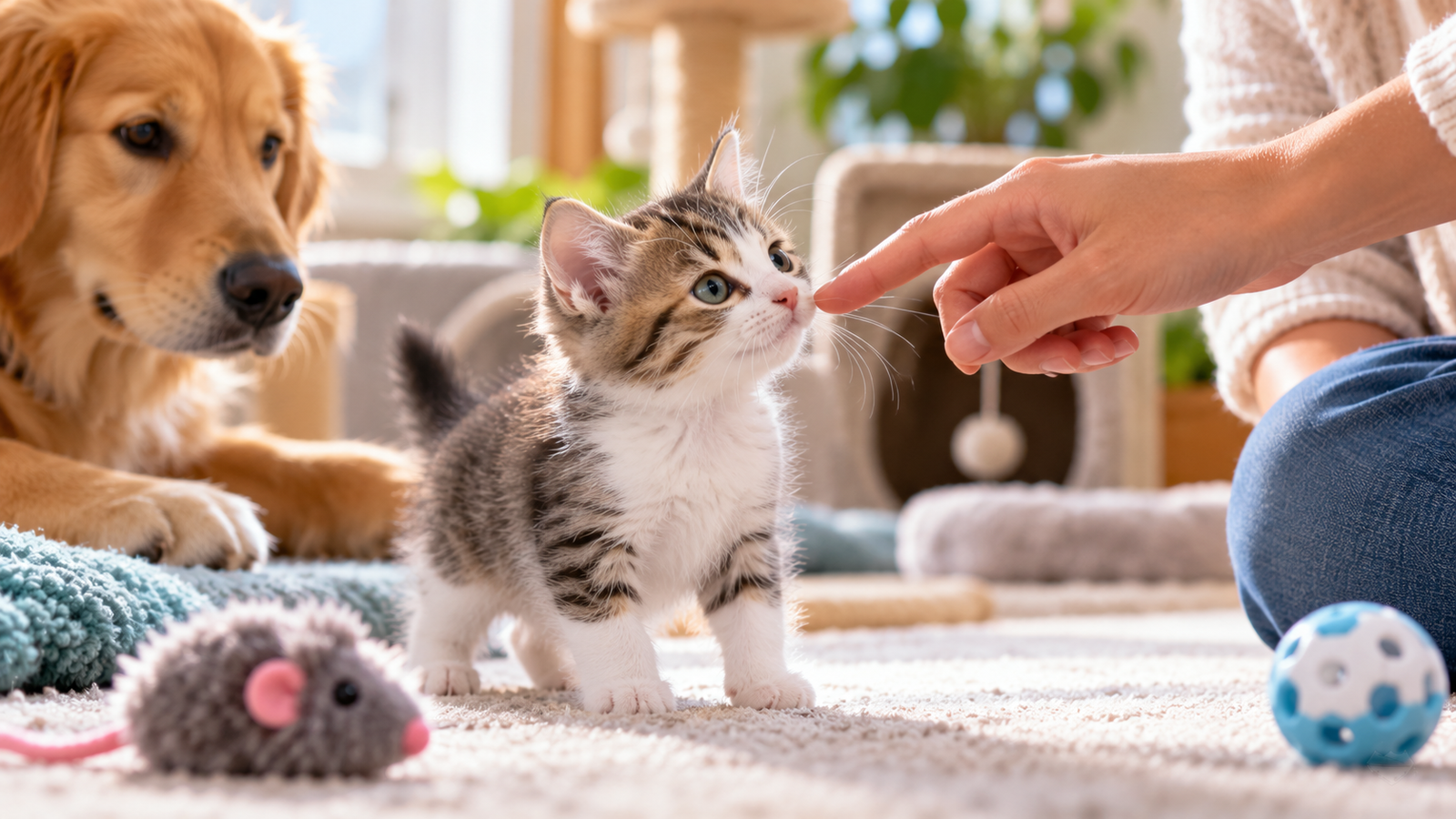
| Dogs | Use a calm controlled dog, barriers and plenty of distance | Teach the kitten that dogs do not automatically represent danger. |
| Grooming | Introduce brushes, nail handling and body care in tiny steps | Prepare for lifelong grooming and health care. |
| Play | Use toys rather than hands and feet | Provide normal predatory play without teaching biting or scratching people. |
What Is Kitten Socialization?
Socialization is the process through which a kitten learns how to respond appropriately to social partners.
These may include:
- People
- Other cats
- Dogs
- Other animals the kitten may safely encounter
The broader process of becoming comfortable with ordinary non-social experiences is often called habituation.
Examples include becoming familiar with:
- Vacuum cleaners
- Doorbells
- Carriers
- Car travel
- Different floor surfaces
- Household activity
- Grooming tools
For everyday purposes, both processes contribute to raising a confident, adaptable kitten.
When Is the Kitten Socialization Period?
The particularly sensitive period for kitten socialization occurs early in life.
Current Feline Veterinary Medical Association guidance describes it as occurring roughly between 2 and 9 weeks of age.
During these early weeks, appropriate positive interactions can strongly influence how a kitten responds to people and unfamiliar experiences later.
However, this period is not an exact switch that turns off on one specific day.
Individual kittens develop differently, and learning continues throughout life.
Why Are the Early Weeks So Important?
During early development, kittens are learning what is normal, safe and relevant in their environment.
Positive experiences can help them become more comfortable with:
- Human contact
- Different people
- Household activity
- Handling
- Other animals
- Travel
- Veterinary care
In contrast, frightening or overwhelming experiences during this period can contribute to persistent fear.
Can You Socialize a Kitten After 9 Weeks?
Yes.
Older kittens can still learn and form positive associations.
However, a kitten that had little or no positive human contact during the earliest weeks may require:
- More time
- Greater distance
- Smaller training steps
- More control over interactions
- Professional behavioral support in difficult cases
Do not assume that an older shy kitten should simply be handled more intensely to “catch up.”
Forcing interaction can increase fear.
Quality Matters More Than the Number of Experiences
A kitten does not need to meet fifty people, ten dogs and every household appliance in one weekend.
A smaller number of calm, successful experiences is more useful than a large number of frightening ones.
Whenever you introduce something new, ask:
- Can the kitten move away?
- Will the kitten still eat or play?
- Is its body relatively relaxed?
- Does it recover quickly?
- Can I make the experience easier if necessary?
Let the Kitten Have a Choice
Choice is one of the most important parts of good socialization.
Instead of repeatedly placing the kitten into unfamiliar situations, create opportunities for the kitten to approach voluntarily.
For example, when meeting a new person:
- Allow the kitten to remain at a comfortable distance.
- Ask the person to sit quietly.
- Let the kitten observe.
- Offer a toy or small food reward.
- Allow the kitten to approach when ready.
If the kitten chooses to leave, let it leave.
Use Positive Reinforcement
Positive reinforcement means giving the kitten something it values after a desired behavior.
Rewards may include:
- Small food treats
- Part of a normal meal
- Interactive play
- Gentle social contact if the kitten enjoys it
For example:
A kitten allows one paw to be touched → receives a tiny treat.
The kitten begins to learn that paw handling predicts something pleasant.
Keep Socialization Sessions Short
A few good minutes can be more productive than a long session.
Stop while your kitten is still comfortable.
Short sessions also give young kittens time for:
- Sleep
- Eating
- Independent exploration
- Normal play
- Recovery from stimulation
How to Socialize a Kitten With People
Kittens benefit from positive exposure to more than one person.
Where practical, allow the kitten to meet calm people who differ in normal everyday ways.
This may include people with:
- Different voices
- Different heights
- Different clothing
- Glasses
- Hats
- Facial hair
The goal is not to create a checklist of every possible human appearance.
Instead, teach the broader lesson that unfamiliar people can be safe.
How Should a New Person Approach a Kitten?
Avoid reaching immediately over the kitten’s head.
A calmer introduction is:
- Sit or crouch at a comfortable distance.
- Avoid staring directly at the kitten.
- Speak quietly.
- Offer a hand low and still if the kitten approaches.
- Let the kitten sniff.
- Pet only if the kitten appears comfortable with contact.
Do Not Pass the Kitten From Person to Person
A social gathering is not automatically good socialization.
Being held by several unfamiliar people without an opportunity to leave may overwhelm a kitten.
Instead, let introductions happen individually or in small numbers.
Socializing Kittens With Children
Children and kittens can develop excellent relationships, but supervision is important.
Before interaction, teach the child to:
- Sit calmly
- Use a quiet voice
- Let the kitten approach
- Stroke gently
- Avoid pulling the tail or ears
- Avoid chasing
- Avoid squeezing or restraining
- Leave the kitten alone when it walks away
Young children should not be left unsupervised with a kitten.
Let Children Use Toys Instead of Hands
A wand toy can create a positive interaction while keeping fingers away from teeth and claws.
The child can participate in play while the kitten practices normal:
- Stalking
- Chasing
- Pouncing
- Catching
Teach the Kitten to Accept Gentle Handling
Handling practice can make future routine care much easier.
Gradually introduce touching around the:
- Paws
- Toes
- Ears
- Cheeks
- Mouth
- Legs
- Chest
- Back
- Tail area
Keep early repetitions extremely brief.
Start With One-Second Handling
You do not need to hold a paw for thirty seconds on the first attempt.
Try:
Touch paw → reward.
Later:
Hold paw briefly → reward.
Then:
Touch one toe → reward.
Small successful steps create a better foundation than suddenly attempting a complete nail trim.
Teach Comfortable Paw Handling
Paw handling prepares the kitten for future:
- Nail checks
- Nail trimming
- Veterinary examinations
- Minor first-aid handling
Begin while the kitten is relaxed rather than during energetic play.
Prepare for Nail Trimming Before You Need It
The first lesson does not need to involve clippers.
A gradual progression might be:
- Touch the shoulder.
- Reward.
- Touch the leg.
- Reward.
- Touch the paw.
- Reward.
- Briefly hold the paw.
- Reward.
- Gently press a toe to expose a claw.
- Reward.
Introduce the actual trimming step only when earlier handling is comfortable.
Teach Ear Handling
Gently touching and briefly lifting the outer ear can prepare the kitten for:
- Veterinary ear examinations
- Future ear medication if needed
- Routine observation at home
Never push objects into the ear canal during socialization practice.
Teach Mouth and Face Handling
Future dental care becomes easier when a kitten is already comfortable with brief face and mouth handling.
Progress might include:
- Touch the cheek.
- Reward.
- Briefly lift the lip.
- Reward.
- Touch the outside of the gums gently.
- Reward.
Do not pry the kitten’s mouth open or turn practice into a wrestling match.
Prepare for Tooth Brushing Early
Once face handling is comfortable, a veterinarian can guide you on introducing feline tooth brushing.
Early cooperative handling can make future oral care much easier.
For dental-health information, read: Cat Dental Disease: Signs, Causes & When to See a Vet .
Introduce Brushing and Grooming
Even short-haired kittens can benefit from learning that grooming tools are safe.
Start by:
- Letting the kitten investigate the brush.
- Giving one gentle stroke.
- Rewarding calm behavior.
- Stopping before the kitten becomes irritated.
Gradually increase the number of strokes.
For detailed grooming guidance, read: How Often Should You Brush a Cat? .
Prepare for Future Baths Without Bathing Unnecessarily
Most healthy kittens do not need frequent routine baths.
However, you can build comfort with:
- Standing on a non-slip bathroom mat
- A damp cloth
- Gentle towel handling
- Brief contact with a small amount of water when appropriate
This can make future necessary cleaning less unfamiliar.
Socialize Your Kitten to Household Sounds
A normal home contains many unpredictable sounds.
These may include:
- Vacuum cleaners
- Doorbells
- Television
- Washing machines
- Kitchen appliances
- Hair dryers
- People talking
- Doors opening and closing
The goal is not to startle the kitten repeatedly until it stops reacting.
Instead, begin at an intensity the kitten can tolerate.
How to Introduce a Vacuum Cleaner
Do not switch the vacuum on beside a sleeping kitten.
Instead:
- Allow the kitten to inspect the vacuum while it is switched off.
- Reward calm investigation.
- Later, operate it in another room.
- Allow the kitten access to a safe retreat.
- Gradually decrease distance over future sessions if the kitten remains comfortable.
There is no reason a cat needs to enjoy the vacuum.
The goal is simply to prevent unnecessary panic.
Introduce Different Surfaces
Kittens can also become familiar with ordinary surfaces such as:
- Carpet
- Tile
- Wood flooring
- Soft bedding
- Rubber mats
- Cardboard
Allow voluntary exploration rather than placing a frightened kitten onto an unfamiliar unstable surface.
Introduce Everyday Objects
Safe exposure can include:
- Umbrellas
- Shopping bags without dangerous handles
- Boxes
- Carriers
- Different toys
- Grooming tools
Always remove choking, entanglement and ingestion hazards.
Use Appropriate Play for Social Development
Kittens have a strong play drive.
Play helps develop:
- Coordination
- Predatory behavior
- Problem-solving
- Social interaction
Useful toys include:
- Wand toys
- Small lightweight balls
- Toy mice
- Tunnels
- Kicker toys
Do Not Use Hands and Feet as Toys
A tiny kitten grabbing fingers may seem harmless.
However, regularly using hands as prey can teach the kitten that biting and scratching human skin are acceptable forms of play.
Redirect predatory play toward toys instead.
Do Not Punish Normal Kitten Play
Chasing and pouncing are normal behaviors.
The goal is to direct them toward appropriate targets.
Avoid:
- Hitting
- Yelling
- Spraying water
- Physical punishment
Punishment can create fear without teaching the kitten what it should do instead.
Teach Simple Positive-Reinforcement Skills
Socialization and training can work together.
Kittens can learn behaviors such as:
- Coming when called
- Touching a target
- Standing on a mat
- Entering a carrier
- Allowing gentle handling
Training gives the kitten predictable ways to interact with people.
For a complete recall guide, read: How to Train a Cat to Come When Called .
Socialize Your Kitten to the Carrier
Do not store the carrier in a closet and bring it out only before a veterinary visit.
Instead, make the carrier part of normal life.
Leave it:
- Open
- Accessible
- In a familiar area
- With comfortable bedding
Occasionally place treats or toys inside.
Let the Kitten Enter the Carrier Voluntarily
The kitten should learn:
Carrier = ordinary safe resting place.
not:
Carrier = being chased, trapped and taken somewhere frightening.
Reward voluntary entry.
Gradually Practise Closing the Carrier
Once the kitten happily enters:
- Close the door briefly.
- Give a reward.
- Open it again.
- Gradually increase the duration.
Later, practise gently lifting the carrier for a few seconds.
Prepare Your Kitten for Car Travel
Some kittens benefit from gradual positive exposure to travel.
Start with the carrier itself before attempting longer journeys.
Possible steps include:
- Kitten rests inside the carrier at home.
- Carrier is briefly lifted.
- Carrier is placed inside the stationary car.
- Kitten experiences a very short drive when appropriate.
- Duration increases gradually if the kitten remains comfortable.
Always secure the carrier appropriately during transport.
Prepare for Veterinary Visits
Positive handling at home can make future veterinary care less unfamiliar.
Practise gentle simulations of:
- Ear examination
- Paw handling
- Looking at teeth
- Touching the abdomen
- Touching the legs
- Standing briefly on a mat
Reward calm participation.
Do Not Pretend to Perform Painful Procedures
Socialization practice should stay gentle.
You do not need to:
- Pin the kitten down
- Scruff it
- Hold it tightly
- Imitate injections
- Cause discomfort
The goal is familiarity with safe handling, not teaching the kitten to tolerate distress.
Introduce Medication Handling Before Your Cat Is Sick
At some point in life, many cats will need medication.
You can prepare a kitten by creating positive associations with:
- Brief mouth handling
- Touching the ears
- Handling the paws
- Touching the shoulders or back
You can also occasionally give a tiny treat in the same way you might later give a pill hidden in food.
Socializing a Kitten With Other Cats
Do not assume two unfamiliar cats should immediately meet face to face.
Even a socially confident kitten should be introduced gradually to a resident cat.
Begin with:
- A separate settling area
- Separate food and water
- A separate litter box
- Safe hiding places
- Gradual scent exposure
Check Health Before Close Contact
Before exposing a kitten to unfamiliar cats, consider:
- Vaccination status
- Parasite control
- Signs of respiratory illness
- Diarrhea
- Known infectious-disease risks
A veterinarian can help assess the appropriate exposure and vaccination plan for your kitten.
For vaccination guidance, read: Cat Vaccination Schedule: What Vaccines Does Your Cat Need? .
Socialization Does Not Require High-Risk Exposure
You do not need to take a young kitten into uncontrolled groups of unfamiliar animals to provide social experience.
Safer opportunities can involve:
- Known healthy household cats
- Appropriately managed kitten classes where available
- Controlled home introductions
- Veterinary-guided exposure
Avoid contact with animals showing signs of infectious disease.
Should You Wait Until Every Vaccine Is Finished?
The early socialization period occurs before a kitten’s vaccination series is usually complete.
Therefore, social development and disease prevention need to be managed together rather than treating them as competing goals.
Use controlled, low-risk experiences and ask your veterinarian what exposure is appropriate based on your kitten’s:
- Age
- Vaccination status
- Health
- Local disease risk
- Lifestyle
Introducing a Kitten to a Resident Cat
The resident cat should have time to adjust too.
Start with physical separation and gradually progress through:
- Scent familiarity
- Positive experiences on opposite sides of a closed door
- Controlled visual access
- Short supervised interaction
- Increasing shared time
Slow down if either cat becomes highly distressed.
Do Not Force Cats Nose to Nose
Holding two unfamiliar cats close together removes their ability to control distance.
A gradual approach is safer and more respectful.
For decisions about multi-cat living, read: Should You Get a Second Cat? What to Consider Before Adopting .
Socializing a Kitten With Dogs
A kitten can learn to live comfortably with a dog, but introductions should be carefully controlled.
Choose a dog that can remain calm and respond reliably to its handler.
A dog with intense uncontrolled chasing behavior requires much greater caution.
Start With Physical Separation
Early kitten-dog introductions can use:
- A secure baby gate
- A closed door
- A controlled leash on the dog
- Plenty of distance
The kitten should always have:
- An escape route
- A high resting place
- A hiding area
Reward the Dog for Calm Behavior Too
The kitten is only half of the introduction.
Reward the dog for:
- Looking away from the kitten
- Settling
- Responding to cues
- Remaining relaxed
Do not permit chasing as a way for the animals to “get used to each other.”
Never Trap the Kitten Near a Dog
The kitten must be able to increase distance.
A kitten held in someone’s arms while a dog sniffs closely cannot choose to retreat.
That may turn a potentially manageable introduction into a frightening experience.
Socializing a Shy Kitten
A shy kitten needs more control, not more force.
Begin in a quiet environment with:
- Food
- Water
- Litter
- A secure hiding place
- Comfortable bedding
- Low-pressure human presence
Spend time nearby without constantly trying to touch the kitten.
Use Food to Build Positive Associations
If the kitten will eat in your presence, you can gradually build trust.
Start with the food at a comfortable distance.
Over multiple sessions, you may be able to sit closer while the kitten remains relaxed.
Do not remove food entirely to force a frightened kitten to approach.
Play Can Help Shy Kittens
Some kittens are willing to play before they are comfortable being touched.
A long wand toy allows interaction while maintaining distance.
Play can help create a positive association with your presence without requiring physical contact.
Do Not Reach Into a Hiding Place
A safe hiding area should remain safe.
Repeatedly reaching inside to pull the kitten out can make the kitten:
- More defensive
- More fearful of hands
- Less willing to use safe areas normally
Instead, allow voluntary emergence whenever possible.
How to Tell if a Kitten Is Afraid
Watch the whole body rather than relying on one signal.
Signs of fear or significant discomfort can include:
- Crouching low
- Freezing
- Trying to hide
- Moving away
- Flattened ears
- Wide pupils
- Tucked posture
- Hissing
- Growling
- Swatting
- Rapid escape attempts
Fear Signals Mean “Make It Easier”
Do not punish hissing or growling.
These behaviors communicate discomfort.
When they appear:
- Increase distance.
- Reduce intensity.
- Allow the kitten to recover.
- Return to an easier version later.
What Is Flooding?
Flooding means exposing an animal to something frightening at an intensity it cannot comfortably escape until the response eventually changes.
Examples might include:
- Holding a frightened kitten while strangers pet it
- Placing the kitten beside a barking dog
- Running a loud appliance very close to a terrified kitten
This is not good socialization.
Overwhelming exposure can increase fear rather than resolve it.
Use Gradual Desensitization Instead
Desensitization begins with the experience at a low enough intensity that the kitten can remain reasonably comfortable.
Then the intensity increases gradually.
For example:
Vacuum in another room → reward.
Later:
Vacuum farther down the hallway → reward.
Eventually:
Vacuum operating closer while the kitten remains comfortable.
Pair New Experiences With Good Things
This is often called counterconditioning.
The kitten begins to associate the previously unfamiliar stimulus with something positive.
For example:
Doorbell → tiny treat.
Carrier door closes → treat.
Paw touched → treat.
Calm dog visible at a distance → play or food.
How Fast Should You Progress?
Let the kitten’s behavior determine the speed.
Progress when the kitten can:
- Remain relatively relaxed
- Eat
- Play
- Explore
- Recover quickly
If the kitten becomes increasingly fearful, you moved too fast.
A Simple Kitten Socialization Routine
You do not need to cover every experience every day.
A typical day might include:
- Morning: brief paw and ear handling before breakfast
- Midday: play with an appropriate interactive toy
- Afternoon: short exposure to a normal household sound
- Evening: carrier exploration with treats
- Later: gentle grooming followed by rest
Another day can focus on a visitor, a different surface or a short transport exercise.
A Kitten Socialization Checklist
Over time, consider positive exposure to:
- Different calm adults
- Supervised children when relevant
- Gentle petting
- Paw handling
- Ear handling
- Mouth and lip handling
- Brushing
- Nail-trim preparation
- Carrier entry
- Carrier movement
- Appropriate car travel
- Veterinary-style body handling
- Different flooring textures
- Household sounds
- Safe toys
- Known healthy cats when appropriate
- Calm controlled dogs when relevant
- Short periods alone in a safe environment
This is not a competition.
Only introduce experiences that are relevant and safe for your kitten’s expected lifestyle.
Socializing a Kitten to Being Alone
A kitten should also learn that short periods without direct human attention are normal.
Provide:
- A safe room or area
- Comfortable sleeping places
- Water
- An appropriate litter box
- Safe independent toys
- Scratching options
Begin with short periods and build gradually.
Constantly carrying or entertaining a kitten every moment can make independent settling harder.
Provide Hiding and Vertical Space
Confidence develops more easily when the kitten has control over its environment.
Useful resources include:
- Boxes
- Covered beds
- Cat trees
- Low shelves
- Window perches
For broader environmental guidance, read: How to Keep an Indoor Cat Happy and Active .
Socialization After Adoption
A newly adopted kitten should first feel safe in the home.
Do not schedule a parade of visitors immediately after arrival simply because you want to socialize the kitten.
Give the kitten time to:
- Eat
- Use the litter box
- Explore
- Rest
- Become comfortable with household members
Then gradually add new experiences.
For more settling-in guidance, read: How to Help a New Cat Settle Into Your Home .
Socializing an Older Unsocialized Kitten
An older kitten that avoids people requires a different approach from a confident eight-week-old companion kitten.
Progress may begin with:
- Quiet human presence
- Eating at a comfortable distance
- Interactive play
- Voluntary approach
- Very brief touch only when tolerated
The process may take considerably longer.
When Should You Seek Behavioral Help?
Talk with your veterinarian or an appropriately qualified feline behavior professional when a kitten shows:
- Persistent extreme fear
- Repeated defensive aggression
- Panic around normal handling
- Little or no improvement despite gradual work
- Fear severe enough to interfere with eating or normal activity
Medical problems should also be considered when behavior changes suddenly.
Do Not Assume Every Avoidant Kitten Is “Unsocialized”
A kitten that suddenly stops interacting may be:
- In pain
- Ill
- Fatigued
- Experiencing digestive upset
- Recovering from another stressor
For common health concerns, read: Common Health Problems in Kittens .
Common Kitten Socialization Mistakes
- Waiting until adulthood to begin normal handling practice
- Trying to expose the kitten to too many things at once
- Passing a frightened kitten from person to person
- Forcing the kitten to remain in someone’s arms
- Ignoring attempts to escape
- Using punishment for fearful behavior
- Using hands and feet as toys
- Allowing children to chase the kitten
- Forcing direct introductions with unfamiliar cats
- Allowing a dog to chase the kitten
- Assuming freezing means the kitten is relaxed
- Removing all hiding opportunities
- Using flooding instead of gradual exposure
- Chasing the kitten into the carrier
- Bringing the carrier out only before veterinary visits
- Attempting a full nail trim before teaching paw handling
- Ignoring infectious-disease risk during animal exposure
- Assuming the socialization window means older kittens cannot learn
- Expecting every kitten to progress at the same speed
Frequently Asked Questions
When should you start socializing a kitten?
Positive socialization begins very early. The particularly sensitive period occurs roughly between 2 and 9 weeks of age, although learning continues afterward.
What is the kitten socialization period?
It is an early developmental period when kittens are particularly receptive to learning about people, animals and new experiences. Current FelineVMA guidance places this period roughly between 2 and 9 weeks.
Can you socialize a kitten after 9 weeks?
Yes. Older kittens can still learn and develop positive associations, although kittens with little early social contact may require slower and more carefully managed introductions.
Is a 4-month-old kitten too old to socialize?
No. A four-month-old kitten can still learn. However, progress depends on previous experience, temperament and current level of fear. Avoid forcing interaction.
How do I socialize a shy kitten?
Provide a quiet safe environment, sit nearby without forcing contact, use food and interactive play to build positive associations, and let the kitten control the distance. Progress in small steps.
Should I pick up a shy kitten to make it social?
Do not repeatedly force a frightened kitten into being held. Build comfort with your presence first, then introduce touch and lifting gradually when the kitten is ready.
How much handling does a kitten need?
Frequent short, positive interactions are preferable to prolonged restraint. Introduce gentle handling of the body, paws, ears and mouth while respecting signs that the kitten needs a break.
How do I get my kitten used to different people?
Introduce calm people individually, allow the kitten to approach voluntarily and pair interactions with play or small food rewards. Avoid overwhelming the kitten with a large group.
How should children meet a kitten?
Children should be supervised and taught to sit quietly, let the kitten approach, touch gently and stop when the kitten moves away. Chasing, grabbing and rough handling should not be allowed.
Should I play with my kitten using my hands?
No. Use toys for predatory play. Regularly allowing a kitten to attack hands or feet can teach biting and scratching of people as an acceptable form of play.
How do I get my kitten used to nail trims?
Begin by briefly touching the legs and paws and rewarding calm behavior. Gradually progress to holding the paw and gently exposing a claw before introducing nail clippers.
How do I socialize my kitten to the carrier?
Leave the carrier open in the home with comfortable bedding. Place treats or toys inside and reward voluntary entry before gradually practising closing and moving the carrier.
How can I prepare my kitten for veterinary visits?
Practise gentle paw, ear, mouth and body handling at home, create a positive association with the carrier and introduce transport gradually where appropriate.
Should I wait until my kitten is fully vaccinated before socialization?
The sensitive socialization period begins before the vaccination series is complete. Use controlled, low-risk exposure rather than uncontrolled contact with unfamiliar animals, and ask your veterinarian what is appropriate for your kitten’s vaccination status and local disease risk.
Can my kitten meet other cats before vaccination is complete?
Exposure should be carefully managed. Known healthy animals in controlled settings carry different risks from unfamiliar cats in high-traffic environments. Your veterinarian can advise based on your kitten’s health and vaccination status.
How do I introduce a kitten to my adult cat?
Start with separate spaces and gradually introduce scent, then controlled visual access and short supervised interactions. Do not force immediate face-to-face contact.
How do I socialize a kitten with a dog?
Use a calm dog under control, begin with distance or a physical barrier, give the kitten elevated escape options and reward calm behavior. Never allow chasing.
Is hissing normal in a scared kitten?
Hissing is communication that usually means the kitten wants more distance. Do not punish it. Make the situation easier and give the kitten time to recover.
What if my kitten hides from visitors?
Allow the kitten to remain hidden rather than pulling it out. Ask visitors to stay calm and use food or play at a distance to create positive associations over time.
How long does kitten socialization take?
There is no fixed timeline. Confident young kittens may adapt quickly, while fearful or older undersocialized kittens may need weeks or longer. Progress should follow the kitten’s behavior rather than a deadline.
Can you over-socialize a kitten?
You can overwhelm a kitten with too much stimulation. Socialization should consist of manageable positive experiences with adequate time to eat, sleep, play and retreat.
What should I do if my kitten seems terrified during socialization?
Increase distance, reduce the intensity and return to an easier step. Persistent severe fear should be discussed with a veterinarian or qualified feline behavior professional.
The Bottom Line
Good kitten socialization is not about forcing a kitten to tolerate everything.
It is about teaching the kitten, through repeated positive experiences, that people, handling, household activities, transport and appropriate animals can be safe and predictable.
The sensitive socialization period occurs roughly between two and nine weeks, so appropriate early experiences are especially valuable. However, learning continues after this period, and older kittens can still build confidence.
Introduce different people gradually, supervise interactions with children and teach everyone to let the kitten control contact whenever possible.
Prepare for lifelong care by gently introducing paw, ear, mouth and body handling, grooming, carrier use and veterinary-style examination. Use food, play or other rewards to reinforce calm participation.
Direct predatory play toward toys rather than hands or feet. Introduce ordinary household sounds at manageable intensity instead of deliberately startling the kitten.
When introducing other cats or dogs, prioritize both behavioral comfort and health safety. Use controlled introductions, appropriate distance and escape options rather than immediate unrestricted contact.
Most importantly, watch the kitten’s response. Curiosity, eating, play and quick recovery suggest the difficulty is manageable. Freezing, persistent hiding, frantic escape, hissing or defensive aggression indicate that the experience needs to become easier.
A well-socialized kitten is not a kitten that never feels fear. It is a kitten that has developed a broad history of safe experiences and has learned that it can explore new situations without being forced beyond its limits.
References and Further Reading
Feline Veterinary Medical Association (FelineVMA)
2025 Socialization of Feral Kittens Position Statement — sensitive socialization period, early human interaction and development of healthy cat-human relationships.
2021 AAHA/AAFP Feline Life Stage Guidelines
Kitten socialization, gradual positive exposure to people and pets, handling, grooming, nail trimming, medication, carrier training, car travel and veterinary visits.
AAFP/ISFM Feline Environmental Needs Guidelines
Positive and predictable human-cat interaction, kitten handling, individual social preferences, safe retreat areas and environmental choice.
AAFP/ISFM Feline-Friendly Handling Guidelines
Positive reinforcement for paw, ear, mouth and body handling, grooming, carrier acclimation and transport preparation.
AAHA Canine and Feline Behavior Management Guidelines
Early social exposure, sensitive developmental periods, controlled disease-risk management and prevention of behavior problems through positive experience.