
Bearded dragons have a reputation as one of the more easygoing pet lizards, and many do become relaxed enough to sit calmly on a lap. Few arrive that way, though. To a newly moved dragon, your hand looks a lot like something that wants to eat it.
Learning how to tame a bearded dragon is mostly about patience and predictability: short, calm steps repeated until your dragon treats you as part of its routine.
The short version: leave a new dragon alone for about a week to settle. Then build trust in stages, approaching from the side at its level rather than from above. When you pick it up, support the whole body with both hands and keep sessions short. Back off if you see a darkened, puffed beard, hissing or a gaping mouth, and always wash your hands after contact because reptiles can carry Salmonella.
The first week: hands off
Before your dragon comes home, the enclosure should already be running at the right temperatures, with UVB and a basking spot in place. On arrival, let it walk into the enclosure on its own rather than tipping it out. After that, keep interaction to the basics: fresh food and water, spot cleaning and quiet checks from outside the glass. The RSPCA advises avoiding unnecessary handling during this first week.
Use this time to learn what normal looks like. Note when your dragon basks, when it eats and where it likes to sleep. Once it is eating well and basking in the open, it’s ready for the next step. Young dragons tend to be jumpier, so let the animal set the pace.
Building trust in stages
Think of taming as a series of small steps, each repeated until your dragon stays calm before you move on. This often takes a few weeks, longer for shy dragons.
- Be a familiar presence. Spend time near the enclosure, moving slowly, so your dragon learns you’re harmless.
- Pair yourself with food. Offer insects or greens with feeding tongs so your dragon links your approach with something good.
- Rest a hand inside. Place your hand flat on the floor of the enclosure, away from the dragon, and keep it still for a minute or two. Let your dragon investigate if it wants to.
- Touch gently. Once your hand is ignored or approached calmly, stroke the side of the body or the back in the direction the scales lie.
- Lift briefly. Pick your dragon up, hold it for a few moments close to the enclosure, then put it back. Gradually lengthen the time.
If your dragon runs, puffs up or hisses at any stage, go back a step and repeat it for a few more days. Pushing through defensive behavior tends to set things back further than waiting.
How to pick up a bearded dragon
Direction matters. In the wild, lizards are often caught by birds swooping down, so a hand descending from above can trigger a panic response. Approach from the side, at your dragon’s eye level, and move slowly enough that it can see your hand coming.
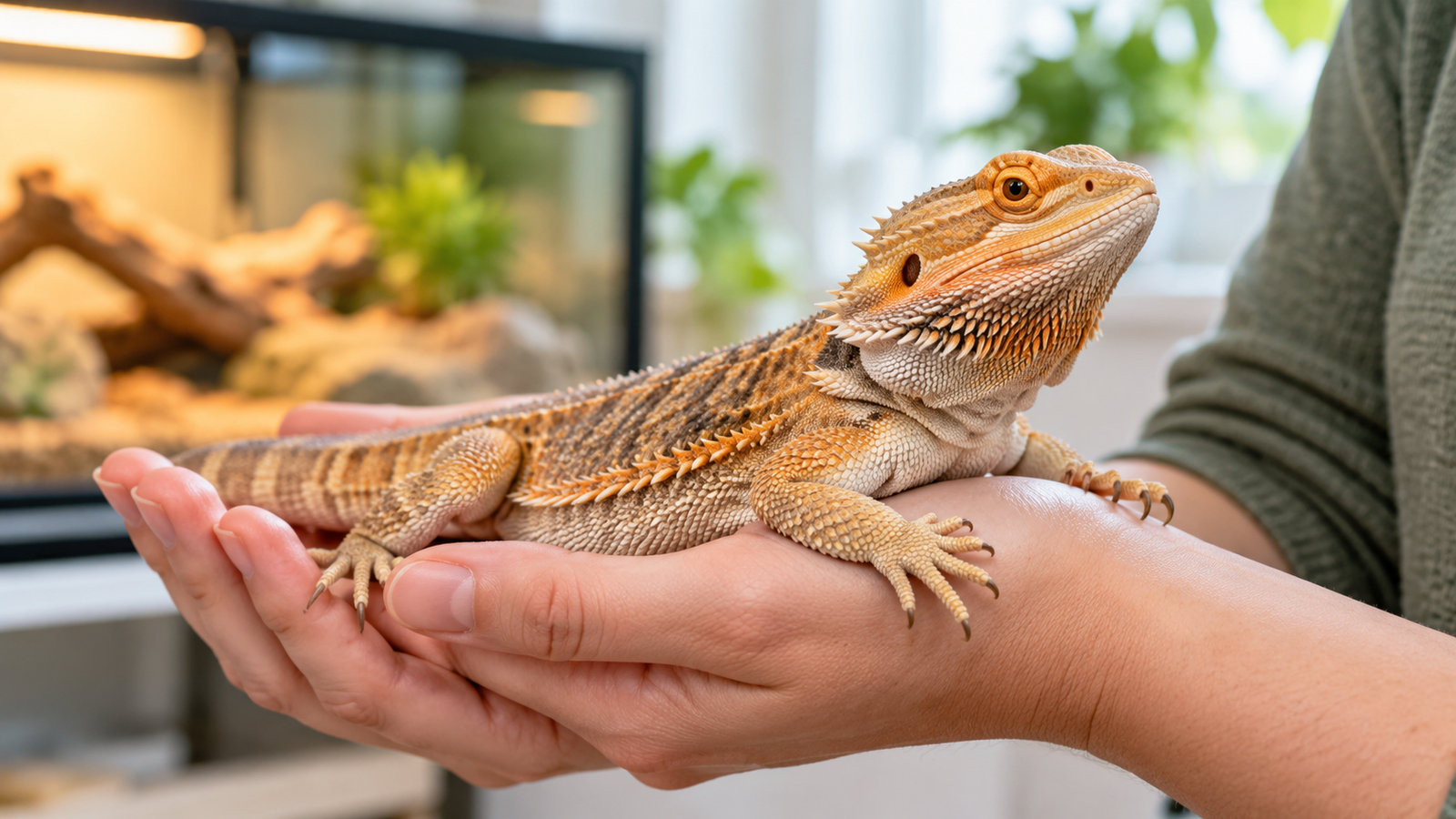
Slide one hand under the chest, just behind the front legs, and use the other to support the hips and back legs. Lift gently, keeping the body level, and let the tail rest along your arm. Once it’s up, let it sit on your palm or forearm with all four feet supported, and keep it close to your body. Never lift a dragon by the tail, a leg or by squeezing around the middle.
While you’re still both learning, sit down to handle your dragon, ideally over a soft surface. A sudden jump from standing height can cause injury, and a dragon that feels secure is less likely to try it.
How long to hold them
Keep early sessions to a few minutes. Even when your dragon is fully relaxed, it’s best to keep handling fairly short, since a bearded dragon relies on its enclosure for heat and cools down away from it. RSPCA guidance puts a sensible limit at roughly 10–15 minutes per session, after which it should go back to warm up.
Choose your timing. Handling right after your dragon has warmed up in the morning usually goes better than trying to pick it up when it’s cold, sleepy or halfway through a meal. Keep other pets out of the room.
Reading your dragon’s body language
Bearded dragons are fairly clear about when they’ve had enough. Stop and give space if you see:
- A beard that turns dark or black, especially when puffed out
- Hissing
- An open, gaping mouth aimed at you
- Flattening the body, backing away or trying hard to escape
- Tail whipping or sudden lunges
Some of these behaviors have other meanings in different contexts, which can be confusing at first. A dragon sitting quietly under the basking lamp with its mouth open is usually just releasing excess heat, not being defensive. A darkened beard can also appear during courtship or when a dragon sees another dragon or its own reflection. What matters is whether the signal appears in response to you.
Relaxed signs include sitting still with eyes open and alert, a normal-colored beard, and exploring your arm at a calm pace.
Common mistakes that slow taming
- Chasing your dragon around the enclosure. If it runs, stop. Being pursued confirms that you’re a predator.
- Handling too often, too soon. A few calm, short sessions build trust faster than long ones that end in a struggle.
- Grabbing from above or reaching into a hide to pull your dragon out.
- Ignoring the enclosure. A dragon that is too cold, lacks UVB or has nowhere to hide is under constant stress and will be harder to handle. Check the setup before blaming temperament.
Hygiene: wash your hands every time
Reptiles, including bearded dragons, commonly carry Salmonella bacteria even when they look perfectly healthy. The US Centers for Disease Control and Prevention (CDC) recommends scrubbing your hands with soap under running water every time you touch, feed or clean up after a reptile. Young children, older adults and anyone whose immune system is weakened face a greater risk of serious illness, and the CDC says children under 5 should not have contact with bearded dragons at all.
A few simple habits help: don’t kiss your dragon or hold it close to your face, keep your dragon and its gear well clear of the kitchen and any room where meals are made or eaten, and scrub tank furniture somewhere other than the kitchen sink. Supervise children closely and make sure they wash their hands straight afterward.
When handling problems point to something else
A dragon that was relaxed and suddenly becomes defensive, or one that seems weak, limp or unusually easy to handle, may be unwell rather than grumpy. Reduced appetite, lethargy, swelling in the limbs or jaw, twitching or trouble walking all deserve a visit to a reptile vet. A dragon that stops resisting altogether can be seriously ill.
A lot of what looks like a bad temper is really a dragon that isn’t comfortable at home. If taming stalls, run through the checklist in our bearded dragon tank setup, and make sure the menu matches what bearded dragons should eat.
Frequently asked questions
How long does it take to tame a bearded dragon?
It varies. Many dragons are comfortable with short handling within a few weeks of settling in, while shy or young dragons can take longer. Moving at your dragon’s pace and keeping sessions calm and short usually gets the best results.
Why does my bearded dragon’s beard turn black when I pick it up?
A dark, puffed beard during handling usually means your dragon feels stressed or threatened. Put it back gently and go back a step in your taming routine. If it happens along with other changes in behavior or appetite, check the enclosure setup and speak to a reptile vet.
How often should I handle my bearded dragon?
Short, regular sessions work better than long, occasional ones. Once your dragon is settled, brief daily handling of up to roughly 10–15 minutes is sensible, letting it return to the warmth of its enclosure afterward.
Is it safe for children to hold a bearded dragon?
Older children can handle a calm dragon with close adult supervision, sitting down and supporting its whole body. The CDC advises that children under 5 avoid contact with bearded dragons because of the Salmonella risk, and everyone should wash their hands with soap and water afterward.