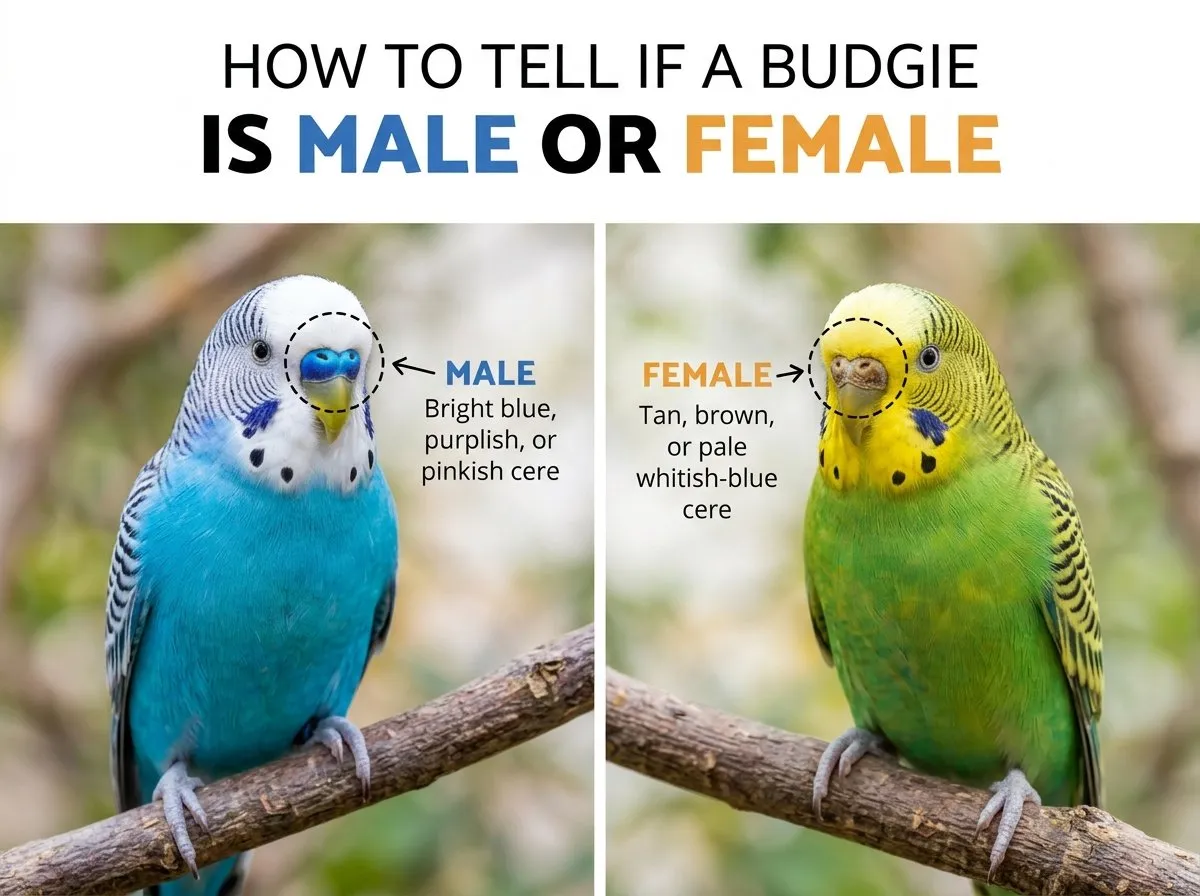

Budgies, also called parakeets, look very alike, so new owners often aren’t sure whether they have a boy or a girl. The best clue is the cere, the band of bare skin above the beak where the nostrils are. Its color usually shows a budgie’s sex once the bird is mature. It isn’t foolproof, though: young birds and some color varieties are hard to read, and the only certain answer is a DNA test or an egg.
Quick answer: In most adult budgies, a blue cere means male and a brown, tan or whitish cere means female. Young budgies have pale ceres that are hard to tell apart, and the adult color usually shows within the first year. Some color varieties, such as lutinos and albinos, keep pinkish or purple ceres as males. Behavior isn’t a reliable guide. If you need to be sure, ask an avian vet about DNA sexing.
Check the cere
Look at your budgie from the front in good light. The cere sits just above the beak and has the two nostrils in it.
| Cere color | Usually means |
|---|---|
| Bright, even blue (sometimes shiny) | Adult male |
| Pinkish, purple or bluish-pink in a lutino, albino or fallow bird | Often an adult male of these varieties |
| Brown or chocolate, sometimes crusty and thickened | Adult female in breeding condition |
| Pale tan, beige, or whitish-blue | Adult female, often not in breeding condition |
| Pale pink, lilac or light blue, even in color | Young bird; often male if pinkish-violet |
| Pale with a whiter ring around each nostril | Often a young female |
Young budgies
Telling the sex of young budgies is tricky. Lafeber notes that young birds often have lavender-pink ceres, which change as they approach a year old. The German budgie site Birds Online explains that young males tend to have more evenly pinkish to violet ceres, while young females are often whitish-blue with a brighter, whiter ring around the nostrils. Viewing the cere from above in bright light helps. If you can’t tell, wait a few months and check again as the color develops.
Young budgies also usually have dark eyes without a visible pale ring, and stripes down to the cere on the forehead. These change as they mature, which can help you judge age, but not sex.
Color varieties that confuse things
Some budgie colors don’t follow the usual rule. According to Birds Online, males of albino, lutino and fallow varieties, and some pied birds, often keep pinkish, bluish-pink or purple ceres as adults instead of turning bright blue. Females of these varieties can also have pale ceres. Lafeber adds that many newer color varieties, including some pale and pastel birds, may never show the classic colors. If your budgie is all white, all yellow, or a pale variety, the cere alone may not give a clear answer.
Does behavior help?
Not reliably. Males are often described as chattier and more likely to learn words, and females as more independent and sometimes nippier, especially when hormonal. But there are plenty of exceptions. Both sexes can sing, display, bob their heads and bite, so behavior on its own isn’t a good way to tell.
The only sure way: DNA sexing
Lafeber notes that DNA testing is the only certain method short of the bird laying an egg. An avian vet can take a small sample, usually a few feathers or a drop of blood, and send it to a lab. Some owners use mail-in kits. DNA sexing is useful if you plan to keep a pair, want to avoid surprise eggs, or have a color variety that is hard to read.
Why it’s useful to know
- Pairs and eggs: a male and female kept together may breed, so you’ll want to plan for that. Our guide on one budgie or two covers company and pairing.
- Health checks: female budgies can lay eggs even without a male, and egg-laying problems can be serious. Knowing you have a female helps you and your vet watch for issues.
- Diet and care: laying females have extra nutritional needs. See what budgies eat.
When cere changes need a vet
Normal hormone cycles can make a female’s cere darker and crusty, and then paler again. Some changes, though, are a reason to see an avian vet:
- A male’s blue cere turning brown, which can be a sign of a hormone problem
- A dull, faded cere along with other signs of illness
- Crusty, scaly patches on the cere, beak or legs, which can be caused by mites
- Swelling, sores or discharge from the nostrils
For other warning signs, see signs of illness in pet birds. A happy, well-kept budgie also needs plenty of enrichment; see how to keep a budgie happy.
Frequently asked questions
At what age can you tell if a budgie is male or female?
The cere color usually becomes clear within the first year, as the bird approaches maturity. Before that, young males often have evenly pinkish-violet ceres and young females paler ones with a whiter ring around the nostrils, but it can be hard to be sure.
Is a blue cere always male?
In most adult budgies, yes. However, inactive or young females can show a pale bluish-white cere, so look for a bright, even blue in a mature bird. DNA testing is the only certain method.
Why is my budgie’s cere brown and crusty?
In a female, a brown, thickened, crusty cere is usually a normal sign of breeding condition. In a male, a blue cere turning brown can point to a health problem, so see an avian vet.
Can female budgies talk?
Some can, though males are generally more likely to learn words and mimic sounds. Every budgie is an individual, so talking ability isn’t a reliable way to tell the sex.