
Bird nails grow continuously, but that does not mean every pet bird needs frequent nail trimming.
Healthy birds use their feet for gripping, climbing, landing, eating and balancing. Their nails help them hold securely onto perches, so trimming too aggressively can make a bird less stable.
The goal of bird nail care is therefore not to make every nail short or blunt. Instead, trim when the nails are genuinely becoming too long, likely to snag, or beginning to interfere with normal movement.
Some calm birds can have their nails safely trimmed at home by an experienced owner. However, small birds, dark nails, nervous parrots, overgrown nails and birds with health problems are often safer in the hands of an avian veterinarian.
Do Pet Birds Need Their Nails Trimmed?
Sometimes.
Wild birds constantly move across branches, bark, rocks and other natural surfaces. This activity helps wear their nails naturally.
Pet birds may spend more time on smooth or uniform perches, so their nails may not receive the same degree of natural wear.
As a result, some companion birds develop nails that become:
- Excessively long
- Very sharply curved
- Likely to snag
- Awkward during perching
- More vulnerable to tearing
Other birds maintain appropriate nail length without frequent trimming.
Sharp Nails Do Not Always Mean Overgrown Nails
This is one of the most important points in bird nail care.
A healthy bird normally has pointed nails.
The tips provide traction and help the feet grip a perch securely.
A nail that feels uncomfortable on your hand is not automatically too long.
Merck Veterinary Manual notes that nail trimming is sometimes requested mainly for the owner’s comfort rather than because the bird actually has nail overgrowth.
In these cases, simply blunting the needle-like tip while maintaining enough nail for a secure grip may be more appropriate than dramatically shortening the nail.
How Can You Tell if a Bird’s Nails Are Too Long?
Look at how the bird stands, walks and grips rather than judging sharpness alone.
Possible signs of excessive nail length include:
- Nails curling excessively around the perch
- Nails frequently catching on clothing
- Nails becoming trapped in toys or fabric
- Difficulty placing the feet normally
- Abnormal toe position while standing
- Poor or awkward grip
- A nail becoming excessively curved
- Repeated nail breakage or tearing
Why Overgrown Bird Nails Can Be Dangerous
A long nail may catch on:
- Rope toys
- Fabric
- Carpet
- Clothing
- Cage bars
- Other toys
If the bird panics and pulls away, the nail may tear.
This can lead to:
- Bleeding
- Pain
- Toe injury
- Fracture
There Is No Fixed Bird Nail-Trimming Schedule
Bird nails should be assessed individually.
One bird may require occasional trimming, while another maintains its nails naturally for long periods.
Factors include:
- Species
- Activity level
- Perch variety
- Nail growth rate
- Age
- Foot health
- Previous nail length
- Medical conditions
Instead of trimming automatically every few weeks, inspect the nails regularly and trim only when needed.
Understanding the Bird Nail Quick
Every toenail contains living tissue extending partway through the nail.
This central structure is commonly called the quick.
The quick contains:
- Blood vessels
- Nerves
Cutting into it can cause pain and bleeding.
What Does the Quick Look Like?
In light-colored or translucent nails, you may be able to see a pink area extending through the center of the nail.
That is the quick.
The clear nail tip beyond it is generally the safer area to shorten.
Dark Bird Nails Are More Difficult
In dark brown or black nails, the quick may be difficult or impossible to see from the outside.
This greatly reduces the margin for error.
If you cannot confidently judge where the quick ends, trim only a tiny amount from the very tip or let an avian veterinarian handle the nail trim.
Long Nails Can Have Long Quicks
When a nail has been overgrown for a long period, the quick may extend farther down the nail.
This means you may not be able to return a severely overgrown nail to normal length in one session without causing bleeding.
An avian veterinarian may recommend gradual shortening over multiple trims.
What Tools Can You Use to Trim Bird Nails?
The appropriate tool depends partly on the bird’s size.
Common options include:
- Human fingernail clippers for very small birds
- Small pet nail clippers
- Scissor-style nail clippers for larger birds
- A nail file for minor smoothing
Veterinarians may also use rotary grinding tools or specialized equipment for larger parrots.
What Should You Prepare Before Starting?
Have everything ready before restraining your bird.
Useful items include:
- Appropriate nail clippers
- Good lighting
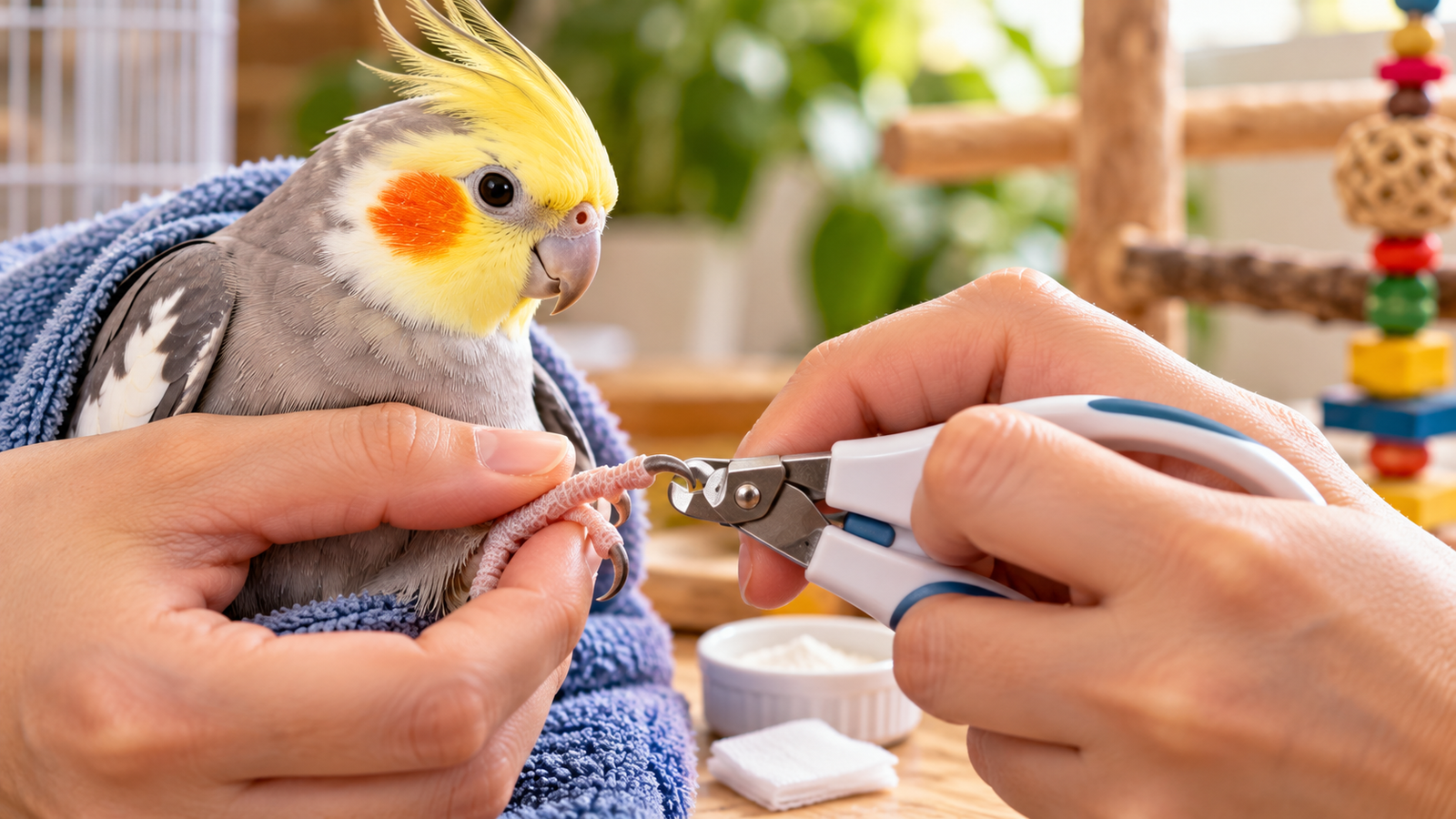
- A clean towel if needed
- Sterile gauze
- A bird-appropriate styptic product
- Your avian veterinarian’s phone number
Can You Trim a Bird’s Nails at Home?
Some owners can safely trim a cooperative bird’s nails at home.
Home trimming is most appropriate when:
- The bird accepts handling calmly
- You understand the nail anatomy
- You can identify a safe amount to remove
- The nails are only mildly long
- You have appropriate bleeding-control supplies available
If any of these conditions are missing, professional trimming is safer.
When Should an Avian Vet Trim the Nails?
Let an avian veterinarian or experienced avian professional perform the trim if:
- You have never trimmed bird nails before
- The bird becomes extremely frightened
- The bird bites aggressively during restraint
- The nails are very dark
- The nails are severely overgrown
- A nail is cracked or partly torn
- The feet appear painful or swollen
- The bird has balance problems
- The bird has heart or respiratory disease
- The bird is elderly or medically fragile
How to Trim a Bird’s Nails Safely
If you are comfortable performing the trim and your bird tolerates handling, use a conservative approach.
Step 1: Choose a Calm Time
Avoid trimming during periods of excitement or immediately after something has frightened your bird.
Work in a quiet room with doors and windows closed.
Step 2: Prepare the Equipment
Set out:
- Clippers
- Gauze
- Styptic product
- Towel if required
Do this before you pick the bird up.
Step 3: Restrain the Bird Gently
Some trained birds may allow a nail to be trimmed while standing calmly on a hand or perch.
Others may require gentle towel restraint.
If using a towel:
- Control the bird without squeezing
- Keep the head safely positioned
- Keep the chest free to move
- Work efficiently
Step 4: Examine One Nail
Look carefully at the nail before cutting.
For light-colored nails, identify the pink quick and leave a safe margin beyond it.
For dark nails, be especially conservative.
Step 5: Trim Only a Small Amount
Remove a tiny amount from the end of the nail.
You can always remove slightly more if necessary.
You cannot put the nail back once too much has been removed.
Step 6: Check the Bird Between Nails
Monitor:
- Breathing
- Strength
- Stress level
- Balance
If your bird becomes highly distressed, stop.
Step 7: Recheck the Grip
After trimming, allow the bird to stand on a familiar perch.
Make sure it can:
- Grip securely
- Balance normally
- Move comfortably
Never Cut Every Nail as Short as Possible
The objective is not to create perfectly blunt, extremely short nails.
Birds depend on their claws for grip.
Removing too much length can reduce traction and increase the risk of:
- Slipping
- Falling
- Loss of confidence while climbing
This can be especially important for older birds with reduced strength or arthritis.
How to Trim a Budgie’s Nails
Budgies have very small toes and nails, so precision matters.
Human fingernail clippers may work for a small bird when used carefully.
Because budgies are small, even modest bleeding can become important.
If the nails are dark or the budgie struggles strongly during handling, an avian veterinarian is the safer option.
Do Budgie Nails Need Regular Trimming?
Not necessarily.
A budgie with:
- Appropriate natural perches
- Plenty of movement
- Normal nail growth
may need only occasional nail care.
Judge the nail according to function and length rather than following a fixed calendar.
How to Trim Cockatiel Nails
Cockatiel nails are larger than budgie nails but still require careful handling.
The same principles apply:
- Remove very little at a time
- Avoid the quick
- Maintain enough nail for grip
- Stop if restraint becomes stressful
Dark nails can make home trimming considerably more difficult.
How to Trim Larger Parrot Nails
Larger parrots have stronger feet, thicker nails and powerful beaks.
Species such as:
- Amazons
- African greys
- Cockatoos
- Macaws
can be difficult to restrain safely without experience.
Veterinarians may use specialized clippers or rotary tools to shorten and round larger nails.
If you are not experienced with large-parrot restraint, professional trimming is generally safer for both you and the bird.
Can You File Bird Nails Instead?
A nail file can be useful when only a sharp tip needs slight smoothing and the bird is comfortable with foot handling.
It may also provide more control than cutting for very minor adjustments.
Do not force a bird to tolerate prolonged filing if it becomes stressed.
What About Electric Nail Grinders?
Veterinarians sometimes use rotary tools for larger parrots.
These can round the nail smoothly, but they also require experience.
Poor technique can create:
- Excessive heat
- Stress
- Accidental injury
- Over-trimming
If you have never used one on a bird, have an avian veterinarian show you the correct technique first.
What if You Cut the Quick?
Stay calm.
A nail quick can bleed substantially.
Immediately apply gentle pressure with clean gauze.
A bird-appropriate styptic product can also be used according to veterinary guidance.
How to Handle Minor Nail Bleeding
- Keep the bird safely restrained.
- Apply gentle direct pressure.
- Use an appropriate clotting product if needed.
- Watch closely to make sure bleeding has stopped.
- Keep the bird calm afterward.
Merck recommends styptic gel rather than loose powders when possible because powder may be inhaled.
For broader bleeding and emergency guidance, read: Bird First Aid Basics: What Every Owner Should Know .
Can You Use Cornstarch on a Bleeding Bird Nail?
Cornstarch may help temporarily with minor nail-tip bleeding when a veterinary clotting product is unavailable.
However, veterinary styptic products are generally more effective.
Avoid creating airborne powder around your bird’s face.
Never pack clotting powder into a deep wound.
What if a Bird Tears Off a Nail?
A torn nail is different from a routine nail trim.
The bird may have:
- Active bleeding
- Damage to the nail bed
- Toe trauma
- A fracture
Apply gentle pressure to active bleeding and contact an avian veterinarian.
Do not pull a partly attached nail off yourself.
What if a Nail Is Cracked?
A superficial chip at the tip may only need smoothing.
A crack extending toward the base is more concerning.
Seek veterinary assessment when the nail is:
- Bleeding
- Loose
- Painful
- Swollen
- Split deeply
Perches Play a Major Role in Nail Health
Appropriate perches encourage natural foot use and some normal nail wear.
Provide several perch types and diameters rather than filling the cage with identical smooth dowels.
For complete cage and perch guidance, read: How to Set Up a Bird Cage: Size, Perches, Toys & Placement .
Use Perches of Different Diameters
Varied diameters change the position of the feet and toes.
This helps distribute pressure rather than forcing the same area of the foot to support the bird all day.
A perch should allow the bird to grip securely.
Natural Wood Perches
Bird-safe natural branches are useful because they provide:
- Different diameters
- Natural texture
- Foot exercise
- Chewing opportunities
Use commercially prepared bird-safe branches or wood that has been positively identified and prepared safely.
Do Sandpaper Perches Keep Bird Nails Short?
They should not be used.
Association of Avian Veterinarians guidance also advises against sandpaper perch covers because they can create painful foot sores.
What About Cement or Ceramic Perches?
A suitable cement or ceramic perch may provide some natural nail wear.
However, it should be only one part of a varied perch setup.
Do not use a rough perch as:
- The only perch
- The main sleeping perch
- The perch where the bird spends most of its day
Constant pressure against an abrasive surface may contribute to foot irritation or pressure sores.
Do Not Try to Solve Severe Overgrowth With Rougher Perches
An excessively long nail is not corrected safely by simply adding an abrasive perch.
The bird may need proper trimming first.
Perches are primarily part of long-term foot and nail management.
Train Your Bird to Accept Foot Handling
Cooperative care can make future nail trims much easier.
Start when the bird is relaxed.
For example:
- Reward your bird for calmly presenting a foot.
- Briefly touch a toe.
- Reward immediately.
- Gradually increase handling.
- Introduce the nail clipper from a distance.
- Reward calm behavior around the tool.
Keep sessions short.
Do Not Force Training Progress
Training should happen separately from an urgent grooming session.
If the bird becomes fearful, return to an easier step.
The goal is to make foot handling predictable rather than frightening.
Why Positive Reinforcement Helps
A bird that voluntarily allows foot handling may require less physical restraint.
That can reduce:
- Fear
- Handling time
- Risk of injury
- Stress during future veterinary care
Never Punish a Bird for Resisting a Nail Trim
Biting, pulling the feet away or attempting to escape usually means the bird is frightened or uncomfortable.
Do not punish the behavior.
Instead, stop when necessary and work gradually on cooperative handling.
Older Birds Need Special Consideration
Senior birds may have:
- Arthritis
- Reduced grip strength
- Foot deformities
- Balance problems
Their nails may help compensate for reduced strength.
Removing too much nail can therefore make perching more difficult.
Merck notes that maintaining useful nail points can support grip and stability in geriatric birds.
Birds With Foot Problems
Do not perform routine home nail trimming when the bird has:
- Swollen feet
- Open sores
- Abnormal toe position
- Loss of grip
- Lameness
- Repeated falls
These signs need veterinary assessment.
Sudden Nail Overgrowth Can Be a Health Clue
Nail length can be influenced by husbandry, but abnormal changes can sometimes have a medical cause.
Merck notes that overgrown nails may occur alongside problems involving:
- Husbandry
- Nutrition
- Liver disease
Therefore, sudden or unusual nail growth should not automatically be treated as a grooming problem.
Watch for Changes in Nail Appearance
Contact an avian veterinarian if you notice changes in:
- Growth rate
- Color
- Texture
- Shape
- Symmetry
The veterinarian can determine whether a medical condition may be contributing.
What About an Overgrown Beak?
Do not treat beak overgrowth as an extension of nail trimming.
A healthy bird usually maintains normal beak length through eating, climbing, chewing and normal beak movements.
An overgrown or misshapen beak can be associated with underlying disease.
An abnormal beak should be examined by an avian veterinarian.
Bird Nail-Trimming Checklist
Before trimming, ask:
- Are the nails truly overgrown rather than simply sharp?
- Is the bird calm enough to handle?
- Can I identify where it is safe to cut?
- Do I have suitable clippers?
- Is the room secure?
- Do I have gauze available?
- Do I have a bird-safe clotting product available?
- Do I know which veterinarian to call if bleeding continues?
If the answer to several of these questions is no, have the nails professionally trimmed.
Common Bird Nail-Trimming Mistakes
- Trimming because the nails feel sharp to a person
- Trying to make every nail extremely short
- Cutting large amounts at once
- Ignoring the quick
- Guessing where the quick ends in dark nails
- Trimming without having bleeding-control supplies nearby
- Squeezing the bird’s chest during restraint
- Continuing when the bird is struggling to breathe
- Trying to restrain a powerful parrot without experience
- Using sandpaper perch covers
- Making an abrasive perch the bird’s main perch
- Ignoring sudden changes in nail growth
- Trying to trim an abnormal beak at home
Frequently Asked Questions
How often should you trim a bird’s nails?
There is no fixed schedule. Inspect the nails regularly and trim when they become genuinely overgrown, begin catching on objects or interfere with normal foot position and grip.
How do I know if my bird’s nails are too long?
Look for excessive curling, frequent snagging, abnormal toe position, difficulty gripping or nails that are clearly interfering with normal movement. Sharp tips alone do not necessarily mean the nails are too long.
Should bird nails be sharp?
Some degree of sharpness is normal. Birds use their claws for secure grip. Veterinary guidance recommends preserving enough nail for stability rather than making the nails excessively short and blunt.
What is the quick in a bird’s nail?
The quick is the living portion of the nail containing blood vessels and nerves. Cutting into it causes pain and bleeding.
Can you see the quick in bird nails?
The quick is often visible as a pink area inside light-colored nails. It can be difficult or impossible to see through dark nails.
Can I use human nail clippers on a bird?
Human fingernail clippers may work for very small birds such as budgies when used carefully. Larger parrots generally require stronger pet nail clippers or professional equipment.
Can I trim my budgie’s nails myself?
An experienced owner may be able to trim a calm budgie’s nails. Because budgies are small and their nails are tiny, have an avian veterinarian demonstrate the technique first if you are inexperienced.
Can I trim my cockatiel’s nails at home?
Possibly, if the bird accepts handling and you can clearly identify a safe amount to remove. Dark nails, excessive growth or difficult restraint make professional trimming safer.
What should I do if my bird’s nail starts bleeding?
Apply gentle direct pressure with clean gauze. A bird-safe styptic product may help minor nail bleeding. Seek veterinary help if bleeding continues or the bird becomes weak or unstable.
Can I use cornstarch on a bleeding bird nail?
Cornstarch may provide temporary help for minor nail-tip bleeding when an appropriate veterinary clotting product is unavailable, although veterinary styptic products are generally more effective.
Are sandpaper perches good for bird nails?
No. Sandpaper perch covers can irritate or injure the feet and should not be used as a nail-trimming substitute.
Do cement perches trim bird nails?
A suitable cement or ceramic perch may contribute to nail wear, but it should be only one perch among several different surfaces. It should not be the bird’s main resting or sleeping perch.
Can natural branches help bird nails?
Yes. Safe natural wood perches provide variable diameter and texture and encourage normal foot use. They are useful as part of a varied perch setup.
Why are my bird’s nails suddenly growing faster?
Changes in nail growth can sometimes reflect husbandry or nutrition problems and may also occur with medical conditions such as liver disease. Significant changes should be evaluated by an avian veterinarian.
Should I trim my bird’s beak while trimming its nails?
No. A normal healthy beak usually does not require routine trimming. An overgrown or misshapen beak can indicate disease and should be assessed by an avian veterinarian rather than trimmed at home.
The Bottom Line
Bird nail trimming should preserve normal foot function rather than simply make the claws comfortable for a person to hold.
Sharp nail tips are normal. Trim only when nails are genuinely becoming too long, snagging on objects or interfering with normal grip and movement.
Every nail contains a quick with blood vessels and nerves. In light nails, it may appear as a pink area. Dark nails are harder to judge and should be trimmed very conservatively.
When trimming at home, prepare your equipment first, minimize restraint time and remove only a small amount from each nail. Never squeeze a bird’s chest during restraint.
Keep clean gauze and a bird-appropriate clotting product nearby in case the quick is accidentally cut. Persistent bleeding requires veterinary attention.
Good perches also matter. Offer natural branches and other safe perches with different diameters. Avoid sandpaper perch covers, and use cement or ceramic perches only as one part of a varied setup rather than as the bird’s primary perch.
Finally, remember that abnormal nail growth can sometimes indicate more than a grooming issue. Sudden changes in nail growth, color, texture or shape deserve evaluation by an avian veterinarian.
References and Further Reading
Merck Veterinary Manual — Management of Pet Birds
Nail trimming, appropriate nail length, safe restraint, bird stability and routine grooming procedures.
Merck Veterinary Manual — Grooming and Routine Care of Pet Birds
Routine nail care, training birds to accept foot handling and appropriate use of cement perches.
Merck Veterinary Manual — Injuries and Accidents of Pet Birds
First-aid supplies, nail bleeding, styptic gel and safe towel restraint.
VCA Animal Hospitals — Beak and Nail Care in Birds
Nail overgrowth, the quick, home nail trimming, bleeding control, clippers, natural perches, sandpaper perch risks and abnormal nail growth.
Association of Avian Veterinarians — Basic Care for Companion Birds
Perch size, natural branch perches, varied surfaces and avoidance of sandpaper perch covers.