
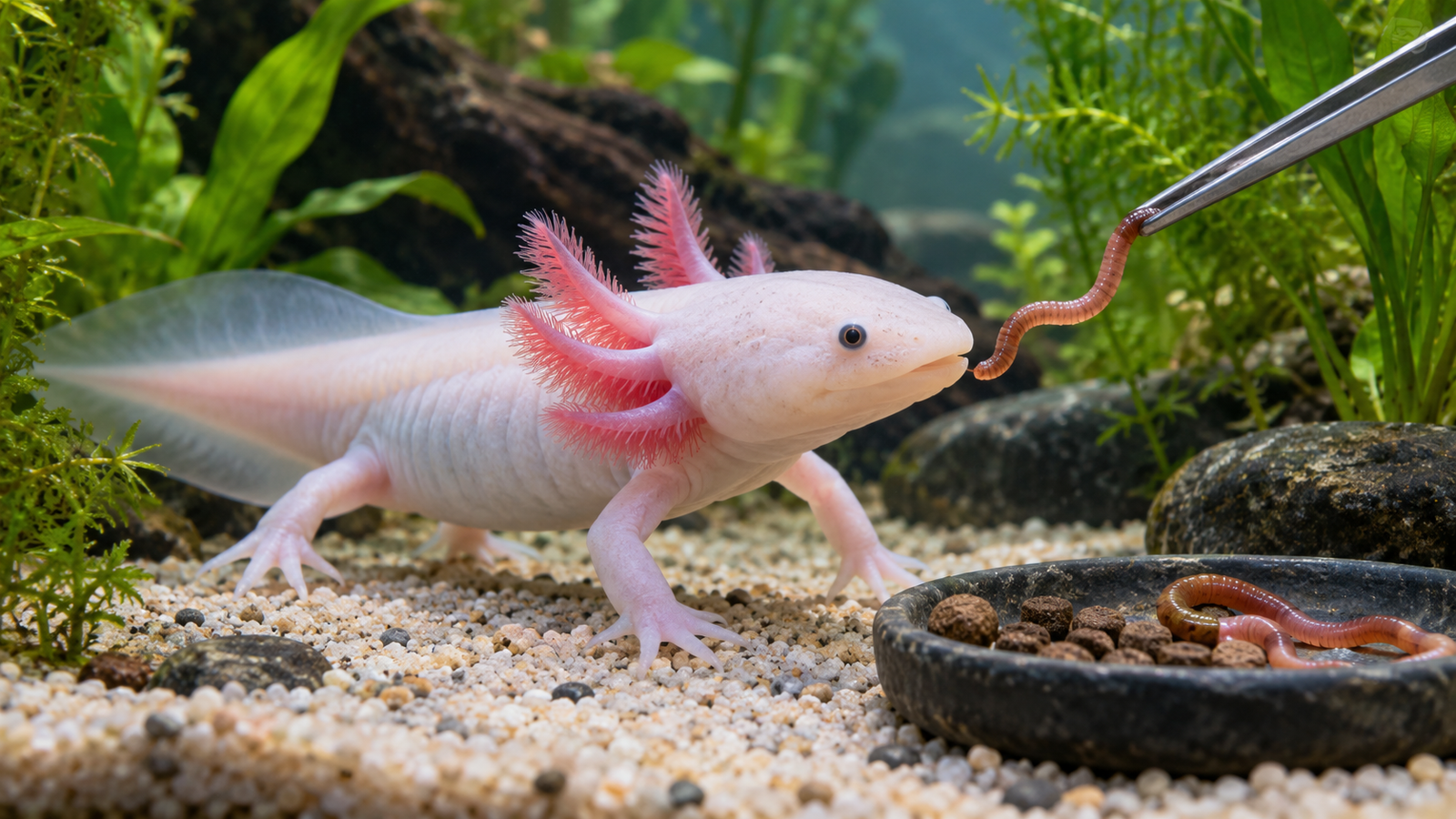

What do axolotls eat? Axolotls are carnivorous amphibians that eat animal-based foods rather than plants. In captivity, commonly used foods include earthworms, blackworms, brine shrimp and suitable sinking pellets.
Feeding is not only about choosing the right food. Portion size, feeding frequency, body condition and water quality all matter. Uneaten food should also be removed before it begins to break down in the aquarium.
Best Foods for Axolotls
Axolotls naturally respond well to animal-based foods. The food should be appropriately sized so the animal can swallow it without difficulty.
| Food | How It Can Be Used |
|---|---|
| Earthworms or nightcrawlers | A commonly recommended food that can be offered whole or in suitable portions depending on the axolotl’s size. |
| Blackworms | May be offered fresh or frozen when obtained from a safe source. |
| Brine shrimp | Can provide variety, particularly when appropriately sized for the animal. |
| Bloodworms | Commonly used as part of an axolotl diet, especially for younger animals or as dietary variety. |
| Axolotl or suitable carnivore pellets | Convenient sinking foods that can form part of a balanced feeding routine. |
Earthworms for Axolotls
Earthworms are one of the most commonly recommended foods in veterinary axolotl care guides. They are easy for many adult axolotls to recognize as prey and can be cut into smaller pieces when necessary.
Use worms from a reliable source. Avoid collecting worms from places that may have been treated with pesticides, herbicides or other chemicals.
If a worm is too large for the axolotl to swallow comfortably, cut it into appropriately sized pieces before feeding.
Can Axolotls Eat Pellets?
Yes. Suitable sinking pellets can be useful, particularly because they are easy to portion and store. Veterinary care sheets commonly include salmon pellets or commercial axolotl pellets among acceptable foods.
Choose a pellet intended for carnivorous aquatic animals and make sure it is an appropriate size for your axolotl.
Some axolotls recognize moving prey more readily than still pellets. If a new axolotl ignores pellets at first, this does not necessarily mean it has lost its appetite.
How Often Should You Feed an Axolotl?
Feeding frequency changes as an axolotl grows. Young animals generally need food more often because they are actively developing.
Veterinary axolotl guidance commonly recommends offering food daily to young axolotls, while healthy adults may be fed approximately every two to three days.
These are general guidelines rather than a fixed rule for every animal. Food type, portion size, body condition, age and health can all affect how often feeding is appropriate.
How Much Food Should You Offer?
There is no single portion that suits every axolotl. A large adult eating earthworms will need a different portion from a juvenile eating smaller foods.
One practical veterinary guideline is to offer only what the animal can consume within a few minutes. This helps reduce overfeeding and prevents excess food from decomposing in the aquarium.
Watch the axolotl’s body condition over time rather than relying only on appetite. If you are unsure whether your animal is underweight or overweight, an amphibian or exotic veterinarian can assess its condition.
How to Offer Food Safely
Axolotls catch food by quickly drawing it into the mouth. This feeding style is one reason aquarium substrate needs to be chosen carefully.
Food can be offered directly in front of the axolotl using clean aquarium feeding tongs, or placed where it can be located easily.
- Choose food that is an appropriate size.
- Use clean feeding tools when needed.
- Keep food away from swallowable gravel or loose objects.
- Watch long enough to make sure the food has actually been eaten.
- Remove leftovers promptly.
Why Uneaten Food Should Be Removed
Leftover food eventually decomposes. That adds organic waste to the aquarium and can contribute to poorer water quality.
Remove food that the axolotl has ignored rather than leaving it in the tank until the next feeding. This is especially important with fresh or frozen foods.
Regular water testing remains important even when the aquarium looks clean.
Foods and Feeding Practices to Avoid
A safe feeding routine is as much about what you avoid as what you offer.
- Do not offer food that is too large for the axolotl to swallow safely.
- Avoid spoiled, moldy or contaminated food.
- Do not collect worms or other prey from areas where pesticides or chemicals may have been used.
- Avoid using random human foods or seasoned meat as a substitute for an appropriate axolotl diet.
- Do not continually overfeed in an attempt to encourage faster growth.
- Do not leave uneaten food in the aquarium to decay.
What About Feeder Fish?
Some veterinary care sheets include small feeder fish among foods that axolotls may eat. However, adding live fish introduces additional considerations, including injury, parasites and disease.
For most pet owners, earthworms and appropriately formulated foods are simpler to manage without introducing another live aquatic species into the tank.
Why Has My Axolotl Stopped Eating?
A missed meal is not always an emergency, especially in a healthy adult, but a noticeable or persistent loss of appetite deserves attention.
Appetite can be affected by water temperature, poor water quality, stress, gastrointestinal problems, parasites or other illness.
If your axolotl suddenly stops eating, start by checking the aquarium temperature and water parameters.
Simple Feeding Routine
A feeding routine does not need to be complicated. Consistency makes it easier to notice changes in appetite and body condition.
- Check the water temperature before feeding if conditions have recently changed.
- Offer an appropriate amount of suitable food.
- Observe the axolotl while it eats.
- Remove leftovers.
- Watch body condition over time.
- Adjust frequency as the axolotl grows.
Frequently Asked Questions
What is the best food for an axolotl?
Earthworms are one of the most commonly recommended foods in veterinary axolotl care guidance. Suitable sinking pellets and other appropriate invertebrate foods can also be included.
How often should adult axolotls eat?
Healthy adults are commonly fed about every two to three days, although the exact schedule depends on portion size, food type, body condition and individual needs.
How often should juvenile axolotls eat?
Young axolotls generally need to eat more frequently than adults. Veterinary guidance commonly recommends offering food daily, with some specialist guidance suggesting once or twice daily for juveniles.
Can axolotls eat pellets every day?
Pellets can form part of the diet, but feeding frequency should be based on the axolotl’s age, body condition and overall intake rather than automatically feeding every day.
Can axolotls eat vegetables?
Axolotls are carnivorous. Their normal captive diet should focus on appropriate animal-based foods rather than vegetables.
Related Axolotl Guides
Final Thoughts
A good axolotl diet is straightforward: choose appropriate animal-based foods, offer portions that suit the animal’s size and age, and avoid overfeeding.
Earthworms and suitable pellets can provide a practical foundation, while other appropriate foods can add variety. Just as importantly, remove leftovers and keep an eye on water quality, appetite and body condition.
Sources and Further Reading
- VCA Animal Hospitals — Axolotls as Pets
- LafeberVet — Care of the Axolotl
- The Unusual Pet Vets — Caring for Axolotls
- MSD Veterinary Manual — Noninfectious Disorders of Amphibians


