
How often should you feed a cat? For most healthy cats, the answer depends on age, daily calorie needs, body condition, lifestyle and health.
Young kittens need several meals each day because they are growing rapidly and have relatively small stomachs. Healthy adults can often do well with two measured meals, although splitting the same daily food allowance into several smaller meals may better match natural feline feeding behavior. Senior cats need an individualized approach because appetite, muscle condition and medical needs can change with age.
Meal frequency is only part of a healthy feeding plan. The total amount of food eaten during the whole day matters just as much.
Cat Feeding Schedule at a Glance
| Life Stage | Practical Meal Frequency | Main Feeding Priority |
|---|---|---|
| Young kitten under about 4 months | Usually 3–4 meals per day | Support rapid growth with a complete and balanced kitten diet. |
| Older kitten | Usually 2–3 or more small meals per day | Continue growth nutrition while controlling excess calorie intake. |
| Healthy adult cat | At least 2 measured meals; several smaller meals can also work well | Maintain healthy body condition and prevent overeating. |
| Mature cat | Usually 2 or more measured meals | Watch weight, muscle condition, activity and appetite. |
| Senior cat | Often 2 or more smaller meals, individualized to the cat | Maintain weight and muscle while accounting for health conditions. |
| Cat on a therapeutic diet | Follow the veterinarian’s feeding plan | Meal timing may be part of treatment for the medical condition. |
These numbers are practical starting points rather than rigid rules. An individual cat may need a different schedule.
Why Cats Often Prefer Small, Frequent Meals
Cats evolved as hunters of relatively small prey.
Instead of eating one enormous meal each day, their natural feeding pattern involves several smaller eating opportunities.
Domestic cats may therefore benefit from a routine that divides the daily food allowance into several smaller portions.
This approach can also create opportunities for:
- Foraging
- Puzzle feeding
- Short hunting-style activities
- Greater daily activity
- More predictable feeding routines
However, frequent feeding only remains healthy when the total daily calorie allowance stays controlled.
How Often Should You Feed a Kitten?
Kittens need more frequent meals than most adult cats.
They grow rapidly, have high energy requirements and cannot comfortably eat their entire daily requirement in one or two large meals.
Merck Veterinary Manual recommends feeding kittens younger than about 4 months 3–4 times per day.
As the kitten grows, meal frequency can gradually decrease.
Feeding a Kitten Under 4 Months
A practical routine is usually:
- Breakfast
- Midday meal
- Late afternoon or evening meal
- An additional small meal when needed
The kitten should eat a food formulated for growth rather than an adult-maintenance diet.
At this stage, growth and body weight should also be monitored closely.
How Often Should You Feed a 4- to 6-Month-Old Kitten?
As kittens become larger, they can usually eat more at each meal.
For many healthy kittens, around three measured meals per day can be practical during this stage.
Some kittens still prefer smaller, more frequent meals. That is acceptable as long as the total daily amount remains appropriate.
How Often Should You Feed a 6- to 12-Month-Old Kitten?
Older kittens can gradually move toward an adult-style schedule.
Two to three measured meals per day often works well.
However, kittens still need nutrition designed for growth until they reach nutritional adulthood, which is commonly around 9–12 months for typical domestic cats.
For broader kitten-health information, read: Common Health Problems in Kittens .
Why Kitten Portions Need Regular Adjustment
A kitten’s energy needs change quickly during growth.
Therefore, the amount that was appropriate several weeks ago may no longer be ideal.
Monitor:
- Body weight
- Body condition
- Growth
- Appetite
- Activity
- Stool quality
Regular veterinary visits provide an opportunity to adjust the feeding plan as the kitten grows.
Neutering Can Change a Kitten’s Calorie Needs
Energy requirements can change after spaying or neutering.
This does not mean a growing kitten should suddenly be placed on a severe calorie restriction.
Instead, monitor body condition and adjust portions as needed while continuing to provide appropriate growth nutrition.
How Often Should You Feed an Adult Cat?
Most healthy adult cats can be fed successfully with at least two measured meals each day.
For example:
- One meal in the morning
- One meal in the evening
However, two meals are not the only healthy option.
Cats often naturally prefer smaller meals. Therefore, dividing the same daily allowance into three, four or several small portions can provide a more feline-friendly feeding pattern.
Is Feeding a Cat Once a Day Enough?
For many cats, one large meal is not the most natural feeding pattern.
A single meal may also leave a long period between eating opportunities.
Most households can provide at least two measured meals, while automatic feeders or puzzle feeders can make several smaller portions easier to manage.
If a medical condition requires a specific schedule, follow your veterinarian’s instructions instead.
Is Feeding a Cat Twice a Day Okay?
Yes.
Two measured meals per day can work well for many healthy adult cats.
The more important questions are:
- Is the total daily amount appropriate?
- Is the cat maintaining a healthy weight?
- Does the cat appear comfortable with the schedule?
- Is food competition occurring?
- Is a medical condition changing nutritional needs?
If those factors are under control, twice-daily feeding can be a practical routine.
Are Three or Four Meals Better Than Two?
They can be.
Several smaller meals can better support normal feline feeding behavior.
They may also provide more opportunities for enrichment and reduce long periods without food.
However, feeding four meals instead of two does not mean doubling the calories.
The same daily food allowance should simply be divided into smaller portions.
A Simple Adult Cat Feeding Example
Suppose your cat’s appropriate daily allowance is represented by four equal portions.
You could feed:
- One portion in the morning
- One portion around midday through an automatic or puzzle feeder
- One portion in the evening
- One small portion later at night
Another household might divide the same daily amount into only breakfast and dinner.
Both approaches can work if calorie intake and body condition remain appropriate.
How Often Should You Feed a Senior Cat?
Senior cats need an individualized feeding plan.
Some maintain body weight easily. Others begin losing weight or muscle and may benefit from smaller, more frequent meals.
Older cats may also develop medical problems that change:
- Appetite
- Calorie needs
- Protein needs
- Hydration needs
- Food texture preferences
- Meal timing
Do Senior Cats Need Less Food?
Not automatically.
Some older cats become less active and need fewer calories. In contrast, other senior cats struggle to maintain weight and muscle and may need more nutritional support.
Therefore, do not reduce food simply because your cat has reached a certain birthday.
Watch the cat in front of you.
Small Meals Can Help Some Senior Cats
Several smaller meals may be easier for an older cat that:
- Eats slowly
- Has a reduced appetite
- Struggles to finish large portions
- Needs more feeding opportunities to maintain weight
However, unexplained appetite or weight changes should be investigated rather than managed only by changing the feeding schedule.
For more information, read: Common Health Problems in Senior Cats .
How Much Should You Feed a Cat?
There is no single cup, pouch or can amount that is correct for every cat.
Food needs vary with:
- Body size
- Age
- Life stage
- Neuter status
- Activity
- Body condition
- Muscle condition
- Health
- Calorie density of the food
Two foods can look similar in the bowl while containing very different numbers of calories.
Start With the Daily Amount, Then Divide It Into Meals
A useful feeding plan works in this order:
- Determine the appropriate total daily food or calorie allowance.
- Choose how many meals you want to offer.
- Divide the daily amount between those meals.
For example, if a measured amount represents the whole day’s allowance, feeding four meals means offering roughly one-quarter of that allowance at each meal.
Do not calculate each meal independently and accidentally multiply the total daily calories.
Are Cat Food Feeding Guides Accurate?
Commercial food labels provide a useful starting point.
However, they cannot account perfectly for every individual cat.
The correct amount is the amount that helps your cat maintain an appropriate body weight and body condition while meeting nutritional needs.
Therefore, feeding directions should be adjusted when necessary based on:
- Weight trend
- Body condition score
- Activity
- Veterinary assessment
Why Measuring Food Matters
Small portion errors can add up over weeks and months.
This is especially important with calorie-dense dry foods.
A digital kitchen scale can provide a more consistent measurement than guessing by eye.
If you use a measuring cup, use the same standardized cup consistently rather than a random household scoop.
What Is Body Condition Score?
Body condition score, or BCS, helps assess whether a cat carries too little, an appropriate amount or too much body fat.
On the commonly used nine-point scale, a score around 4–5 out of 9 is generally considered ideal.
In a cat near ideal condition:
- The ribs should be easy to feel under a light fat covering.
- A waist should be visible when viewed from above.
- The body should not look heavily rounded by excess fat.
Body weight alone cannot show the full picture.
Muscle Condition Matters Too
A cat can lose muscle while remaining overweight.
This becomes particularly important in senior cats and cats with chronic disease.
Veterinarians may therefore assess both:
- Body condition score
- Muscle condition score
These two measurements answer different nutritional questions.
Scheduled Feeding vs Free Feeding
Scheduled feeding means offering measured food at planned times.
Free feeding means leaving food continuously available so the cat can eat whenever it wants.
Both methods may appear convenient, but they have different advantages and risks.
Advantages of Measured Scheduled Meals
Measured meals make it easier to:
- Control total calories
- Notice appetite changes
- Track how much the cat eats
- Prevent one cat from eating another cat’s food
- Manage therapeutic diets
- Recognize illness earlier
A sudden change in meal consumption can provide an early clue that a cat is unwell.
Problems With Unlimited Free Feeding
Leaving an unlimited supply of highly palatable food available all day can encourage some cats to overeat.
It can also make it difficult to determine exactly how much a cat consumed.
In multi-cat homes, another problem appears: one cat may quietly eat much more than its share.
For those reasons, unlimited free-choice feeding is not ideal for many indoor cats.
Can You Offer Small Meals Without Being Home All Day?
Yes.
Several tools can help:
- Automatic timed feeders
- Puzzle feeders
- Food-dispensing toys
- Measured food hidden in safe locations
These can create additional feeding opportunities without increasing the total daily food allowance.
Using Puzzle Feeders
Puzzle feeders encourage the cat to work for part of its meal.
Depending on the design, the cat may need to:
- Push an object
- Move a slider
- Reach into compartments
- Roll a food-dispensing toy
- Search for hidden portions
This can combine feeding with enrichment.
Start with an easy puzzle so the cat learns how it works before increasing difficulty.
Do Not Make a Cat Earn Every Meal Immediately
A sudden switch from an ordinary bowl to a difficult food puzzle can frustrate some cats.
Instead:
- Keep part of the normal meal easily available.
- Place a small portion in an easy puzzle.
- Let the cat learn gradually.
- Increase the challenge only when the cat is comfortable.
The purpose is enrichment, not making access to food stressful.
Feeding Cats in Multi-Cat Homes
Cats do not necessarily want to eat shoulder-to-shoulder simply because they live together.
Some cats tolerate shared feeding areas, while others feel threatened or quietly wait until another cat leaves.
Separate feeding locations can reduce competition.
Signs of Food Competition Between Cats
Watch for:
- One cat rushing to finish another cat’s meal
- A cat standing over the bowls
- Another cat waiting at a distance
- Weight gain in one cat and weight loss in another
- Growling or staring around food
- A nervous cat eating only when others leave
Not all feeding conflict involves obvious fighting.
How to Feed Multiple Cats Separately
Options include:
- Different rooms
- Visually separated feeding stations
- Different heights when mobility allows
- Timed feeders
- Microchip-controlled feeders
Ideally, each cat should be able to eat without another cat blocking access.
Where Should You Put a Cat’s Food Bowl?
Choose a quiet, comfortable location.
Avoid placing the feeding station:
- Beside the litter box
- In a noisy walkway
- Where another animal can corner the cat
- Next to machinery that suddenly starts
- Where another cat constantly guards access
Cats generally prefer to eat where they feel secure.
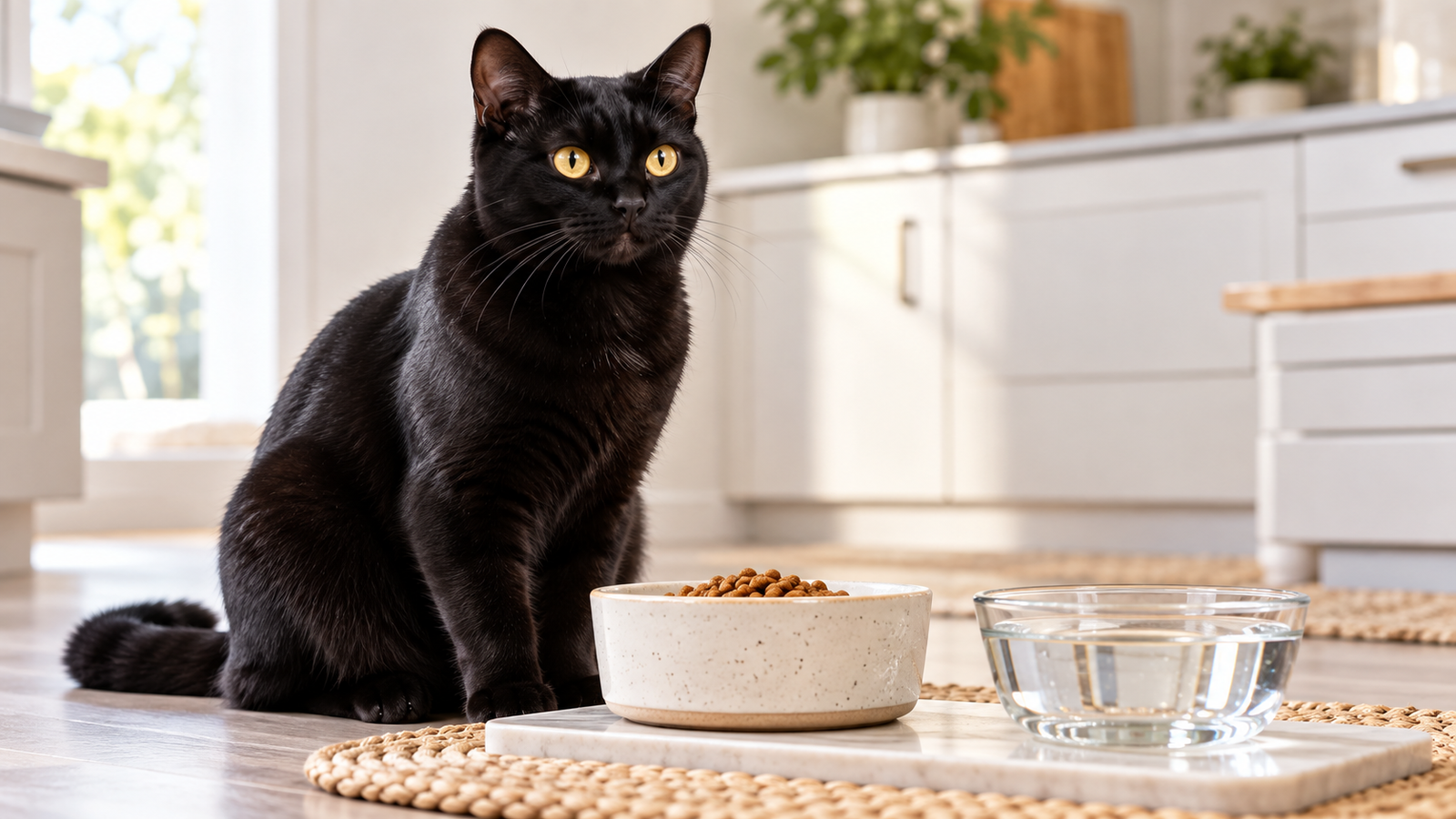
Should Food and Water Bowls Be Together?
They do not have to be.
Many cats benefit from having several water sources located separately from food and litter resources.
Providing choices can encourage normal drinking behavior.
For more hydration guidance, read: Why Is My Cat Not Drinking Much Water? .
Wet Food vs Dry Food: Does Meal Frequency Change?
Both wet and dry foods can form part of a feeding plan when the main diet is nutritionally complete and appropriate for the cat’s life stage and health.
The feeding method may differ, however.
Wet food
Wet food contains much more water and should not be left sitting at room temperature for long periods.
Measured meals often work well.
Dry food
Dry food is easier to use in certain automatic feeders and puzzle toys.
However, because it can be calorie-dense, accurate portion measurement remains important.
Can You Feed Both Wet and Dry Food?
Yes, many cats eat a combination.
The important point is to count both foods toward the same total daily calorie allowance.
For example, adding wet food on top of a full day’s dry-food allowance without reducing the dry portion may unintentionally increase calories.
Wet Food and Hydration
Foods with higher water content can increase overall water intake.
That may be useful for some cats.
However, cats with kidney, urinary or other medical conditions may need a more specific nutritional plan.
How Many Treats Can a Cat Have?
Treat calories count too.
Current veterinary nutrition guidance recommends keeping treats and other non-complete foods to no more than about 10% of total daily calories.
The remaining calories should come primarily from nutritionally complete and balanced food.
Remember Hidden Calories
Extra calories may come from:
- Commercial treats
- Table scraps
- Food used for giving medication
- Food toppers
- Supplements
- Food stolen from another pet
These calories can be easy to overlook.
Can You Use Regular Cat Food as Treats?
Yes.
One useful strategy is to reserve part of the cat’s normal daily food allowance for:
- Training
- Puzzle feeders
- Food hunts
- Rewards
That provides enrichment without automatically adding extra calories.
Why Appetite Is an Important Health Sign
Feeding on a schedule makes appetite changes easier to notice.
For example, you may quickly recognize that your cat:
- Leaves half the meal
- Approaches food but walks away
- Chews differently
- Suddenly appears extremely hungry
- Stops eating altogether
These changes can provide important medical clues.
What Can Cause a Cat to Eat Less?
Possible causes include:
- Dental disease
- Nausea
- Kidney disease
- Respiratory infection
- Pain
- Digestive disease
- Stress
- Other illnesses
A cat with dental pain may approach food but struggle to chew.
For detailed oral-health guidance, read: Cat Dental Disease: Signs, Causes & When to See a Vet .
What if Your Cat Suddenly Wants Much More Food?
A major increase in appetite can also be medically important.
For example, increased hunger can occur with:
- Hyperthyroidism
- Diabetes mellitus
- Some digestive diseases
- Changes in calorie needs
A cat that eats more while losing weight needs veterinary evaluation.
When Should Appetite Loss Be Taken Seriously?
Cats should not go for long periods without eating adequately.
Contact a veterinarian when an adult cat has eaten little or nothing for around 24 hours, particularly if other symptoms are present.
Seek advice sooner for:
- Young kittens
- Senior cats
- Diabetic cats
- Cats with chronic disease
- Cats that are weak or dehydrated
For broader warning signs, read: Signs Your Cat Is Sick: Symptoms You Should Not Ignore .
Why Overweight Cats Should Not Be Crash-Dieted
If a cat needs to lose weight, simply removing a large amount of food without a planned program can be unsafe.
Cats need adequate essential nutrients even while losing body fat.
Weight reduction should therefore use:
- An appropriate calorie target
- A nutritionally complete diet
- Measured portions
- Regular weighing
- Veterinary monitoring when significant weight loss is needed
Feeding an Underweight Cat
Increasing food may seem like the obvious answer, but first consider why the cat is thin.
Weight loss can occur with:
- Dental disease
- Hyperthyroidism
- Kidney disease
- Diabetes
- Chronic digestive disease
- Cancer
- Other illness
Therefore, unexplained weight loss should be investigated before simply doubling portions.
Feeding Around Medications
Some medicines should be given with food, while others have different instructions.
Follow the prescribing veterinarian’s directions rather than assuming every medicine belongs in a meal.
Also remember that food used to hide medication contributes calories.
If the cat refuses a medicated meal, avoid mixing medication into an entire daily portion because the cat may then avoid both the medicine and its food.
Cats on Prescription or Therapeutic Diets
Cats with certain medical conditions may need a veterinarian-prescribed diet.
Examples include some cats with:
- Kidney disease
- Diabetes
- Food-responsive disease
- Urinary problems
- Obesity
- Chronic digestive disease
In these situations, meal timing, calorie amount and food choice may all form part of treatment.
Follow the individual veterinary plan instead of using a general feeding schedule from the internet.
Should You Change Cat Food Suddenly?
When there is no medical reason for an immediate change, transitioning gradually can reduce digestive upset and give the cat time to accept the new food.
A transition over roughly a week is often used.
However, some medical situations require a different approach, so follow veterinary advice when illness is present.
If diarrhea develops during or after a food change, see: Diarrhea in Cats: Causes, Warning Signs & When to See a Vet .
Should Cats Be Fed at Exactly the Same Time Every Day?
A reasonably predictable routine can be helpful.
However, you do not need to feed at the exact second every day.
More important factors include:
- Providing enough feeding opportunities
- Controlling total calories
- Monitoring appetite
- Avoiding long periods without food when possible
- Keeping the feeding environment comfortable
What if Your Cat Wakes You Up for Food?
A cat can learn that vocalizing or pawing at you causes breakfast to appear.
An automatic feeder can sometimes help break the connection between waking the owner and receiving food.
You can also reserve part of the daily allowance for a small later-night meal.
However, sudden new hunger or nighttime vocalization in an older cat can also have a medical cause and should not automatically be treated as a behavior problem.
Should Cats Exercise Before Meals?
Short play sessions before some meals can mimic parts of the natural hunt-eat sequence.
For example:
- Allow a brief wand-toy chase.
- Let the cat catch the toy.
- Then provide a measured meal.
This combines feeding with physical and mental activity.
Adjust play intensity for kittens, senior cats and cats with arthritis or other health limitations.
Creating a Healthy Cat Feeding Routine
A practical feeding plan can follow these steps:
- Choose a complete and balanced food appropriate for your cat’s life stage.
- Determine an appropriate daily amount.
- Measure the total daily food.
- Divide it into two or more meals.
- Add extra small feeding opportunities if desired without increasing total calories.
- Feed each cat separately when competition is possible.
- Keep fresh water available.
- Monitor body weight and body condition.
- Adjust the plan when activity, age or health changes.
A Sample Feeding Routine for an Adult Indoor Cat
One possible routine is:
- Morning: measured breakfast
- Midday: small portion in a puzzle or automatic feeder
- Evening: measured main meal
- Later evening: small remaining portion if the daily allowance permits
This is only an example.
The correct amount and timing depend on the individual cat.
A Sample Feeding Routine for a Young Kitten
A kitten under about 4 months may have:
- Morning meal
- Midday meal
- Evening meal
- Small additional meal later in the day
All meals together should provide the kitten’s appropriate total daily nutrition for growth.
A Sample Feeding Routine for a Senior Cat
A senior cat that prefers smaller meals might receive:
- Small breakfast
- Small midday meal
- Evening meal
- Small late meal
However, if a senior cat suddenly needs encouragement to eat or begins losing weight, arrange a health assessment rather than assuming the change is simply part of aging.
Common Cat Feeding Mistakes
- Leaving unlimited food out for a cat that overeats
- Adding extra meals without reducing portion size
- Guessing portions by eye
- Ignoring calorie differences between foods
- Allowing one cat to eat another cat’s meals
- Feeding every cat in one crowded location
- Giving too many treats
- Reducing senior-cat food automatically because of age
- Ignoring unexplained appetite changes
- Ignoring gradual weight or muscle loss
- Crash-dieting an overweight cat
- Changing diets repeatedly without a clear reason
- Using adult food as the main diet for a growing young kitten
- Assuming begging always means the cat needs more calories
Frequently Asked Questions
How many times a day should I feed my cat?
Most healthy adult cats can be fed at least twice daily. Several smaller measured meals can also work well and may better support natural feline feeding behavior.
How often should kittens eat?
Kittens younger than about 4 months generally need three to four meals per day. Meal frequency can gradually decrease as they grow, although older kittens still need appropriate nutrition for growth.
How often should a 6-month-old kitten eat?
Many healthy kittens around this age do well with two to three measured meals per day. Individual needs vary, and the kitten should still receive a nutritionally complete growth diet.
Is it okay to feed an adult cat twice a day?
Yes. Breakfast and dinner can work well for many healthy adults. You can also divide the same daily food allowance into several smaller meals.
Is one meal a day enough for a cat?
One large daily meal is not the most natural feeding pattern for many cats. Providing at least two eating opportunities, or several smaller portions, generally offers more flexibility and better matches feline feeding behavior.
Do cats prefer several small meals?
Many do. Cats naturally tend to consume small feeding portions, and multiple measured meals can support foraging and predatory-style feeding behavior.
Can I leave dry food out all day?
Unlimited free feeding can lead some cats to overeat and makes calorie intake harder to monitor. Measured meals or measured portions provided through timed and puzzle feeders offer better control.
How much food should my cat eat each day?
The amount depends on the food’s calorie density and your cat’s weight, age, body condition, activity, neuter status and health. Package guidance can provide a starting point, but portions may need adjustment.
Should I measure my cat’s food?
Yes. Measuring makes calorie intake easier to control and helps prevent accidental overfeeding. A digital kitchen scale can provide particularly consistent portion measurements.
Should senior cats eat more often?
Some senior cats benefit from several smaller meals, particularly when they have difficulty maintaining weight or finishing larger portions. Feeding should be individualized to body and muscle condition and medical needs.
Do senior cats need fewer calories?
Not necessarily. Some older cats need fewer calories, while others struggle to maintain weight and muscle. Age alone should not determine portion size.
Can I feed wet and dry food together?
Yes. Both can be included in a feeding plan, but calories from both foods must be counted toward the same daily allowance.
Does wet food help cats drink more water?
Foods with higher moisture content can increase overall water intake. However, cats with urinary, kidney or other medical conditions may need an individualized nutritional plan.
How many treats can I give my cat?
Veterinary nutrition guidance recommends keeping treats and other non-complete foods to no more than about 10% of total daily calories.
Should cats eat together in a multi-cat household?
Not necessarily. Many cats prefer to eat separately. Providing visually separated feeding stations can reduce competition and makes individual food intake easier to monitor.
Are automatic cat feeders useful?
Yes. Automatic feeders can provide measured meals while you are away and make several small daily meals easier to manage.
Are puzzle feeders good for cats?
They can provide useful mental and physical enrichment by allowing cats to work for part of their measured daily food. Introduce them gradually so feeding does not become frustrating.
Why is my cat suddenly always hungry?
The feeding plan may need adjustment, but increased appetite can also occur with conditions such as hyperthyroidism or diabetes. Increased hunger combined with weight loss deserves veterinary evaluation.
When should I worry if my cat stops eating?
Contact your veterinarian if an adult cat eats little or nothing for around 24 hours, especially when vomiting, weakness or another symptom is present. Kittens and medically fragile cats may need attention sooner.
The Bottom Line
How often you should feed a cat depends mainly on age, body condition, lifestyle and health.
Young kittens need frequent meals to support rapid growth. Kittens under about four months generally do well with three to four meals per day, while older kittens can gradually move toward two or three feeding periods.
Healthy adult cats can usually be fed at least twice daily. However, dividing the same daily allowance into several smaller meals can better match normal feline feeding behavior and create useful enrichment opportunities.
Senior cats need more individualized feeding. Some require calorie control, while others need extra nutritional support to maintain body weight and muscle.
Regardless of meal frequency, total daily calorie intake matters. Measure portions, count treats, monitor body and muscle condition, and adjust the feeding plan when weight, activity or health changes.
Finally, treat appetite as useful health information. A feeding schedule does more than provide nutrition—it makes it easier to recognize when your cat suddenly starts eating too little, too much or differently than usual.
References and Further Reading
AAHA/AAFP Feline Life Stage Guidelines
Nutrition, body condition, muscle condition, kitten growth, adult weight management, senior-cat nutrition and hydration.
American Association of Feline Practitioners — Feline Feeding Programs Consensus Statement
Multiple small meals, feeding enrichment, puzzle feeders, food measurement and separate feeding stations in multi-cat homes.
Merck Veterinary Manual
Proper Nutrition for Cats — kitten meal frequency, adult feeding schedules, weight management and risks associated with unrestricted free-choice feeding.
AAHA Nutrition and Weight Management Guidelines
Daily calorie planning, portion measurement, body condition monitoring, treats and prevention of obesity.
World Small Animal Veterinary Association Nutrition Committee
Treat guidance and the recommendation that treats contribute no more than approximately 10% of a healthy cat’s daily calorie intake.