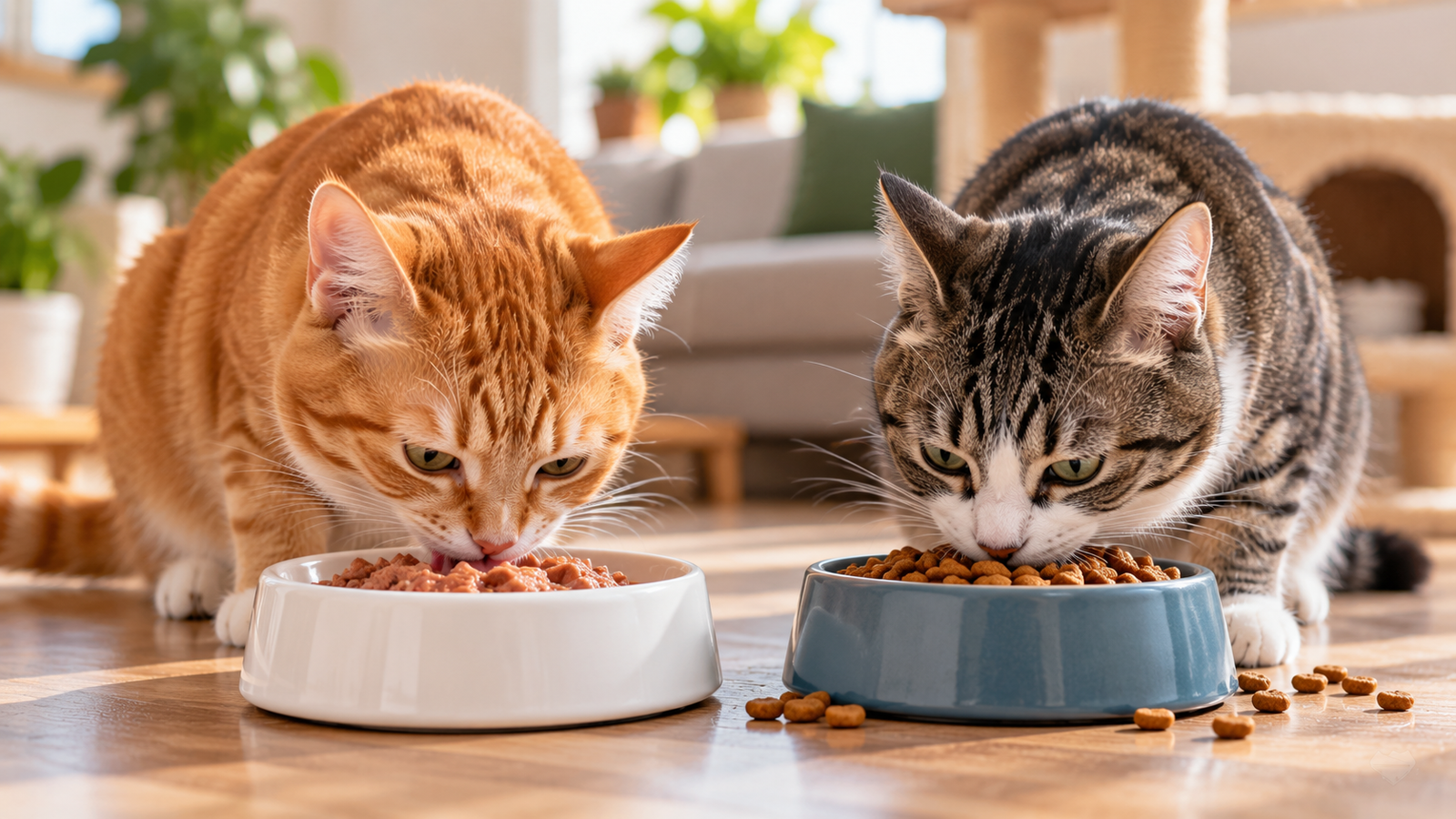

Wet food vs dry food for cats is one of the most common nutrition questions owners ask. Both can provide appropriate nutrition, but they differ significantly in moisture, calorie density, texture, storage and feeding convenience.
Wet cat food contains much more water. Dry food is more concentrated, easier to store and convenient for measured portions, automatic feeders and some puzzle feeders.
Neither format is automatically healthy or unhealthy simply because it comes in a can, pouch or bag.
The first priority is choosing a nutritionally complete and balanced food appropriate for your cat’s life stage and health. After that, factors such as hydration, calorie requirements, medical conditions, food preference, lifestyle and budget can help determine whether wet food, dry food or a combination makes the most sense.
Wet Food vs Dry Food for Cats at a Glance
| Factor | Wet Cat Food | Dry Cat Food |
|---|---|---|
| Moisture | Usually high, often around 70% or more | Usually around 10% or less |
| Hydration support | Provides substantial water with every meal | Cats must obtain more of their water from drinking |
| Calories by volume | Often lower because much of the food is water | Usually more calorie-dense by weight or volume |
| Storage before opening | Cans and pouches store well unopened | Convenient for storing larger quantities |
| After serving | More perishable and should not sit out indefinitely | More suitable for some timed and puzzle feeders |
| Palatability | Often aromatic and appealing to many cats | Some cats strongly prefer crunchy textures |
| Portion measurement | Cans, trays and pouches can simplify portioning | Easy to weigh accurately in grams |
| Cost | Usually more expensive per calorie | Usually less expensive per calorie |
| Dental effect | Does not mechanically clean teeth | Ordinary kibble is not a substitute for dental care; specially formulated dental diets may help control plaque or tartar |
| Best use | Useful when increased dietary moisture is desirable | Useful when convenience, food puzzles or compact calorie delivery matter |
Which Is Better: Wet or Dry Cat Food?
For a healthy cat, the answer is not simply “wet” or “dry.”
A better question is:
Which nutritionally complete diet best meets this individual cat’s needs?
Consider:
- Age and life stage
- Body weight
- Body condition
- Muscle condition
- Activity level
- Hydration
- Dental health
- Medical conditions
- Food preferences
- Daily calorie requirements
- Your ability to measure portions consistently
The answer can also change during a cat’s life.
A diet that works well for a healthy three-year-old may no longer be appropriate after the cat develops kidney disease, diabetes, obesity or another medical condition.
Start With Complete and Balanced Nutrition
Before comparing moisture or texture, make sure the food is designed to provide complete nutrition for cats.
Cats have specific requirements for nutrients such as:
- Protein
- Essential amino acids, including taurine
- Essential fatty acids
- Vitamins
- Minerals
A nutritionally complete food should meet established feline nutrient standards for the appropriate life stage.
Do not assume a food is suitable as the main diet simply because the packaging says:
- Natural
- Premium
- High meat
- Grain-free
- Gourmet
Those marketing descriptions are not substitutes for nutritional adequacy.
Check the Nutritional Adequacy Statement
Look for a statement indicating that the food is complete and balanced for the intended life stage.
Common life-stage categories include:
- Growth
- Adult maintenance
- Growth and reproduction
- All life stages
A product described only as a treat, topper, complementary food or intermittent feeding product should not automatically replace a complete main diet.
The Biggest Difference: Water Content
The clearest practical difference between wet and dry cat food is moisture.
Typical canned cat foods contain roughly 68–78% water, although individual products vary.
Dry foods contain much less water, often around 10%.
That difference can substantially affect how much water a cat receives through its food.
Why Hydration Matters for Cats
Cats evolved eating prey that naturally contained substantial moisture.
As a result, some cats do not compensate completely for low dietary moisture by drinking large amounts from a water bowl.
A cat eating wet food may therefore drink less directly while still receiving substantial water through meals.
Cats eating dry food generally need to obtain a larger proportion of their water through drinking.
Does Wet Food Help Cats Stay Hydrated?
Yes, wet food can increase water intake because water is built directly into the meal.
That can be particularly useful for cats that naturally drink relatively little.
However, wet food does not eliminate the need for fresh drinking water.
Every cat should still have access to clean water.
For more hydration guidance, read: Why Is My Cat Not Drinking Much Water? .
Can a Cat Stay Hydrated on Dry Food?
Many healthy cats eat dry food and maintain normal hydration.
They typically compensate by drinking more water than cats eating high-moisture diets.
Help encourage drinking by providing:
- Multiple water bowls
- Fresh water changed regularly
- Water in several locations
- A fountain if your cat prefers moving water
- Wide, comfortable drinking containers
Pay attention to your individual cat rather than assuming all cats drink in the same way.
Wet Food and Urinary Health
Increasing dietary water can increase urine volume and help produce more dilute urine.
For some cats with urinary concerns, increasing moisture intake forms part of a broader management plan.
However, urinary disease is more complicated than simply choosing wet instead of dry food.
Dietary factors can include:
- Water intake
- Mineral balance
- Urine concentration
- Urinary pH
- Total calorie intake
- Specific stone or crystal type
Does Wet Food Prevent Urinary Crystals?
More moisture can help dilute urine, but wet food alone cannot guarantee that crystals or stones will not develop.
Different urinary conditions require different nutritional strategies.
Some cats need a therapeutic urinary diet specifically formulated to alter urine characteristics or reduce the building blocks of particular stones.
Follow veterinary guidance rather than assuming any ordinary canned food is equivalent to a prescription urinary diet.
Wet vs Dry Food for Cats With Kidney Disease
Cats with chronic kidney disease are prone to hydration problems because diseased kidneys become less able to conserve water efficiently.
Higher-moisture foods can help increase water intake.
However, moisture is only one part of kidney nutrition.
Therapeutic renal diets are designed around factors such as:
- Phosphorus control
- Appropriate protein quantity and quality
- Calorie intake
- Electrolyte balance
- Other renal-supportive nutrients
Wet Food vs Dry Food for Weight Control
Wet foods are often less calorie-dense by volume because a large percentage of the food is water.
That can allow a cat to eat a larger-looking portion while consuming fewer calories than it would from the same volume of calorie-dense dry food.
However, wet food does not automatically cause weight loss.
A cat gains weight when calorie intake consistently exceeds its energy needs.
Is Dry Food Fattening?
Dry food is not inherently fattening.
The challenge is that dry food is usually calorie-dense, so relatively small measuring errors can add a meaningful number of calories.
For example, repeatedly adding an unmeasured handful to the bowl can gradually create substantial overfeeding.
To control intake:
- Measure the daily amount
- Preferably weigh dry food in grams
- Count treats
- Count food used for training
- Monitor body weight and body condition
Does Wet Food Make Cats Feel Fuller?
Higher-moisture foods can provide greater food volume for the same number of calories in some formulations.
That may be useful for certain cats during weight management.
However, satiety is influenced by more than water alone.
Factors include:
- Protein
- Fiber
- Fat
- Calorie density
- Meal pattern
- Individual appetite
For an overweight cat, a veterinarian may recommend a therapeutic weight-management diet rather than simply reducing a normal maintenance food.
Never Crash-Diet an Overweight Cat
Wet Food vs Dry Food for Dental Health
A common belief is that ordinary dry food automatically cleans a cat’s teeth.
That is too simple.
Standard kibble should not be treated as a substitute for:
- Dental examinations
- Home oral care
- Tooth brushing when tolerated
- Professional dental treatment when needed
Does Dry Kibble Clean a Cat’s Teeth?
Ordinary dry food does not reliably provide the same dental effect as a diet specifically designed and clinically evaluated for plaque or tartar control.
Many standard kibble pieces break apart before providing meaningful cleaning along the tooth surface.
Special dental diets use particular kibble structures or formulations designed to produce a measurable effect.
Look for Evidence-Based Dental Products
If dental benefit is important, ask your veterinarian about products that have demonstrated plaque or tartar control.
Some feline dental diets have been accepted by the Veterinary Oral Health Council for specific plaque or tartar claims.
That is different from assuming every bag of dry cat food provides dental protection.
For detailed oral-health guidance, read: Cat Dental Disease: Signs, Causes & When to See a Vet .
Which Has More Protein: Wet or Dry Cat Food?
You cannot accurately answer this by looking only at the protein percentage printed on two packages.
Wet food contains much more water, which dilutes the nutrients when they are listed on an “as fed” basis.
For example, a wet food showing 10% protein on the label may actually contain a substantial amount of protein once the water is removed mathematically.
Dry food may show 35% protein partly because there is far less moisture in the product.
Compare Nutrients on a Dry-Matter or Calorie Basis
When comparing wet and dry foods, more useful comparisons include:
- Dry-matter percentage
- Grams of nutrient per 100 calories
- Percentage of metabolizable energy from the nutrient
These approaches reduce the distortion caused by very different moisture levels.
Your veterinarian or veterinary nutritionist can help interpret labels when a medical condition makes precise nutrient comparison important.
Are Cats Obligate Carnivores?
Yes.
Cats are obligate carnivores and have nutritional requirements that differ from those of people and dogs.
They require nutrients associated with animal tissues, including specific amino acids and fatty acids.
However, “obligate carnivore” does not mean that every carbohydrate-containing food is harmful.
Are Carbohydrates Bad for Cats?
This topic is often oversimplified online.
Adult cats do not have a specific dietary requirement for carbohydrate because they can produce glucose through their own metabolism.
However, cats can digest properly cooked starches efficiently.
Therefore, the presence of carbohydrates alone does not prove that a food is nutritionally poor.
Does Dry Food Always Contain More Carbohydrate?
Many dry foods require starch as part of the manufacturing process, so they often contain more carbohydrate than many canned foods.
However, there is substantial variation between individual products.
You cannot reliably determine carbohydrate content from food format alone.
Likewise, “grain-free” does not necessarily mean low-carbohydrate because other ingredients such as potatoes, peas or legumes may provide starch.
Do Healthy Cats Need a Low-Carbohydrate Diet?
Healthy cats need a nutritionally appropriate diet that provides adequate essential nutrients and calories.
Simply selecting the product with the lowest possible carbohydrate number is not automatically better.
The optimal macronutrient profile may also change when a cat has a medical condition.
Wet vs Dry Food for Cats With Diabetes
Diet becomes especially important in cats with diabetes mellitus.
Current veterinary diabetes guidance often favors diets that are relatively high in protein and lower in carbohydrate for many diabetic cats.
Many canned foods fit that nutritional pattern better than typical maintenance dry foods, but not every canned diet does.
Some therapeutic dry diets and mixed feeding plans can also be appropriate.
Calories Matter More Than Bowl Size
Wet and dry food should not be compared cup for cup.
A cup of dry food can contain far more calories than the same physical volume of wet food.
Instead, look for the calorie information on the package.
Depending on the product, calories may be listed as:
- Calories per can
- Calories per pouch
- Calories per cup
- Calories per kilogram
Why Calorie Density Matters
Imagine one cat needs a certain number of calories each day.
A calorie-dense dry food might provide that amount in a relatively small bowl.
A high-moisture food might require a much larger physical volume to deliver the same calories.
Neither is automatically better.
The appropriate choice depends on factors such as:
- Appetite
- Weight goals
- Stomach capacity
- Medical condition
- Food preference
Wet Food and Palatability
Many cats find wet food particularly appealing because it has a strong aroma and soft texture.
That can help when a cat has a reduced appetite.
Warming wet food slightly can sometimes increase its aroma further.
Food should only be gently warmed and should never be served hot.
Dry Food and Palatability
Some cats strongly prefer dry food.
They may enjoy:
- The texture
- The smell
- The consistency
- The ability to eat small amounts throughout the day
A cat’s established preference can be important, particularly in a senior or medically fragile cat where reliable calorie intake is a priority.
What if Your Cat Refuses Wet Food?
Do not assume you must win a battle against your cat.
Instead, experiment gradually with:
- Different textures
- Pâté
- Chunks
- Shreds
- Gravy-style foods
- Different temperatures
- Small amounts alongside familiar food
Some cats accept a new format slowly.
What if Your Cat Refuses Dry Food?
A cat does not need dry food simply because kibble is common.
A nutritionally complete wet diet can serve as the main diet for many healthy cats.
However, sudden refusal of a previously preferred dry food deserves attention.
It may indicate:
- Dental pain
- Oral disease
- Nausea
- Illness
- A change in the food itself
Can Cats Eat Both Wet and Dry Food?
Yes.
Many cats can eat a combination of wet and dry food.
This is often called mixed feeding.
A mixed plan might include:
- Wet food at breakfast
- A measured dry portion in a puzzle feeder
- Wet food again in the evening
The key is to calculate the combined calories.
The Biggest Mixed-Feeding Mistake
A common mistake is feeding the recommended full daily amount of dry food and then adding wet food on top.
That can turn mixed feeding into overfeeding.
Instead:
- Determine the appropriate total daily calories.
- Decide what proportion will come from wet food.
- Use dry food for the remaining calories.
- Include treats in the calculation.
A Simple Mixed-Feeding Example
Imagine that your veterinarian has established an appropriate daily calorie target for your cat.
You could divide that total between:
- Morning wet meal
- Small measured dry-food puzzle
- Evening wet meal
- A small remaining dry portion if needed
The exact amount depends on the calorie content of the individual foods.
Do not use this example as a fixed calorie prescription.
Mixed Feeding Can Add Variety
Using both formats can give owners flexibility.
Wet food can contribute moisture, while measured dry food may work well for:
- Puzzle feeders
- Automatic feeders
- Training rewards
- Small food-search activities
For meal-frequency guidance, read: How Often Should You Feed a Cat? Guide by Age & Life Stage .
Wet Food vs Dry Food for Kittens
Kittens need a nutritionally complete diet formulated for growth.
Both wet and dry kitten foods can be appropriate when properly formulated.
Wet food provides additional moisture and a soft texture.
Dry kitten food is convenient and can also provide complete growth nutrition.
Some owners use both formats.
Very Young Kittens Need Special Care
A kitten transitioning from milk to solid food needs food appropriate for its developmental stage.
The texture may need to be softened initially.
Young kittens also require frequent meals because of their rapid growth and relatively small stomach capacity.
For broader kitten guidance, read: Common Health Problems in Kittens .
Wet Food vs Dry Food for Senior Cats
Senior cats should not all be fed the same way simply because of age.
Some older cats remain healthy and maintain weight easily.
Others develop:
- Kidney disease
- Hyperthyroidism
- Diabetes
- Dental disease
- Digestive problems
- Reduced appetite
- Muscle loss
Those conditions can influence which diet and food format works best.
Wet Food Can Be Helpful for Some Seniors
Potential advantages include:
- Additional dietary moisture
- A strong aroma
- A softer texture
- Greater food volume per calorie in many products
However, an older cat that strongly prefers an appropriate dry diet should not automatically be forced onto wet food simply because it has reached a certain age.
For more information, read: Common Health Problems in Senior Cats .
Dental Pain Can Change Food Preference
A cat with painful teeth or gums may suddenly become reluctant to chew a previously accepted food.
You may notice:
- Dropping food
- Chewing on one side
- Approaching food and walking away
- Drooling
- Reduced appetite
- Preferring softer food
Changing to wet food may make eating temporarily easier, but it does not treat the underlying dental disease.
Prescription Diets: Food Form Comes Second
When a veterinarian prescribes a therapeutic diet, the nutrient formulation is designed for a specific medical purpose.
Examples include diets for:
- Chronic kidney disease
- Urinary disease
- Diabetes
- Obesity
- Food-responsive conditions
- Some digestive disorders
In those situations, choosing the appropriate therapeutic formulation may be more important than a general wet-versus-dry rule.
Do Not Replace a Prescription Diet With Ordinary Wet Food
For example, a standard canned maintenance diet may contain plenty of moisture but may not have the phosphorus profile of a therapeutic renal diet.
Likewise, ordinary wet food may not produce the urinary characteristics required for a cat with a specific stone or crystal problem.
Discuss substitutions with the veterinarian managing the condition.
How to Compare Wet and Dry Cat Food Labels
Start with five pieces of information:
- Nutritional adequacy statement
- Life stage
- Calories
- Guaranteed analysis
- Feeding directions
Then consider your individual cat.
1. Nutritional Adequacy
Confirm that the food is suitable as a complete diet rather than only a treat, topper or supplemental product.
2. Life Stage
A kitten has different nutritional requirements from an adult maintenance cat.
Do not select a diet only because the flavor or packaging looks appealing.
3. Calories
Calories are essential when comparing foods.
Look for the calorie content per:
- Can
- Pouch
- Cup
- Kilogram
4. Guaranteed Analysis
This usually lists minimum or maximum amounts of nutrients such as:
- Crude protein
- Crude fat
- Crude fiber
- Moisture
Remember that wet and dry foods cannot be compared directly from these percentages without accounting for moisture.
5. Feeding Directions
Package feeding recommendations provide a starting point rather than a perfect prescription for every cat.
Adjust intake according to:
- Weight trend
- Body condition
- Activity
- Neuter status
- Health
What Is Dry-Matter Basis?
Dry-matter analysis mathematically removes the water from food so products with very different moisture levels can be compared more fairly.
For example, imagine:
- A wet food contains 80% water.
- That leaves 20% dry matter.
- The nutrients are then evaluated within that 20% rather than within the total wet weight.
This explains why a wet food can appear to have a low protein percentage on the label while providing substantial protein relative to its dry matter.
Do Ingredients Matter More Than Nutrients?
Ingredient lists can provide useful information, but they do not tell the whole nutritional story.
A diet should be evaluated according to:
- Whether it meets feline nutritional requirements
- Quality control
- Digestibility
- Calorie density
- Suitability for the individual cat
- Evidence supporting therapeutic claims when relevant
An ingredient list alone cannot tell you whether the finished diet delivers nutrients in appropriate amounts and proportions.
Is Grain-Free Cat Food Better?
Not automatically.
“Grain-free” describes the absence of certain ingredients rather than proving that the food has a superior nutrient profile.
Grain-free foods can still contain substantial carbohydrate from ingredients such as:
- Potatoes
- Peas
- Lentils
- Other starches
Choose food based on its overall nutritional suitability rather than a single marketing phrase.
Is High-Protein Food Always Better?
Cats have relatively high protein requirements compared with many other species.
However, more is not automatically better in every medical situation.
For example, a cat with chronic kidney disease may benefit from a therapeutic renal diet designed to control phosphorus and provide an appropriate protein profile.
Nutrition should be matched to the individual cat rather than reduced to one nutrient number.
Wet Food Storage
Unopened canned or pouched food can generally be stored according to the manufacturer’s instructions until its expiration or best-use date.
Once opened, wet food is perishable.
Follow the manufacturer’s instructions regarding:
- Refrigeration
- Storage containers
- How long opened food can be kept
- How long a served portion should remain at room temperature
Discard food that appears spoiled or has been handled outside recommended storage conditions.
Dry Food Storage
Dry food lasts longer after opening, but it still needs appropriate storage.
Protect it from:
- Moisture
- Heat
- Insects
- Rodents
- Contamination
Keep the package information and expiration date available in case a product recall or quality issue arises.
Wash Food Bowls Regularly
Both wet and dry feeding require clean dishes.
Food residue, saliva and moisture can build up in bowls.
Wash feeding equipment regularly and keep water bowls clean and fresh.
Can Wet Food Be Used in an Automatic Feeder?
Yes, but choose a feeder designed to keep wet food safely stored for the intended period.
Some models use:
- Cooling packs
- Refrigerated compartments
- Timed lids
Follow the feeder and food manufacturer’s safety instructions.
Dry Food Works Well for Food Puzzles
Dry food is particularly convenient for many:
- Puzzle feeders
- Treat balls
- Automatic dispensers
- Food-search games
This can turn part of the daily calorie allowance into mental enrichment.
Remember not to add puzzle-feeder calories on top of the normal daily amount.
Can Wet Food Be Used for Enrichment?
Yes.
Wet food can be offered in:
- Lick mats designed for cats
- Suitable slow feeders
- Food puzzles made for moist food
Supervise new feeding equipment and clean it thoroughly after use.
How to Transition From Dry to Wet Food
Some cats accept wet food immediately.
Others need a gradual introduction.
Try:
- Offering a small amount beside the familiar food.
- Letting the cat investigate without pressure.
- Trying different textures.
- Serving the food slightly warmed for aroma.
- Increasing the new food gradually as acceptance improves.
Do not allow a stubborn food transition to turn into prolonged fasting.
How to Transition From Wet to Dry Food
The same principle applies in reverse.
Introduce the new food gradually when possible and monitor:
- Appetite
- Stool quality
- Vomiting
- Body weight
- Water intake
What if a Food Change Causes Diarrhea?
Abrupt diet changes can contribute to digestive upset in some cats.
If diarrhea is persistent, severe or accompanied by vomiting, lethargy, blood or appetite loss, contact your veterinarian.
For detailed guidance, read: Diarrhea in Cats: Causes, Warning Signs & When to See a Vet .
What if Your Cat Stops Eating During a Food Change?
Do not keep withholding the familiar food in an attempt to force acceptance of the new diet.
Cats should not go for prolonged periods without adequate calorie intake.
Wet Food Advantages
Potential advantages of wet food include:
- High moisture content
- Increased dietary water intake
- Often lower calorie density by volume
- Strong aroma and palatability for many cats
- Soft texture
- Easy portioning with individual cans or pouches
- Many therapeutic diets available in wet formulations
Wet Food Disadvantages
Potential disadvantages include:
- Higher cost per calorie in many cases
- More refrigeration and storage requirements after opening
- Food cannot be left at room temperature indefinitely
- Can be less convenient for some automatic feeders
- Some cats simply dislike the texture
Dry Food Advantages
Potential advantages of dry food include:
- Convenient storage
- Usually lower cost per calorie
- Easy weighing and measuring
- Works well in many puzzle feeders
- Works well in many automatic feeders
- Useful for food-search enrichment
- Some cats strongly prefer the texture
Dry Food Disadvantages
Potential disadvantages include:
- Low moisture content
- Higher calorie density in a relatively small volume
- Easy to overfeed when portions are not measured
- Unlimited free feeding can make intake difficult to monitor
- Ordinary kibble should not be mistaken for complete dental care
Who May Benefit From More Wet Food?
A veterinarian may particularly consider higher-moisture feeding for some cats with:
- Low water intake
- Certain urinary conditions
- Some kidney-related hydration concerns
- A need for greater meal volume during weight management
- Difficulty chewing because of oral problems
- Reduced appetite where aroma and palatability are useful
The exact diet still needs to fit the medical condition.
Who May Do Well With Dry Food?
Dry food can work well for a healthy cat when:
- The food provides appropriate complete nutrition
- Calories are measured
- The cat maintains a healthy body condition
- Water intake is adequate
- No medical condition requires a different nutritional strategy
Dry food may also be particularly practical for households using timed feeders or food puzzles.
Who May Benefit From Mixed Feeding?
Mixed feeding can be a useful compromise when you want:
- Additional dietary moisture
- The convenience of dry food
- More feeding-enrichment options
- Different textures
- Greater flexibility in meal scheduling
Careful calorie accounting remains essential.
A Practical Way to Decide
Ask these questions:
- Is the food complete and balanced for my cat’s life stage?
- Does my cat have a medical condition that changes its nutritional needs?
- Does my cat drink enough water?
- Is my cat at an appropriate body weight?
- Can I accurately measure portions?
- Does my cat reliably eat the food?
- Can I afford and store the diet consistently?
- Does the feeding method work with my household routine?
The answers matter more than the simple label “wet” or “dry.”
Common Wet vs Dry Cat Food Myths
Myth: Wet food is always healthier.
Wet food offers important hydration advantages, but an individual product must still provide appropriate nutrition and calories.
Myth: Dry food is bad for every cat.
A nutritionally complete dry food can support healthy cats when portions and hydration are appropriately managed.
Myth: Dry food automatically cleans teeth.
Ordinary kibble should not replace dental care. Some specifically designed dental diets have demonstrated plaque or tartar benefits.
Myth: Cats cannot digest carbohydrates.
Cats do not require dietary carbohydrate in the same way they require certain essential amino acids and fats, but they can efficiently digest properly cooked starch.
Myth: Grain-free means low-carbohydrate.
Grain-free foods may contain carbohydrate from other starch sources.
Myth: Wet food always contains more protein.
Protein must be compared on an appropriate dry-matter or calorie basis because water dramatically changes the percentages shown on labels.
Myth: A cat eating wet food does not need drinking water.
Fresh clean water should remain available regardless of diet type.
Myth: You cannot mix wet and dry cat food.
Many cats can eat both formats successfully when the combined diet remains nutritionally appropriate and total calories are controlled.
Common Feeding Mistakes
- Choosing food based only on wet or dry format
- Ignoring the nutritional adequacy statement
- Comparing wet and dry protein percentages directly
- Ignoring calories
- Leaving unlimited dry food available for a cat that overeats
- Adding wet food on top of a full dry-food allowance
- Assuming all canned foods are low carbohydrate
- Assuming all dry foods are high carbohydrate
- Using ordinary kibble as the main dental-care strategy
- Assuming grain-free automatically means healthier
- Ignoring hydration in a dry-fed cat
- Replacing a therapeutic veterinary diet with ordinary wet food
- Changing a diabetic cat’s diet without veterinary guidance
- Changing food too quickly when a gradual transition would be appropriate
- Allowing a cat to stop eating in an attempt to force a new diet
Frequently Asked Questions
Is wet food better than dry food for cats?
Not for every cat. Wet food provides substantially more water and may be useful when increased moisture intake is desirable. Dry food can also provide complete nutrition and offers convenience. The best choice depends on the individual cat.
Is dry food bad for cats?
No. Properly formulated dry cat food can provide complete and balanced nutrition. Portion control, water intake, body condition and individual health needs still matter.
Can cats live on wet food only?
Yes, when the wet food is complete and balanced for the cat’s life stage and provides an appropriate amount of calories and nutrients.
Can cats live on dry food only?
Many healthy cats can eat a complete dry diet successfully. Fresh water should always be available, and owners should monitor hydration, calorie intake and body condition.
Can I feed my cat both wet and dry food?
Yes. Mixed feeding can work well. Calculate calories from both foods so the combined amount does not result in overfeeding.
Does wet food help cats drink more water?
Wet food increases total water intake because much of the meal itself consists of water. Cats eating wet food may therefore drink less directly from a bowl while still receiving substantial dietary moisture.
How much water is in wet cat food?
Many canned cat foods contain roughly 68–78% water, although the exact percentage varies by product.
How much water is in dry cat food?
Dry foods commonly contain around 10% water or less, although individual formulations vary.
Is wet food better for a cat’s kidneys?
Additional dietary moisture can help support hydration, which is important in cats with chronic kidney disease. However, cats with diagnosed CKD often need a therapeutic renal diet with specific nutrient modifications. Ordinary wet food is not automatically a renal diet.
Is wet food better for urinary health?
Increased water intake can help produce more dilute urine and may form part of managing some urinary conditions. However, individual urinary diseases can require specific therapeutic diets, so wet food alone should not be considered a complete treatment.
Does dry food clean cats’ teeth?
Ordinary kibble should not be relied upon as a dental-care treatment. Some specially formulated dental diets have demonstrated plaque or tartar benefits, but regular dental care remains important.
Does wet food cause dental disease?
Dental disease has multiple causes. Feeding wet food does not eliminate the need for dental care, but neither does ordinary dry food guarantee clean teeth.
Does wet food have more protein than dry food?
Not necessarily. Because wet food contains much more water, label percentages should be converted to a dry-matter or calorie basis before comparing protein accurately.
Are carbohydrates bad for cats?
Cats are obligate carnivores and have specific nutritional requirements, but they can digest properly cooked starches. A food should be assessed by its complete nutritional profile rather than rejected simply because it contains carbohydrate.
Is grain-free food better for cats?
Not automatically. Grain-free foods can still contain starch and carbohydrate from other ingredients. Nutritional adequacy and suitability for the individual cat matter more than the grain-free label.
Is wet food better for overweight cats?
Wet foods are often less calorie-dense by volume and may allow larger meal portions for the same calories. However, weight loss still depends on appropriate calorie control and a nutritionally complete feeding plan.
Does dry food make cats overweight?
Dry food does not automatically cause obesity, but its high calorie density makes portion control important. Free-choice feeding can cause some cats to consume more calories than they need.
Which is better for kittens, wet or dry food?
Both formats can be appropriate when formulated as complete and balanced kitten food. Some owners use both. Young kittens also need frequent meals to support growth.
Which is better for senior cats?
It depends on the individual senior cat. Wet food may help with hydration, aroma and soft texture, while some older cats prefer dry food. Medical conditions and maintenance of body and muscle condition should guide the decision.
Why does my cat prefer dry food?
Cats develop individual preferences for smell, texture and feeding routines. A strong preference for dry food is not unusual.
Why does my cat prefer wet food?
Many cats find wet food’s aroma, moisture and soft texture appealing. Individual food preferences vary considerably.
Should I switch my cat from dry to wet food?
A switch may be useful when greater dietary moisture or another nutritional change is desirable, but it is not mandatory for every healthy cat. Consider your cat’s health, weight, hydration and veterinary recommendations.
How do I compare wet and dry cat food?
Compare nutritional adequacy, calories, life-stage suitability and nutrients on a dry-matter or calorie basis rather than comparing the package percentages directly.
The Bottom Line
Wet food and dry food can both be appropriate choices for cats. Neither format is automatically superior in every situation.
Wet food’s clearest advantage is moisture. It delivers substantial water with every meal and can be particularly useful when increasing overall water intake is desirable.
Dry food offers practical advantages. It is convenient, generally economical, easy to weigh and useful in automatic feeders, puzzle feeders and food-search activities.
However, dry food is typically more calorie-dense, so accurate portion control becomes especially important. Ordinary kibble should also not be mistaken for complete dental care unless it is a specifically evaluated dental formulation.
Do not judge protein or other nutrients by comparing package percentages directly. Wet food contains far more water, so meaningful comparisons often require a dry-matter or calorie basis.
Likewise, avoid simple nutrition myths. Cats are obligate carnivores, but that does not mean they are incapable of digesting properly cooked carbohydrate. “Grain-free,” “high protein” and “wet” are not complete measures of nutritional quality.
Mixed feeding can also work well. Wet meals can contribute water, while carefully measured dry food can provide convenience and enrichment. Just make sure calories from both formats are counted toward the same daily allowance.
For cats with kidney disease, diabetes, urinary disease, obesity or another medical condition, the specific therapeutic nutrient profile may matter more than whether the food is wet or dry.
Ultimately, choose a complete and balanced food your cat reliably eats, feed an appropriate number of calories, maintain access to fresh water, monitor body and muscle condition, and adjust the plan when age or health changes.
References and Further Reading
Merck Veterinary Manual
Dog and Cat Foods — moisture content of dry and canned foods, food processing, nutritional adequacy, storage considerations and differences between pet-food formats.
Merck Veterinary Manual
Proper Nutrition for Cats — feline nutrient requirements, balanced feeding, hydration, wet food and drinking-water considerations.
Merck Veterinary Manual
Nutritional Requirements of Small Animals — feline protein, fat, carbohydrate and water requirements, including carbohydrate digestion and feline metabolic adaptations.
AAHA/AAFP Feline Life Stage Guidelines
Individualized nutrition, body and muscle condition, calorie control, hydration and nutritional management across feline life stages.
AAHA 2026 Diabetes Management Guidelines for Cats
Current dietary management of feline diabetes, including protein, carbohydrate, calorie control, canned and mixed feeding, body weight and concurrent disease.
International Renal Interest Society (IRIS)
Dietary management of chronic kidney disease in cats, including therapeutic renal diets, phosphorus management, adequate calorie intake and individualized nutritional treatment.
Veterinary Oral Health Council (VOHC)
Evidence-based plaque and tartar claims for feline dental diets and other oral-health products.
World Small Animal Veterinary Association (WSAVA)
Global Nutrition Guidelines — nutritional assessment, appropriate diet selection and individualized feeding recommendations.