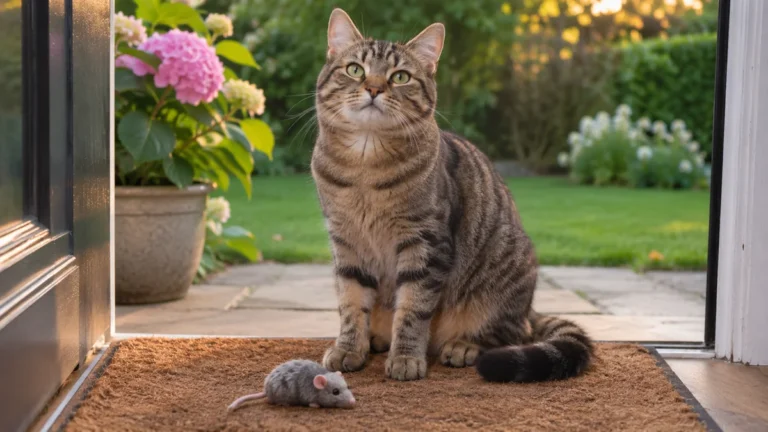


Learning how to train a cat to come when called can make everyday life easier and give you another useful way to communicate with your cat.
A recall cue can help when you need your cat to leave another room, come inside from a secure enclosure, move away from something interesting or simply appear when you cannot find them.
Cats can learn recall through positive reinforcement. The basic idea is simple: use a clear cue, reward the cat immediately for approaching you and gradually practise from greater distances and around mild distractions.
The goal is not to force obedience. Instead, you want your cat to learn that responding to the recall cue consistently leads to something worthwhile.
Cat Recall Training at a Glance
| Training Stage | What to Do | Goal |
|---|---|---|
| Choose a cue | Pick one short word or distinctive sound. | Create one clear signal that always means “come to me.” |
| Find the right reward | Test small treats, play or another reward your cat values. | Give your cat a strong reason to participate. |
| Start close | Practise from only a short distance in a quiet room. | Make the first repetitions easy to succeed. |
| Reward immediately | Reward as soon as your cat reaches you. | Build a clear connection between coming and the reward. |
| Add distance | Move progressively farther away. | Teach the cue to work across a room or home. |
| Add distractions | Introduce mild distractions gradually. | Help the behavior become reliable in everyday situations. |
| Maintain the skill | Practise occasionally and continue rewarding good responses. | Keep recall valuable over time. |
Can Cats Really Be Trained to Come When Called?
Yes.
Cats learn through consequences just as many other animals do.
When a behavior reliably produces something the cat enjoys, that behavior becomes more likely to happen again.
For recall training, the sequence becomes:
- You give the recall cue.
- Your cat approaches you.
- You immediately provide something rewarding.
After enough successful repetitions, the cue itself begins to predict a good outcome.
That is the foundation of a reliable recall.
Positive Reinforcement Works Best
Positive reinforcement means adding something the cat values immediately after a desired behavior.
Possible rewards include:
- A small food treat
- A piece of the cat’s regular food
- Interactive play
- Petting for cats that enjoy it
- Access to a favorite activity
Food is convenient, but it is not automatically the best reward for every cat.
The best reward is whatever your individual cat finds motivating.
Find Out What Your Cat Values Most
Before formal recall training begins, test a few possible rewards.
For example, offer separate opportunities for:
- A small favorite treat
- A piece of ordinary kibble
- A wand-toy game
- Gentle petting
Notice which reward gets the strongest positive response.
A highly valued reward is especially useful when introducing a new behavior or increasing training difficulty.
For more information about daily feeding, read: How Often Should You Feed a Cat? Guide by Age & Life Stage .
Choose a Clear Recall Cue
Your recall cue should be short, clear and easy to repeat consistently.
Examples include:
- “Come”
- “Here”
- Your cat’s name followed by “come”
- A whistle
- A specific kiss or clicking sound
There is no magic word.
Consistency matters more than the exact sound.
Should You Use Your Cat’s Name as the Recall Cue?
You can, but there is an advantage to separating name recognition from recall.
Your cat’s name can simply mean:
“Pay attention to me.”
The recall cue can then mean:
“Come all the way to me.”
For example:
“Milo — come!”
This gives the cat two useful pieces of information.
How to Teach Your Cat Its Name
Start while your cat is nearby and relaxed.
- Say the cat’s name once.
- When the cat looks toward you, immediately reward.
- Repeat only a few times.
- End before your cat loses interest.
At first, reward even a small response such as turning the ears or head toward you.
Later, you can become more selective and reward a clear look in your direction.
This attention response makes later recall training easier.
Step 1: Start in a Quiet Room
Begin somewhere familiar with very few distractions.
Good locations include:
- A bedroom
- A quiet living room
- A home office
- Another secure indoor space
Avoid beginning while your cat is:
- Sleeping deeply
- Eating
- Watching another animal closely
- Highly excited
- Frightened
Choose a moment when the cat is awake, comfortable and reasonably interested in interacting.
Step 2: Begin From a Very Short Distance
Start only a few feet away.
Your cat should already be able to see you.
Say the recall cue once in a friendly tone:
“Come.”
Then encourage the cat toward you.
You can:
- Crouch slightly
- Move backward a step
- Show the reward briefly
- Use gentle inviting body language
The first goal is simply to create successful repetitions.
Step 3: Reward the Moment Your Cat Arrives
Timing matters.
Give the reward as soon as the cat reaches you.
Do not wait several seconds while you walk to another room or search for the treats.
The faster the reward follows the behavior, the easier it is for the cat to understand which action earned it.
Step 4: Repeat Only a Few Times
More repetitions are not always better.
Cats can lose interest when a session continues too long.
For a beginner, a session might contain only:
- Three successful recalls
- Five successful recalls
- Or even fewer for a cautious cat
Stop while your cat is still engaged.
Several tiny training sessions across the week are often more useful than one long session.
Step 5: Gradually Increase the Distance
Once your cat reliably comes from a short distance, move slightly farther away.
Progress might look like:
- Two feet away
- Across the room
- From the doorway
- From the next room
- From farther across the home
Increase only one level at a time.
If your cat suddenly stops responding, the difficulty probably increased too quickly.
Move closer again and rebuild success.
Step 6: Practise From Another Room
When your cat understands the cue while watching you, begin calling from just out of sight.
Start from:
- Just around a doorway
- A nearby hallway
- An adjoining room
Reward generously when your cat finds you.
This teaches the cat that the recall cue means locating you, not merely walking toward a visible treat.
Step 7: Add Mild Distractions
Reliable recall around distractions takes more training than recall in an empty room.
Begin with easy distractions such as:
- A toy resting on the floor
- Another person quietly sitting nearby
- Normal household background sounds
Do not start by calling your cat away from the most interesting thing in the house.
Build difficulty slowly.
Change One Difficulty at a Time
Recall becomes harder when you change:
- Distance
- Distractions
- Location
Avoid dramatically increasing all three at once.
For example, if you move training into a new room, begin from a shorter distance again.
That gives your cat a better chance to succeed.
Step 8: Practise in Different Parts of the Home
Cats do not always automatically understand that a learned behavior applies everywhere.
Once recall works in one room, practise in:
- The hallway
- Bedroom
- Living room
- Kitchen when food is not being prepared
- Other safe indoor areas
Changing locations helps the recall cue become more useful in normal daily life.
What Is a Marker Word?
A marker tells the cat the exact moment it performed the behavior you wanted.
Examples include:
- “Yes!”
- “Good!”
- A clicker sound
The marker should immediately predict a reward.
For example:
Cat arrives → “Yes!” → treat.
The marker helps bridge the short moment between the correct behavior and delivery of the reward.
Can You Use a Clicker for Cat Recall?
Yes.
Clicker training can work well with cats.
First, teach the meaning of the click:
- Click once.
- Immediately give a reward.
- Repeat several times over short sessions.
Once the cat expects a reward after hearing the click, you can use it to mark the moment the cat completes a desired behavior.
During recall:
Recall cue → cat comes → click → reward.
A clicker is optional. Good timing with a marker word can work too.
Do You Need to Show the Treat Before Calling?
Showing the reward can help during the very first repetitions.
However, the goal is eventually for your cat to respond to the cue rather than needing to see food first.
As training progresses:
- Keep the reward out of sight.
- Give the recall cue.
- Wait for the response.
- Reward after the cat reaches you.
The reward should follow the behavior rather than becoming a visible bribe every time.
Should You Repeat “Come, Come, Come”?
Try not to.
If you repeatedly say the cue while your cat ignores it, the word can lose meaning.
Instead:
- Say the cue once.
- Pause briefly.
- If your cat does not respond, make the exercise easier.
Move closer, reduce the distraction or try again later.
Never Punish a Cat for Coming Slowly
Imagine calling your cat several times and finally seeing the cat walk toward you.
It can be tempting to sound frustrated.
Avoid that.
From the cat’s perspective, the most recent behavior was:
Coming to you.
If arriving leads to anger, grabbing or punishment, recall can become less appealing.
Reward the arrival and adjust the training setup next time.
Why Punishment Hurts Recall Training
Shouting, spraying water or physically punishing a cat does not explain what you wanted the cat to do.
Instead, punishment can make the cat:
- Fearful
- Less willing to approach you
- More likely to avoid training
- More cautious around your hands or voice
Recall depends on the cat choosing to approach you.
That makes trust especially important.
Do Not Use Recall Mainly for Unpleasant Things
The recall cue should usually lead to something positive.
Avoid repeatedly calling your cat only when you are about to:
- Trim nails
- Give an unpleasant medicine
- End a favorite activity
- Place the cat into a carrier for a stressful trip
- Do something the cat strongly dislikes
Otherwise, the cat may learn:
“Come” means something unpleasant is about to happen.
That can weaken recall quickly.
What if You Need Your Cat for Something Unpleasant?
Use a different routine whenever practical.
For example, carrier training can build a positive association with entering the carrier rather than using the recall cue to trick the cat into it.
Likewise, cooperative handling can make nail trims or medication easier without damaging your recall cue.
Build a Strong Reward History
During early training, reward almost every successful recall.
The cat needs a strong history of learning:
“When I hear that cue and go to my person, good things happen.”
Once the behavior becomes reliable, rewards can become somewhat less predictable.
However, do not stop rewarding recall completely.
Do You Need to Give a Treat Every Time Forever?
Not necessarily.
Once recall is well established, rewards can vary.
For example:
- Sometimes give a small treat.
- Sometimes give an especially good treat.
- Sometimes begin a favorite game.
- Sometimes provide affection if your cat values it.
Occasionally giving an excellent reward helps keep the behavior worthwhile.
What Is an Emergency Recall?
Some owners create a second, highly valuable recall cue for unusual situations.
This is sometimes called an emergency recall.
The cue should be:
- Different from everyday words
- Easy to hear
- Used rarely
- Followed by an exceptional reward
Examples might include a distinctive whistle or unusual phrase.
How to Teach an Emergency Recall
Start indoors in a completely safe environment.
- Prepare an unusually valuable reward.
- Use the special emergency cue.
- Encourage your cat toward you.
- Give a generous reward immediately.
- End the exercise positively.
Practise occasionally rather than using the cue throughout the day.
Can Recall Make Outdoor Cats Safe?
No recall cue can remove the risks of unrestricted outdoor access.
A cat may ignore even a well-learned cue when:
- Chasing prey
- Frightened by a dog
- Startled by traffic
- Fleeing from another cat
- Exploring unfamiliar territory
Do not test recall beside traffic or another serious hazard.
For cats whose temperament suits controlled outdoor enrichment, a secure enclosure or carefully introduced harness may provide safer options.
See: Cat Harness Training: Is It Right for Your Cat? .
Recall Training for Indoor Cats
Recall is still useful for cats that never go outdoors.
You might use it to:
- Find a hiding cat
- Call the cat away from a doorway
- Move the cat to another room
- Bring the cat down from furniture
- Begin a training or play session
- Check where your cat is before leaving home
It also provides useful mental stimulation.
Training a Newly Adopted Cat
Do not rush formal training immediately after bringing a nervous cat home.
A new cat first needs:
- A secure environment
- Predictable resources
- Time to explore
- Safe hiding places
- Positive experiences with people
Once the cat is comfortable approaching you voluntarily, short recall sessions can begin.
For settling-in guidance, read: How to Help a New Cat Settle Into Your Home .
Recall Training for Kittens
Kittens are often curious and highly responsive to play or food, making early training useful.
Keep sessions extremely short.
A kitten may only need a few successful repetitions before attention shifts elsewhere.
Use:
- Tiny food rewards
- Gentle play
- A cheerful cue
- Easy distances
Avoid chasing or grabbing the kitten at the end of every recall.
Can Adult Cats Learn Recall?
Yes.
Training is not limited to kittens.
Adult cats can learn new associations when training is:
- Rewarding
- Predictable
- Voluntary
- Appropriate for the individual cat
An adult cat with years of established routines may need more repetitions than a highly food-motivated kitten, but age alone does not make training impossible.
Recall Training for Senior Cats
Senior cats can also participate in training.
Adjust the exercise for:
- Reduced mobility
- Arthritis
- Hearing loss
- Vision changes
- Reduced energy
For example, use shorter distances and place rewards where the cat does not need to jump.
If hearing has declined, a visual cue or vibration associated with your approach may be more useful than a quiet verbal cue.
Training Multiple Cats
Begin by training each cat separately.
Otherwise, one cat may:
- Steal another cat’s rewards
- Interrupt the exercise
- Block access to you
- Create competition
Separate sessions also let you identify which reward motivates each cat.
Once both cats understand the cue individually, you can practise with both present if they remain comfortable.
Should Every Cat Have a Different Recall Cue?
Not necessarily.
If you want all cats to come together, one shared cue can work.
If you sometimes need one specific cat, using:
Name + recall cue
can make the request clearer.
For example:
- “Luna, come.”
- “Milo, come.”
What if Your Cat Does Not Come When Called?
Do not assume your cat is stubborn.
Ask what changed.
Common reasons include:
- The reward is not valuable enough
- The cat is distracted
- You moved too far away too quickly
- The cue has been repeated too often without reinforcement
- The cat has learned that coming predicts something unpleasant
- The training session is too long
- The cat is tired or stressed
Make the Exercise Easier Again
If recall begins to fail:
- Reduce the distance.
- Remove distractions.
- Use a better reward.
- Practise only a few repetitions.
- Finish after a successful response.
Training should progress from easy success toward greater difficulty, not from repeated failure toward frustration.
What if Your Cat Only Comes When It Sees Food?
This usually means the visible food has become the main cue.
To change that:
- Hide the reward before calling.
- Give the verbal recall cue.
- Reward only after the cat arrives.
Over time, the verbal cue should become meaningful on its own because it predicts the reward.
What if Your Cat Comes Halfway and Stops?
At first, you can make the distance easier.
You can also move backward slightly to encourage forward movement.
Reward only when the cat reaches the location you want.
Gradually, the cat learns that the complete behavior is:
Come all the way to the person.
What if Your Cat Walks Away During Training?
Let the cat leave.
Training should remain voluntary.
Walking away may mean:
- The cat is full
- The reward has lost value
- The session was too long
- The environment is distracting
- The cat simply wants to do something else
Try another short session later.
Do Not Chase a Cat That Ignores Recall
Chasing can turn the interaction into:
- A game of keep-away
- A frightening experience
- A reason to avoid approaching you
Instead, reduce the difficulty and improve the reward value during the next training session.
Using Recall Around Doorways
Recall can be useful for moving a cat away from an entrance, but prevention is safer than waiting for the cat to cross the threshold.
You can teach the cat to move toward a:
- Mat
- Cat tree
- Bed
- Feeding station
when the door is being opened.
Rewarding an alternative location can complement recall training.
Recall and Scratching-Post Training Use the Same Principle
Positive reinforcement works across many feline behaviors.
For example, when a cat scratches an appropriate scratching post and immediately receives something valuable, that scratching location becomes more rewarding.
The same learning principle drives recall.
For scratching guidance, read: How to Get a Cat to Use a Scratching Post Instead of Furniture .
How Long Does It Take to Train a Cat to Come?
There is no fixed timeline.
Some cats understand the basic association after only a few short sessions.
Building a reliable response around distance and distractions takes longer.
Progress depends on:
- The individual cat
- Reward value
- Training consistency
- Environment
- Previous experiences
- Level of distraction
Focus on steady improvement rather than a deadline.
How Often Should You Practise Recall?
Brief regular practice works well.
For example, you might practise a few recalls:
- Before part of a meal
- During a short training session
- Before play
- At different times around the home
Avoid calling constantly simply to test whether the cat will respond.
Every cue should have a purpose and a reasonable chance of success.
When Should You Stop a Training Session?
End the session when:
- Your cat has just completed a good recall
- The cat begins losing interest
- Responses become slower
- The cat walks away
- Distractions become too strong
Finishing after success keeps training positive.
Can Recall Training Strengthen Your Bond?
Training can become a predictable form of positive interaction.
The cat learns that approaching you can lead to:
- Food
- Play
- Attention
- Other enjoyable experiences
When training remains voluntary and reward-based, it can create useful communication without relying on force.
Common Cat Recall Training Mistakes
- Starting in a highly distracting environment
- Calling from too far away too soon
- Repeating the recall cue continuously
- Rewarding too slowly
- Using rewards the cat does not value
- Making training sessions too long
- Showing the treat forever instead of teaching the verbal cue
- Calling the cat mainly before unpleasant events
- Scolding the cat for arriving slowly
- Chasing a cat that ignores the cue
- Trying to train several cats together before each understands recall
- Stopping rewards completely once the behavior improves
- Expecting recall to override fear or strong hunting motivation every time
- Relying on recall instead of physical safety measures outdoors
Frequently Asked Questions
Can you really train a cat to come when called?
Yes. Cats can learn that a specific word or sound predicts a reward for approaching you. Positive reinforcement and gradual practice are the foundation of recall training.
What word should I use to call my cat?
Any short, consistent cue can work. Common choices include “come,” “here,” a whistle or your cat’s name followed by a recall word.
Should I use my cat’s name as the recall cue?
You can, but it may be useful to teach the name as an attention cue and use a separate word such as “come” for moving all the way toward you.
What is the best reward for cat recall training?
The best reward is the one your individual cat values most. It may be a tiny food treat, part of a normal meal, interactive play or social attention.
How long should a cat training session last?
Keep sessions brief and stop before your cat loses interest. A few successful repetitions may be enough, particularly for a beginner or young kitten.
How do I teach my cat its name?
Say the name once while the cat is nearby. When the cat looks toward you, immediately reward the response. Repeat in short sessions until the name reliably gets the cat’s attention.
Can I clicker-train my cat to come?
Yes. Once the clicker has been paired with rewards, click when your cat completes the recall and immediately provide the reward.
Why does my cat only come when I have treats?
Your cat may have learned that seeing food rather than hearing the recall cue predicts the reward. Hide the treat, give the cue first and produce the reward only after your cat arrives.
Why does my cat ignore me when I say “come”?
The environment may be too distracting, the distance may be too great or the reward may not be valuable enough. Make the exercise easier and rebuild successful responses.
Should I keep repeating my cat’s recall cue?
Avoid repeating it continuously. Say the cue once, then make the exercise easier if your cat does not respond. Repeated ignored cues can weaken their meaning.
Should I punish my cat for not coming?
No. Punishment can create fear and make approaching you less rewarding. Instead, reduce the difficulty and reinforce successful responses.
Can adult cats learn to come when called?
Yes. Recall training is not limited to kittens. Adult and senior cats can learn through positive reinforcement when training is adapted to their abilities and motivation.
Can I train two cats at the same time?
It is usually easier to teach each cat separately first. Once both understand the cue, you can practise together if food competition or tension does not interfere.
What is an emergency recall for cats?
An emergency recall is a distinctive cue that is practised occasionally and paired with an unusually valuable reward. It can provide a useful backup response, but it should never replace secure physical safety measures.
Can I rely on recall when my cat is outdoors?
No. Fear, prey, unfamiliar animals and other strong distractions can override a trained response. Recall should not replace secure containment, a carrier or other appropriate safety measures.
How long does it take to teach cat recall?
Some cats understand the basic cue after a few short sessions, while reliable recall around distance and distractions takes longer. Progress depends on the individual cat and training consistency.
Should I give my cat a treat every time it comes?
Reward most successful recalls while teaching the behavior. Once recall is reliable, rewards can vary, but continuing to provide worthwhile rewards helps maintain the behavior.
Can recall training help a shy cat?
It can provide a predictable positive interaction, but a frightened cat should never be pressured to approach. Begin only at a distance where the cat feels comfortable and allow participation to remain voluntary.
The Bottom Line
Training a cat to come when called is built on one simple association: approaching you after the recall cue should reliably lead to something the cat values.
Begin in a quiet room with a short, consistent cue and a strong reward. Practise from a very short distance, reward immediately and end each session while your cat is still interested.
As the response becomes reliable, gradually increase distance, practise from other rooms and introduce mild distractions. If your cat begins ignoring the cue, make the exercise easier instead of repeating the word or becoming frustrated.
Positive reinforcement is especially important because recall depends on voluntary approach. Punishment, chasing and repeatedly calling a cat before unpleasant experiences can weaken the behavior and damage trust.
Clickers and marker words can improve timing, but they are optional. What matters most is a clear cue, a reward your cat genuinely values and consistent practice.
Finally, remember the limits of recall. A well-trained response is useful, but it cannot guarantee safety around roads, unfamiliar outdoor environments or situations where a cat is frightened or intensely distracted. Secure physical safety measures should always come first.
References and Further Reading
Feline Veterinary Medical Association (FelineVMA)
Positive Reinforcement Training Educational Toolkit — feline learning, individual reward preferences, positive reinforcement, training environment and why punishment can interfere with learning.
FelineVMA / AAFP
Feline Behavior Guidance — reward-based training, immediate reinforcement and teaching behaviors such as coming when called.
American Animal Hospital Association (AAHA)
Cat Training 101 — voluntary training, marker cues, immediate rewards and keeping training sessions short and positive.
Merck Veterinary Manual
Treatment of Behavior Problems in Cats — positive reinforcement, marker signals, clicker training and reward-based feline learning.
Ontario SPCA
Teaching Your Cat Recall — low-distraction training, gradually increasing distance and distractions, and keeping recall associated with positive experiences.