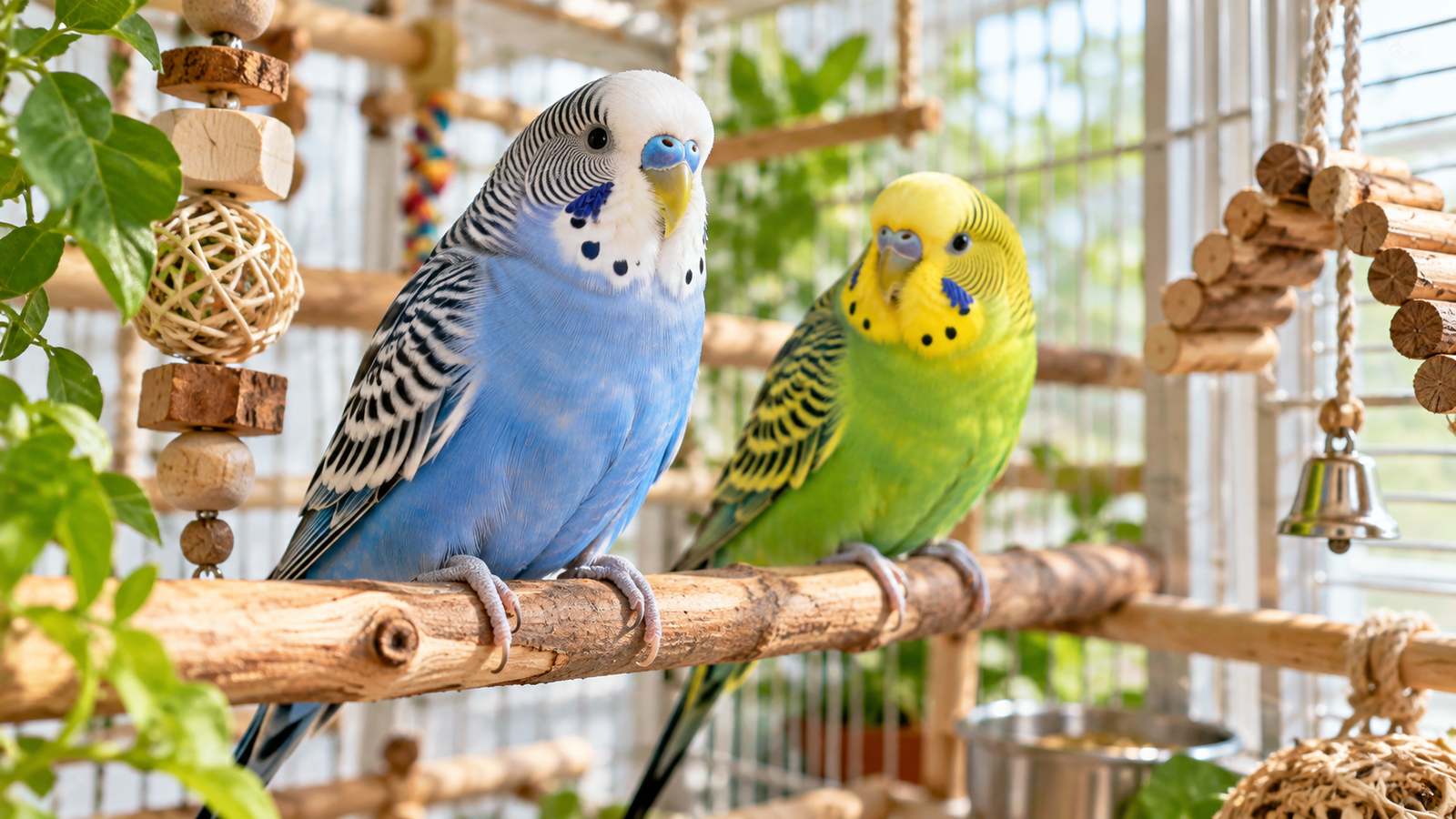

Budgies are small, cheap to feed and easy to fit into most homes, so it is tempting to start with just one. But a budgie’s needs are not small at all when it comes to company. In the wild they live in flocks, and a lone bird in a cage is missing something its whole nature expects.
So should you get one budgie or two? For most households, two is the kinder and more realistic choice. There are trade-offs, though, and the right answer depends on how much time you can give, what you hope the relationship with your bird will look like, and how you choose the pair.
The short version: budgies are flock birds and most do better with at least one other budgie. A single bird can cope only if someone is home and interacting with it for a large part of every day. Pairs may be less keen on hands, but they are usually happier. Two males or a male and female are common choices, and any new bird needs a vet check and a quarantine period before the two meet.
Why budgies need company
Wild budgerigars travel, feed, preen and roost together in groups. Almost everything they do is social: they call to each other, copy each other’s behavior and feel safer when there are other eyes watching for danger. That instinct does not switch off because a bird was hatched in captivity.
A second budgie provides things you simply cannot. It speaks the same language, keeps the same hours, preens the hard-to-reach feathers on the head and is there when you are at work or asleep. Animal welfare organizations generally recommend keeping budgies at least in pairs, and some go further and advise small groups where space allows.
Can one budgie be happy?
Some single budgies do well, but only when their person effectively becomes the flock. That means more than a few minutes of chat when you pass the cage. A lone bird needs daily time out of the cage with you, regular training or play, and someone around for much of the day. If everyone in the house is out from morning to evening, a single budgie will spend most of its waking life alone.
Signs that a solo bird is not getting enough social contact can include repetitive or constant calling, feather picking, pacing or other repetitive movements, and a bird that becomes quiet and dull. Some of these can also be signs of illness, so an avian vet check is worth doing before assuming the cause is loneliness.
It helps to be honest with yourself about the next decade, not just the next few weeks. Estimates vary between sources, but pet budgies can live anywhere from about 5 to 15 years. Work patterns, holidays and family life change, and a pair copes with those changes far better than a single bird relying on one person.
Will two budgies bond less with you?
This is the most common reason people hesitate, and there is some truth to it. Budgies that live together form a strong bond with each other, and a bird that has a budgie companion usually has less interest in being handled. Avian vets and experienced keepers often note that a paired bird may become less hand-tame over time, especially if taming work was never finished.
That said, “less interested in your finger” is not the same as “no relationship.” Pairs still learn their names, come to recognize their people, respond to voices and take treats from the hand. Many will still step up if you keep up short, regular training sessions. What changes is that you are a welcome part of their life rather than the whole of it.
If a very hand-tame bird matters to you, the usual approach is to buy young birds from a breeder who has handled them, and to put in daily, gentle training from the start. What is not a good trade is keeping a budgie alone mainly so that it depends on you.
Choosing a pair: males, females or one of each
Budgies of any combination can live together, but some pairings are easier than others.
| Pairing | What to expect |
|---|---|
| Two males | No breeding to manage, and males are generally less territorial than hens, so this is often a straightforward pairing. |
| Two females | Can work, but hens tend to be more dominant and territorial, so squabbles over space and perches are more likely. Give plenty of room. |
| Male and female | Usually compatible, but they may try to breed. Avoid nest boxes and dark, enclosed hideaways that can trigger nesting. |
Breeding is best avoided unless you have planned for it. Finding good homes for chicks is harder than it sounds, and repeated egg laying drains a hen’s calcium and can lead to reproductive problems. Be aware that a female can lay infertile eggs even without a male. If eggs start appearing, speak to an avian vet about how to discourage more laying.
Personality counts as much as sex. If you can, choose two birds that already share a cage or aviary and clearly get along, and check with the seller how confident they are about each bird’s sex, since young budgies can be hard to tell apart.
Adding a second budgie to a single bird
If you already have one budgie, a companion can still be a good move. Take it slowly, because a new bird can carry infections that are not obvious from the outside.
- Get the new bird checked. Book an avian vet visit before it comes anywhere near your existing budgie.
- Quarantine it. Keep the newcomer in its own cage in a separate room, ideally with its own air space, for around 30 to 45 days. Feed and clean your resident bird first, and wash your hands between them.
- Let them see and hear each other. After quarantine, place the two cages near each other so the birds can get used to one another through the bars.
- Try supervised time together. Short sessions in a neutral space, such as a play stand or a safe room, work better than putting the new bird straight into the resident’s cage.
- Move in together once things are calm. Use a cage large enough for two to fly and perch apart, with duplicate food and water bowls so neither bird can guard them.
Some chasing and beak-waving while they sort out their relationship is normal. Separate them if you see persistent bullying, one bird being kept from food, or any injury. Some birds, especially those that have lived alone for years, take longer to accept a companion, and a few never do.
A companion doesn’t replace a good diet or things to do. Once your pair is settled, read up on what budgies eat and on keeping budgies mentally stimulated.
Frequently asked questions
Is it cruel to keep one budgie?
Not necessarily, but it is harder to do well. A single budgie needs a lot of daily social time with people. If you are out for most of the day, a pair is a much better choice for the bird.
Will my budgie still like me if I get it a friend?
Most budgies still recognize and respond to their people after getting a companion, though many become less interested in being handled. Regular, gentle training helps keep a good relationship with both birds.
Should I get two male or two female budgies?
Two males avoid any breeding and tend to be less territorial than hens. Two females can live together, but hens tend to be more territorial, so they need plenty of space. A male and female pair may try to breed.
How long should I quarantine a new budgie?
A quarantine of about 30 to 45 days in a separate room is commonly advised, after a check with an avian vet. Ask your vet what is right for your situation.